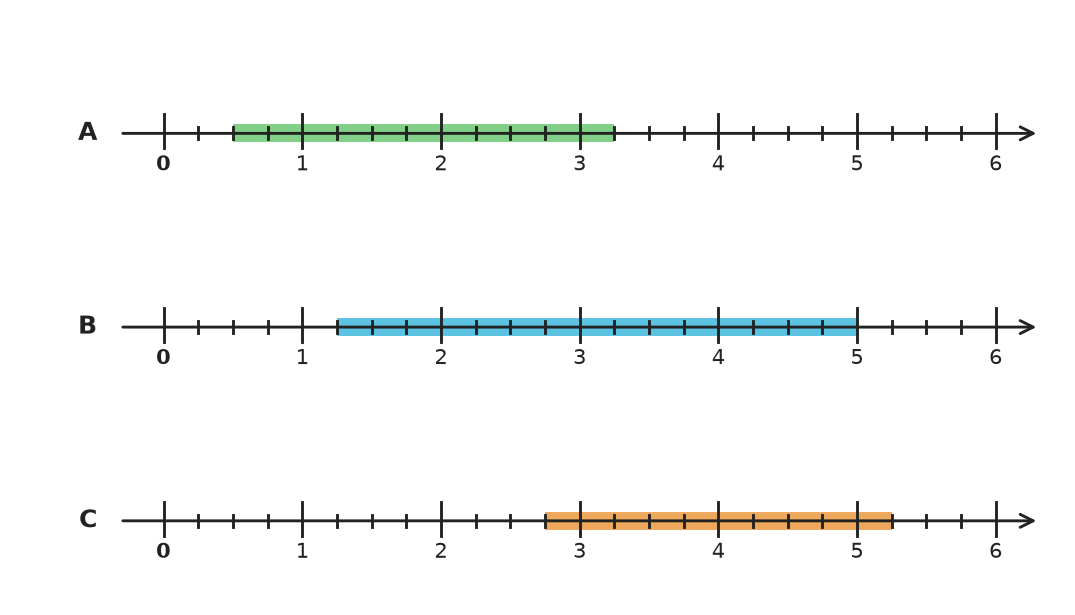
Three metal rails, \(A\), \(B\), and \(C\), are shown with centimeter scales.
a) Find the length of rail \(A\).
b) Find the length of rail \(B\).
c) Which rail is exactly \(1.25\,\text{cm}\) longer than rail \(C\)? Show the subtraction.
d) What is the total length of rails \(A\) and \(C\)?
Hints
- Subtract the starting value from the ending value to find a rail's length.
- Each small interval represents \(0.25\,\text{cm}\).
- Find rail C's length before comparing it with the others.
- Add the two rail lengths for part d).
Solution
1. a) Rail A runs from \(0.5\) to \(3.25\), so its length is \(3.25 - 0.5 = 2.75\,\text{cm}\).
2. b) Rail B runs from \(1.25\) to \(5.0\), so its length is \(5.0 - 1.25 = 3.75\,\text{cm}\).
3. Rail C runs from \(2.75\) to \(5.25\), so its length is \(5.25 - 2.75 = 2.5\,\text{cm}\).
4. c) \(3.75 - 2.5 = 1.25\,\text{cm}\), so rail B is \(1.25\,\text{cm}\) longer than rail C.
5. d) \(2.75 + 2.5 = 5.25\,\text{cm}\).
Answer
a) \(2.75\,\text{cm}\)
b) \(3.75\,\text{cm}\)
c) Rail \(B\), because \(3.75\,\text{cm} - 2.5\,\text{cm} = 1.25\,\text{cm}\)
d) \(5.25\,\text{cm}\)