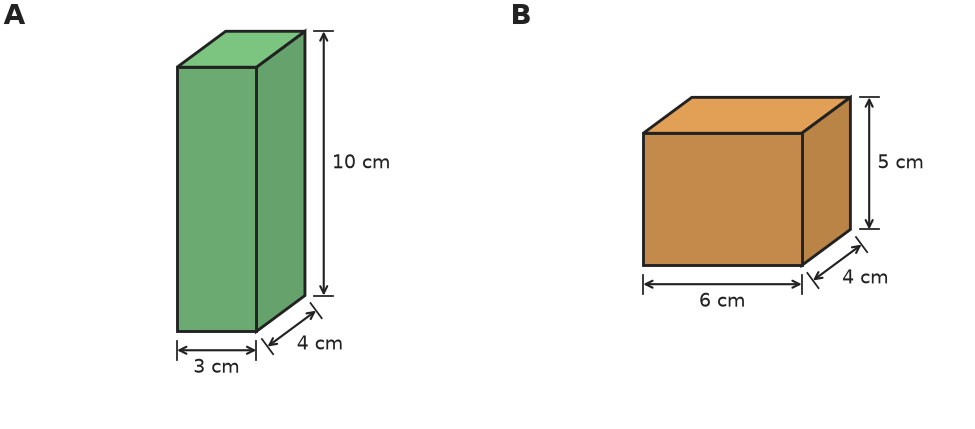
The two rectangular prisms shown have equal volume.
a) For each prism, use the bottom face as the base. Find \(B\), \(h\), and \(V\) using \(V=B\times h\).
b) Compare the two base areas and heights. Explain why doubling the base area while halving the height keeps the volume unchanged.
c) A third prism has the same volume and base area \(30\,\text{cm}^2\). Find its height and give one pair of whole-number base dimensions with area \(30\,\text{cm}^2\).
Hints
- Find the bottom-face area of each pictured prism before comparing their heights.
- Compare the factor change in \(B\) with the factor change in \(h\).
- For the third prism, work backward from the common volume and the new base area.
- Any whole-number rectangle with area \(30\,\text{cm}^2\) can serve as the requested base.
Solution
1. Prism A has base area \(B=3\times4=12\,\text{cm}^2\) and height \(10\,\text{cm}\), so \(V=12\times10=120\,\text{cm}^3\).
2. Prism B has base area \(B=6\times4=24\,\text{cm}^2\) and height \(5\,\text{cm}\), so \(V=24\times5=120\,\text{cm}^3\).
3. From A to B, the base area doubles from \(12\) to \(24\), while the height is halved from \(10\) to \(5\). These opposite factor changes leave \(B\times h\) unchanged.
4. For the third prism, \(120=30\times h\), so \(h=4\,\text{cm}\). One whole-number base is \(5\,\text{cm}\times6\,\text{cm}\).
Answer
a) Prism A: \(B=12\,\text{cm}^2\), \(h=10\,\text{cm}\), \(V=120\,\text{cm}^3\)
Prism B: \(B=24\,\text{cm}^2\), \(h=5\,\text{cm}\), \(V=120\,\text{cm}^3\)
b) The base area is doubled and the height is halved, so the product \(B\times h\) stays \(120\,\text{cm}^3\).
c) \(h=4\,\text{cm}\); one possible base is \(5\,\text{cm}\times6\,\text{cm}\).