Aimathic
Login | English | Deutsch

Free math worksheets

Build your own math worksheets from 30,000+ problems for grades 3 to 12, from fractions to AP Calculus. Every problem comes with step-by-step solutions.

Zeros and multiplicity

Click problems to add them to your worksheet.

53359611
Let \(u\) and \(v\) be polynomial functions, and define their product by \(w(x)=u(x)v(x)\). Suppose \(a\) is a real number. Decide whether this statement is always true, and justify your answer from the definition of \(w\): “If \(u(a)=0\), then \(w(a)=0\).”

Hints

- Translate “\(u\) has a zero at \(a\)” into an equation. - Substitute that equation into the product definition \(w(a)=u(a)v(a)\). - Focus on what happens when one factor of a product is zero.

Solution

1. By the definition of the product polynomial, \(w(a)=u(a)v(a)\). 2. If \(u(a)=0\), then \(w(a)=0\cdot v(a)=0\). 3. Therefore, the statement is always true.

Answer

True. If \(u(a)=0\), then \(w(a)=u(a)v(a)=0\).
53440711
The figure shows graphs from the family \(h_k(x)=x^2(x-k)\). Find the value of \(k\) for graphs p, q, and r.
Figure for problem 534407

Hints

- One x-intercept is fixed for every member of the family. - Compare the factor containing \(k\) with the graph's other x-intercept. - Read the nonzero x-intercept for each labeled curve.

Solution

1. The zeros are \(x=0\), with multiplicity \(2\), and \(x=k\). 2. Read the second x-intercept from each graph. Graph p crosses at \(x=2\), so \(k=2\). Graph q crosses at \(x=-3\), so \(k=-3\). Graph r crosses at \(x=4\), so \(k=4\).

Answer

p) \(k=2\) q) \(k=-3\) r) \(k=4\)
55578511
The polynomial is already factored: \(f(x)=6(x-4)(x+1)^2\). List all distinct real zeros of \(f\).

Hints

- Ignore any nonzero constant factor when looking for zeros. - Set each variable factor equal to zero.

Solution

1. A zero occurs when a variable factor equals \(0\). 2. From \(x-4=0\), one zero is \(x=4\). From \(x+1=0\), the other zero is \(x=-1\). 3. The constant factor \(6\) does not create a zero.

Answer

\(x=-1\) and \(x=4\)
55578611
Consider \(g(x)=-3(x+2)^4(x-5)^2\). State the multiplicity of the zero \(x=-2\) and the multiplicity of the zero \(x=5\).

Hints

- Match each stated zero with its linear factor. - The exponent on that factor records how many times the factor is repeated.

Solution

1. The factor \((x+2)^4\) corresponds to the zero \(x=-2\), so its multiplicity is \(4\). 2. The factor \((x-5)^2\) corresponds to the zero \(x=5\), so its multiplicity is \(2\).

Answer

\(x=-2\): multiplicity \(4\) \(x=5\): multiplicity \(2\)
51492811
Consider \(f(x)=2x^4\) and \(g(x)=-2x^6\). a) Without solving an equation, explain why the origin \((0, 0)\) must be the only common point of the two graphs. b) Confirm your reasoning by solving \(f(x)=g(x)\).

Hints

- Determine the possible signs of \(f(x)\) and \(g(x)\). - Can a positive number equal a negative number? - For the algebraic check, move all terms to one side and factor before deciding which factors can be zero for real \(x\).

Solution

1. For every real \(x\), \(x^4\ge0\), so \(f(x)\ge0\). Also, \(x^6\ge0\), so \(g(x)\le0\). The values can be equal only when both are \(0\), which occurs at \(x=0\). 2. Solve algebraically: \(2x^4=-2x^6\), so \(2x^4+2x^6=0\). 3. Factor: \(2x^4(1+x^2)=0\). 4. The factor \(2x^4\) is zero only when \(x=0\). The equation \(1+x^2=0\) has no real solution. Therefore, the only intersection is \((0, 0)\).

Answer

a) \(f(x)\) is always nonnegative and \(g(x)\) is always nonpositive, so they can be equal only when both are \(0\). b) \(2x^4(1+x^2)=0\) has the only real solution \(x=0\). The only intersection is \((0, 0)\).
52251111
Find all zeros of \(f(x)=\frac{x^4-6x^3+9x^2}{x^2+1}\), including the multiplicity of each zero.

Hints

- A rational function equals zero when its numerator is zero and its denominator is nonzero. - Factor out the greatest power of \(x\) from the numerator. - Does the remaining quadratic match a perfect-square trinomial? - Check whether the denominator can be zero for real \(x\).

Solution

1. The denominator \(x^2+1\) is positive for every real \(x\), so it does not exclude any real zeros. 2. Factor the numerator: \(x^4-6x^3+9x^2=x^2(x^2-6x+9)=x^2(x-3)^2\). 3. Therefore, the zeros are \(x=0\) and \(x=3\). 4. Each corresponding factor is squared, so each zero has multiplicity \(2\).

Answer

\(x=0\) has multiplicity \(2\), and \(x=3\) has multiplicity \(2\).
52289611
Let \(q(x)=\frac{1}{10}(x^2-4)(x^2-25)\). a) Determine whether the graph is symmetric about the y-axis or the origin. b) Find all zeros and state their multiplicities. c) Find the y-intercept. d) Describe the end behavior for large positive and negative values of \(x\).

Hints

- Replace \(x\) with \(-x\) to test symmetry. - A product equals zero when at least one factor equals zero. - Substitute \(x=0\) for the y-intercept. - Use the degree and leading coefficient for end behavior.

Solution

1. Since \(q(-x)=q(x)\), the function is even and its graph is symmetric about the y-axis. 2. Setting each factor equal to zero gives \(x=\pm2\) and \(x=\pm5\). Each factor occurs once after factoring into linear factors, so all four zeros have multiplicity \(1\). 3. \(q(0)=\frac{1}{10}(-4)(-25)=10\), so the y-intercept is \((0, 10)\). 4. The leading term is \(0.1x^4\). Because the degree is even and the leading coefficient is positive, \(q(x)\to\infty\) as \(x\to\pm\infty\).

Answer

a) Symmetric about the y-axis b) \(x=-5, -2, 2, 5\), each with multiplicity \(1\) c) \((0, 10)\) d) \(q(x)\to\infty\) as \(x\to\pm\infty\)
52319711
Find all real zeros of each polynomial function and state the multiplicity of each zero. a) \(f(x) = (x - 3)(x + 8)^2\) b) \(g(x) = -x^2(x - 0.4)\) c) \(h(x) = (x^2 + 16)x\)

Hints

- When does a product of several factors equal zero? - How does an exponent on a factor indicate the multiplicity of the corresponding zero? - For a factor such as \(x^2 + a\), consider whether a real number can have a negative square. - Ignore any nonzero constant factor when finding zeros.

Solution

1. Use the zero-product property: a product equals zero when at least one factor equals zero. 2. For a), \(x - 3 = 0\) gives \(x = 3\), which has multiplicity 1. Also, \((x + 8)^2 = 0\) gives \(x = -8\), which has multiplicity 2. 3. For b), the factor \(x^2\) gives \(x = 0\) with multiplicity 2. The factor \(x - 0.4\) gives \(x = 0.4\) with multiplicity 1. The factor \(-1\) does not affect the zeros. 4. For c), the factor \(x\) gives \(x = 0\) with multiplicity 1. The equation \(x^2 + 16 = 0\) has no real solutions, so there are no other real zeros.

Answer

a) \(x = 3\) with multiplicity 1; \(x = -8\) with multiplicity 2 b) \(x = 0\) with multiplicity 2; \(x = 0.4\) with multiplicity 1 c) \(x = 0\) with multiplicity 1; no other real zeros
52321511
The polynomial function \(f\) is defined by \(f(x) = x^3 + 3x^2 - 10x\). Find all zeros and state the multiplicity of each zero.

Hints

- Look for a common factor in all three terms. - Use the zero-product property after factoring. - For the remaining quadratic, find two integers whose product is \(-10\) and whose sum is \(3\). - In a complete factorization, the exponent on each linear factor gives the multiplicity.

Solution

1. Set \(f(x)\) equal to zero: \(x^3 + 3x^2 - 10x = 0\). 2. Factor out \(x\): \(x(x^2 + 3x - 10) = 0\). This gives the zero \(x = 0\). 3. Factor the quadratic: \(x^2 + 3x - 10 = (x - 2)(x + 5)\). The other zeros are \(x = 2\) and \(x = -5\). 4. The complete factorization is \(f(x) = x(x - 2)(x + 5)\). Each linear factor occurs once, so every zero has multiplicity 1.

Answer

\(x = -5\), \(x = 0\), and \(x = 2\), each with multiplicity 1
52324511
Write a polynomial function \(f\) of the least possible degree whose only zeros are \(x = -5\), \(x = 0\), and \(x = 1.5\), with each zero having multiplicity 1.

Hints

- Use the number of distinct simple zeros to determine the least possible degree. - Write one linear factor for each zero. - Multiply the factors to form the polynomial. - The problem does not require expanded form unless you choose to provide it.

Solution

1. Three distinct simple zeros require a polynomial of degree at least 3. 2. The corresponding linear factors are \(x + 5\), \(x\), and \(x - 1.5\). 3. Choose a nonzero leading constant of \(1\): \(f(x) = x(x + 5)(x - 1.5)\). 4. Expanding gives \(f(x) = x^3 + 3.5x^2 - 7.5x\).

Answer

\(f(x) = x(x + 5)(x - 1.5)\), or \(f(x) = x^3 + 3.5x^2 - 7.5x\)
52326911
Compare the behavior of the following graphs at the zero \(x = 5\): \(f(x) = (x - 5)x\) \(g(x) = (x - 5)^2x\) \(h(x) = (x - 5)^3x\) Explain whether each graph crosses or touches the x-axis and whether the function changes sign.

Hints

- The exponent on \(x - 5\) gives the multiplicity of the zero. - Compare graph behavior at zeros of even and odd multiplicity. - A sign change means the graph moves from one side of the x-axis to the other. - Compare a simple crossing with a crossing at a higher odd multiplicity.

Solution

1. At \(x = 5\), the multiplicities are 1 for \(f\), 2 for \(g\), and 3 for \(h\). 2. A zero of odd multiplicity produces a sign change, so the graph crosses the x-axis. Therefore, \(f\) crosses at \(x = 5\). 3. A zero of even multiplicity produces no sign change, so the graph touches the x-axis and turns around. Therefore, \(g\) touches at \(x = 5\). 4. Function \(h\) also changes sign because its multiplicity is odd. Since the multiplicity is 3, the graph crosses with a flattened shape and a horizontal tangent at \(x = 5\).

Answer

\(f\): crosses the x-axis and changes sign \(g\): touches the x-axis and does not change sign \(h\): crosses the x-axis with a flattened shape and changes sign
52328511
Find all real zeros of each function. a) \(f(x) = x^3 - 4x^2 - 12x\) b) \(f(x) = (x^2 - 5)(x + 3)\)

Hints

- Look for a greatest common factor in the expanded polynomial. - A product equals zero when at least one factor equals zero. - Factor or solve the remaining quadratic expression. - For an equation containing only \(x^2\) and a constant, isolate \(x^2\) and take both square roots.

Solution

1. For a), factor out \(x\): \(x(x^2 - 4x - 12) = 0\). 2. Factor the quadratic: \(x^2 - 4x - 12 = (x - 6)(x + 2)\). The real zeros are \(x = -2\), \(x = 0\), and \(x = 6\). 3. For b), use the zero-product property. The equation \(x^2 - 5 = 0\) gives \(x = \pm\sqrt{5}\), and \(x + 3 = 0\) gives \(x = -3\).

Answer

a) \(x = -2\), \(x = 0\), and \(x = 6\) b) \(x = -3\), \(x = -\sqrt{5} \approx -2.24\), and \(x = \sqrt{5} \approx 2.24\)
52329811
Evaluate this claim: “It is impossible to construct a polynomial function whose zeros are exactly \(-2\), \(-1\), \(0\), \(1\), and \(2\).” Show that the claim is false by giving a suitable function in factored form.

Hints

- A zero \(x = a\) corresponds to the factor \(x - a\). - Combine the factors for all required zeros in one product. - A general factored polynomial has the form \(a(x - x_1)(x - x_2)\cdots\), where \(a \ne 0\). - One valid counterexample is enough to disprove an impossibility claim.

Solution

1. A zero \(x = r\) corresponds to a linear factor \(x - r\). 2. The five required zeros give the factors \(x + 2\), \(x + 1\), \(x\), \(x - 1\), and \(x - 2\). 3. Their product defines the polynomial \(f(x) = x(x + 2)(x + 1)(x - 1)(x - 2)\). 4. This fifth-degree polynomial has exactly the five required zeros, so the claim is false.

Answer

The claim is false. One example is \(f(x) = x(x + 2)(x + 1)(x - 1)(x - 2)\).
52332511
Find each solution set over the real numbers. a) \(x^4 = 2401\) b) \(x^5 = -32\) c) \(x^6 = 4096\)

Hints

- Distinguish between even and odd exponents. - Consider how the sign of the right side affects the number of real solutions. - For an even exponent and a positive right side, include both positive and negative roots. - Odd roots of negative numbers are real.

Solution

1. For a), take the fourth root. Because the exponent is even and the right side is positive, there are two real solutions: \(x = \pm\sqrt[4]{2401} = \pm 7\). 2. For b), take the fifth root. An odd power equation has one real solution: \(x = \sqrt[5]{-32} = -2\). 3. For c), take the sixth root. Because the exponent is even and the right side is positive, there are two real solutions: \(x = \pm\sqrt[6]{4096} = \pm 4\).

Answer

a) \(\{-7, 7\}\) b) \(\{-2\}\) c) \(\{-4, 4\}\)
52332611
Find all real solutions. a) \(2x^4 = 162\) b) \(x^3 + 125 = 0\) c) \(x^4 + 16 = 0\)

Hints

- Isolate the power of \(x\) before taking a root. - Check whether the isolated equation can have real solutions. - An even power of a real number is always nonnegative. - Compare the number of real solutions for odd and even powers.

Solution

1. For a), divide by \(2\): \(x^4 = 81\). Taking fourth roots gives \(x = \pm 3\). 2. For b), subtract \(125\): \(x^3 = -125\). Taking the cube root gives \(x = -5\). 3. For c), subtract \(16\): \(x^4 = -16\). A fourth power of a real number cannot be negative, so there are no real solutions.

Answer

a) \(x = -3\) or \(x = 3\) b) \(x = -5\) c) No real solution
52332711
Let \(f(x) = x^n\) and let \(g(x) = c\) be a constant function. Determine the number of intersection points of the two graphs for each set of parameters. a) \(n = 4\), \(c = 15\) b) \(n = 6\), \(c = -1\) c) \(n = 3\), \(c = -27\) d) \(n = 10\), \(c = 0\)

Hints

- Compare the graphs of even- and odd-power functions. - Determine which outputs an even power can produce. - Think about how a horizontal line can intersect an even- or odd-power graph. - Consider both the parity of the exponent and the sign of the constant.

Solution

1. The number of intersection points equals the number of real solutions of \(x^n = c\). 2. For a), the exponent is even and \(c > 0\), so there are two real solutions and two intersection points. 3. For b), the exponent is even and \(c < 0\). An even power cannot be negative, so there are no real solutions and no intersection points. 4. For c), the exponent is odd. An odd-power equation has exactly one real solution for every real \(c\), so there is one intersection point. 5. For d), \(x^{10} = 0\) has only the solution \(x = 0\), so there is one intersection point.

Answer

a) \(2\) intersection points b) \(0\) intersection points c) \(1\) intersection point d) \(1\) intersection point
52556111
Consider the system \(y=x^3\) \(y=\frac{16}{x}\). a) Find the real \(x\)-values of the solutions algebraically. b) Give the coordinates of the intersection points. c) The system \(y=x^2\) and \(y=\frac{8}{x}\) has only one real solution. Explain why the given system has two.

Hints

- Use substitution by setting the two expressions for \(y\) equal. - Clear the denominator before solving the power equation. - Substitute each \(x\)-value into either original equation to find \(y\). - Compare even and odd exponents.

Solution

1. Set the two expressions for \(y\) equal: \(x^3=\frac{16}{x}\). Since \(x\ne0\), multiply by \(x\): \(x^4=16\). 2. The real solutions are \(x=\pm2\). 3. Substitute into \(y=x^3\). When \(x=2\), \(y=8\). When \(x=-2\), \(y=-8\). 4. The intersection points are \((2, 8)\) and \((-2, -8)\). 5. In the comparison system, substitution produces \(x^3=8\), which has one real solution because the exponent is odd. Here, \(x^4=16\) has two real solutions because the exponent is even and the right side is positive.

Answer

a) \(x=\pm2\) b) \((2, 8)\) and \((-2, -8)\) c) The equation \(x^4=16\) has two real solutions, while \(x^3=8\) has only one.
52556911
Consider the system, with \(x\ne0\): \(yx^2=54\) \(y=2x\). 1. Solve the system over the real numbers. 2. Use the resulting power equation to explain why the system has exactly one solution.

Hints

- Substitute the expression for \(y\) into the other equation. - Combine the powers of \(x\). - Recall how many real solutions \(x^3=a\) has.

Solution

1. Substitute \(y=2x\) into \(yx^2=54\): \((2x)x^2=54\). 2. Simplify: \(2x^3=54\), so \(x^3=27\) and \(x=3\). 3. Substitute into \(y=2x\): \(y=6\). The solution is \((3, 6)\). 4. The equation \(x^3=27\) has exactly one real solution because an odd power function takes each real value exactly once.

Answer

1. \((3, 6)\) 2. The odd-power equation \(x^3=27\) has exactly one real solution.
52827811
Find all real zeros of each function and state their multiplicities when applicable. a) \(f(x) = 5x^4 - 405\) b) \(g(x) = x^3 + 343\) c) \(h(x) = x^6\) d) \(k(x) = x^4 + 16\)

Hints

- Set each function equal to zero. - Isolate the power of the variable. - Use complete factored form to determine multiplicity. - For even exponents, check whether a negative right side is possible over the real numbers.

Solution

1. For a), set the function equal to zero: \(5x^4 - 405 = 0\), so \(x^4 = 81\). The real zeros are \(x = -3\) and \(x = 3\), each with multiplicity 1. 2. For b), \(x^3 + 343 = 0\) gives \(x^3 = -343\), so \(x = -7\). This zero has multiplicity 1. 3. For c), \(x^6 = 0\) gives \(x = 0\). The factor \(x\) occurs six times, so the zero has multiplicity 6. 4. For d), \(x^4 + 16 = 0\) would require \(x^4 = -16\). An even power of a real number cannot be negative, so there are no real zeros.

Answer

a) \(x = -3\) and \(x = 3\), each with multiplicity 1 b) \(x = -7\) with multiplicity 1 c) \(x = 0\) with multiplicity 6 d) No real zeros
52828811
Consider \(f(x) = x^4 - 81\). 1. Find all real zeros of \(f\). 2. Use difference-of-squares identities to factor \(f(x)\) as far as possible over the real numbers. State the multiplicity of each real zero.

Hints

- Apply the difference-of-squares identity in stages. - A positive equation of the form \(x^4 = a\) has two real solutions. - Check whether the final quadratic factor has any real zeros.

Solution

1. Set \(x^4 - 81 = 0\), so \(x^4 = 81\). The real solutions are \(x = -3\) and \(x = 3\). 2. Factor the difference of squares: \(x^4 - 81 = (x^2 - 9)(x^2 + 9)\). 3. Factor \(x^2 - 9\) again: \(f(x) = (x - 3)(x + 3)(x^2 + 9)\). 4. The factor \(x^2 + 9\) has no real zeros. The linear factors each occur once, so \(x = -3\) and \(x = 3\) each have multiplicity 1.

Answer

1. \(x = -3\), \(x = 3\) 2. \(f(x) = (x - 3)(x + 3)(x^2 + 9)\); each real zero has multiplicity 1.
52829311
Find all real zeros of the function \(f(x) = 0.5x^4 - 8\).

Hints

- What equation must be true at a zero of a function? - Isolate the fourth-power term before taking a root. - How many real solutions can \(x^n = a\) have when \(n\) is even? - Taking a fourth root reverses raising a number to the fourth power.

Solution

1. Set the function equal to zero: \(0.5x^4 - 8 = 0\). 2. Isolate the power: \(0.5x^4 = 8\), so \(x^4 = 16\). 3. Take the fourth root. Because the exponent is even, include both signs: \(x = \pm\sqrt[4]{16} = \pm 2\). 4. Therefore, the real zeros are \(x = -2\) and \(x = 2\).

Answer

The real zeros are \(x = -2\) and \(x = 2\).
52829411
The function \(g\) is defined by \(g(x) = -2x^3 - 250\). Find its real zero.

Hints

- What value must \(g(x)\) have at a zero? - Isolate the term containing the variable first. - Use the inverse operation for raising a number to the third power. - An odd root of a negative number is real.

Solution

1. Set the function equal to zero: \(-2x^3 - 250 = 0\). 2. Isolate the power: \(-2x^3 = 250\), so \(x^3 = -125\). 3. Take the cube root: \(x = \sqrt[3]{-125} = -5\). 4. Because an odd-power equation has one real solution, the only real zero is \(x = -5\).

Answer

The real zero is \(x = -5\).
52878311
a) State the mathematical condition that a value \(x_0\) in the domain must satisfy to be a zero of a function \(f\). Do not use graphical terms such as “graph” or “axis.” b) The function \(g\) is defined by \(g(x) = (x + 5)(x^2 - 4x - 12)\). Find all zeros of \(g\).

Hints

- What function value corresponds to the word “zero”? - When is a product of factors equal to zero? - Factor the quadratic expression before solving.

Solution

1. A value \(x_0\) is a zero of \(f\) exactly when the function value at that input is zero: \(f(x_0) = 0\). 2. Set \(g(x) = 0\): \((x + 5)(x^2 - 4x - 12) = 0\). 3. Factor the quadratic: \(x^2 - 4x - 12 = (x - 6)(x + 2)\). 4. Apply the zero-product property to \((x + 5)(x - 6)(x + 2) = 0\). The zeros are \(x = -5\), \(x = -2\), and \(x = 6\).

Answer

a) A value \(x_0\) is a zero of \(f\) when \(f(x_0) = 0\). b) The zeros are \(x = -5\), \(x = -2\), and \(x = 6\).
52878911
For each polynomial function, state its degree and the greatest possible number of real zeros. a) \(f(x) = 4x^3 - 12x^5 + 7x^2 - 8\) b) \(g(x) = (x^2 - 9)(x + 1)(x - 5)\) c) \(h(x) = x^2(x^3 + 4) - x^5 + 2x\)

Hints

- A polynomial cannot have more real zeros than its degree. - Terms may not be written in descending order, so identify the greatest exponent carefully. - For a product of nonzero polynomials, add the degrees of the factors. - Simplify an expression before deciding its degree because leading terms may cancel.

Solution

1. In a), the highest-degree term is \(-12x^5\), so the degree is \(5\). A degree-\(5\) polynomial can have at most \(5\) real zeros. 2. In b), the degrees of the factors add: \(2 + 1 + 1 = 4\). Therefore, the degree is \(4\), and the function can have at most \(4\) real zeros. 3. In c), simplify first: \(x^2(x^3 + 4) - x^5 + 2x = x^5 + 4x^2 - x^5 + 2x = 4x^2 + 2x\). The degree is \(2\), so the function can have at most \(2\) real zeros.

Answer

a) Degree \(5\); at most \(5\) real zeros b) Degree \(4\); at most \(4\) real zeros c) Degree \(2\); at most \(2\) real zeros
52907311
Find all real zeros of \(f(x) = (x^2 - 5)(x^2 + 4x + 4)\). State the multiplicity of each zero.

Hints

- A product is zero when at least one factor is zero. - Solve the two quadratic equations separately. - Look for a perfect-square trinomial in the second factor. - The exponent on a linear factor gives the multiplicity.

Solution

1. Apply the zero-product property: \(x^2 - 5 = 0\) or \(x^2 + 4x + 4 = 0\). 2. From \(x^2 - 5 = 0\), \(x^2 = 5\), so \(x = -\sqrt{5}\) and \(x = \sqrt{5}\). Each corresponding linear factor occurs once, so each zero has multiplicity 1. 3. The second quadratic is a perfect square: \(x^2 + 4x + 4 = (x + 2)^2\). 4. Therefore, \(x = -2\) is a zero with multiplicity 2.

Answer

\(x = -\sqrt{5}\) with multiplicity 1; \(x = \sqrt{5}\) with multiplicity 1; \(x = -2\) with multiplicity 2
52907411
The polynomial function is \(g(x) = \frac{1}{3}x^3 - \frac{4}{3}x^2 - 4x\). Find the coordinates of all x-intercepts of its graph.

Hints

- What y-coordinate does every point on the x-axis have? - Look for a greatest common factor in all terms. - Factor or solve the quadratic expression that remains. - Report ordered pairs, not only x-values.

Solution

1. At an x-intercept, \(g(x) = 0\): \(\frac{1}{3}x^3 - \frac{4}{3}x^2 - 4x = 0\). 2. Factor out the greatest common factor: \(\frac{1}{3}x(x^2 - 4x - 12) = 0\). 3. Factor the quadratic: \(x^2 - 4x - 12 = (x - 6)(x + 2)\). 4. The zeros are \(x = -2\), \(x = 0\), and \(x = 6\). 5. Every x-intercept has y-coordinate \(0\), so the intercepts are \((-2, 0)\), \((0, 0)\), and \((6, 0)\).

Answer

The x-intercepts are \((-2, 0)\), \((0, 0)\), and \((6, 0)\).
52908111
For each polynomial function, find all zeros, state each multiplicity, and determine whether the function changes sign at the zero. a) \(f(x) = (x - 3)^2(x + 1)\) b) \(g(x) = x^3(x - 0.5)\) c) \(h(x) = \left(x + \frac{1}{4}\right)^2(x - 2)^3\)

Hints

- Set each linear factor equal to zero. - The exponent on a factor gives the multiplicity of its zero. - Compare the sign behavior of even and odd powers near zero. - To decide about a sign change, compare the sign of the relevant factor just to the left and right of the zero.

Solution

1. For \(f\), the zeros are \(x = 3\) with multiplicity 2 and \(x = -1\) with multiplicity 1. The function does not change sign at \(x = 3\) because the multiplicity is even, and it changes sign at \(x = -1\) because the multiplicity is odd. 2. For \(g\), the zeros are \(x = 0\) with multiplicity 3 and \(x = 0.5\) with multiplicity 1. Both multiplicities are odd, so the function changes sign at both zeros. 3. For \(h\), the zeros are \(x = -\frac{1}{4}\) with multiplicity 2 and \(x = 2\) with multiplicity 3. The function does not change sign at \(x = -\frac{1}{4}\), and it changes sign at \(x = 2\).

Answer

a) \(x = 3\), multiplicity 2, no sign change; \(x = -1\), multiplicity 1, sign change b) \(x = 0\), multiplicity 3, sign change; \(x = 0.5\), multiplicity 1, sign change c) \(x = -\frac{1}{4}\), multiplicity 2, no sign change; \(x = 2\), multiplicity 3, sign change
53260111
Consider the family of polynomial functions \(f_a(x)=(x+3)(x-a)\). The figure shows four graphs labeled p, q, r, and s, corresponding to \(a=-2,-1,1,2\). Find the value of \(a\) for each graph and justify your choices using the zeros.
Figure for problem 532601

Hints

- Factorization already shows one zero that all four graphs share. - The second factor determines the other zero. - Match each graph by the x-intercept that is not \(-3\).

Solution

1. Every function in the family has the common zero \(x=-3\). 2. The other zero satisfies \(x-a=0\), so the other x-intercept is \(x=a\). 3. Graph p has its other zero at \(-2\), so \(a=-2\). Graph q has its other zero at \(-1\), so \(a=-1\). Graph r has its other zero at \(1\), so \(a=1\). Graph s has its other zero at \(2\), so \(a=2\).

Answer

p: \(a=-2\); q: \(a=-1\); r: \(a=1\); s: \(a=2\)
53315911
The graph of a polynomial function \(f\) is shown. Which equation matches the graph? Justify your choice using the zeros, their multiplicities, and the end behavior. a) \(f(x) = (x + 1)^2(x - 3)\) b) \(f(x) = (x + 1)(x - 3)^2\) c) \(f(x) = -(x + 1)(x - 3)^2\) d) \(f(x) = (x - 1)(x + 3)^2\)
Figure for problem 533159

Hints

- Identify the two x-intercepts and compare the graph's local behavior at them. - Use that behavior to narrow the choices by the locations of the repeated and unrepeated factors. - Then use the right-end behavior to choose the sign of the leading coefficient.

Solution

1. The graph crosses the x-axis at \(x = -1\), so \(x = -1\) is a zero of odd multiplicity. It touches the x-axis at \(x = 3\), so \(x = 3\) is a zero of even multiplicity. 2. Choices b) and c) have a factor \((x + 1)\) and a squared factor \((x - 3)^2\), so both have the correct zeros and multiplicities. 3. The graph rises to the right, so the leading coefficient is positive. Choice b) has a positive leading coefficient, while choice c) has a negative leading coefficient. 4. Therefore, choice b) matches the graph.

Answer

b) \(f(x) = (x + 1)(x - 3)^2\)
53363211
Find the zeros of \(g(x)=x^3-3x^2\) algebraically by factoring out the greatest common factor. Then describe how the multiplicity of each zero determines whether the graph crosses or touches the x-axis.

Hints

- Factor out the greatest common factor from all terms. - Apply the zero-product property. - Use the parity of each multiplicity to decide whether the sign changes at that zero.

Solution

1. Set \(g(x)=0\) and factor: \(x^3-3x^2=x^2(x-3)\). 2. By the zero-product property, \(x^2=0\) or \(x-3=0\). Therefore, \(x=0\) has multiplicity \(2\) and \(x=3\) has multiplicity \(1\). 3. At the double zero \(x=0\), the graph touches the x-axis. At the simple zero \(x=3\), the graph crosses the x-axis.

Answer

The zeros are \(x=0\) with multiplicity \(2\) and \(x=3\) with multiplicity \(1\). The graph touches the x-axis at \(x=0\) and crosses it at \(x=3\).
53364511
Which graph represents \(f(x) = 0.2(x + 1)^2(x - 3)\)? Use the zeros, their multiplicities, and the end behavior to justify your choice.
Figure for problem 533645

Hints

- Set each factor equal to zero to identify the zeros. - Use each factor's exponent to decide whether the graph crosses or touches the x-axis. - Check the direction of the graph's right end.

Solution

1. The zeros are \(x = -1\) and \(x = 3\). 2. The factor \((x + 1)^2\) gives a double zero at \(x = -1\), so the graph touches the x-axis there. 3. The factor \((x - 3)\) gives a simple zero at \(x = 3\), so the graph crosses the x-axis there. 4. The polynomial has odd degree and a positive leading coefficient, so its right end rises. 5. Only Graph 1 has all of these features.

Answer

Graph 1
53432111
The graph shown is a fourth-degree polynomial. Which function rule matches the graph? Explain why the other two choices do not. (1) \(f(x)=0.1(x+3)(x+1)(x-1)(x-3)\) (2) \(f(x)=-0.1(x+3)(x+1)(x-1)(x-3)\) (3) \(f(x)=0.1(x+3)^2(x-1)(x-3)\)
Figure for problem 534321

Hints

- Match the x-intercepts to the factors in each rule. - Decide whether the graph crosses or touches the x-axis at each zero. - Use the end behavior to determine the sign of the leading coefficient.

Solution

1. The graph crosses the x-axis at \(x=-3, -1, 1, 3\). Each crossing represents a zero with odd multiplicity, and the choices show each as a simple zero when present. 2. Both ends of the graph rise, so the polynomial has a positive leading coefficient. 3. Choice (1) has all four observed zeros and a positive leading coefficient, so it matches. 4. Choice (2) has the correct zeros but a negative leading coefficient, which would make both ends fall. 5. Choice (3) has a double zero at \(x=-3\), where its graph would touch rather than cross the x-axis, and it has no zero at \(x=-1\).

Answer

Choice (1), \(f(x)=0.1(x+3)(x+1)(x-1)(x-3)\), matches the graph. Choice (2) has the wrong end behavior, and choice (3) has the wrong zeros and multiplicities.
55110711
A polynomial is written in complete factored form as \(f(x)=2(x+2)^3(x-1)^2(x-4)\). A student says, “The polynomial has degree \(6\), so it has \(6\) distinct real zeros.” Explain the student's mistake. State the degree, the number of distinct real zeros, and the total multiplicity of the real zeros.

Hints

- Separate the number of different factor bases from the exponents on those factors. - Add the exponents to determine the degree. - Count each zero location only once when asked for distinct zeros.

Solution

1. The degree is the sum of the factor exponents: \(3+2+1=6\). 2. The distinct real zeros are \(-2\), \(1\), and \(4\), so there are \(3\) distinct real zeros. 3. Their multiplicities are \(3\), \(2\), and \(1\), whose total is \(6\). 4. Degree counts zeros with multiplicity, not necessarily distinct real zero locations.

Answer

Degree \(6\); \(3\) distinct real zeros; total multiplicity \(6\). The student confused zeros counted with multiplicity with distinct zero locations.
55110911
Compare \(p(x)=(x+2)(x-1)^2\) and \(q(x)=(x+2)(x-1)^3\). Describe exactly what changes when the exponent on \(x-1\) increases from \(2\) to \(3\): the degree, the multiplicity of \(x=1\), and the graph's local behavior there. State what does not change at \(x=-2\).

Hints

- Changing a factor exponent changes both degree and the multiplicity of its corresponding zero. - Compare the parity of \(2\) and \(3\). - A factor whose exponent is unchanged keeps the same zero multiplicity.

Solution

1. The degree increases from \(3\) for \(p\) to \(4\) for \(q\). 2. The multiplicity of the zero \(x=1\) increases from \(2\) to \(3\). 3. For \(p\), multiplicity \(2\) is even, so the graph touches the x-axis at \(x=1\). For \(q\), multiplicity \(3\) is odd, so the graph crosses there. 4. The factor \(x+2\) is unchanged, so \(x=-2\) remains a simple zero where both graphs cross the x-axis.

Answer

Degree: \(3\to4\); multiplicity at \(x=1\): \(2\to3\); behavior at \(x=1\): touch \(\to\) cross. The zero \(x=-2\) remains simple and crossing.
51543511
The graph of \(f(x)=ax^4\) and the graph of \(g(x)=x^2\) intersect at \(P(2, 4)\). a) Find \(a\). b) Find the coordinates of all other intersection points.

Hints

- Use the given point to solve for \(a\). - After finding \(a\), set the two function expressions equal. - Even powers produce y-axis symmetry, which may help you anticipate another point.

Solution

1. Substitute \(P(2, 4)\) into \(f\): \(4=a(2^4)=16a\), so \(a=\frac{1}{4}\). 2. Set the functions equal: \(\frac{1}{4}x^4=x^2\). 3. Factor: \(\frac{1}{4}x^4-x^2=x^2\left(\frac{1}{4}x^2-1\right)=0\). 4. The solutions are \(x=0\) and \(x=\pm2\). 5. The corresponding points are \((0, 0)\), \((2, 4)\), and \((-2, 4)\). Excluding the given point, the other intersections are \((0, 0)\) and \((-2, 4)\).

Answer

a) \(a=\frac{1}{4}\) b) The other intersection points are \((0, 0)\) and \((-2, 4)\).
52289511
Let \(p(x)=-0.1(x+3)(x-1)^2\). a) Find the zeros of \(p\) and state the multiplicity of each. b) Find the y-intercept. c) Describe the end behavior as \(x\to\infty\) and as \(x\to-\infty\). d) Use the zeros to explain, without expanding the function, why the graph is neither symmetric about the y-axis nor symmetric about the origin.

Hints

- Read zeros and multiplicities directly from the factors. - Substitute \(x=0\) to find the y-intercept. - Use the degree and leading coefficient for end behavior. - Symmetry requires corresponding zeros at opposite \(x\)-values.

Solution

1. From the factored form, \(x=-3\) is a zero of multiplicity \(1\), and \(x=1\) is a zero of multiplicity \(2\). 2. The y-intercept is \(p(0)=-0.1(3)(1)=-0.3\), so the point is \((0, -0.3)\). 3. The leading term is \(-0.1x^3\). Therefore, \(p(x)\to-\infty\) as \(x\to\infty\), and \(p(x)\to\infty\) as \(x\to-\infty\). 4. Either listed symmetry would require zeros to occur in opposite pairs with matching multiplicities. Since \(x=1\) is a double zero but \(x=-1\) is not a zero, neither symmetry is possible.

Answer

a) \(x=-3\), multiplicity \(1\); \(x=1\), multiplicity \(2\) b) \((0, -0.3)\) c) \(p(x)\to-\infty\) as \(x\to\infty\), and \(p(x)\to\infty\) as \(x\to-\infty\) d) The zeros are not paired across the origin with matching multiplicities, so neither symmetry applies.
52291311
Find all real zeros of each polynomial function. a) \(f(x)=5x^3-20x^2+15x\) b) \(g(x)=(x^2-2)(x^2+9)\) c) \(h(x)=x^4-13x^2+36\)

Hints

- First look for a greatest common factor. - Use the zero-product property when an expression is written as a product. - In part c), compare the powers \(x^4\) and \(x^2\) and look for a repeated algebraic structure. - Some factors may have no real zeros.

Solution

1. Factor \(f\): \(5x^3-20x^2+15x=5x(x^2-4x+3)=5x(x-1)(x-3)\). The real zeros are \(x=0\), \(x=1\), and \(x=3\). 2. For \(g\), the zero-product property gives \(x^2-2=0\) or \(x^2+9=0\). The first equation gives \(x=\pm\sqrt{2}\); the second has no real solutions. Thus, the real zeros are \(x=-\sqrt{2}\) and \(x=\sqrt{2}\). 3. For \(h\), let \(u=x^2\). Then \(u^2-13u+36=0\), which factors as \((u-9)(u-4)=0\). Thus, \(x^2=9\) or \(x^2=4\), giving \(x=-3, -2, 2, 3\).

Answer

a) \(x=0, 1, 3\) b) \(x=-\sqrt{2}, \sqrt{2}\) c) \(x=-3, -2, 2, 3\)
52291411
Find all real zeros of each polynomial function. State any repeated zeros. a) \(p(x)=(x-1.5)\left(x+\frac{1}{3}\right)^2(x^2+5)\) b) \(q(x)=0.5x^4-3.5x^2-4\) c) \(r(x)=2x^4+4x^3-6x^2\)

Hints

- A squared factor produces a repeated zero. - In part b), compare the powers \(x^4\) and \(x^2\) and look for a repeated algebraic structure. - Use the degree to check the maximum possible number of zeros, counting multiplicity. - Factor out a common power of \(x\) when every term contains one.

Solution

1. For \(p\), the zero-product property gives \(x=1.5\) and \(x=-\frac{1}{3}\). The zero \(-\frac{1}{3}\) has multiplicity \(2\). The factor \(x^2+5\) has no real zeros. 2. For \(q\), let \(u=x^2\). Then \(0.5u^2-3.5u-4=0\). Multiplying by \(2\) gives \(u^2-7u-8=(u-8)(u+1)=0\). Since \(u=x^2\ge 0\), only \(u=8\) gives real values of \(x\). Therefore, \(x=\pm2\sqrt{2}\). 3. For \(r\), factor: \(2x^4+4x^3-6x^2=2x^2(x^2+2x-3)=2x^2(x+3)(x-1)\). The real zeros are \(x=-3\), \(x=0\), and \(x=1\), with \(x=0\) having multiplicity \(2\).

Answer

a) \(x=1.5\); \(x=-\frac{1}{3}\) with multiplicity \(2\) b) \(x=-2\sqrt{2}, 2\sqrt{2}\) c) \(x=-3, 0, 1\); \(x=0\) has multiplicity \(2\)
52319511
Find the zeros of the polynomial function \(f(x) = x^3 - 6x^2 + 9x\). State the multiplicity of each zero, and write the function in factored form as a product of linear factors.

Hints

- Look for a greatest common factor that can be factored from every term. - Check whether the remaining quadratic is a perfect-square trinomial or can be factored another way. - In factored form, the exponent on a factor gives the multiplicity of its corresponding zero.

Solution

1. Set the function equal to zero: \(x^3 - 6x^2 + 9x = 0\). 2. Factor out \(x\): \(x(x^2 - 6x + 9) = 0\). This gives the zero \(x = 0\). 3. Factor the perfect-square trinomial: \(x^2 - 6x + 9 = (x - 3)^2\). Therefore, the other zero is \(x = 3\). 4. In \(x(x - 3)^2\), the factor \(x\) occurs once, so \(x = 0\) has multiplicity 1. The factor \((x - 3)\) occurs twice, so \(x = 3\) has multiplicity 2. 5. The factored form is \(f(x) = x(x - 3)^2\).

Answer

Zeros: \(x = 0\) with multiplicity 1; \(x = 3\) with multiplicity 2 Factored form: \(f(x) = x(x - 3)^2\)
52319811
Find all real zeros of each function. Factor further when possible. a) \(f(x)=2(x^2-36)(x+6)\) b) \(g(x)=x(x-1.5)(x+11)\) c) \(h(x)=(x^2-0.25)x^2\)

Hints

- Factor expressions of the form \(x^2-a^2\) as a difference of squares. - Set each factor equal to zero. - Check whether the same zero occurs in more than one factor. - A nonzero constant factor does not affect the zeros.

Solution

1. For part a, \(x^2-36=(x-6)(x+6)\), so \(f(x)=2(x-6)(x+6)^2\). The real zeros are \(x=6\) and \(x=-6\), with \(-6\) having multiplicity \(2\). 2. For part b, the factors give zeros \(x=0\), \(x=1.5\), and \(x=-11\). 3. For part c, \(x^2-0.25=(x-0.5)(x+0.5)\). The real zeros are \(x=-0.5\), \(x=0\), and \(x=0.5\), with \(0\) having multiplicity \(2\).

Answer

a) \(x=-6, 6\); \(-6\) has multiplicity \(2\). b) \(x=-11, 0, 1.5\) c) \(x=-0.5, 0, 0.5\); \(0\) has multiplicity \(2\).
52320111
The polynomial function \(f\) is defined by \(f(x) = \frac{1}{2}x^3 - 3x^2 - 8x\). 1. Find all zeros of \(f\). 2. Write \(f(x)\) in factored form as a product of linear factors.

Hints

- Begin by setting the function equal to zero. - Check whether every term has a common factor involving \(x\). - Use the zero-product property after factoring. - Find two numbers whose product is \(-16\) and whose sum is \(-6\).

Solution

1. Set \(f(x)\) equal to zero and factor out \(\frac{1}{2}x\): \(\frac{1}{2}x(x^2 - 6x - 16) = 0\). The factor \(x\) gives the zero \(x = 0\). 2. Factor the quadratic: \(x^2 - 6x - 16 = (x - 8)(x + 2)\). Therefore, the remaining zeros are \(x = 8\) and \(x = -2\). 3. The factored form is \(f(x) = \frac{1}{2}x(x - 8)(x + 2)\).

Answer

1. \(x = -2\), \(x = 0\), and \(x = 8\) 2. \(f(x) = \frac{1}{2}x(x - 8)(x + 2)\)
52320211
Find the zeros of \(g(x) = -\frac{1}{3}x^4 + 2x^3 - 3x^2\), and state the multiplicity of each zero.

Hints

- Look for the greatest power of \(x\) that is common to every term. - Check whether the remaining trinomial is a perfect square. - In factored form, the exponent on a factor gives the multiplicity of its corresponding zero.

Solution

1. Set the function equal to zero and factor out \(-\frac{1}{3}x^2\): \(-\frac{1}{3}x^2(x^2 - 6x + 9) = 0\). 2. The factor \(x^2\) gives the zero \(x = 0\) with multiplicity 2. 3. Factor the perfect-square trinomial: \(x^2 - 6x + 9 = (x - 3)^2\). The factor \((x - 3)^2\) gives the zero \(x = 3\) with multiplicity 2.

Answer

\(x = 0\) with multiplicity 2; \(x = 3\) with multiplicity 2
52320911
Find all real zeros of each polynomial function. a) \(f(x) = x^4 - 3x^2 - 4\) b) \(g(x) = x^3 + 4x^2 + 4x\)

Hints

- In part a), compare the exponents and look for a repeated expression that could simplify the equation. - Look for a greatest common factor in every term. - Check whether the remaining quadratic is a perfect-square trinomial. - Use the zero-product property after factoring. - When you rewrite part a) in a simpler form, check which resulting equations have real solutions.

Solution

1. For a), substitute \(u = x^2\). Then \(u^2 - 3u - 4 = 0\), which factors as \((u - 4)(u + 1) = 0\). 2. The values are \(u = 4\) and \(u = -1\). Substituting back gives \(x^2 = 4\) or \(x^2 = -1\). Therefore, the real zeros are \(x = -2\) and \(x = 2\); \(x^2 = -1\) has no real solutions. 3. For b), factor out \(x\): \(g(x) = x(x^2 + 4x + 4) = x(x + 2)^2\). 4. By the zero-product property, the real zeros are \(x = 0\) and \(x = -2\).

Answer

a) \(x = -2\), \(x = 2\) b) \(x = -2\), \(x = 0\)
52321611
Find the coordinates of all intersection points of the graphs of \(f\) and \(g\), where \(f(x) = x^3 - 4x^2 + 5x + 1\) and \(g(x) = x + 1\).

Hints

- At an intersection point, the two functions have the same output for the same input. - Move all terms to one side so the equation equals zero. - Look for a common factor before factoring the remaining quadratic. - After finding each x-coordinate, substitute it into either original function to find the y-coordinate.

Solution

1. At an intersection point, \(f(x) = g(x)\). Set the expressions equal: \(x^3 - 4x^2 + 5x + 1 = x + 1\). 2. Move all terms to one side: \(x^3 - 4x^2 + 4x = 0\). 3. Factor: \(x(x^2 - 4x + 4) = x(x - 2)^2 = 0\). Thus, the x-coordinates are \(x = 0\) and \(x = 2\). 4. Substitute into \(g(x) = x + 1\): \(g(0) = 1\) and \(g(2) = 3\). 5. The intersection points are \((0, 1)\) and \((2, 3)\).

Answer

\((0, 1)\) and \((2, 3)\)
52321911
Find the coordinates of all intersection points of the graphs of \(f(x) = \frac{1}{2}x^3 - 2x\) and \(g(x) = \frac{3}{2}x^2\).

Hints

- At an intersection point, the two functions have equal outputs. - Rewrite the equation so that one side is zero. - Look for a common factor in every term. - Use the zero-product property after factoring. - Substitute each x-coordinate into either original function to find the y-coordinate.

Solution

1. Set the functions equal: \(\frac{1}{2}x^3 - 2x = \frac{3}{2}x^2\). 2. Move all terms to one side and factor out \(x\): \(\frac{1}{2}x^3 - \frac{3}{2}x^2 - 2x = x\left(\frac{1}{2}x^2 - \frac{3}{2}x - 2\right) = 0\). 3. The factor \(x\) gives \(x = 0\). Multiply the quadratic equation by \(2\) to get \(x^2 - 3x - 4 = 0\), which factors as \((x - 4)(x + 1) = 0\). Thus, the other x-coordinates are \(x = 4\) and \(x = -1\). 4. Substitute into \(g(x) = \frac{3}{2}x^2\): \(g(0) = 0\), \(g(4) = 24\), and \(g(-1) = \frac{3}{2}\). 5. The intersection points are \((-1, 1.5)\), \((0, 0)\), and \((4, 24)\).

Answer

\((-1, 1.5)\), \((0, 0)\), and \((4, 24)\)
52322611
Consider the polynomial function \(g(x) = -\frac{1}{4}x^4 + x^2\). 1. Find all zeros of \(g\). 2. State the multiplicity of each zero. 3. For each zero, determine whether the graph crosses or only touches the x-axis. Justify your answer using multiplicity.

Hints

- Factor out the greatest common factor first. - Use the difference-of-squares pattern to factor the remaining quadratic. - The exponent on a linear factor gives the multiplicity of its zero. - Relate even and odd multiplicities to whether the function changes sign.

Solution

1. Factor out \(-\frac{1}{4}x^2\): \(g(x) = -\frac{1}{4}x^2(x^2 - 4)\). 2. Factor the difference of squares: \(g(x) = -\frac{1}{4}x^2(x - 2)(x + 2)\). The zeros are \(x = -2\), \(x = 0\), and \(x = 2\). 3. The factor \(x^2\) gives \(x = 0\) multiplicity 2. The factors \(x - 2\) and \(x + 2\) each occur once, so \(x = 2\) and \(x = -2\) each have multiplicity 1. 4. A graph crosses the x-axis at a zero of odd multiplicity and touches without crossing at a zero of even multiplicity. Therefore, the graph touches at \(x = 0\) and crosses at \(x = -2\) and \(x = 2\).

Answer

1. \(x = -2\), \(x = 0\), and \(x = 2\) 2. \(x = -2\): multiplicity 1; \(x = 0\): multiplicity 2; \(x = 2\): multiplicity 1 3. The graph touches the x-axis at \(x = 0\) and crosses it at \(x = -2\) and \(x = 2\).
52322811
The polynomial function \(h\) is defined by \(h(x) = (x + 1)^2(x - 3)x\). a) Determine the degree of \(h\). b) List all zeros of \(h\) and state the multiplicity of each zero. c) Determine where the graph touches the x-axis without crossing it. Justify your answer.

Hints

- In factored form, add the degrees of the factors to find the degree of the polynomial. - Each factor equals zero at its corresponding zero. - The exponent on a factor gives the multiplicity of that zero. - Compare the graph behavior at zeros of even and odd multiplicity.

Solution

1. The degree is the sum of the degrees of the factors: \(2 + 1 + 1 = 4\). 2. The factor \((x + 1)^2\) gives \(x = -1\) with multiplicity 2. The factor \(x - 3\) gives \(x = 3\) with multiplicity 1. The factor \(x\) gives \(x = 0\) with multiplicity 1. 3. A polynomial graph touches the x-axis without crossing at a zero of even multiplicity. Therefore, the graph touches the x-axis at \(x = -1\).

Answer

a) \(4\) b) \(x = -1\) with multiplicity 2; \(x = 0\) with multiplicity 1; \(x = 3\) with multiplicity 1 c) The graph touches the x-axis at \(x = -1\) because that zero has even multiplicity.
52323511
Consider the following polynomial functions: \(f(x) = (x - 2)(x + 2)(x - 5)\) \(g(x) = (x^2 - 4)(x + 5)\) \(h(x) = (x - 2)^2(x + 2)(x - 5)\) \(i(x) = x(x - 2)(x + 2)(x - 5)\) \(j(x) = \frac{1}{2}(x - 2)(x + 2)(x - 5)\) a) Which functions have exactly the zero set \(L = \{-2, 2, 5\}\)? b) Which function has a double zero? State the zero. c) Explain briefly why \(i\) and \(f\) have different zero sets.

Hints

- Set each factor equal to zero to identify the zero set. - Watch for additional factors such as \(x\). - A repeated linear factor creates a zero with multiplicity greater than 1. - A nonzero constant factor changes the vertical scale but not the zeros.

Solution

1. For \(f\), the factors give the zero set \(\{-2, 2, 5\}\). 2. For \(g\), factor \(x^2 - 4 = (x - 2)(x + 2)\). Its zero set is \(\{-5, -2, 2\}\). 3. For \(h\), the zero set is \(\{-2, 2, 5\}\). The factor \((x - 2)^2\) shows that \(x = 2\) is a double zero. 4. For \(i\), the additional factor \(x\) gives the zero set \(\{-2, 0, 2, 5\}\). 5. For \(j\), the nonzero factor \(\frac{1}{2}\) does not affect the zeros, so its zero set is \(\{-2, 2, 5\}\). 6. Therefore, \(f\), \(h\), and \(j\) have exactly the given zero set. Function \(h\) has a double zero at \(x = 2\), and \(i\) differs from \(f\) because \(i\) also has the zero \(x = 0\).

Answer

a) \(f\), \(h\), and \(j\) b) \(h\) has a double zero at \(x = 2\). c) The factor \(x\) gives \(i\) the additional zero \(x = 0\).
52323611
Consider the following polynomial functions: \(k(x) = (x + 3)(x - 3)(x - 1)\) \(l(x) = (x^2 - 9)(x - 3)\) \(m(x) = (x + 3)(x - 3)^2\) \(n(x) = (x^2 - 9)(x + 1)\) a) Which functions have exactly the two zeros \(x = -3\) and \(x = 3\)? b) Which function has exactly the three zeros \(-3\), \(3\), and \(1\)? c) Find all zeros of \(l\) and state the multiplicity of each zero.

Hints

- Factor \(x^2 - 9\) as a difference of squares. - Compare the zero sets carefully, especially the signs of the third zeros. - In complete factored form, the exponent on each linear factor gives its zero’s multiplicity.

Solution

1. Function \(k\) has zeros \(x = -3\), \(x = 3\), and \(x = 1\). 2. For \(l\), factor the difference of squares: \(l(x) = (x - 3)(x + 3)(x - 3) = (x + 3)(x - 3)^2\). Its zeros are \(x = -3\) and \(x = 3\). 3. Function \(m\) also has exactly the zeros \(x = -3\) and \(x = 3\). 4. Function \(n\) has zeros \(x = -3\), \(x = 3\), and \(x = -1\). 5. Therefore, \(l\) and \(m\) answer part a), and \(k\) answers part b). In \(l(x) = (x + 3)(x - 3)^2\), \(x = -3\) has multiplicity 1 and \(x = 3\) has multiplicity 2.

Answer

a) \(l\) and \(m\) b) \(k\) c) \(x = -3\) with multiplicity 1; \(x = 3\) with multiplicity 2
52324311
A fourth-degree polynomial function \(f\) has a double zero at \(x = -1\) and simple zeros at \(x = 0\) and \(x = 4\). Its graph passes through \((2, 18)\). Find a possible equation for \(f\) in factored form.

Hints

- Write one linear factor for each given zero. - Use an exponent of 2 for the double zero. - Substitute the coordinates of the given point to determine the leading constant. - Check that the multiplicities add to the stated degree.

Solution

1. Use the zeros and multiplicities to write \(f(x) = ax(x + 1)^2(x - 4)\). 2. Substitute the point \((2, 18)\): \(18 = a(2)(2 + 1)^2(2 - 4)\). 3. Simplify: \(18 = a(2)(9)(-2) = -36a\), so \(a = -\frac{1}{2}\). 4. Therefore, a possible equation is \(f(x) = -\frac{1}{2}x(x + 1)^2(x - 4)\).

Answer

\(f(x) = -\frac{1}{2}x(x + 1)^2(x - 4)\)
52324411
Find an equation for a polynomial function \(g\) of the least possible degree that satisfies all three conditions: 1. The graph crosses the x-axis at \(x = -3\) and \(x = 5\). 2. The graph touches the x-axis at \(x = 1\). 3. The y-intercept is \((0, -3)\).

Hints

- Crossing and touching the x-axis correspond to different zero multiplicities. - Translate each x-intercept into a linear factor. - Use the y-intercept to determine the leading constant. - Add the required multiplicities to determine the least possible degree.

Solution

1. Crossing the x-axis at \(x = -3\) and \(x = 5\) requires simple factors \(x + 3\) and \(x - 5\). Touching at \(x = 1\) requires the repeated factor \((x - 1)^2\). The least possible degree is \(1 + 1 + 2 = 4\). 2. Write \(g(x) = a(x + 3)(x - 5)(x - 1)^2\). 3. Use the y-intercept: \(-3 = a(0 + 3)(0 - 5)(0 - 1)^2 = -15a\). 4. Thus, \(a = \frac{1}{5}\), so \(g(x) = \frac{1}{5}(x + 3)(x - 5)(x - 1)^2\).

Answer

\(g(x) = \frac{1}{5}(x + 3)(x - 5)(x - 1)^2\)
52324611
Find a polynomial function \(g\) of the least possible degree whose only zeros are the simple zeros \(x = -\sqrt{6}\), \(x = 2\), and \(x = \sqrt{6}\).

Hints

- Write a linear factor for each zero, including zeros containing radicals. - Multiply the conjugate factors using the difference-of-squares pattern. - A simple zero corresponds to a factor with exponent 1.

Solution

1. Three distinct simple zeros require a polynomial of degree 3. 2. The corresponding linear factors are \(x + \sqrt{6}\), \(x - 2\), and \(x - \sqrt{6}\). 3. Choose a leading constant of \(1\): \(g(x) = (x + \sqrt{6})(x - \sqrt{6})(x - 2)\). 4. Use the difference of squares: \((x + \sqrt{6})(x - \sqrt{6}) = x^2 - 6\). 5. Therefore, \(g(x) = (x^2 - 6)(x - 2) = x^3 - 2x^2 - 6x + 12\).

Answer

\(g(x) = (x^2 - 6)(x - 2)\), or \(g(x) = x^3 - 2x^2 - 6x + 12\)
52325511
Find a polynomial function \(f\) of the least possible degree that has a double zero at \(x = -2\), a simple zero at \(x = 3\), and passes through \((1, -18)\).

Hints

- Write a linear factor for each zero. - Use an exponent of 2 for the double zero. - Substitute the coordinates of the given point to determine the leading constant.

Solution

1. The zeros and multiplicities give \(f(x) = a(x + 2)^2(x - 3)\). 2. Substitute the point \((1, -18)\): \(-18 = a(1 + 2)^2(1 - 3)\). 3. Simplify: \(-18 = a(9)(-2) = -18a\), so \(a = 1\). 4. Therefore, \(f(x) = (x + 2)^2(x - 3)\).

Answer

\(f(x) = (x + 2)^2(x - 3)\)
52325711
Let \(f\) be a third-degree polynomial function. a) Use linear factors to explain why \(f\) can have at most three distinct real zeros. b) Give one possible factored form for a third-degree polynomial with each number of distinct real zeros: 1. exactly one 2. exactly two 3. exactly three

Hints

- Relate the degree of a product to the number of its linear factors. - Consider what happens to degrees when factors are multiplied. - Use the zero-product property. - Repeated zeros allow fewer distinct zeros without lowering the degree. - A quadratic factor with no real zeros can also limit the number of real zeros.

Solution

1. Each distinct real zero \(x = r\) produces a distinct linear factor \(x - r\). 2. Four distinct real zeros would require at least four distinct linear factors, whose product has degree at least 4. Therefore, a third-degree polynomial can have at most three distinct real zeros. 3. For exactly one distinct real zero, \(f(x) = (x - 1)^3\) works. 4. For exactly two distinct real zeros, \(f(x) = (x - 1)^2(x - 2)\) works. 5. For exactly three distinct real zeros, \(f(x) = (x - 1)(x - 2)(x - 3)\) works.

Answer

a) Each distinct real zero gives a distinct linear factor. Four distinct zeros would require degree at least 4, so a cubic can have at most three. b) 1. \(f(x) = (x - 1)^3\) 2. \(f(x) = (x - 1)^2(x - 2)\) 3. \(f(x) = (x - 1)(x - 2)(x - 3)\)
52326411
The polynomial function \(g\) is defined by \(g(x) = 4x^3 - 8x^2 - 11x - 3\), and \(x = 3\) is a zero. Determine whether \(g\) has any other zeros, state the multiplicity of each zero, and write \(g(x)\) as a product of linear factors.

Hints

- Divide by the linear factor associated with the known zero. - Check whether the quadratic quotient is a perfect-square trinomial. - A repeated solution of the quadratic creates a repeated zero of the original polynomial. - Preserve the original leading coefficient in the final factorization.

Solution

1. Divide by the factor corresponding to the known zero: \((4x^3 - 8x^2 - 11x - 3) \div (x - 3) = 4x^2 + 4x + 1\), with remainder \(0\). 2. Factor the quotient: \(4x^2 + 4x + 1 = (2x + 1)^2\). Therefore, the additional zero is \(x = -\frac{1}{2}\). 3. The complete factorization is \(g(x) = (x - 3)(2x + 1)^2\), equivalently \(g(x) = 4(x - 3)\left(x + \frac{1}{2}\right)^2\). 4. The zero \(x = 3\) has multiplicity 1, and \(x = -\frac{1}{2}\) has multiplicity 2.

Answer

Zeros: \(x = 3\) with multiplicity 1; \(x = -\frac{1}{2}\) with multiplicity 2 Factored form: \(g(x) = (x - 3)(2x + 1)^2\)
52326611
Consider \(g(x) = x^3 - 5x^2 + 8x - 4\). Test integers from \(-2\) through \(2\) to find one zero. Then factor \(g(x)\) completely into linear factors and state all zeros and their multiplicities.

Hints

- Test the small integers in the stated interval. - Divide by the linear factor corresponding to the zero you find. - Check whether the quadratic quotient is a perfect-square trinomial. - Read multiplicities from the exponents in the complete factorization.

Solution

1. Testing integers gives \(g(1) = 1 - 5 + 8 - 4 = 0\), so \(x = 1\) is a zero. 2. Divide by the corresponding factor: \((x^3 - 5x^2 + 8x - 4) \div (x - 1) = x^2 - 4x + 4\), with remainder \(0\). 3. Factor the quotient: \(x^2 - 4x + 4 = (x - 2)^2\). 4. Therefore, \(g(x) = (x - 1)(x - 2)^2\). The zero \(x = 1\) has multiplicity 1, and \(x = 2\) has multiplicity 2.

Answer

Factored form: \(g(x) = (x - 1)(x - 2)^2\) Zeros: \(x = 1\) with multiplicity 1; \(x = 2\) with multiplicity 2
52327011
The polynomial function \(p\) is defined by \(p(x) = (x + 3)^2x(x - 2)^3\). Find all zeros and state the multiplicity of each. Describe how the graph behaves at each zero: a regular crossing, a touch-and-turn point, or a flattened crossing.

Hints

- Set each factor equal to zero. - Read each multiplicity from the exponent on its factor. - Even multiplicity means no sign change; odd multiplicity means a sign change. - Compare multiplicity 1 with a higher odd multiplicity such as 3.

Solution

1. The factors give the zeros \(x = -3\), \(x = 0\), and \(x = 2\). 2. The factor \((x + 3)^2\) gives \(x = -3\) multiplicity 2. Because the multiplicity is even, the graph touches the x-axis and turns around. 3. The factor \(x\) gives \(x = 0\) multiplicity 1. The graph crosses the x-axis normally and changes sign. 4. The factor \((x - 2)^3\) gives \(x = 2\) multiplicity 3. The graph crosses the x-axis, changes sign, and has a flattened shape with a horizontal tangent.

Answer

\(x = -3\), multiplicity 2: touch-and-turn point \(x = 0\), multiplicity 1: regular crossing \(x = 2\), multiplicity 3: flattened crossing
52327811
Find all zeros of \(g(x) = x^5 - 6x^4 + 9x^3\), state the multiplicity of each zero, and write the function as a product of linear factors.

Hints

- Factor out the greatest power of \(x\) common to every term. - Use the zero-product property after factoring. - Check whether the remaining quadratic is a perfect-square trinomial. - Read multiplicities from the exponents in the complete factorization.

Solution

1. Factor out the greatest common factor: \(g(x) = x^3(x^2 - 6x + 9)\). 2. Factor the perfect-square trinomial: \(x^2 - 6x + 9 = (x - 3)^2\). 3. Therefore, \(g(x) = x^3(x - 3)^2\). 4. The zero \(x = 0\) has multiplicity 3, and the zero \(x = 3\) has multiplicity 2.

Answer

Zeros: \(x = 0\) with multiplicity 3; \(x = 3\) with multiplicity 2 Factored form: \(g(x) = x^3(x - 3)^2\)
52328611
Find the zeros of each function and state the multiplicity of each zero. a) \(f(x) = x^4 - 17x^2 + 16\) b) \(f(x) = x(x - 2)^2(x + 5)\)

Hints

- In part a), compare the exponents and look for a repeated-power structure that can be simplified. - An exponent on a factor gives the multiplicity of its zero. - Read zeros directly from a complete factorization. - After simplifying the repeated-power structure, convert each result back to values of \(x\).

Solution

1. For a), substitute \(u = x^2\). Then \(u^2 - 17u + 16 = 0\), which factors as \((u - 16)(u - 1) = 0\). 2. Substituting back gives \(x^2 = 16\) or \(x^2 = 1\). Thus, the zeros are \(x = -4\), \(x = -1\), \(x = 1\), and \(x = 4\), each with multiplicity 1. 3. For b), read the zeros from the factors. The factor \(x\) gives \(x = 0\) with multiplicity 1, \((x - 2)^2\) gives \(x = 2\) with multiplicity 2, and \(x + 5\) gives \(x = -5\) with multiplicity 1.

Answer

a) \(x = -4\), \(x = -1\), \(x = 1\), and \(x = 4\), each with multiplicity 1 b) \(x = -5\) with multiplicity 1; \(x = 0\) with multiplicity 1; \(x = 2\) with multiplicity 2
52329911
The polynomial function \(f\) is defined by \(f(x) = x^4 + 3x^2 + 2\). a) Use substitution to show that \(f\) has no real zeros. b) Explain generally why a polynomial containing only even powers of \(x\), with every coefficient positive and a positive constant term, cannot have a real zero.

Hints

- Substitute a new variable for \(x^2\). - Consider the possible values of \(x^2\), \(x^4\), and other even powers for real \(x\). - Determine what happens when nonnegative terms are added to a positive constant.

Solution

1. For a), substitute \(u = x^2\). The equation \(f(x) = 0\) becomes \(u^2 + 3u + 2 = 0\). 2. Factor: \((u + 1)(u + 2) = 0\), so \(u = -1\) or \(u = -2\). 3. Substituting back gives \(x^2 = -1\) or \(x^2 = -2\). Neither equation has a real solution, so \(f\) has no real zeros. 4. For b), every even power of a real number is nonnegative. Multiplying those powers by positive coefficients keeps each variable term nonnegative. Adding a positive constant makes the entire polynomial strictly positive for every real \(x\). Therefore, it can never equal zero.

Answer

a) The substitution \(u = x^2\) gives \(u = -1\) or \(u = -2\), neither of which can equal \(x^2\) for real \(x\). Therefore, there are no real zeros. b) All even-power terms are nonnegative for real \(x\), and the positive constant term makes the total strictly positive.
52330111
Find the coordinates of all intersection points of the graphs of \(f(x) = x^3 + 2x^2 - 4x + 6\) and \(g(x) = x^2 - 2x + 6\).

Hints

- Set the two function expressions equal at an intersection point. - Move all terms to one side so the equation equals zero. - Look for a common factor before factoring the quadratic part. - Substitute each x-coordinate into either original function to find its y-coordinate.

Solution

1. At an intersection point, \(f(x) = g(x)\): \(x^3 + 2x^2 - 4x + 6 = x^2 - 2x + 6\). 2. Move all terms to one side: \(x^3 + x^2 - 2x = 0\). 3. Factor: \(x(x^2 + x - 2) = x(x + 2)(x - 1) = 0\). Thus, the x-coordinates are \(x = -2\), \(x = 0\), and \(x = 1\). 4. Substitute into \(g(x)\): \(g(-2) = 14\), \(g(0) = 6\), and \(g(1) = 5\). 5. The intersection points are \((-2, 14)\), \((0, 6)\), and \((1, 5)\).

Answer

\((-2, 14)\), \((0, 6)\), and \((1, 5)\)
52330211
Find all zeros of \(p(x) = x^4 - 2x^3 - 3x^2\), and state the multiplicity of each zero.

Hints

- Begin by setting the polynomial equal to zero and factoring. - Factor out the greatest power of \(x\) common to every term. - Read multiplicities from the exponents in complete factored form. - A factor \(x^2\) produces a zero at \(x = 0\) with multiplicity 2.

Solution

1. Factor out the greatest common factor: \(p(x) = x^2(x^2 - 2x - 3)\). 2. Factor the quadratic: \(x^2 - 2x - 3 = (x - 3)(x + 1)\). 3. Therefore, \(p(x) = x^2(x - 3)(x + 1)\). 4. The zero \(x = 0\) has multiplicity 2. The zeros \(x = 3\) and \(x = -1\) each have multiplicity 1.

Answer

\(x = -1\) with multiplicity 1; \(x = 0\) with multiplicity 2; \(x = 3\) with multiplicity 1
52332811
Determine the number of distinct real zeros of \(f(x) = x^4(x^2 - 81)\). Also state the multiplicity of each zero.

Hints

- A product equals zero when at least one factor equals zero. - Analyze the two factors separately. - A positive equation of the form \(x^2 = a\) has two real solutions. - Read multiplicity from the exponent on each linear factor.

Solution

1. Use the zero-product property: \(x^4 = 0\) or \(x^2 - 81 = 0\). 2. The equation \(x^4 = 0\) gives \(x = 0\). Because the factor is \(x^4\), this zero has multiplicity 4. 3. Factor the difference of squares: \(x^2 - 81 = (x - 9)(x + 9)\). This gives the zeros \(x = 9\) and \(x = -9\), each with multiplicity 1. 4. Therefore, the function has three distinct real zeros.

Answer

Three distinct real zeros: \(x = -9\) with multiplicity 1 \(x = 0\) with multiplicity 4 \(x = 9\) with multiplicity 1
52448311
The polynomial expression is \(T(x) = x^3 - 2x^2 + x - 2\). a) Verify algebraically that \(x = 2\) is a zero. b) Factor \(T(x)\) as a product of one linear factor and one quadratic factor. c) Explain why the quadratic factor cannot be factored further into real linear factors.

Hints

- Substitute the proposed zero into the expression. - After verifying the zero, look for a way to reorganize the four terms so a common polynomial factor appears. - Consider whether any real number has a square equal to \(-1\).

Solution

1. Substitute \(x = 2\): \(T(2) = 2^3 - 2(2^2) + 2 - 2 = 8 - 8 + 2 - 2 = 0\). Therefore, \(x = 2\) is a zero. 2. Factor by grouping: \(x^3 - 2x^2 + x - 2 = x^2(x - 2) + 1(x - 2)\). 3. Factor out \(x - 2\): \(T(x) = (x - 2)(x^2 + 1)\). 4. The equation \(x^2 + 1 = 0\) would require \(x^2 = -1\), which has no real solution. Therefore, \(x^2 + 1\) has no real linear factors.

Answer

a) \(T(2) = 0\) b) \(T(x) = (x - 2)(x^2 + 1)\) c) \(x^2 + 1 > 0\) for every real \(x\), so it has no real zeros and no real linear factors.
52532711
An equation of the form \(x^4 + ax^2 + b = 0\) has \(x = \sqrt{2}\) and \(x = 5\) among its solutions. Find \(a\) and \(b\), and write the complete equation.

Hints

- Solutions of an equation with only even powers occur in opposite pairs. - Use the solutions to write factors. - Pair opposite roots to form expressions of the form \(x^2 - c\). - Expand and compare coefficients.

Solution

1. Because the equation contains only even powers of \(x\), the opposite values \(-\sqrt{2}\) and \(-5\) are also solutions. 2. Write the equation in factored form: \((x - \sqrt{2})(x + \sqrt{2})(x - 5)(x + 5) = 0\). 3. Combine conjugate factors: \((x^2 - 2)(x^2 - 25) = 0\). 4. Expand: \(x^4 - 27x^2 + 50 = 0\). 5. Therefore, \(a = -27\) and \(b = 50\).

Answer

\(a = -27\), \(b = 50\); the equation is \(x^4 - 27x^2 + 50 = 0\).
52534511
Write an equation of the form \(x^4 + ax^2 + b = 0\) whose real solution set is \(\{-\sqrt{5}, -\sqrt{2}, \sqrt{2}, \sqrt{5}\}\).

Hints

- Use each solution to form a factor. - Pair opposite roots and apply the difference-of-squares pattern. - Expand the two quadratic factors.

Solution

1. Use the given solutions to write factors: \((x - \sqrt{5})(x + \sqrt{5})(x - \sqrt{2})(x + \sqrt{2}) = 0\). 2. Pair opposite roots: \((x^2 - 5)(x^2 - 2) = 0\). 3. Expand: \(x^4 - 7x^2 + 10 = 0\).

Answer

\(x^4 - 7x^2 + 10 = 0\)
52534611
A polynomial function has the form \(f(x) = x^4 + ax^2 + b\) and has a double zero at \(x = 3\). Find \(a\) and \(b\), and give the complete real solution set of \(f(x) = 0\).

Hints

- Determine the symmetry of a polynomial with only even powers. - A double zero produces a squared linear factor. - Use the corresponding opposite zero. - Expand the factored form and compare coefficients.

Solution

1. The function is even, so a double zero at \(x = 3\) also gives a double zero at \(x = -3\). 2. Write the factored form: \(f(x) = (x - 3)^2(x + 3)^2\). 3. Combine the factors: \(f(x) = (x^2 - 9)^2\). 4. Expand: \(f(x) = x^4 - 18x^2 + 81\). 5. Therefore, \(a = -18\), \(b = 81\), and the real solution set is \(\{-3, 3\}\).

Answer

\(a = -18\), \(b = 81\), and the real solution set is \(\{-3, 3\}\).
52566611
In \(x^2 + px + 12 = 0\), one real zero is three times the other. Find all possible values of \(p\).

Hints

- Represent the zeros as \(r\) and \(3r\). - Use the zeros to write the monic quadratic as a product of two linear factors. - Expand the factors and compare coefficients with the given quadratic.

Solution

1. Let the zeros be \(r\) and \(3r\). 2. Because the quadratic is monic, its factored form is \((x-r)(x-3r)\). 3. Expand: \((x-r)(x-3r)=x^2-4rx+3r^2\). 4. Compare the constant term with \(x^2+px+12\): \(3r^2=12\), so \(r^2=4\) and \(r=2\) or \(r=-2\). 5. Compare the coefficient of \(x\): \(p=-4r\). Thus \(p=-8\) when \(r=2\), and \(p=8\) when \(r=-2\).

Answer

\(p = -8\) or \(p = 8\)
52666911
Find all fifth-degree polynomial functions whose graphs are symmetric about the origin and cross the x-axis at \(x=1\) and \(x=2\).

Hints

- Origin symmetry implies that the polynomial is an odd function. - Zeros of an odd function occur in opposite pairs, along with \(x=0\). - Use factored form to build a polynomial from its zeros. - Include a nonzero leading coefficient to describe all possible functions.

Solution

1. Origin symmetry means the polynomial is odd. Therefore, if \(1\) and \(2\) are zeros, then \(-1\), \(-2\), and \(0\) are also zeros. 2. A fifth-degree polynomial with these five zeros has the form \(f_a(x)=a x(x-1)(x+1)(x-2)(x+2)\), where \(a\ne0\). 3. Simplify: \(f_a(x)=a x(x^2-1)(x^2-4)\) \(=a(x^5-5x^3+4x)\). Every function in this family has degree \(5\), origin symmetry, and the required x-intercepts.

Answer

\(f_a(x)=a(x^5-5x^3+4x)\), where \(a\in\mathbb R\setminus\{0\}\)
52829211
Consider the polynomial functions \(g_1(x) = (x^2 - 1)^2\) \(g_2(x) = x^4 - 1\) \(g_3(x) = (1 - x^2)^2\) \(g_4(x) = (x - 1)^2(x + 1)^2\) \(g_5(x) = (x - 1)(x + 1)(x^2 + 1)\). a) Evaluate each function at \(x = 1\) and \(x = 0\). b) Find the real zeros of each function and state their multiplicities. c) Which functions are identical?

Hints

- Apply the difference-of-squares identity more than once when useful. - Squaring an expression removes an overall negative sign. - Check whether a factor such as \(x^2 + 1\) has real zeros. - Read multiplicity from the exponent on each linear factor.

Solution

1. At \(x = 1\), all five functions equal \(0\). At \(x = 0\), the values are \(g_1(0) = 1\), \(g_2(0) = -1\), \(g_3(0) = 1\), \(g_4(0) = 1\), and \(g_5(0) = -1\). 2. Factor \(g_1\): \((x^2 - 1)^2 = (x - 1)^2(x + 1)^2\). Because squaring removes a negative sign, \((1 - x^2)^2 = (x^2 - 1)^2\). Therefore, \(g_1\), \(g_3\), and \(g_4\) each have zeros \(x = -1\) and \(x = 1\), both with multiplicity 2. 3. Factor \(g_2\): \(x^4 - 1 = (x^2 - 1)(x^2 + 1) = (x - 1)(x + 1)(x^2 + 1)\). Thus, \(g_2 = g_5\). Since \(x^2 + 1\) has no real zeros, both functions have zeros \(x = -1\) and \(x = 1\), each with multiplicity 1. 4. Therefore, \(g_1 = g_3 = g_4\), and \(g_2 = g_5\).

Answer

a) At \(x = 1\), all five values are \(0\). At \(x = 0\): \(g_1 = 1\), \(g_2 = -1\), \(g_3 = 1\), \(g_4 = 1\), \(g_5 = -1\). b) \(g_1\), \(g_3\), and \(g_4\): \(x = -1\) and \(x = 1\), each with multiplicity 2 \(g_2\) and \(g_5\): \(x = -1\) and \(x = 1\), each with multiplicity 1 c) \(g_1 = g_3 = g_4\), and \(g_2 = g_5\).
52829711
The functions \(f\) and \(g\) are defined by \(f(x) = x^4 - c\) and \(g(x) = x^5 - c\), where \(c\) is a real constant. a) Find all real zeros of both functions when \(c = 16\). b) Find all real zeros of both functions when \(c = -32\). c) Determine the values of \(c\) for which \(f\) has exactly one real zero. Explain your reasoning and compare the result with the number of real zeros of \(g\).

Hints

- How many real solutions can \(x^n = a\) have when \(n\) is even? - How does the answer change when \(n\) is odd? - Compare the graphs of power functions with even and odd exponents. - Subtracting \(c\) shifts each power-function graph vertically.

Solution

1. When \(c = 16\), the equation \(f(x) = 0\) becomes \(x^4 = 16\). Its real solutions are \(x = -2\) and \(x = 2\). 2. For \(g\), the equation is \(x^5 = 16\), so \(x = \sqrt[5]{16} \approx 1.74\). 3. When \(c = -32\), the equation \(f(x) = 0\) becomes \(x^4 = -32\). An even power of a real number cannot be negative, so \(f\) has no real zeros. 4. For \(g\), the equation is \(x^5 = -32\), so \(x = \sqrt[5]{-32} = -2\). 5. In general, \(f(x) = 0\) is equivalent to \(x^4 = c\). It has two real solutions when \(c > 0\), one real solution when \(c = 0\), and no real solutions when \(c < 0\). Therefore, \(f\) has exactly one real zero only when \(c = 0\). 6. The function \(x^5\) is strictly increasing and takes every real value. Thus, \(x^5 = c\) has exactly one real solution for every \(c \in \mathbb{R}\), so \(g\) always has exactly one real zero.

Answer

a) \(f\): \(x = -2\), \(x = 2\); \(g\): \(x = \sqrt[5]{16} \approx 1.74\) b) \(f\): no real zeros; \(g\): \(x = -2\) c) \(f\) has exactly one real zero when \(c = 0\). The function \(g\) has exactly one real zero for every \(c \in \mathbb{R}\).
52829811
Consider these equations, where \(a \in \mathbb{R}\): (1) \(x^6 = a\) (2) \(x^7 = a\) a) Find the real solution set of each equation when \(a = 1\). b) Find the real solution set of each equation when \(a = -128\). c) For each equation, determine the values of \(a\) that produce exactly one real solution.

Hints

- Compare even and odd roots of positive and negative numbers. - Can a number raised to the sixth power be negative? - Compare the number of intersections of \(y = x^6\) and \(y = x^7\) with a horizontal line.

Solution

1. When \(a = 1\), equation (1) is \(x^6 = 1\). Its real solutions are \(x = -1\) and \(x = 1\), so \(S_1 = \{-1, 1\}\). Equation (2) is \(x^7 = 1\), which has the single real solution \(x = 1\), so \(S_2 = \{1\}\). 2. When \(a = -128\), equation (1) is \(x^6 = -128\). An even power of a real number cannot be negative, so \(S_1 = \varnothing\). Equation (2) is \(x^7 = -128\), so \(x = \sqrt[7]{-128} = -2\) and \(S_2 = \{-2\}\). 3. For equation (1), an even-power equation has two real solutions when \(a > 0\), exactly one real solution when \(a = 0\), and no real solutions when \(a < 0\). Therefore, equation (1) has exactly one real solution only for \(a = 0\). 4. For equation (2), the odd-power function \(x^7\) is strictly increasing and takes every real value. Therefore, equation (2) has exactly one real solution for every \(a \in \mathbb{R}\).

Answer

a) (1) \(S_1 = \{-1, 1\}\); (2) \(S_2 = \{1\}\) b) (1) \(S_1 = \varnothing\); (2) \(S_2 = \{-2\}\) c) Equation (1) has exactly one real solution when \(a = 0\). Equation (2) has exactly one real solution for every \(a \in \mathbb{R}\).
52877511
The polynomial function \(f\) is defined by \(f(x) = 2x^4 - 12x^3 + 18x^2\). a) Factor \(f(x)\) completely over the real numbers. b) Find all real zeros of \(f\) and state the multiplicity of each zero.

Hints

- First look for a greatest common factor in all terms. - Check whether the remaining trinomial is a perfect-square trinomial. - In factored form, the exponent on a linear factor gives the multiplicity of its zero.

Solution

1. Factor out the greatest common factor: \(f(x) = 2x^2(x^2 - 6x + 9)\). 2. The trinomial is a perfect square: \(x^2 - 6x + 9 = (x - 3)^2\). 3. Therefore, the complete factored form is \(f(x) = 2x^2(x - 3)^2\). 4. Set each variable factor equal to zero. The factors give \(x = 0\) and \(x = 3\). 5. Each linear factor is squared, so both zeros have multiplicity 2.

Answer

a) \(f(x) = 2x^2(x - 3)^2\) b) \(x = 0\) with multiplicity 2; \(x = 3\) with multiplicity 2
52877611
Consider the polynomial function \(h(x) = (x^2 - 1)(x^2 - 10x + 25)\). Determine where the graph crosses the x-axis and where it only touches the x-axis. Justify your conclusions using the multiplicity of each zero.

Hints

- Factor each quadratic expression completely. - How does odd or even multiplicity affect a graph at a zero? - Distinguish between crossing the x-axis and touching it without crossing.

Solution

1. Factor the difference of squares: \(x^2 - 1 = (x - 1)(x + 1)\). 2. Factor the perfect-square trinomial: \(x^2 - 10x + 25 = (x - 5)^2\). 3. The complete factored form is \(h(x) = (x - 1)(x + 1)(x - 5)^2\). 4. The zeros are \(x = -1\), \(x = 1\), and \(x = 5\). The zeros \(x = -1\) and \(x = 1\) each have multiplicity 1, while \(x = 5\) has multiplicity 2. 5. A graph crosses the x-axis at a zero with odd multiplicity and touches without crossing at a zero with even multiplicity. Therefore, the graph crosses at \(x = -1\) and \(x = 1\), and it touches at \(x = 5\).

Answer

The graph crosses the x-axis at \(x = -1\) and \(x = 1\), where the zeros have multiplicity 1. It touches the x-axis at \(x = 5\), where the zero has multiplicity 2.
52878411
Find all zeros of the polynomial function \(h(x) = x^3 - 4x^2 - 7x + 10\).

Hints

- Try small integer values to find one zero of the cubic polynomial. - Possible integer zeros are related to the factors of the constant term. - After finding a zero \(x_0\), divide by \(x - x_0\) to reduce the degree. - Factor or solve the quadratic quotient to find the remaining zeros.

Solution

1. Test possible integer zeros among the factors of the constant term \(10\). Since \(h(1) = 1 - 4 - 7 + 10 = 0\), \(x = 1\) is a zero. 2. Divide the polynomial by its corresponding factor: \((x^3 - 4x^2 - 7x + 10) \div (x - 1) = x^2 - 3x - 10\), with remainder \(0\). 3. Factor the quotient: \(x^2 - 3x - 10 = (x - 5)(x + 2)\). 4. Therefore, \(h(x) = (x - 1)(x - 5)(x + 2)\), so the zeros are \(x = -2\), \(x = 1\), and \(x = 5\).

Answer

The zeros are \(x = -2\), \(x = 1\), and \(x = 5\).
52878711
The polynomial function is \(f(x) = x^3 - 7x - 6\). Determine which of the numbers \(-3\), \(-1\), and \(0.5\) is a zero of \(f\). Then find all remaining zeros.

Hints

- Substitute each given number into the function and check whether the result is zero. - After finding a zero \(x_0\), divide the polynomial by \(x - x_0\). - Polynomial division reduces the cubic to a quadratic. - Factor or solve the quadratic quotient to find the remaining zeros.

Solution

1. Evaluate the function at each given number: \(f(-3) = (-3)^3 - 7 \cdot (-3) - 6 = -12 \ne 0\), \(f(-1) = (-1)^3 - 7 \cdot (-1) - 6 = 0\), and \(f(0.5) = (0.5)^3 - 7 \cdot 0.5 - 6 = -9.375 \ne 0\). Therefore, \(x = -1\) is the zero among the given numbers. 2. Divide by the corresponding factor: \((x^3 - 7x - 6) \div (x + 1) = x^2 - x - 6\), with remainder \(0\). 3. Factor the quotient: \(x^2 - x - 6 = (x - 3)(x + 2)\). 4. Thus, \(f(x) = (x + 1)(x - 3)(x + 2)\), and the remaining zeros are \(x = -2\) and \(x = 3\).

Answer

Among the given numbers, \(-1\) is a zero. The remaining zeros are \(x = -2\) and \(x = 3\).
52878811
Consider the function \(g(x) = 2x^3 - 5x^2 - 4x + 3\). Determine which of the numbers \(-1\), \(2\), and \(1.5\) is a zero of \(g\). Then find all remaining zeros.

Hints

- Substitute each given number and check whether the function value is zero. - Use polynomial division or synthetic division after identifying one zero. - Be careful with signs when dividing by a factor such as \(x + 1\). - Factor or solve the quadratic quotient, including its leading coefficient.

Solution

1. Evaluate the function at each given number: \(g(-1) = 2 \cdot (-1)^3 - 5 \cdot (-1)^2 - 4 \cdot (-1) + 3 = 0\), \(g(2) = 2 \cdot 2^3 - 5 \cdot 2^2 - 4 \cdot 2 + 3 = -9 \ne 0\), and \(g(1.5) = 2 \cdot (1.5)^3 - 5 \cdot (1.5)^2 - 4 \cdot 1.5 + 3 = -7.5 \ne 0\). Therefore, \(x = -1\) is the zero among the given numbers. 2. Divide by the corresponding factor: \((2x^3 - 5x^2 - 4x + 3) \div (x + 1) = 2x^2 - 7x + 3\), with remainder \(0\). 3. Factor the quotient: \(2x^2 - 7x + 3 = (2x - 1)(x - 3)\). 4. Thus, the remaining zeros are \(x = 0.5\) and \(x = 3\).

Answer

Among the given numbers, \(-1\) is a zero. The remaining zeros are \(x = 0.5\) and \(x = 3\).
52879011
Evaluate these statements about the number of zeros of polynomial functions. a) What is the greatest possible number of real zeros of \(p(x) = x^n - x + 10\) when \(n = 8\)? b) A student claims, “Every degree-\(3\) polynomial function has exactly three real zeros.” Decide whether the claim is true. Give a counterexample if it is false. c) Determine the degree of \(k(x) = (3x^3 - 2)^2\) and state the greatest possible number of real zeros.

Hints

- Distinguish between the greatest possible number of zeros and the actual number. - Try to construct a cubic whose remaining quadratic factor has no real zeros. - When a power is squared, multiply its exponent by \(2\).

Solution

1. When \(n = 8\), the function is \(p(x) = x^8 - x + 10\). Its degree is \(8\), so it can have at most \(8\) real zeros. 2. The claim in b) is false because the degree gives a maximum, not the exact number of real zeros. For example, \(q(x) = x^3 + x = x(x^2 + 1)\). Since \(x^2 + 1\) has no real zeros, \(q\) has only the real zero \(x = 0\). 3. For c), \((3x^3 - 2)^2 = 9x^6 - 12x^3 + 4\). The degree is \(6\), so the function can have at most \(6\) real zeros.

Answer

a) At most \(8\) real zeros b) The claim is false. For example, \(q(x) = x^3 + x\) has only one real zero, \(x = 0\). c) Degree \(6\); at most \(6\) real zeros
52879111
Find all zeros of \(f(x) = x^3 + 2x^2 - 11x - 12\). Then write the function as a product of linear factors.

Hints

- Possible integer zeros are related to the factors of the constant term. - After finding one zero, divide by its corresponding linear factor. - Polynomial or synthetic division reduces the cubic to a quadratic. - A zero \(x = r\) corresponds to the factor \(x - r\).

Solution

1. Test possible integer zeros among the factors of \(-12\). Since \(f(-1) = -1 + 2 + 11 - 12 = 0\), \(x = -1\) is a zero. 2. Divide by the corresponding factor: \((x^3 + 2x^2 - 11x - 12) \div (x + 1) = x^2 + x - 12\), with remainder \(0\). 3. Factor the quotient: \(x^2 + x - 12 = (x - 3)(x + 4)\). 4. Therefore, \(f(x) = (x + 1)(x - 3)(x + 4)\), and the zeros are \(x = -4\), \(x = -1\), and \(x = 3\).

Answer

The zeros are \(x = -4\), \(x = -1\), and \(x = 3\). The linear-factor form is \(f(x) = (x + 1)(x - 3)(x + 4)\).
52879211
Find all zeros of \(g(x) = x^3 - 4x^2 - 3x + 18\) and state the multiplicity of each zero.

Hints

- Test small integer factors of the constant term to find one zero. - Divide by the linear factor associated with the known zero. - A repeated linear factor indicates a zero with multiplicity greater than 1.

Solution

1. Test possible integer zeros among the factors of \(18\). Since \(g(3) = 27 - 36 - 9 + 18 = 0\), \(x = 3\) is a zero. 2. Divide by the corresponding factor: \((x^3 - 4x^2 - 3x + 18) \div (x - 3) = x^2 - x - 6\), with remainder \(0\). 3. Factor the quotient: \(x^2 - x - 6 = (x - 3)(x + 2)\). 4. Therefore, \(g(x) = (x - 3)^2(x + 2)\). The zero \(x = 3\) has multiplicity 2, and the zero \(x = -2\) has multiplicity 1.

Answer

\(x = 3\) with multiplicity 2; \(x = -2\) with multiplicity 1
52883511
Let \(f(x)=(x+1)(2x-4)-(x-2)^2\). Show that \(f\) is quadratic. Then find every x-value at which the function changes sign.

Hints

- Expand each product and combine like terms. - The degree of the simplified polynomial determines whether it is quadratic. - Factor the quadratic to find its zeros. - A zero of odd multiplicity produces a sign change.

Solution

1. Expand the first product: \((x+1)(2x-4)=2x^2-2x-4\). 2. Expand the square: \((x-2)^2=x^2-4x+4\). 3. Subtract and combine like terms: \(f(x)=2x^2-2x-4-(x^2-4x+4)=x^2+2x-8\). The leading term is \(x^2\), so \(f\) is quadratic. 4. Factor: \(x^2+2x-8=(x+4)(x-2)\). The zeros are \(x=-4\) and \(x=2\), each with multiplicity \(1\). 5. A polynomial changes sign at each zero of odd multiplicity, so \(f\) changes sign at \(x=-4\) and \(x=2\).

Answer

\(f(x)=x^2+2x-8\). The function changes sign at \(x=-4\) and \(x=2\).
52906711
The polynomial function is \(f(x) = \frac{1}{4}x^3 - \frac{3}{2}x^2 + \frac{11}{4}x - \frac{3}{2}\). Find all zeros by first rewriting the function as a product of linear factors.

Hints

- Clear the fractions to make testing possible integer zeros easier. - After finding a zero \(x_0\), divide by \(x - x_0\). - Keep the leading coefficient when writing the complete factorization. - Expand the factors to check the result.

Solution

1. Multiply the equation \(f(x) = 0\) by \(4\) to work with \(x^3 - 6x^2 + 11x - 6 = 0\). Testing integer factors of \(-6\) shows that \(x = 1\) is a zero. 2. Divide the original polynomial by \(x - 1\): \(f(x) \div (x - 1) = \frac{1}{4}x^2 - \frac{5}{4}x + \frac{3}{2}\), with remainder \(0\). 3. Factor the quadratic quotient: \(\frac{1}{4}x^2 - \frac{5}{4}x + \frac{3}{2} = \frac{1}{4}(x^2 - 5x + 6) = \frac{1}{4}(x - 2)(x - 3)\). 4. Therefore, \(f(x) = \frac{1}{4}(x - 1)(x - 2)(x - 3)\), so the zeros are \(x = 1\), \(x = 2\), and \(x = 3\).

Answer

The zeros are \(x = 1\), \(x = 2\), and \(x = 3\). The linear-factor form is \(f(x) = \frac{1}{4}(x - 1)(x - 2)(x - 3)\).
52906811
Consider \(p(x) = 2x^3 + 2x^2 - 10x + 6\). Verify that \(x = 1\) is a zero. Then find all remaining zeros, write the polynomial as a product of linear factors, and state the multiplicity of each zero.

Hints

- Substitute \(x = 1\) to verify the given zero. - Divide by \(x - 1\) to reduce the cubic to a quadratic. - Check whether the known zero appears again when the quadratic is factored. - Multiplicity is shown by the exponent on a linear factor.

Solution

1. Evaluate the function: \(p(1) = 2 + 2 - 10 + 6 = 0\). Therefore, \(x = 1\) is a zero. 2. Divide by the corresponding factor: \((2x^3 + 2x^2 - 10x + 6) \div (x - 1) = 2x^2 + 4x - 6\), with remainder \(0\). 3. Factor the quotient: \(2x^2 + 4x - 6 = 2(x^2 + 2x - 3) = 2(x - 1)(x + 3)\). 4. Therefore, \(p(x) = 2(x - 1)^2(x + 3)\). The zero \(x = 1\) has multiplicity 2, and the zero \(x = -3\) has multiplicity 1.

Answer

The zeros are \(x = 1\) with multiplicity 2 and \(x = -3\) with multiplicity 1. The linear-factor form is \(p(x) = 2(x - 1)^2(x + 3)\).
52907811
Find all real zeros of \(g(x) = x^6 + 26x^3 - 27\).

Hints

- Set the function value equal to zero. - Compare the exponents \(6\) and \(3\) and look for a repeated-power structure that can turn the equation into a quadratic. - Solve the resulting quadratic equation first. - Convert the resulting power equations back to real values of \(x\).

Solution

1. Set the function equal to zero: \(x^6 + 26x^3 - 27 = 0\). 2. Substitute \(u = x^3\). Then \(x^6 = u^2\), so the equation becomes \(u^2 + 26u - 27 = 0\). 3. Factor the quadratic: \(u^2 + 26u - 27 = (u - 1)(u + 27)\). Thus, \(u = 1\) or \(u = -27\). 4. Substitute back. From \(x^3 = 1\), \(x = 1\). From \(x^3 = -27\), \(x = -3\). 5. Therefore, the real zeros are \(x = -3\) and \(x = 1\).

Answer

The real zeros are \(x = -3\) and \(x = 1\).
52908211
Factor each polynomial completely. Then find every zero, state its multiplicity, and determine whether the function changes sign at that zero. a) \(f(x) = x^3 - 4x\) b) \(g(x) = x^4 - 2x^3 + x^2\) c) \(h(x) = (x^2 - 9)(x + 3)\)

Hints

- Look for a greatest common factor first. - Use difference-of-squares and perfect-square identities where applicable. - A repeated linear factor produces a zero with the same multiplicity as its exponent. - Compare the sign of the factored expression on the two sides of each zero.

Solution

1. For a), factor out \(x\) and then use the difference of squares: \(f(x) = x(x^2 - 4) = x(x - 2)(x + 2)\). The zeros \(x = -2\), \(x = 0\), and \(x = 2\) each have multiplicity 1, so the function changes sign at each zero. 2. For b), factor out \(x^2\): \(g(x) = x^2(x^2 - 2x + 1) = x^2(x - 1)^2\). The zeros \(x = 0\) and \(x = 1\) each have multiplicity 2, so the function does not change sign at either zero. 3. For c), factor the difference of squares: \(h(x) = (x - 3)(x + 3)(x + 3) = (x - 3)(x + 3)^2\). The zero \(x = 3\) has multiplicity 1 and a sign change. The zero \(x = -3\) has multiplicity 2 and no sign change.

Answer

a) \(f(x) = x(x - 2)(x + 2)\); \(x = -2\), \(0\), and \(2\) each have multiplicity 1 and a sign change b) \(g(x) = x^2(x - 1)^2\); \(x = 0\) and \(x = 1\) each have multiplicity 2 and no sign change c) \(h(x) = (x - 3)(x + 3)^2\); \(x = 3\) has multiplicity 1 and a sign change; \(x = -3\) has multiplicity 2 and no sign change
52908711
Write one possible polynomial function \(f\) that satisfies each set of conditions. a) \(f\) has degree \(3\) and zeros \(x = -4\), \(x = 0\), and \(x = 1\). b) \(f\) has degree \(4\) and has only the zeros \(x = -2\) and \(x = 5\). c) \(f\) has degree \(3\) and exactly two distinct real zeros, one of which is \(x = 3\).

Hints

- A zero \(x = r\) corresponds to a factor \(x - r\). - Use linear-factor form to build the polynomial. - The sum of the multiplicities equals the degree. - If there are fewer distinct zeros than the degree, at least one zero must be repeated.

Solution

1. Build each function from linear factors. The sum of the multiplicities must equal the degree. 2. For a), three distinct zeros in a degree-\(3\) polynomial can each have multiplicity 1. One example is \(f(x) = x(x + 4)(x - 1)\). 3. For b), the two given zeros must have multiplicities that add to \(4\). One example is \(f(x) = (x + 2)^2(x - 5)^2\). 4. For c), a degree-\(3\) polynomial with exactly two distinct zeros must have one simple zero and one double zero. Choosing \(x = 3\) as the double zero and \(x = 0\) as the other zero gives \(f(x) = x(x - 3)^2\).

Answer

a) \(f(x) = x(x + 4)(x - 1)\) b) \(f(x) = (x + 2)^2(x - 5)^2\) c) \(f(x) = x(x - 3)^2\)
52934111
Let \(f_k(x)=x^3-kx^2-4x+4k\), where \(k\) is real. a) Find all points shared by every graph in the family. b) For which values of \(k\) is the x-axis tangent to the graph? Give each point of tangency. c) Show that the graph for \(k=0\) has rotational symmetry about the origin.

Hints

- Factor the polynomial completely. - A shared point must be independent of \(k\). - Tangency at the x-axis corresponds to a zero of even multiplicity. - For origin symmetry, test whether \(f(-x)=-f(x)\).

Solution

1. Factor the family: \(f_k(x)=(x^2-4)(x-k)=(x-2)(x+2)(x-k)\). 2. The factors \(x-2\) and \(x+2\) are present for every \(k\), so every graph contains \((2, 0)\) and \((-2, 0)\). 3. The graph is tangent to the x-axis when one of these zeros is repeated. If \(k=2\), then \(x=2\) has multiplicity \(2\), giving tangency at \((2, 0)\). If \(k=-2\), then \(x=-2\) has multiplicity \(2\), giving tangency at \((-2, 0)\). 4. When \(k=0\), \(f_0(x)=x^3-4x\). Then \(f_0(-x)=-x^3+4x=-f_0(x)\), so \(f_0\) is odd and its graph has rotational symmetry about the origin.

Answer

a) \((-2, 0)\) and \((2, 0)\) b) \(k=-2\) at \((-2, 0)\); \(k=2\) at \((2, 0)\) c) \(f_0(-x)=-f_0(x)\), so the graph is symmetric about the origin.
52934311
Let \(f_a(x)=x^3-3ax^2+4a^3\), where \(a\ne0\). a) Show that every graph in the family is tangent to the x-axis. b) Show that the graphs of \(f_a\) and \(f_{-a}\) have rotational symmetry about the origin with respect to each other.

Hints

- Factor the polynomial completely. - What does an even-multiplicity zero tell you about the graph at the x-axis? - Compare \(f_a(-x)\) with \(-f_{-a}(x)\). - Recall the algebraic condition for a \(180^\circ\) rotation about the origin.

Solution

1. Factor the polynomial: \(f_a(x)=(x-2a)^2(x+a)\). 2. Therefore, \(x=2a\) is a zero of even multiplicity for every nonzero \(a\). A graph touches, rather than crosses, the x-axis at a zero of even multiplicity. Thus, every graph is tangent to the x-axis at \((2a, 0)\). 3. To compare the two graphs, evaluate \(f_a(-x)\): \(f_a(-x)=-x^3-3ax^2+4a^3\). 4. Also, \(-f_{-a}(x)=-\left(x^3+3ax^2-4a^3\right)=-x^3-3ax^2+4a^3\). 5. Since \(f_a(-x)=-f_{-a}(x)\) for every \(x\), a \(180^\circ\) rotation about the origin maps the graph of \(f_a\) onto the graph of \(f_{-a}\).

Answer

a) Since \(f_a(x)=(x-2a)^2(x+a)\), every graph is tangent to the x-axis at \((2a, 0)\). b) \(f_a(-x)=-f_{-a}(x)\), so the two graphs have rotational symmetry about the origin with respect to each other.
52934711
Let \(f_k(x)=x^3+k(x^2-6x)\), where \(k\) is real, and let \(G_k\) be its graph. 1. Determine whether all graphs \(G_k\) share any points. Give the coordinates of every shared point. 2. Find the value of \(k\) for which \(G_k\) has exactly two distinct x-intercepts.

Hints

- For a shared point, the term multiplied by \(k\) must not affect the output. - Factor \(f_k(x)\) before analyzing its zeros. - One zero is already fixed at \(x=0\). - Determine what condition makes the quadratic factor contribute exactly one distinct real zero, then check any resulting values of \(k\).

Solution

1. A point shared by every graph must have a function value independent of \(k\). The parameter term is zero when \(x^2-6x=x(x-6)=0\), so \(x=0\) or \(x=6\). 2. Evaluate the corresponding y-values: \(f_k(0)=0\) and \(f_k(6)=216\). Therefore, the shared points are \((0, 0)\) and \((6, 216)\). 3. Factor the equation for the x-intercepts: \(f_k(x)=x(x^2+kx-6k)\). One zero is always \(x=0\). 4. For exactly two distinct x-intercepts, the quadratic factor must have one repeated nonzero zero. Its discriminant must equal zero: \(k^2+24k=0\), so \(k=0\) or \(k=-24\). 5. When \(k=0\), \(f_0(x)=x^3\), which has only one distinct zero. When \(k=-24\), \(f_{-24}(x)=x(x-12)^2\), which has the two distinct zeros \(0\) and \(12\). Therefore, \(k=-24\).

Answer

1. \((0, 0)\) and \((6, 216)\) 2. \(k=-24\)
52945211
Consider the family of polynomial functions \(g_k(x)=x^3+kx^2-k^2x-k^3\), where \(k\in\mathbb{R}\setminus\{0\}\). a) Factor \(g_k(x)\) and find all real zeros with their multiplicities. b) For each zero, state whether the graph crosses the x-axis or touches the x-axis and turns around.

Hints

- Try factoring by grouping so that a common binomial factor appears. - Read each zero and its multiplicity from the fully factored form. - Compare the graph behavior associated with odd and even multiplicities.

Solution

1. Factor by grouping: \(g_k(x)=x^2(x+k)-k^2(x+k)=(x+k)(x^2-k^2)=(x-k)(x+k)^2\). 2. Thus \(x=k\) is a zero of multiplicity \(1\), and \(x=-k\) is a zero of multiplicity \(2\). 3. A zero of odd multiplicity changes the sign of the polynomial, so the graph crosses the x-axis at \(x=k\). 4. A zero of even multiplicity does not change the sign of the polynomial, so the graph touches the x-axis and turns around at \(x=-k\).

Answer

a) \(g_k(x)=(x-k)(x+k)^2\). The zeros are \(x=k\) with multiplicity \(1\) and \(x=-k\) with multiplicity \(2\). b) The graph crosses at \(x=k\) and touches the x-axis and turns around at \(x=-k\).
53217011
The graph of a polynomial function \(f\) is shown. Which function matches the graph? - **A**: \(f(x) = (x - 1)^2(x + 1)(x - 3)\) - **B**: \(f(x) = (x - 1)(x + 1)^2(x - 3)\) - **C**: \(f(x) = (x - 1)(x + 1)(x - 3)^2\) - **D**: \(f(x) = -(x - 1)^2(x + 1)(x - 3)\)
Figure for problem 532170

Hints

- Identify the x-intercepts and compare what the graph does at each one. - Which candidate places the repeated factor at the intercept where the graph behaves differently from the other two? - After matching the factors, use the end behavior to distinguish the sign of the leading coefficient.

Solution

1. The graph has zeros at \(x = -1\), \(x = 1\), and \(x = 3\). 2. At \(x = -1\), the graph crosses the x-axis, so the zero has odd multiplicity. At \(x = 1\), the graph touches the x-axis without crossing, so the zero has even multiplicity. At \(x = 3\), the graph crosses again, so that zero has odd multiplicity. 3. These behaviors give the form \(f(x) = a(x - 1)^2(x + 1)(x - 3)\). 4. Both ends of the graph rise, so the leading coefficient is positive. Among the choices, this gives \(a = 1\). 5. Therefore, choice **A** matches the graph.

Answer

**A**: \(f(x) = (x - 1)^2(x + 1)(x - 3)\)
53229011
The graph shows the power function \(f(x)=ax^4\) and the line \(g\). a) Use a convenient point on the graph to find \(a\). b) Write an equation whose solutions are the x-coordinates of the intersection points. c) Estimate the solutions from the graph. d) Find the exact solutions and round them to three decimal places.
Figure for problem 532290

Hints

- Read a point whose coordinates lie exactly on grid lines. - Substitute that point into \(f(x)=ax^4\). - Write the equation of the horizontal line and set the two function values equal. - An even power equal to a positive number gives two real solutions.

Solution

1. The graph of \(f\) passes through \((2, 8)\). Substitute into \(f(x)=ax^4\): \(8=a(2)^4=16a\), so \(a=0.5\). Thus \(f(x)=0.5x^4\). 2. The line is \(g(x)=3\). Set the functions equal: \(0.5x^4=3\). 3. From the graph, the intersections occur at approximately \(x=-1.6\) and \(x=1.6\). 4. Algebraically, \(x^4=6\), so \(x=\pm\sqrt[4]{6}\approx\pm1.565\).

Answer

a) \(a=0.5\), so \(f(x)=0.5x^4\) b) \(0.5x^4=3\) c) \(x\approx-1.6\) and \(x\approx1.6\) d) \(x=\pm\sqrt[4]{6}\approx\pm1.565\)
53233011
Match each function with Graph A, B, or C. Justify each match using the zeros and their multiplicities. - \(f(x) = 0.25(x + 1)^2(x - 2)\) - \(g(x) = 0.25(x + 1)(x - 2)^2\) - \(h(x) = 0.25(x + 1)(x - 1)(x - 2)\)
Figure for problem 532330

Hints

- Read the zeros and exponents directly from each factored expression. - Compare each factor pattern with the number and local behavior of the x-intercepts in each graph. - One graph has three distinct intercepts; use that feature first to reduce the choices.

Solution

1. For \(f\), the zero \(x = -1\) has multiplicity 2, so the graph touches the x-axis there. The zero \(x = 2\) has multiplicity 1, so the graph crosses there. This matches Graph B. 2. For \(g\), the zero \(x = -1\) has multiplicity 1, so the graph crosses there. The zero \(x = 2\) has multiplicity 2, so the graph touches there. This matches Graph C. 3. For \(h\), the zeros \(x = -1\), \(x = 1\), and \(x = 2\) each have multiplicity 1, so the graph crosses the x-axis at all three zeros. This matches Graph A.

Answer

\(f\) matches Graph B; \(g\) matches Graph C; \(h\) matches Graph A.
53233211
The graph shows a cubic polynomial function \(f\). a) Find the zeros of \(f\) and state the multiplicity of each zero. b) Use the zeros and the y-intercept to write \(f(x)\) in factored form.
Figure for problem 532332

Hints

- Identify where the graph crosses or touches the x-axis. - Compare the local behavior at each x-intercept with what different factor exponents would produce. - Write a factored expression with an unknown leading coefficient. - Use the exact y-intercept to solve for the leading coefficient.

Solution

1. The graph crosses the x-axis at \(x = -1\), so that zero has multiplicity 1. The graph touches the x-axis at \(x = 2\), so that zero has multiplicity 2. 2. A cubic with these zeros has the form \(f(x) = a(x + 1)(x - 2)^2\). 3. The graph has y-intercept \((0, -2)\). Substitute this point: \(-2 = a(0 + 1)(0 - 2)^2 = 4a\). 4. Therefore, \(a = -0.5\), and \(f(x) = -0.5(x + 1)(x - 2)^2\).

Answer

a) \(x = -1\) with multiplicity 1; \(x = 2\) with multiplicity 2 b) \(f(x) = -0.5(x + 1)(x - 2)^2\)
53233511
The graph is a cubic polynomial of the form \(f(x) = c(x - a)(x - b)^2\), where \(c > 0\). 1. Use the zeros to determine \(a\) and \(b\). Explain how the graph shows which zero belongs to the simple factor and which belongs to the squared factor. 2. Use the y-intercept to determine \(c\).
Figure for problem 532335

Hints

- Compare the graph's behavior at its two x-intercepts with the exponents already shown in the given form. - Decide which intercept corresponds to the factor with exponent \(1\) and which corresponds to the factor with exponent \(2\). - After finding \(a\) and \(b\), use the exact y-intercept to determine \(c\).

Solution

1. The graph crosses the x-axis at \(x = -1\), so this is the simple zero and \(a = -1\). The graph touches the x-axis at \(x = 2\), so this is the double zero and \(b = 2\). 2. The function therefore has the form \(f(x) = c(x + 1)(x - 2)^2\). 3. The y-intercept is \((0, 2)\). Substitute this point: \(2 = c(0 + 1)(0 - 2)^2 = 4c\). 4. Thus, \(c = 0.5\), and the complete function is \(f(x) = 0.5(x + 1)(x - 2)^2\).

Answer

1. \(a = -1\) and \(b = 2\) 2. \(c = 0.5\)
53233711
Graphs A, B, and C represent cubic polynomial functions. Match each graph with the correct equation. 1. \(p(x) = \frac{1}{4}(x + 1)(x - 2)^2\) 2. \(q(x) = -\frac{1}{4}(x + 1)^2(x - 2)\) 3. \(r(x) = \frac{1}{4}x(x + 1)(x - 2)\) 4. \(s(x) = -\frac{1}{4}x(x + 1)(x - 2)\) Justify each match using whether the graph crosses or touches at its zeros and the end behavior.
Figure for problem 532337

Hints

- Compare the x-intercepts in each graph with the zeros shown by each factored expression. - Pay attention to which intercept has behavior different from the others. - After matching the zero structure, use the right-end behavior to decide the sign of the leading coefficient.

Solution

1. Graph A crosses at \(x = -1\) and touches at \(x = 2\). Its right end rises, so the leading coefficient is positive. This matches equation 1, \(p(x) = \frac{1}{4}(x + 1)(x - 2)^2\). 2. Graph B touches at \(x = -1\) and crosses at \(x = 2\). Its right end falls, so the leading coefficient is negative. This matches equation 2, \(q(x) = -\frac{1}{4}(x + 1)^2(x - 2)\). 3. Graph C crosses at \(x = -1\), \(x = 0\), and \(x = 2\). Its right end rises, so the leading coefficient is positive. This matches equation 3, \(r(x) = \frac{1}{4}x(x + 1)(x - 2)\). 4. Equation 4 has the same zeros as equation 3 but the opposite end behavior, so it does not match any displayed graph.

Answer

Graph A: equation 1; Graph B: equation 2; Graph C: equation 3; equation 4 is unused.
53237611
Match Graphs A, B, and C with the correct function. One function will not be used. Justify your choices. (1) \(f(x) = 0.5(x + 2)(x - 1)^2\) (2) \(f(x) = -0.5(x + 2)(x - 1)^2\) (3) \(f(x) = 0.5(x + 2)^2(x - 1)\) (4) \(f(x) = -0.5(x + 2)^2(x - 1)\)
Figure for problem 532376

Hints

- Identify the x-intercepts and compare the local behavior at each one. - For each candidate function, note which factor is squared and compare that structure with the graph. - Use the sign of the leading coefficient to determine the right-end behavior. - Combine the zero structure and end behavior to make each match.

Solution

1. Functions (1) and (2) have a simple zero at \(x = -2\) and a double zero at \(x = 1\). Functions (3) and (4) have a double zero at \(x = -2\) and a simple zero at \(x = 1\). 2. Graph A crosses at \(x = -2\), touches at \(x = 1\), and rises to the right. It matches function (1). 3. Graph B crosses at \(x = -2\), touches at \(x = 1\), and falls to the right. It matches function (2). 4. Graph C touches at \(x = -2\), crosses at \(x = 1\), and falls to the right. It matches function (4). 5. Function (3) is unused because it would touch at \(x = -2\), cross at \(x = 1\), and rise to the right.

Answer

Graph A: function (1); Graph B: function (2); Graph C: function (4); function (3) is unused.
53238111
The figure shows graphs a and b of two polynomial functions with the forms \(p(x) = a(x - b)^2(x - c)\) and \(q(x) = d(x - e)^3 + f\), where all parameters are real. a) Match graphs a and b with \(p\) and \(q\). Justify your answer using zeros, multiplicity, and crossing or touching behavior. b) Determine \(a\), \(b\), \(c\), \(d\), \(e\), and \(f\).
Figure for problem 532381

Hints

- Compare the distinct local behavior at each x-intercept with the exponent patterns already built into the two given forms. - For graph a, decide which zero belongs to the squared factor and which belongs to the simple factor. - For graph b, use the visible horizontal shift of the cubic-shaped crossing and then an exact point to determine its scale.

Solution

1. Graph a touches the x-axis at \(x = 1\), indicating a double zero, and crosses at \(x = -2\), indicating a simple zero. Therefore, graph a matches \(p(x) = a(x - b)^2(x - c)\), with \(b = 1\) and \(c = -2\). 2. Use the point \((-1, -1)\) on graph a: \(-1 = a(-1 - 1)^2(-1 + 2) = 4a\). Thus, \(a = -0.25\). 3. Graph b crosses the x-axis with flattening at \(x = 2\), indicating a triple zero. Thus, it matches \(q(x) = d(x - e)^3 + f\), with \(e = 2\) and \(f = 0\). 4. Use the point \((3, 1)\) on graph b: \(1 = d(3 - 2)^3\), so \(d = 1\).

Answer

a) Graph a represents \(p\), and graph b represents \(q\). b) \(a = -0.25\), \(b = 1\), \(c = -2\), \(d = 1\), \(e = 2\), \(f = 0\)
53242311
The graph shows a cubic polynomial function \(f\). 1. Find the zeros of \(f\) and state the multiplicity of each zero. 2. Use the zeros and the marked point \(P(2, 1)\) to write a possible equation for \(f\) in factored form.
Figure for problem 532423

Hints

- Read both x-intercepts and compare the graph's local behavior at them. - Because the polynomial is cubic, decide how the total multiplicity must be distributed between the two zeros. - Write a factored form with an unknown scale factor, then use the marked point to determine it.

Solution

1. The graph crosses the x-axis at \(x = -3\), so that zero has multiplicity 1. It touches the x-axis at \(x = 1\), so that zero has multiplicity 2. 2. A cubic with these zeros has the form \(f(x) = a(x + 3)(x - 1)^2\). 3. Substitute \(P(2, 1)\): \(1 = a(2 + 3)(2 - 1)^2 = 5a\). 4. Therefore, \(a = \frac{1}{5} = 0.2\), and \(f(x) = \frac{1}{5}(x + 3)(x - 1)^2\).

Answer

1. \(x = -3\) with multiplicity 1; \(x = 1\) with multiplicity 2 2. \(f(x) = \frac{1}{5}(x + 3)(x - 1)^2\)
53242411
For each graph, write an equation for the polynomial function of least possible degree. Use exact, readable points such as intercepts or integer-coordinate grid points to determine the scale factor.
Figure for problem 532424

Hints

- At each x-intercept, compare whether the graph crosses, touches, or crosses with noticeable flattening. - Because the problem asks for least possible degree, choose the smallest exponents consistent with those local behaviors. - After writing each factored form with an unknown scale factor, use an exact grid point to determine it.

Solution

1. For graph a), the graph crosses at \(x = -1\), so that zero has multiplicity 1. It touches at \(x = 2\), so that zero has multiplicity 2. The least possible degree is \(3\), and \(f(x) = a(x + 1)(x - 2)^2\). 2. The y-intercept is \((0, 1)\). Substituting gives \(1 = a(1)(4)\), so \(a = \frac{1}{4}\). Thus, \(f(x) = \frac{1}{4}(x + 1)(x - 2)^2\). 3. For graph b), the graph crosses the x-axis with a horizontal tangent at \(x = -1\), so that zero has multiplicity 3. It crosses normally at \(x = 2\), so that zero has multiplicity 1. The least possible degree is \(4\), and \(g(x) = a(x + 1)^3(x - 2)\). 4. The y-intercept is \((0, -1)\). Substituting gives \(-1 = a(1)^3(-2)\), so \(a = \frac{1}{2}\). Thus, \(g(x) = \frac{1}{2}(x + 1)^3(x - 2)\).

Answer

a) \(f(x) = \frac{1}{4}(x + 1)(x - 2)^2\) b) \(g(x) = \frac{1}{2}(x + 1)^3(x - 2)\)
53244711
The graph shows a cubic polynomial function \(f\). 1. Find the zeros from the graph and state whether each is a simple or double zero. 2. Use the marked point \(P(0, -2)\) to write \(f(x)\) in factored form. Then expand it into standard form.
Figure for problem 532447

Hints

- Determine whether the graph crosses or touches at each x-intercept. - Translate each zero and multiplicity into a linear factor and exponent. - Substitute the marked point to determine the leading coefficient. - Expand the factored form using the distributive property.

Solution

1. At \(x = -1\), the graph touches the x-axis without crossing, so \(x = -1\) is a double zero. At \(x = 2\), the graph crosses the x-axis, so \(x = 2\) is a simple zero. 2. The factored form has the shape \(f(x) = a(x + 1)^2(x - 2)\). 3. Substitute \(P(0, -2)\): \(-2 = a(0 + 1)^2(0 - 2) = -2a\), so \(a = 1\). 4. Therefore, \(f(x) = (x + 1)^2(x - 2)\). 5. Expand: \((x^2 + 2x + 1)(x - 2) = x^3 - 3x - 2\).

Answer

1. \(x = -1\) is a double zero; \(x = 2\) is a simple zero. 2. Factored form: \(f(x) = (x + 1)^2(x - 2)\) Standard form: \(f(x) = x^3 - 3x - 2\)
53245111
Determine an equation for the cubic polynomial function shown in the graph. Use the visible zeros, their multiplicities, and one additional exact point.
Figure for problem 532451

Hints

- Read the exact x-intercepts and y-intercept from the graph. - Compare the local behavior at the two x-intercepts and use the fact that the polynomial is cubic to assign the exponents. - Write factored form with an unknown leading coefficient, then use the y-intercept to determine it.

Solution

1. The graph touches the x-axis at \(x = -2\), so \(x = -2\) is a double zero. It crosses the x-axis at \(x = 1\), so \(x = 1\) is a simple zero. 2. The factored form is \(f(x) = a(x + 2)^2(x - 1)\). 3. The y-intercept is \((0, -2)\). Substitute it: \(-2 = a(0 + 2)^2(0 - 1) = -4a\). 4. Therefore, \(a = 0.5\), so \(f(x) = 0.5(x + 2)^2(x - 1)\). 5. Expanding gives \(f(x) = 0.5x^3 + 1.5x^2 - 2\).

Answer

\(f(x) = 0.5(x + 2)^2(x - 1)\), or \(f(x) = 0.5x^3 + 1.5x^2 - 2\) in standard form.
53245911
The graphs represent polynomial functions. - The blue graph \(f\) is a degree-\(4\) function symmetric about the y-axis. It passes through \(P(0, 2)\). - The orange graph \(g\) is a degree-\(3\) function symmetric about the origin. It passes through \(Q(2, -2)\). Find equations in the forms \(f(x) = ax^4 + bx^2 + c\) and \(g(x) = ax^3 + bx\).
Figure for problem 532459

Hints

- Use symmetry to identify whether only even or only odd powers should appear. - Read the zeros from each graph and write a factored form. - Crossing x-intercepts correspond to simple factors. - Substitute the given point to determine the scale factor. - Expand the factored expression into the requested standard form.

Solution

1. The zeros of \(f\) are \(x = -2\), \(x = -1\), \(x = 1\), and \(x = 2\). Y-axis symmetry pairs the zeros, so \(f(x) = A(x^2 - 1)(x^2 - 4)\). 2. Substitute \(P(0, 2)\): \(2 = A(-1)(-4) = 4A\), so \(A = 0.5\). Expanding gives \(f(x) = 0.5x^4 - 2.5x^2 + 2\). 3. The zeros of \(g\) are \(x = -3\), \(x = 0\), and \(x = 3\). Origin symmetry is consistent with \(g(x) = Bx(x^2 - 9)\). 4. Substitute \(Q(2, -2)\): \(-2 = B \cdot 2(4 - 9) = -10B\), so \(B = 0.2\). Expanding gives \(g(x) = 0.2x^3 - 1.8x\).

Answer

\(f(x) = 0.5x^4 - 2.5x^2 + 2\) \(g(x) = 0.2x^3 - 1.8x\)
53256811
Match the functions \(f\), \(g\), and \(h\) with Graph A, B, or C. \(f(x) = (x - 1)^2(x + 2)\) \(g(x) = -(x - 1)(x + 2)^2\) \(h(x) = (x - 1)(x + 2)^2\) Justify the matches using end behavior and the locations and multiplicities of the zeros.
Figure for problem 532568

Hints

- Start with end behavior to identify the function with a negative leading coefficient. - For the remaining choices, compare which zero has the repeated factor with the graph behavior at that intercept. - Use the y-intercept only as a final check if needed.

Solution

1. Function \(g\) has a negative leading coefficient, so its graph rises to the left and falls to the right. It touches at \(x = -2\) and crosses at \(x = 1\). This matches Graph A. 2. Function \(f\) has a positive leading coefficient, crosses at \(x = -2\), and touches at \(x = 1\). This matches Graph B. 3. Function \(h\) also has a positive leading coefficient, but it touches at \(x = -2\) and crosses at \(x = 1\). This matches Graph C.

Answer

Graph A: \(g(x) = -(x - 1)(x + 2)^2\); Graph B: \(f(x) = (x - 1)^2(x + 2)\); Graph C: \(h(x) = (x - 1)(x + 2)^2\)
53277511
The graph shown represents a cubic polynomial function \(f\). a) Identify the zeros from the graph and state whether each zero has multiplicity 1 or 2. b) Use the y-intercept to write an equation for \(f\) in factored form.
Figure for problem 532775

Hints

- Compare how a graph behaves at a zero of multiplicity 1 with how it behaves at a zero of multiplicity 2. - Use the factored form \(f(x) = a(x - x_1)^{m_1}(x - x_2)^{m_2}\). - Read the y-intercept from the graph. - Substitute the y-intercept into your factored form to determine \(a\).

Solution

1. The graph touches the x-axis at \(x = -1\), so \(x = -1\) is a zero of multiplicity 2. The graph crosses the x-axis at \(x = 3\), so \(x = 3\) is a zero of multiplicity 1. 2. A factored form with these zeros is \(f(x) = a(x + 1)^2(x - 3)\). 3. The y-intercept is \((0, 1.5)\). Substitute this point: \(1.5 = a(0 + 1)^2(0 - 3) = -3a\), so \(a = -0.5\). 4. Therefore, \(f(x) = -0.5(x + 1)^2(x - 3)\).

Answer

a) The zero \(x = -1\) has multiplicity 2, and the zero \(x = 3\) has multiplicity 1. b) \(f(x) = -0.5(x + 1)^2(x - 3)\)
53278011
A cubic polynomial \(f\) has zeros at \(x=-2\), \(x=1\), and \(x=3\), and passes through \(P(-1, 4)\). Find \(f\) in factored form and expanded form.

Hints

- Use factored form when all zeros are known. - Include an unknown nonzero leading factor. - Substitute the additional point to find that factor. - Expand the factors carefully. - Check that the expanded form retains all three zeros.

Solution

1. The zeros give \(f(x)=a(x+2)(x-1)(x-3)\). 2. Using \(P(-1, 4)\), \(4=a(1)(-2)(-4)=8a\), so \(a=\frac{1}{2}\). 3. Thus, the factored form is \(f(x)=\frac{1}{2}(x+2)(x-1)(x-3)\). 4. Expanding gives \(f(x)=\frac{1}{2}x^3-x^2-\frac{5}{2}x+3\).

Answer

Factored form: \(f(x)=\frac{1}{2}(x+2)(x-1)(x-3)\) Expanded form: \(f(x)=\frac{1}{2}x^3-x^2-\frac{5}{2}x+3\)
53316011
Which equation matches the graph of the polynomial function \(p\)? a) \(p(x) = 0.1(x + 2)^2(x - 2)^2\) b) \(p(x) = -0.1(x + 2)(x - 2)^3\) c) \(p(x) = -0.1(x + 2)^2(x - 2)^2\) d) \(p(x) = -0.1x^2(x - 4)\)
Figure for problem 533160

Hints

- Identify each zero and decide whether the graph crosses or touches the x-axis there. - Use the left- and right-end behavior to determine the sign of the leading coefficient. - Compare the zeros in the graph with the values in the factors. - Substitute \(x = 0\) as an additional check.

Solution

1. The graph touches the x-axis at \(x = -2\) and \(x = 2\), so both zeros have even multiplicity. This requires the factors \((x + 2)^2\) and \((x - 2)^2\). 2. Both ends of the graph fall, so the polynomial has even degree and a negative leading coefficient. 3. Only choice c) has double zeros at \(x = -2\) and \(x = 2\) together with a negative leading coefficient. 4. As a check, \(p(0) = -0.1 \cdot 2^2 \cdot (-2)^2 = -1.6\), which agrees with the graph. 5. Therefore, choice c) is correct.

Answer

c) \(p(x) = -0.1(x + 2)^2(x - 2)^2\)
53347011
The graph shows a power function \(f(x)=ax^3\) and a horizontal line \(g\). a) Find the scale factor \(a\) and the constant value of \(g\). b) Find the x-coordinate of the intersection point from the graph and algebraically. Round the algebraic result to three decimal places.
Figure for problem 533470

Hints

- Use a point with convenient coordinates to determine \(a\). - Read the y-value of the horizontal line. - Set the function values equal and take a cube root.

Solution

1. The graph of \(f\) passes through \((2, 4)\). Substitution gives \(4=a(2)^3=8a\), so \(a=0.5\). Thus \(f(x)=0.5x^3\). The horizontal line is \(g(x)=-2\). 2. Set the functions equal: \(0.5x^3=-2\), so \(x^3=-4\). 3. The graph suggests \(x\approx-1.6\). Algebraically, \(x=-\sqrt[3]{4}\approx-1.587\).

Answer

a) \(a=0.5\) and \(g(x)=-2\) b) Graphically, \(x\approx-1.6\); algebraically, \(x=-\sqrt[3]{4}\approx-1.587\)
53347411
The graph shows \(f(x)=ax^4\) and \(g(x)=c\). a) Determine \(a\) and \(c\) from the graph. b) Find the x-coordinates of the intersection points, rounded to three decimal places.
Figure for problem 533474

Hints

- Look for an exact grid point on \(f\) whose coordinates make evaluating \(x^4\) straightforward. - Read the constant y-value of the horizontal line. - At an intersection, the two functions have the same output.

Solution

1. The graph of \(f\) passes through \((2, -4)\). Thus \(-4=a(2)^4=16a\), so \(a=-0.25\). The horizontal line is \(g(x)=-2\), so \(c=-2\). 2. Set the functions equal: \(-0.25x^4=-2\). Therefore, \(x^4=8\). 3. The real solutions are \(x=\pm\sqrt[4]{8}\approx\pm1.682\).

Answer

a) \(a=-0.25\) and \(c=-2\) b) \(x\approx-1.682\) and \(x\approx1.682\)
53347511
The graph shows the power function \(f(x)=x^3\) and a line \(g\) through the origin. 1. Find the equation of line \(g\). 2. Write an equation whose solutions give the intersection points of the two graphs. 3. Estimate the solutions from the graph, then calculate them to the nearest thousandth.
Figure for problem 533475

Hints

- Use a visible point and the origin to find the line’s slope. - Set the two function expressions equal at an intersection. - Move all terms to one side and factor.

Solution

1. The line passes through \((0, 0)\) and \((1, 3)\), so its slope is \(3\). Therefore, \(g(x)=3x\). 2. At an intersection, \(x^3=3x\). 3. The graph suggests solutions near \(-1.7\), \(0\), and \(1.7\). 4. Algebraically, \(x^3-3x=x(x^2-3)=0\). Thus, \(x=0\) or \(x=\pm\sqrt{3}\), giving \(x\approx -1.732, 0.000, 1.732\).

Answer

1. \(g(x)=3x\) 2. \(x^3=3x\) 3. \(x\approx -1.732, 0.000, 1.732\)
53359911
Match each equation with Graph A, B, C, or D. Use the locations and multiplicities of the zeros and the y-intercept as key features. 1. \(p(x)=x^3-2x^2-x+2\) 2. \(q(x)=-x^4+2x^2+1\) 3. \(r(x)=0.5x^3-1.5x+1\) 4. \(s(x)=x^4-5x^2+4\)
Figure for problem 533599

Hints

- Start with easy-to-read features such as each y-intercept and the number of visible x-intercepts. - Factor each polynomial when its structure allows it; for an even-power polynomial, look for a way to treat one repeated power as a single quantity. - Compare the resulting zero structure and end behavior with the four graphs.

Solution

1. Factor \(p(x)=(x+1)(x-1)(x-2)\). It has three simple zeros at \(x=-1\), \(x=1\), and \(x=2\), and its y-intercept is \(2\). This matches Graph B. 2. To find the zeros of \(q\), solve \(-x^4+2x^2+1=0\). Let \(u=x^2\). Then \(u^2-2u-1=0\), so \(u=1\pm\sqrt{2}\). Only \(u=1+\sqrt{2}\) is nonnegative, giving two simple real zeros \(x=\pm\sqrt{1+\sqrt{2}}\). Also, \(q\) is even, its y-intercept is \(1\), and its negative leading coefficient makes both ends fall. This matches Graph A. 3. Factor \(r(x)=0.5(x-1)^2(x+2)\). It has a double zero at \(x=1\), a simple zero at \(x=-2\), and a y-intercept of \(1\). This matches Graph D. 4. Factor \(s(x)=(x-2)(x-1)(x+1)(x+2)\). It has simple zeros at \(x=-2\), \(x=-1\), \(x=1\), and \(x=2\), and its y-intercept is \(4\). This matches Graph C.

Answer

1. Graph B 2. Graph A 3. Graph D 4. Graph C
53360511
Match each polynomial function with Graph A, B, or C. Justify your matches using the number and multiplicities of the zeros and the end behavior. 1. \(p(x) = 0.5x^3 - 2x\) 2. \(q(x) = x^2 - 0.25x^4\) 3. \(r(x) = (x - 1)^2(x + 2)\)
Figure for problem 533605

Hints

- Factor each polynomial before comparing it with the graphs. - Compare the exponents on the factors with the local behavior of the corresponding x-intercepts. - Use degree and the sign of the leading coefficient to confirm the end behavior.

Solution

1. Factor \(p(x)\): \(p(x) = 0.5x(x - 2)(x + 2)\). It has three simple zeros at \(x = -2\), \(x = 0\), and \(x = 2\). Its left end falls and its right end rises. This matches Graph C. 2. Factor \(q(x)\): \(q(x) = -0.25x^2(x - 2)(x + 2)\). It has a double zero at \(x = 0\) and simple zeros at \(x = -2\) and \(x = 2\). Because its degree is even and its leading coefficient is negative, both ends fall. This matches Graph A. 3. Function \(r(x) = (x - 1)^2(x + 2)\) has a double zero at \(x = 1\) and a simple zero at \(x = -2\). This matches Graph B.

Answer

1. Graph C 2. Graph A 3. Graph B
53360811
Find all real zeros of \(h(x)=x^6-7x^3-8\) by using an appropriate substitution.

Hints

- Look for a substitution that turns the equation into a quadratic equation. - After solving for the substituted variable, replace it with the original expression. - Each equation of the form \(x^3=a\) has exactly one real solution.

Solution

1. Because the exponents are \(6\) and \(3\), let \(z=x^3\). Then \(x^6=z^2\). 2. The equation \(h(x)=0\) becomes \(z^2-7z-8=0\). 3. Factor: \(z^2-7z-8=(z-8)(z+1)\). Thus, \(z=8\) or \(z=-1\). 4. Substitute back. From \(x^3=8\), \(x=2\). From \(x^3=-1\), \(x=-1\).

Answer

The real zeros are \(x=-1\) and \(x=2\).
53361511
The functions \(f\) and \(g\) are defined by \(f(x)=x^3-3x+1\) and \(g(x)=x+1\). Find the coordinates of all intersection points of their graphs.

Hints

- Set the two function expressions equal to find the x-coordinates. - Look for a common factor in the resulting polynomial equation. - Substitute each x-coordinate into the simpler function to find its y-coordinate.

Solution

1. Set the functions equal: \(x^3-3x+1=x+1\). 2. Rewrite and factor: \(x^3-4x=0\), so \(x(x^2-4)=x(x-2)(x+2)=0\). 3. The x-coordinates are \(x=-2\), \(x=0\), and \(x=2\). 4. Substitute into \(g(x)=x+1\): \(g(-2)=-1\), \(g(0)=1\), and \(g(2)=3\). 5. The intersection points are \((-2, -1)\), \((0, 1)\), and \((2, 3)\).

Answer

\((-2, -1)\), \((0, 1)\), and \((2, 3)\)
53362211
Find an equation for the polynomial function of lowest possible degree shown in the coordinate plane. Use the marked points to determine the equation exactly.
Figure for problem 533622

Hints

- Decide how the graph behaves at each x-intercept. - Use the lowest-degree condition together with that local behavior to choose the factor exponents. - Write a factored equation with an unknown leading factor \(a\). - Substitute the additional marked point to determine \(a\).

Solution

1. The graph touches the x-axis at \(x = -3\), so \(x = -3\) is a zero of multiplicity 2. It crosses at \(x = 1\), so \(x = 1\) is a zero of multiplicity 1. 2. The lowest-degree equation has the form \(f(x) = a(x + 3)^2(x - 1)\). 3. Use the marked point \((0, -1.8)\): \(-1.8 = a(0 + 3)^2(0 - 1) = -9a\). 4. Solving gives \(a = 0.2\). 5. Therefore, \(f(x) = 0.2(x + 3)^2(x - 1)\).

Answer

\(f(x) = 0.2(x + 3)^2(x - 1)\)
53362311
The graph shown represents a cubic polynomial function. Use the marked points to determine its equation.
Figure for problem 533623

Hints

- Use the crossing and touching behavior to determine the multiplicity of each zero. - Write a cubic equation in factored form with an unknown leading factor. - Substitute the point \((1, -2)\) to determine the leading factor.

Solution

1. The graph touches the x-axis at \(x = 0\), so \(x = 0\) is a zero of multiplicity 2. It crosses at \(x = 3\), so \(x = 3\) is a zero of multiplicity 1. 2. A cubic equation with these zeros is \(f(x) = ax^2(x - 3)\). 3. Use the point \((1, -2)\): \(-2 = a(1)^2(1 - 3) = -2a\). 4. Thus, \(a = 1\). 5. Therefore, \(f(x) = x^2(x - 3)\), or equivalently \(f(x) = x^3 - 3x^2\).

Answer

\(f(x) = x^2(x - 3)\)
53362411
A cubic polynomial function \(f\) crosses the x-axis at \(x=-2\), \(x=0\), and \(x=2\). Find an equation for \(f\) if it also passes through \(P(1, -3)\).

Hints

- Use each x-intercept to write a linear factor. - Compare the three distinct zeros with the stated degree of the polynomial. - Include an unknown leading factor \(a\), then substitute the given point.

Solution

1. Because the cubic has three distinct zeros and degree \(3\), each zero must have multiplicity \(1\), so write \(f(x)=a(x+2)x(x-2)\). 2. Substitute \(P(1, -3)\): \(-3=a(1+2)(1)(1-2)=-3a\). 3. Therefore, \(a=1\). 4. The equation is \(f(x)=x(x+2)(x-2)\), or equivalently \(f(x)=x^3-4x\).

Answer

\(f(x)=x(x+2)(x-2)\)
53362511
Find an equation for a polynomial function of lowest possible degree that crosses the x-axis at \(x=-1\), \(x=1\), and \(x=2\) and has y-intercept \(2\).

Hints

- Use each x-intercept to identify a corresponding linear factor. - Because the problem asks for lowest possible degree, decide the smallest exponent consistent with crossing at each intercept. - Substitute \(x=0\) and use the y-intercept to determine the leading factor.

Solution

1. Three crossings require three simple zeros, so the lowest possible degree is \(3\). Write \(f(x)=a(x+1)(x-1)(x-2)\). 2. The y-intercept is \((0, 2)\). Substitute this point: \(2=a(0+1)(0-1)(0-2)=2a\). 3. Thus, \(a=1\). 4. Therefore, \(f(x)=(x+1)(x-1)(x-2)\).

Answer

\(f(x)=(x+1)(x-1)(x-2)\)
53362611
Find an equation for a polynomial function \(f\) of lowest possible degree whose graph touches the x-axis at \(x=-2\) and \(x=2\) and passes through \(S(0, -4)\).

Hints

- Compare what touching the x-axis implies about the parity of a zero's multiplicity. - Because the problem asks for lowest possible degree, choose the smallest exponents consistent with both touches. - Substitute the given point to determine the leading factor.

Solution

1. Touching the x-axis indicates an even multiplicity. For the lowest possible degree, use multiplicity \(2\) at each zero. 2. Write \(f(x)=a(x+2)^2(x-2)^2=a(x^2-4)^2\). 3. Substitute \(S(0, -4)\): \(-4=a(0^2-4)^2=16a\). 4. Thus, \(a=-0.25\). 5. Therefore, \(f(x)=-0.25(x^2-4)^2\).

Answer

\(f(x)=-0.25(x^2-4)^2\)
53362711
Find an equation for a fourth-degree polynomial function whose graph touches the x-axis at the origin and at \(x=3\) and passes through \(P(1, 4)\).

Hints

- Use the graph behavior at each zero to decide what kind of factor exponent is possible. - The two factor exponents must add to the stated degree \(4\). - Substitute the given point to determine the leading factor.

Solution

1. The local behavior at both zeros requires repeated factors. Since the polynomial has degree \(4\), the two factor exponents must total \(4\), giving multiplicity \(2\) at each zero. 2. Write \(f(x)=ax^2(x-3)^2\). 3. Substitute \(P(1, 4)\): \(4=a(1)^2(1-3)^2=4a\). 4. Therefore, \(a=1\). 5. The equation is \(f(x)=x^2(x-3)^2\).

Answer

\(f(x)=x^2(x-3)^2\)
53362811
Find an equation for a polynomial function of lowest possible degree that touches the x-axis at \(x=0\), crosses it at \(x=-2\) and \(x=2\), and passes through \(P(1, -3)\).

Hints

- Add the smallest possible multiplicities to determine the lowest possible degree. - Use crossing or touching behavior to choose the exponent of each factor. - Substitute the additional point to determine the leading factor.

Solution

1. The touch at \(x=0\) gives a zero of multiplicity \(2\). The crossings at \(x=-2\) and \(x=2\) give simple zeros. The lowest possible degree is \(2+1+1=4\). 2. Write \(f(x)=ax^2(x+2)(x-2)=ax^2(x^2-4)\). 3. Substitute \(P(1, -3)\): \(-3=a(1)^2(1^2-4)=-3a\). 4. Thus, \(a=1\). 5. Therefore, \(f(x)=x^2(x^2-4)\), or equivalently \(f(x)=x^4-4x^2\).

Answer

\(f(x)=x^2(x^2-4)\)
53362911
The graph shown represents a fourth-degree polynomial function. Use the marked points to determine its equation.
Figure for problem 533629

Hints

- Identify every zero and decide whether it is simple or double. - Use the y-intercept to determine the leading factor, then check its sign against the end behavior.

Solution

1. The graph crosses the x-axis at \(x = -1\) and \(x = 2\), so these are simple zeros. It touches at \(x = 1\), so \(x = 1\) is a double zero. 2. Write \(f(x) = a(x + 1)(x - 2)(x - 1)^2\). 3. The y-intercept is \((0, 2)\). Substitute it: \(2 = a(1)(-2)(-1)^2 = -2a\). 4. Therefore, \(a = -1\). 5. The equation is \(f(x) = -(x + 1)(x - 2)(x - 1)^2\).

Answer

\(f(x) = -(x + 1)(x - 2)(x - 1)^2\)
53363011
The graph of \(f\) is orange, and the graph of \(g\) is blue. Their equations have the forms \(p(x) = a(x - x_1)^2(x - x_2)\) and \(q(x) = b(x - x_3)^2(x - x_4)^2\). Match each graph with \(p\) or \(q\), and determine \(a\), \(b\), and the zeros \(x_1\) through \(x_4\).
Figure for problem 533630

Hints

- Compare each graph's x-intercept behavior with the exponent patterns already present in the two given forms. - Decide which graph has one repeated factor and which has two repeated factors. - Use a readable point, such as the y-intercept, to determine each leading factor.

Solution

1. Graph \(f\) has one touching zero and one crossing zero, so it matches \(p\). Graph \(g\) has two touching zeros, so it matches \(q\). 2. For graph \(f\), the double zero is \(x_1 = -1\) and the simple zero is \(x_2 = 2\). Thus, \(p(x) = a(x + 1)^2(x - 2)\). 3. The y-intercept of graph \(f\) is \((0, -2)\). Substitution gives \(-2 = a(1)^2(-2)\), so \(a = 1\). 4. For graph \(g\), the double zeros are \(x_3 = -2\) and \(x_4 = 2\). Thus, \(q(x) = b(x + 2)^2(x - 2)^2\). 5. The y-intercept of graph \(g\) is \((0, 2)\). Substitution gives \(2 = b(2)^2(-2)^2 = 16b\), so \(b = \frac{1}{8} = 0.125\).

Answer

Graph \(f\) matches \(p\), with \(a = 1\), \(x_1 = -1\), and \(x_2 = 2\); graph \(g\) matches \(q\), with \(b = \frac{1}{8}\), \(x_3 = -2\), and \(x_4 = 2\).
53364111
Consider the family of polynomial functions \(f_n(x) = \frac{1}{4}(x + 2)(x - 1)^n\), where \(n\) is a positive integer. The graphs for \(n = 1\) and \(n = 2\) are shown. a) Describe the behavior of each graph at the zero \(x = 1\). b) Describe the graph for \(n = 3\). Pay particular attention to the behavior at each zero and to the end behavior. c) As \(n\) increases, how does the graph's behavior at \(x = 1\) differ for even and odd values of \(n\)?
Figure for problem 533641

Hints

- Relate the exponent of \((x - 1)\) to the zero's multiplicity and graph behavior. - Use the degree and leading coefficient to determine the end behavior. - Evaluate a few useful x-values, including the y-intercept, to refine your description of the graph.

Solution

1. For \(n = 1\), \(x = 1\) is a simple zero, so the graph crosses the x-axis there. For \(n = 2\), \(x = 1\) is a double zero, so the graph touches the x-axis at a local minimum. 2. For \(n = 3\), \(f_3(x) = \frac{1}{4}(x + 2)(x - 1)^3\). The graph crosses at the simple zero \(x = -2\) and crosses with flattening at the triple zero \(x = 1\). The polynomial has degree 4 and a positive leading coefficient, so both ends rise. 3. For even \(n\), the graph touches the x-axis at \(x = 1\). For odd \(n\), it crosses there; when \(n \geq 3\), the crossing becomes flatter as the multiplicity increases. As \(n\) increases, the graph becomes flatter near \(x = 1\).

Answer

a) For \(n = 1\), the graph crosses the x-axis at \(x = 1\). For \(n = 2\), it touches the x-axis there at a local minimum. b) For \(n = 3\), the graph has a simple zero at \(x = -2\), a triple zero where it crosses with flattening at \(x = 1\), and both ends rise. c) Even values of \(n\) produce a touch at \(x = 1\), while odd values produce a crossing. Larger values of \(n\) make the graph flatter near the zero.
53364211
Consider the family of polynomial functions \(g_n(x)=\frac{1}{10}(x^n-16x^{n-2})\) for integers \(n\ge3\). a) Find all zeros of \(g_3\) and \(g_4\), including their multiplicities. b) Determine whether \(g_3\) and \(g_4\) are even, odd, or neither. c) Predict the symmetry of the graph of \(g_5\), and justify your answer from its equation.

Hints

- Factor out the greatest power of \(x\) from the family expression. - Use the exponent on each factor to determine multiplicity. - Compare the exponents in each expanded function to the definitions of even and odd functions.

Solution

a) Factor the family: \(g_n(x)=\frac{1}{10}x^{n-2}(x^2-16)=\frac{1}{10}x^{n-2}(x-4)(x+4)\). For \(n=3\), the zeros \(-4\), \(0\), and \(4\) all have multiplicity \(1\). For \(n=4\), the zero \(0\) has multiplicity \(2\), while \(-4\) and \(4\) each have multiplicity \(1\). b) The function \(g_3(x)=\frac{1}{10}(x^3-16x)\) contains only odd powers, so it is odd. The function \(g_4(x)=\frac{1}{10}(x^4-16x^2)\) contains only even powers, so it is even. c) The function \(g_5(x)=\frac{1}{10}(x^5-16x^3)\) contains only odd powers, so it is odd and its graph is symmetric about the origin.

Answer

a) \(g_3\): \(-4\), \(0\), and \(4\), each with multiplicity \(1\). \(g_4\): \(0\) with multiplicity \(2\), and \(-4\) and \(4\) with multiplicity \(1\). b) \(g_3\) is odd; \(g_4\) is even. c) \(g_5\) is odd, so its graph is symmetric about the origin.
53364611
The graph shown represents a cubic polynomial function. Find its equation in the form \(f(x) = a(x - x_1)(x - x_2)(x - x_3)\). Use the marked point \(P(2, 2.4)\) to determine \(a\).
Figure for problem 533646

Hints

- Read the three x-intercepts from the graph. - Use each zero to write a factor, paying attention to its sign. - Substitute the coordinates of \(P\) to solve for \(a\).

Solution

1. The graph crosses the x-axis at \(x = -4\), \(x = 0\), and \(x = 4\). These are three simple zeros. 2. Write \(f(x) = a(x + 4)x(x - 4)\). 3. Substitute \(P(2, 2.4)\): \(2.4 = a(2 + 4)(2)(2 - 4)\). 4. Thus, \(2.4 = -24a\), so \(a = -0.1\). 5. Therefore, \(f(x) = -0.1x(x + 4)(x - 4)\).

Answer

\(f(x) = -0.1x(x + 4)(x - 4)\)
53365811
The functions are \(f(x) = x^3 - x\) and \(g(x) = x^2 - 1\). Find all intersection points of their graphs. At \(x = 1\), do the graphs cross or touch?

Hints

- Set the two function expressions equal and move all terms to one side. - Look for repeated algebraic structure that lets the resulting polynomial factor efficiently. - After finding the intersection x-values, examine whether the corresponding zero of \(f(x)-g(x)\) is repeated.

Solution

1. Set the functions equal: \(x^3 - x = x^2 - 1\). 2. Move all terms to one side: \(x^3 - x^2 - x + 1 = 0\). 3. Factor by grouping: \(x^2(x - 1) - (x - 1) = (x^2 - 1)(x - 1) = (x - 1)^2(x + 1)\). 4. The solutions are \(x = 1\) with multiplicity \(2\) and \(x = -1\) with multiplicity \(1\). 5. Substitution gives \(f(1) = g(1) = 0\) and \(f(-1) = g(-1) = 0\). 6. Therefore, the intersection points are \((1, 0)\) and \((-1, 0)\). The double solution at \(x = 1\) means the graphs touch there rather than cross.

Answer

The intersection points are \((-1, 0)\) and \((1, 0)\). At \(x = 1\), the graphs touch.
53378411
The graph shows three polynomial functions, \(f\), \(g\), and \(h\). Match each equation with its graph. Justify your matches using the locations and multiplicities of the zeros. (A) \(p(x) = 0.2(x + 2)^2(x - 1)\) (B) \(q(x) = -0.2(x + 2)(x - 1)^2\) (C) \(r(x) = 0.2x(x + 2)(x - 2)\)
Figure for problem 533784

Hints

- Read the zeros and exponents from each factored equation. - Compare those exponent patterns with the local behavior at the corresponding x-intercepts in the three graphs. - Use end behavior or the y-intercept as an additional check when two choices share the same zero locations.

Solution

1. Equation (A) has a double zero at \(x = -2\) and a simple zero at \(x = 1\). Its graph touches at \(x = -2\) and crosses at \(x = 1\), so (A) matches \(f\). 2. Equation (B) has a simple zero at \(x = -2\) and a double zero at \(x = 1\). Its negative leading coefficient makes the right end fall, so (B) matches \(g\). 3. Equation (C) has three simple zeros at \(x = -2\), \(x = 0\), and \(x = 2\). Its graph crosses the x-axis at all three zeros, so (C) matches \(h\).

Answer

(A) \(f\); (B) \(g\); (C) \(h\)
53379011
The polynomial function \(g\) is defined by \(g(x) = -0.5(x + 1)(x - 2)^2\). Give three different features of the displayed graph that prove it is not the graph of \(g\).
Figure for problem 533790

Hints

- Compare the degree and leading coefficient with the graph's end behavior. - Determine the multiplicity of each zero from the factored equation. - Compare every x-intercept of the displayed graph with the zeros of \(g\).

Solution

1. Function \(g\) is a cubic with a negative leading coefficient, so its right end must fall. The displayed graph has both ends rising. 2. Function \(g\) has a simple zero at \(x = -1\), so it should cross the x-axis there. The displayed graph touches the x-axis at \(x = -1\). 3. Function \(g\) has a double zero at \(x = 2\), so it should touch the x-axis there. The displayed graph crosses the x-axis at \(x = 2\). 4. The displayed graph also has an additional zero at \(x = -2\), which \(g\) does not have.

Answer

Any three of the following: 1. The displayed graph rises to the right, but \(g\) must fall to the right. 2. The displayed graph touches at \(x = -1\), but \(g\) must cross there. 3. The displayed graph crosses at \(x = 2\), but \(g\) must touch there. 4. The displayed graph has a zero at \(x = -2\), but \(g\) does not.
53379311
The graph shown represents a cubic polynomial function \(g\). Use the x-intercepts and y-intercept to find a possible equation in the form \(g(x) = a(x - x_1)(x - x_2)(x - x_3)\).
Figure for problem 533793

Hints

- Read the three x-intercepts from the graph. - Use the zeros to write a factored equation with an unknown leading factor. - Use the y-intercept to determine the leading factor. - Check the resulting equation against the graph's end behavior.

Solution

1. The graph crosses the x-axis at \(x = -1\), \(x = 1\), and \(x = 4\). 2. Write \(g(x) = a(x + 1)(x - 1)(x - 4)\). 3. The y-intercept is \((0, 2)\). Substitute it: \(2 = a(1)(-1)(-4) = 4a\). 4. Thus, \(a = 0.5\). 5. Therefore, \(g(x) = 0.5(x + 1)(x - 1)(x - 4)\). Expanding gives \(g(x) = 0.5x^3 - 2x^2 - 0.5x + 2\).

Answer

\(g(x) = 0.5(x + 1)(x - 1)(x - 4)\)
53379411
The graph shown represents a fourth-degree polynomial function \(h\). Use the zeros, their multiplicities, and the marked point \(P\) to find a possible equation.
Figure for problem 533794

Hints

- Use crossing and touching behavior to determine the exponent of each factor. - Check that the multiplicities add to the degree of the polynomial. - Substitute the coordinates of \(P\) to determine the leading factor.

Solution

1. The graph touches the x-axis at \(x = -2\), so \(x = -2\) is a double zero. It crosses at \(x = 1\) and \(x = 4\), so those are simple zeros. 2. Write \(h(x) = a(x + 2)^2(x - 1)(x - 4)\). 3. Use \(P(3, 5)\): \(5 = a(3 + 2)^2(3 - 1)(3 - 4)\). 4. Thus, \(5 = -50a\), so \(a = -0.1\). 5. Therefore, \(h(x) = -0.1(x + 2)^2(x - 1)(x - 4)\).

Answer

\(h(x) = -0.1(x + 2)^2(x - 1)(x - 4)\)
53379711
Graph a is purple, and graph b is blue. The functions have the forms \(f(x) = a(x + 2)(x - 1)^2\) and \(g(x) = bx^4 + c\), where \(a\), \(b\), and \(c\) are real numbers. a) Match \(f\) and \(g\) with graph a or graph b. Justify your answer using multiplicity and symmetry. b) Use characteristic points on the graphs to determine \(a\), \(b\), and \(c\).
Figure for problem 533797

Hints

- Compare a simple zero with a double zero on the graphs. - Determine which algebraic form must produce y-axis symmetry. - Use each y-intercept to determine one parameter. - Substitute one additional point to determine the remaining parameter.

Solution

1. Graph a crosses the x-axis at \(x = -2\) and touches it at \(x = 1\). This matches the simple factor \((x + 2)\) and the squared factor \((x - 1)^2\), so graph a represents \(f\). 2. Graph b is symmetric about the y-axis, which matches the even function \(g(x) = bx^4 + c\). 3. Graph a has y-intercept \(1\). Therefore, \(1 = a(0 + 2)(0 - 1)^2 = 2a\), so \(a = 0.5\). 4. Graph b has y-intercept \(2\), so \(c = 2\). 5. Graph b passes through \((2, 0)\). Thus, \(0 = b(2)^4 + 2 = 16b + 2\), so \(b = -\frac{1}{8} = -0.125\).

Answer

a) Graph a represents \(f\), and graph b represents \(g\). b) \(a = 0.5\), \(b = -\frac{1}{8}\), and \(c = 2\)
53394111
For each graph, find a possible polynomial equation of lowest possible degree. Use the zeros, their multiplicities, and one additional readable point to determine the leading factor.
Figure for problem 533941

Hints

- Compare the local behavior at each x-intercept. - Because the problem asks for lowest possible degree, use the smallest exponents consistent with those behaviors. - Choose an exact grid point away from the x-axis to determine the leading factor.

Solution

1. For Graph a), the graph crosses at \(x = -3\) and \(x = 2\) and touches at \(x = 0\). Thus, \(f(x) = ax^2(x + 3)(x - 2)\). 2. The graph passes through \((-2, 4)\). Substitute: \(4 = a(-2)^2(-2 + 3)(-2 - 2) = -16a\), so \(a = -0.25\). Therefore, \(f(x) = -0.25x^2(x + 3)(x - 2)\). 3. For Graph b), the graph crosses at \(x = -2\) and \(x = 1\) and touches at \(x = 3\). Thus, \(g(x) = a(x + 2)(x - 1)(x - 3)^2\). 4. The graph passes through \((2, 1)\). Substitute: \(1 = a(2 + 2)(2 - 1)(2 - 3)^2 = 4a\), so \(a = 0.25\). Therefore, \(g(x) = 0.25(x + 2)(x - 1)(x - 3)^2\).

Answer

a) \(f(x) = -0.25x^2(x + 3)(x - 2)\) b) \(g(x) = 0.25(x + 2)(x - 1)(x - 3)^2\)
53394511
The graph shown represents a cubic polynomial function \(f\). a) Identify the zeros and their multiplicities. b) Use the marked point \(P(0, -3)\) to write \(f\) in factored form. c) Write the equation in standard form.
Figure for problem 533945

Hints

- Read each x-intercept from the graph. - Decide whether the graph crosses or touches at each zero. - Use the zeros to write a factored equation with an unknown leading factor. - Substitute the marked point to determine the leading factor. - Expand the factors one pair at a time.

Solution

1. The graph crosses the x-axis at \(x = -3\), \(x = -1\), and \(x = 2\), so all three zeros have multiplicity 1. 2. Write \(f(x) = a(x + 3)(x + 1)(x - 2)\). 3. Substitute \(P(0, -3)\): \(-3 = a(3)(1)(-2) = -6a\), so \(a = 0.5\). Thus, \(f(x) = 0.5(x + 3)(x + 1)(x - 2)\). 4. Expand: \((x + 3)(x + 1) = x^2 + 4x + 3\), and \((x^2 + 4x + 3)(x - 2) = x^3 + 2x^2 - 5x - 6\). Therefore, \(f(x) = 0.5x^3 + x^2 - 2.5x - 3\).

Answer

a) \(x = -3\), \(x = -1\), and \(x = 2\), each with multiplicity 1 b) \(f(x) = 0.5(x + 3)(x + 1)(x - 2)\) c) \(f(x) = 0.5x^3 + x^2 - 2.5x - 3\)
53394611
The graph shown represents a fourth-degree polynomial function \(g\). a) Identify the zeros and state whether each is simple or repeated. Justify your answer from the graph. b) Use the point \(Q(2, 2)\) to find the equation of \(g\) in factored form.
Figure for problem 533946

Hints

- Distinguish the local behavior at each x-intercept. - Use the stated fourth degree to check that the factor exponents you infer account for the full degree. - Write one factor for each x-intercept with exponents consistent with the graph. - Substitute the given point to solve for the leading factor.

Solution

1. The graph crosses the x-axis at \(x = -2\) and \(x = 3\), so these are simple zeros. It touches the x-axis at \(x = 1\), so \(x = 1\) is a double zero. The multiplicities add to \(1 + 2 + 1 = 4\). 2. Write \(g(x) = a(x + 2)(x - 1)^2(x - 3)\). 3. Substitute \(Q(2, 2)\): \(2 = a(2 + 2)(2 - 1)^2(2 - 3) = -4a\). 4. Thus, \(a = -0.5\), so \(g(x) = -0.5(x + 2)(x - 1)^2(x - 3)\).

Answer

a) \(x = -2\) and \(x = 3\) are simple zeros; \(x = 1\) is a double zero. b) \(g(x) = -0.5(x + 2)(x - 1)^2(x - 3)\)
53397911
The graph shows three fourth-degree polynomial functions, \(k_1\), \(k_2\), and \(k_3\). Match each graph with one equation. \(y_A = x^4 - 2x^2 + 1\) \(y_B = x^4 - 5x^2 + 4\) \(y_C = -0.5x^4 + 2.5x^2 - 2\) Use the number and multiplicities of the zeros and the end behavior.
Figure for problem 533979

Hints

- Use the sign of the leading coefficient to determine whether both ends rise or fall. - Factor each expression to identify the zeros and their multiplicities. - Use touching versus crossing behavior at the x-axis. - Compare the y-intercepts as a final check.

Solution

1. Equation \(y_C\) has a negative leading coefficient, so both ends fall. This matches \(k_2\). 2. Factor \(y_A\): \(y_A = (x^2 - 1)^2 = (x - 1)^2(x + 1)^2\). It has double zeros at \(x = -1\) and \(x = 1\), so its graph touches the x-axis at both zeros. This matches \(k_3\). 3. Factor \(y_B\): \(y_B = (x^2 - 1)(x^2 - 4) = (x - 1)(x + 1)(x - 2)(x + 2)\). It has four simple zeros at \(x = -2\), \(x = -1\), \(x = 1\), and \(x = 2\), so its graph crosses at all four zeros. This matches \(k_1\). 4. The y-intercepts provide a check: \(y_A(0) = 1\), \(y_B(0) = 4\), and \(y_C(0) = -2\).

Answer

\(k_1\): \(y_B = x^4 - 5x^2 + 4\); \(k_2\): \(y_C = -0.5x^4 + 2.5x^2 - 2\); \(k_3\): \(y_A = x^4 - 2x^2 + 1\)
53399211
The graph of the cubic polynomial \(f(x)=ax^3+bx+c\) is shown. a) Identify each real zero and state its multiplicity. b) Use those zeros and one exact point from the graph to write \(f\) in factored form. c) Expand your factored form and determine \(a\), \(b\), and \(c\).
Figure for problem 533992

Hints

- Compare the graph's local behavior at each x-intercept; the behavior matters as well as the intercept location. - Use the stated cubic degree to check that the multiplicities account for the full degree. - After writing a factored form with an unknown scale factor, use an exact point from the graph.

Solution

1. The graph touches the x-axis at \(x=-1\) and crosses at \(x=2\). Since \(f\) is cubic, the multiplicities must total \(3\), so \(x=-1\) has multiplicity \(2\) and \(x=2\) has multiplicity \(1\). 2. Write \(f(x)=k(x+1)^2(x-2)\). 3. The y-intercept is \((0, 2)\). Using \(f(0)=2\) gives \(-2k=2\), so \(k=-1\). 4. Thus \(f(x)=-(x+1)^2(x-2)\). 5. Expanding gives \(f(x)=-x^3+3x+2\). Therefore, \(a=-1\), \(b=3\), and \(c=2\).

Answer

a) \(x=-1\) has multiplicity \(2\); \(x=2\) has multiplicity \(1\). b) \(f(x)=-(x+1)^2(x-2)\) c) \(a=-1\), \(b=3\), \(c=2\)
53399311
The graph shown represents a fourth-degree function of the form \(f(x)=ax^4+bx^2+c\). a) Identify all real zeros and state the multiplicity of each zero. b) Use the zeros to write \(f\) in factored form, including any needed scale factor. c) Expand the factored form to determine the equation in the given standard form.
Figure for problem 533993

Hints

- List every x-intercept before using the coefficient form. - Use the stated fourth degree to check how the multiplicities across the visible zeros can total \(4\). - Pair opposite linear factors before expanding.

Solution

1. The graph crosses the x-axis at \(x=-2\), \(x=-1\), \(x=1\), and \(x=2\). These are four distinct zeros of a fourth-degree polynomial, so each has multiplicity \(1\). 2. Write \(f(x)=a(x+2)(x+1)(x-1)(x-2)=a(x^2-1)(x^2-4)\). 3. The y-intercept is \((0, 4)\). Substituting gives \(4=a(-1)(-4)=4a\), so \(a=1\). 4. Therefore, \(f(x)=(x^2-1)(x^2-4)\). 5. Expanding gives \(f(x)=x^4-5x^2+4\).

Answer

a) \(x=-2,-1,1,2\), each with multiplicity \(1\) b) \(f(x)=(x+2)(x+1)(x-1)(x-2)=(x^2-1)(x^2-4)\) c) \(f(x)=x^4-5x^2+4\)
53399411
The graph shown represents a fourth-degree function of the form \(f(x)=ax^4+bx^2+c\). a) Identify every real zero and state its multiplicity. b) Use the zeros and one exact point from the graph to write \(f\) in factored form. c) Expand your factored form to determine the equation in the given standard form.
Figure for problem 533994

Hints

- Compare how the curve behaves at each x-intercept. - Use the fourth-degree condition to constrain the total multiplicity. - Write a factored form first, then use an exact point from the graph to determine its scale factor.

Solution

1. The graph touches the x-axis at \(x=-2\) and \(x=2\). Each zero therefore has even multiplicity. 2. Since \(f\) has degree \(4\) and these are its only real zeros, the two positive even multiplicities must total \(4\). Thus each zero has multiplicity \(2\). 3. Write \(f(x)=a(x-2)^2(x+2)^2=a(x^2-4)^2\). 4. The y-intercept is \((0, 4)\). Substituting gives \(4=a(0^2-4)^2=16a\), so \(a=0.25\). 5. Therefore, \(f(x)=0.25(x^2-4)^2\). 6. Expanding gives \(f(x)=0.25x^4-2x^2+4\).

Answer

a) \(x=-2\) and \(x=2\), each with multiplicity \(2\) b) \(f(x)=0.25(x-2)^2(x+2)^2=0.25(x^2-4)^2\) c) \(f(x)=0.25x^4-2x^2+4\)
53399711
The graph shown represents a function of the form \(f(x) = ax^4 + bx^3\). Determine its equation.
Figure for problem 533997

Hints

- A flattened crossing at the origin indicates a zero of odd multiplicity greater than 1. - Use the other zero and one additional point to determine the equation.

Solution

1. The graph crosses with flattening at \(x = 0\), so \(x = 0\) is a triple zero. It also has a simple zero at \(x = -2\). 2. Write \(f(x) = ax^3(x + 2)\). 3. Use the point \((-1, 1)\): \(1 = a(-1)^3(-1 + 2) = -a\), so \(a = -1\). 4. Therefore, \(f(x) = -x^3(x + 2) = -x^4 - 2x^3\).

Answer

\(f(x) = -x^4 - 2x^3\)
53399811
The graph shown represents \(f(x)=ax^4+bx^3\). a) Factor the given algebraic form enough to identify the zero forced at \(x=0\). Use both the factorization and the graph to state the multiplicity of that zero. b) Identify the other real zero from the graph and write \(f\) in factored form with an unknown scale factor. c) Use one exact nonzero point from the graph to determine the scale factor, then find \(a\) and \(b\).
Figure for problem 533998

Hints

- Factor the common power of \(x\) from the given algebraic form before reading the graph. - Compare that factorization with the graph's local behavior at the origin and with the stated degree. - Read the remaining x-intercept and choose a convenient nonzero grid point to determine the scale factor.

Solution

1. Factor the given form: \(f(x)=x^3(ax+b)\). The factor \(x^3\) forces \(x=0\) to be a zero of multiplicity at least \(3\), and the graph shows the corresponding flattened crossing at the origin. Because the polynomial is fourth degree and has another zero, the multiplicity at \(0\) is exactly \(3\). 2. The other x-intercept is \(x=4\), so write \(f(x)=k x^3(x-4)\). 3. The graph passes through \((2, -4)\). Substituting gives \(-4=k\cdot8\cdot(-2)=-16k\), so \(k=\frac{1}{4}\). 4. Thus \(f(x)=\frac{1}{4}x^3(x-4)=\frac{1}{4}x^4-x^3\), so \(a=\frac{1}{4}\) and \(b=-1\).

Answer

a) \(x=0\) has multiplicity \(3\). b) The other zero is \(x=4\), and \(f(x)=k x^3(x-4)\). c) \(k=\frac{1}{4}\), so \(a=\frac{1}{4}\) and \(b=-1\).
53401311
Determine the equation of the cubic polynomial function shown. Use the zeros, their multiplicities, and the y-intercept.
Figure for problem 534013

Hints

- Identify whether each x-intercept is a crossing or a touch. - Use the behavior at each zero to choose the factor's exponent. - Substitute the y-intercept to determine the leading factor.

Solution

1. The graph touches the x-axis at \(x = -2\), so \(x = -2\) is a double zero. It crosses at \(x = 2\), so \(x = 2\) is a simple zero. 2. Write \(f(x) = a(x + 2)^2(x - 2)\). 3. The y-intercept is \((0, -2)\). Substitute: \(-2 = a(2)^2(-2) = -8a\), so \(a = 0.25\). 4. Therefore, \(f(x) = 0.25(x + 2)^2(x - 2)\).

Answer

\(f(x) = 0.25(x + 2)^2(x - 2)\)
53401611
Determine the equation of the fourth-degree polynomial function shown. The graph is symmetric about the y-axis and passes through \(P(2, -2)\).
Figure for problem 534016

Hints

- Use the y-axis symmetry and the visible x-intercepts together. - Compare the graph's local behavior at the origin with the stated fourth degree to determine the exponent of the factor \(x\). - Substitute the marked point into the factored form to determine the scale factor.

Solution

1. The graph touches the x-axis at \(x = 0\), so \(x = 0\) is a double zero. It crosses at \(x = -3\) and \(x = 3\), so these are simple zeros. 2. Write \(f(x) = ax^2(x + 3)(x - 3) = ax^2(x^2 - 9)\). 3. Substitute \(P(2, -2)\): \(-2 = a(2)^2(2^2 - 9) = -20a\). 4. Thus, \(a = 0.1\), so \(f(x) = 0.1x^2(x^2 - 9)\).

Answer

\(f(x) = 0.1x^2(x^2 - 9)\)
53401711
A cubic polynomial has a triple zero at \(x=1\) and passes through \(S(3, 2)\). Determine its equation.

Hints

- Translate the given zero and its multiplicity into a factored form with an unknown scale factor. - Use the additional point to determine that factor. - Check that the resulting polynomial still has degree \(3\).

Solution

1. A triple zero at \(x=1\) gives the form \(f(x)=a(x-1)^3\). 2. Use the point \(S(3, 2)\): \(2=a(3-1)^3=8a\). 3. Thus, \(a=0.25\). 4. Therefore, \(f(x)=0.25(x-1)^3\).

Answer

\(f(x)=0.25(x-1)^3\)
53403311
The graph shown represents a polynomial function \(f\) of lowest possible degree and is symmetric about the origin. a) Identify the zeros from the graph. b) Use the marked point \(P(1, -1.5)\) to find a possible equation for \(f\).
Figure for problem 534033

Hints

- Read the x-intercepts from the graph. - Use origin symmetry to check the possible powers of \(x\). - Write the equation in factored form using the zeros. - Substitute the marked point to determine the leading factor.

Solution

1. The zeros are \(x = -2\), \(x = 0\), and \(x = 2\). 2. The graph crosses at all three zeros, so the lowest possible degree is 3. Its origin symmetry is consistent with an odd polynomial. 3. Write \(f(x) = ax(x - 2)(x + 2) = a(x^3 - 4x)\). 4. Substitute \(P(1, -1.5)\): \(-1.5 = a(1^3 - 4) = -3a\). 5. Thus, \(a = 0.5\), so \(f(x) = 0.5x^3 - 2x\).

Answer

a) \(x = -2\), \(x = 0\), and \(x = 2\) b) \(f(x) = 0.5x^3 - 2x\)
53432011
Match each equation with Graph A, B, or C. Justify your matches using the zeros, whether each graph crosses or touches the x-axis, and the right-end behavior. (1) \(p(x) = \frac{1}{2}x^2(x - 3)\) (2) \(q(x) = \frac{1}{2}x(x - 3)^2\) (3) \(r(x) = -\frac{1}{2}x^2(x - 3)\)
Figure for problem 534320

Hints

- Compare which factor is squared in each equation with the local behavior at the corresponding x-intercept. - Use the sign of the leading coefficient to determine the right-end behavior. - Compare the zeros in each equation with the x-intercepts of the graphs. - Use all of these features together rather than relying on a single visual cue.

Solution

1. Function \(p\) has a double zero at \(x = 0\), a simple zero at \(x = 3\), and a positive leading coefficient. Its graph touches at \(0\), crosses at \(3\), and rises to the right. This matches Graph A. 2. Function \(q\) has a simple zero at \(x = 0\), a double zero at \(x = 3\), and a positive leading coefficient. Its graph crosses at \(0\), touches at \(3\), and rises to the right. This matches Graph B. 3. Function \(r\) has the same zero multiplicities as \(p\), but its leading coefficient is negative, so its right end falls. This matches Graph C.

Answer

(1) Graph A; (2) Graph B; (3) Graph C
53432411
A student claims that the displayed graph represents \(h(x) = (x - 1)^2(x + 2)\). Refute the claim with three different arguments based on the zeros and the y-intercept.
Figure for problem 534324

Hints

- Use the exponent on each factor to determine whether the graph should cross or touch. - Compare the graph behavior at both zeros. - Evaluate the equation at \(x = 0\). - Check whether the displayed graph has any other relevant features.

Solution

1. In \(h\), the factor \((x - 1)^2\) gives a double zero at \(x = 1\), so the graph of \(h\) should touch the x-axis there. The displayed graph crosses there. 2. In \(h\), the factor \((x + 2)\) gives a simple zero at \(x = -2\), so the graph of \(h\) should cross there. The displayed graph touches there. 3. The y-intercept of \(h\) is \(h(0) = (-1)^2(2) = 2\), but the displayed graph has y-intercept \(-4\).

Answer

The claim is false because: 1. \(h\) should touch at \(x = 1\), but the displayed graph crosses there. 2. \(h\) should cross at \(x = -2\), but the displayed graph touches there. 3. \(h\) has y-intercept \(2\), but the displayed graph has y-intercept \(-4\).
53485411
The graph shown belongs to a polynomial function \(g\). 1. State the least possible degree of \(g\) and justify your answer. 2. Use the graph's symmetry to write a general form for \(g\). 3. Find an equation for \(g\). Its zeros are \(x=-3\), \(x=0\), and \(x=3\), and the graph passes through \(P(1, -2)\).
Figure for problem 534854

Hints

- Count the turning points and inspect the graph's end behavior. - Use the \(180^\circ\) rotational symmetry about the origin. - Write the polynomial in factored form from its zeros. - Substitute the additional point to find the leading factor.

Solution

1. The graph has two turning points, so its degree is at least \(3\). A cubic is the least possible degree and is consistent with the graph's end behavior. 2. The graph has \(180^\circ\) rotational symmetry about the origin, so \(g\) is odd. A general cubic with this symmetry is \(g(x)=ax^3+cx\). 3. Using the three zeros, write \(g(x)=a x(x+3)(x-3)=a(x^3-9x)\). Since \(P(1, -2)\) lies on the graph, \(-2=a(1-9)=-8a\), so \(a=\frac{1}{4}\). Therefore, \(g(x)=\frac{1}{4}x^3-\frac{9}{4}x\).

Answer

1. Least possible degree: \(3\) 2. \(g(x)=ax^3+cx\) 3. \(g(x)=\frac{1}{4}x^3-\frac{9}{4}x\)
53486211
The graph shown represents a cubic polynomial function. Use the zeros and the marked point \(Q\) to determine its equation.
Figure for problem 534862

Hints

- Distinguish a crossing from a touch at each x-intercept. - Represent a touching zero with a squared factor. - Substitute the marked point to determine the leading factor.

Solution

1. The graph crosses the x-axis at \(x = 0\), so \(x = 0\) is a simple zero. It touches at \(x = 4\), so \(x = 4\) is a double zero. 2. Write \(f(x) = ax(x - 4)^2\). 3. Use \(Q(2, 2)\): \(2 = a(2)(2 - 4)^2 = 8a\). 4. Thus, \(a = 0.25\). 5. Therefore, \(f(x) = 0.25x(x - 4)^2\).

Answer

\(f(x) = 0.25x(x - 4)^2\)
53486311
A cubic polynomial function \(f\) has zeros at \(x=-4\), \(x=0\), and \(x=2\). Use the point \(P(-2, 8)\) to determine the equation of \(f\).

Hints

- Use the known zeros to write a factored equation with an unknown leading factor. - Substitute the given point to determine that factor. - Pay close attention to signs when expanding.

Solution

1. Use the three zeros to write \(f(x)=a(x+4)x(x-2)\). 2. Substitute \(P(-2, 8)\): \(8=a(-2+4)(-2)(-2-2)\). 3. Thus, \(8=16a\), so \(a=0.5\). 4. The factored form is \(f(x)=0.5x(x+4)(x-2)\). 5. Expanding gives \(f(x)=0.5x^3+x^2-4x\).

Answer

\(f(x)=0.5x^3+x^2-4x\)
55110811
Consider \(f(x)=-2(x+1)^2(x-3)^3\). Without graphing, decide whether the graph crosses or touches the x-axis at each zero. Also state at which zeros the sign of \(f(x)\) changes. Explain using multiplicity.

Hints

- Read each zero and its multiplicity from the exponent on its factor. - Compare even and odd multiplicities. - The nonzero constant factor does not change whether a zero has even or odd multiplicity.

Solution

1. The zero \(x=-1\) has multiplicity \(2\), which is even. The graph touches the x-axis there and does not change sign. 2. The zero \(x=3\) has multiplicity \(3\), which is odd. The graph crosses the x-axis there and changes sign. 3. The outside factor \(-2\) changes overall orientation but does not change the parity rule at either zero.

Answer

At \(x=-1\), the graph touches and does not change sign. At \(x=3\), the graph crosses and changes sign.
55111011
A polynomial has the form \(f(x)=a(x+3)^2(x-1)\), where \(a\ne0\), and \(f(0)=18\). a) Find \(a\). b) State all real zeros and their multiplicities. c) Describe whether the graph crosses or touches the x-axis at each zero.

Hints

- Use the given function value to determine the unknown scale factor. - Read zeros and multiplicities from the completed factored form. - Use multiplicity parity for crossing versus touching.

Solution

a) Substitute \(x=0\): \(18=a(3)^2(-1)=-9a\), so \(a=-2\). b) The zeros are \(x=-3\) with multiplicity \(2\) and \(x=1\) with multiplicity \(1\). c) The graph touches the x-axis at \(x=-3\) because the multiplicity is even, and crosses at \(x=1\) because the multiplicity is odd.

Answer

a) \(a=-2\) b) \(x=-3\), multiplicity \(2\); \(x=1\), multiplicity \(1\) c) Touches at \(x=-3\); crosses at \(x=1\)
55111111
The graph shows a polynomial function \(f\) of lowest possible degree. Use only the graph to identify each real zero and whether the graph crosses or touches at that zero. Then use the marked point \(P\) to determine an equation for \(f\) in factored form.
Figure for problem 551111

Hints

- Read x-intercepts and local crossing/touching behavior directly from the graph. - Use the lowest multiplicities consistent with that behavior because the problem specifies lowest possible degree. - After writing a factored form with an unknown scale factor, use the marked point.

Solution

1. The graph touches the x-axis at \(x=-2\), so the least possible multiplicity there is \(2\). It crosses at \(x=1\), so the least possible multiplicity there is \(1\). 2. Therefore, the lowest-degree form is \(f(x)=a(x+2)^2(x-1)\). 3. The marked point is \(P(0,-2)\). Substitute it: \(-2=a(2)^2(-1)=-4a\), so \(a=\frac{1}{2}\). 4. Thus, \(f(x)=\frac{1}{2}(x+2)^2(x-1)\).

Answer

Zeros: \(x=-2\) with multiplicity \(2\) and \(x=1\) with multiplicity \(1\). \(f(x)=\frac{1}{2}(x+2)^2(x-1)\)
51556411
The function is \(f(x) = 2x^2 + kx + 8\). a) Find all real values of \(k\) for which \(f\) can be written as \(f(x) = 2(x - x_1)(x - x_2)\) with real zeros, including a repeated zero. b) A student claims, “When \(k\) is a very large positive number, the zeros are nearly symmetric about the origin.” Evaluate the claim by examining the x-coordinate of the vertex as a function of \(k\). c) Prove that if \(g(x) = ax^2 + bx + c\) has two zeros that are opposites, so \(x_1 = -x_2\), then \(b = 0\).

Hints

- Connect the coefficients of the quadratic with the condition required for its zeros to be real. - The vertex lies halfway between the zeros. - Expand \(a(x - x_1)(x - x_2)\) and compare the coefficient of \(x\).

Solution

1. Real zeros exist when the discriminant is nonnegative: \(D = k^2 - 4 \cdot 2 \cdot 8 = k^2 - 64 \ge 0\). 2. Solving \(k^2 \ge 64\) gives \(k \le -8\) or \(k \ge 8\). 3. The x-coordinate of the vertex is \(x = -\frac{k}{2 \cdot 2} = -\frac{k}{4}\). As a positive \(k\) becomes large, the midpoint of the zeros moves farther left, not closer to the origin. The claim is false. 4. If the zeros are \(x_1\) and \(x_2\), then \(g(x) = a(x - x_1)(x - x_2)\). 5. Expanding gives \(g(x) = ax^2 - a(x_1 + x_2)x + ax_1x_2\). Therefore, \(b = -a(x_1 + x_2)\). 6. If \(x_1=-x_2\), then \(x_1+x_2=0\), so \(b=0\).

Answer

a) \(k \le -8\) or \(k \ge 8\) b) The claim is false because the midpoint of the zeros is \(-\frac{k}{4}\), which moves away from the origin as positive \(k\) increases. c) Opposite zeros have sum \(0\), and coefficient comparison gives \(b = -a(x_1 + x_2) = 0\).
52323711
Consider the family of polynomial functions \(f_k(x) = x^3 - 4x^2 + kx\), where \(k\) is real. Determine the values of \(k\) for which \(f_k\) has a) exactly one distinct real zero, b) exactly two distinct real zeros, c) exactly three distinct real zeros.

Hints

- Factor the polynomial to identify one zero that is present for every value of \(k\). - Decide what must be true of the remaining quadratic for it to have zero, one, or two real zeros. - Check when the quadratic factor produces the zero that is already present. - Organize the result by the possible numbers of real zeros contributed by the quadratic factor.

Solution

1. Factor out \(x\): \(f_k(x) = x(x^2 - 4x + k)\). Therefore, \(x = 0\) is always a zero. 2. The discriminant of \(x^2 - 4x + k\) is \(D = (-4)^2 - 4(1)(k) = 16 - 4k\). 3. If \(k > 4\), then \(D < 0\), so the quadratic factor has no real zeros. The function has only the zero \(x = 0\). 4. If \(k = 4\), then \(D = 0\), and the quadratic factor has the repeated zero \(x = 2\). Together with \(x = 0\), the function has two distinct real zeros. 5. If \(k < 4\), then the quadratic factor has two distinct real zeros. One of these equals the existing zero \(x = 0\) only when \(k = 0\). For \(k = 0\), \(f_0(x) = x^2(x - 4)\), so there are two distinct real zeros. 6. For \(k < 4\) with \(k \ne 0\), the two quadratic zeros are distinct from \(0\), so the function has three distinct real zeros.

Answer

a) \(k > 4\) b) \(k = 0\) or \(k = 4\) c) \(k < 4\) and \(k \ne 0\)
52323811
The family of polynomial functions \(g_b\) is defined by \(g_b(x) = (x - 2)(x^2 + bx + 25)\), where \(b\) is real. a) Find \(b\) so that \(x = 2\) is a double zero. b) Find all values of \(b\) for which the function has a double zero that is not \(2\). c) Explain why no value of \(b\) can produce a triple zero.

Hints

- For \(x = 2\) to be a repeated zero, both factors must be zero there. - In part b), determine what condition makes a quadratic have exactly one real zero. - After finding \(b\), factor the quadratic to identify the repeated zero. - For a triple zero, all three linear factors would need to correspond to the same value of \(x\).

Solution

1. For \(x = 2\) to be a double zero, the quadratic factor must also equal zero at \(x = 2\): \(2^2 + 2b + 25 = 0\). Thus, \(2b + 29 = 0\), so \(b = -\frac{29}{2} = -14.5\). 2. A double zero different from \(2\) occurs when the quadratic factor has one repeated real zero. Its discriminant must be zero: \(b^2 - 4(1)(25) = b^2 - 100 = 0\). Therefore, \(b = -10\) or \(b = 10\). 3. If \(b = -10\), then the quadratic is \((x - 5)^2\), so the double zero is \(x = 5\). If \(b = 10\), then the quadratic is \((x + 5)^2\), so the double zero is \(x = -5\). 4. A triple zero would require the quadratic factor to be \((x - 2)^2 = x^2 - 4x + 4\). Its constant term would have to be \(4\), but the given constant term is fixed at \(25\). Therefore, a triple zero is impossible.

Answer

a) \(b = -14.5\) b) \(b = -10\) or \(b = 10\) c) A triple zero would require \(x^2 + bx + 25 = (x - 2)^2\), but the constant terms \(25\) and \(4\) cannot be equal.
52598911
Consider the family \(f_a(x)=ax^4-(a+1)x^2\), where \(a\ne0\). a) Find all points common to every graph in the family. b) Find all values of \(a\) for which the graph has exactly one distinct real zero. c) Explain why every graph is symmetric about the y-axis. Find an equation for a function \(g_a\) whose graph is obtained by shifting the graph of \(f_a\) so that its axis of symmetry is \(x=2\).

Hints

- Separate the parameter-dependent and parameter-independent parts. - Factor the function before counting distinct zeros. - Analyze when an equation of the form \(x^2=c\) has real solutions. - A horizontal shift replaces \(x\) with \(x-h\).

Solution

1. Rewrite \(f_a(x)=a(x^4-x^2)-x^2\). A point is independent of \(a\) when \(x^4-x^2=0\), so \(x=0\) or \(x=\pm1\). The corresponding points are \((0, 0)\), \((1, -1)\), and \((-1, -1)\). 2. Factor \(f_a(x)=x^2(ax^2-a-1)\). Besides \(x=0\), additional real zeros exist when \(x^2=\frac{a+1}{a}\) is positive. Exactly one distinct real zero occurs when \(\frac{a+1}{a}\le0\), which gives \(-1\le a<0\). 3. Only even powers of \(x\) occur, so \(f_a(-x)=f_a(x)\). Shifting the graph \(2\) units right gives \(g_a(x)=f_a(x-2)=a(x-2)^4-(a+1)(x-2)^2\), whose axis of symmetry is \(x=2\).

Answer

a) \((0, 0)\), \((1, -1)\), and \((-1, -1)\) b) \(-1\le a<0\) c) \(g_a(x)=a(x-2)^4-(a+1)(x-2)^2\)
52667011
Find all fourth-degree polynomial functions whose graphs are symmetric about the y-axis and have a local extremum on the x-axis at \(x=2\).

Hints

- Y-axis symmetry means zeros occur in opposite pairs. - A graph that touches the x-axis has a zero of even multiplicity. - Use the degree to determine the multiplicities. - Include a nonzero scale factor to describe the full family.

Solution

1. Y-axis symmetry means the polynomial is even. Therefore, if \(x=2\) is a zero, then \(x=-2\) is also a zero. 2. A local extremum on the x-axis means the graph touches, rather than crosses, the axis. Thus, each zero has even multiplicity. 3. Because the polynomial has degree \(4\), both zeros must have multiplicity \(2\). Therefore, \(f_a(x)=a(x-2)^2(x+2)^2\), where \(a\ne0\). 4. Equivalently, \(f_a(x)=a(x^2-4)^2=ax^4-8ax^2+16a\).

Answer

\(f_a(x)=a(x^2-4)^2\), where \(a\in\mathbb R\setminus\{0\}\)
52883611
Determine whether \(h\) is quadratic, and find every x-value at which its function values change sign: \(h(x)=x^4-(x^2-3)(x^2+3)+(x-5)^2-9\)

Hints

- Use the difference-of-squares identity before expanding everything. - Check whether the higher-degree terms cancel. - Factor the simplified quadratic. - A squared factor has even multiplicity and does not change sign.

Solution

1. Use the difference-of-squares identity: \((x^2-3)(x^2+3)=x^4-9\). 2. Then \(x^4-(x^4-9)=9\). 3. Expand \((x-5)^2=x^2-10x+25\) and combine all terms: \(h(x)=9+x^2-10x+25-9=x^2-10x+25\). Thus, \(h\) is quadratic. 4. Factor: \(h(x)=(x-5)^2\). The only zero is \(x=5\), with multiplicity \(2\). 5. A zero of even multiplicity does not produce a sign change. Therefore, \(h\) does not change sign at any x-value.

Answer

\(h(x)=x^2-10x+25=(x-5)^2\). It has no sign-change points.
52908811
Write one possible polynomial function \(f\) with each set of properties. a) The graph is symmetric about the y-axis. The function has degree \(4\) and zeros \(x = -3\) and \(x = 3\). b) The function has degree \(5\) and exactly three distinct real zeros: \(x = -2\), \(x = 0\), and \(x = 2\). c) The function has degree \(4\) and no real zeros.

Hints

- Y-axis symmetry means the function is even. - Use multiplicities so their sum equals the required degree. - An odd-degree polynomial must have at least one real zero. - To avoid real zeros, choose an expression that stays strictly positive or strictly negative.

Solution

1. For a), y-axis symmetry requires an even function. The factor \(x^2 - 9\) gives the zeros \(x = -3\) and \(x = 3\). Squaring it produces degree \(4\) without adding zeros: \(f(x) = (x^2 - 9)^2\). 2. For b), the multiplicities must add to \(5\). One choice is to make \(x = 0\) a simple zero and \(x = -2\) and \(x = 2\) double zeros: \(f(x) = x(x + 2)^2(x - 2)^2\). 3. For c), \(x^4 \ge 0\) for every real \(x\), so \(x^4 + 1 > 0\). Therefore, \(f(x) = x^4 + 1\) has degree \(4\) and no real zeros.

Answer

a) \(f(x) = (x^2 - 9)^2\) b) \(f(x) = x(x + 2)^2(x - 2)^2\) c) \(f(x) = x^4 + 1\)
53234211
Lukas is studying the family of polynomial functions \(f_n(x) = (x + 1)(x - 1)^n\), where \(n\) is a positive integer. The graphs of \(f_1\), \(f_2\), and \(f_3\) are shown. a) Show algebraically that every graph in the family passes through \(P(-1, 0)\), \(Q(1, 0)\), and \(R(2, 3)\). Explain why there are no other points common to every graph. b) Describe how the graph behaves at the zero \(x = 1\) as \(n\) changes from \(1\) to \(2\) to \(3\). State the general relationship between multiplicity and graph behavior at a zero. c) Describe the behavior of \(f_4\) at \(x = 1\). Does the function change sign there? Compare its local behavior with \(f_2\).
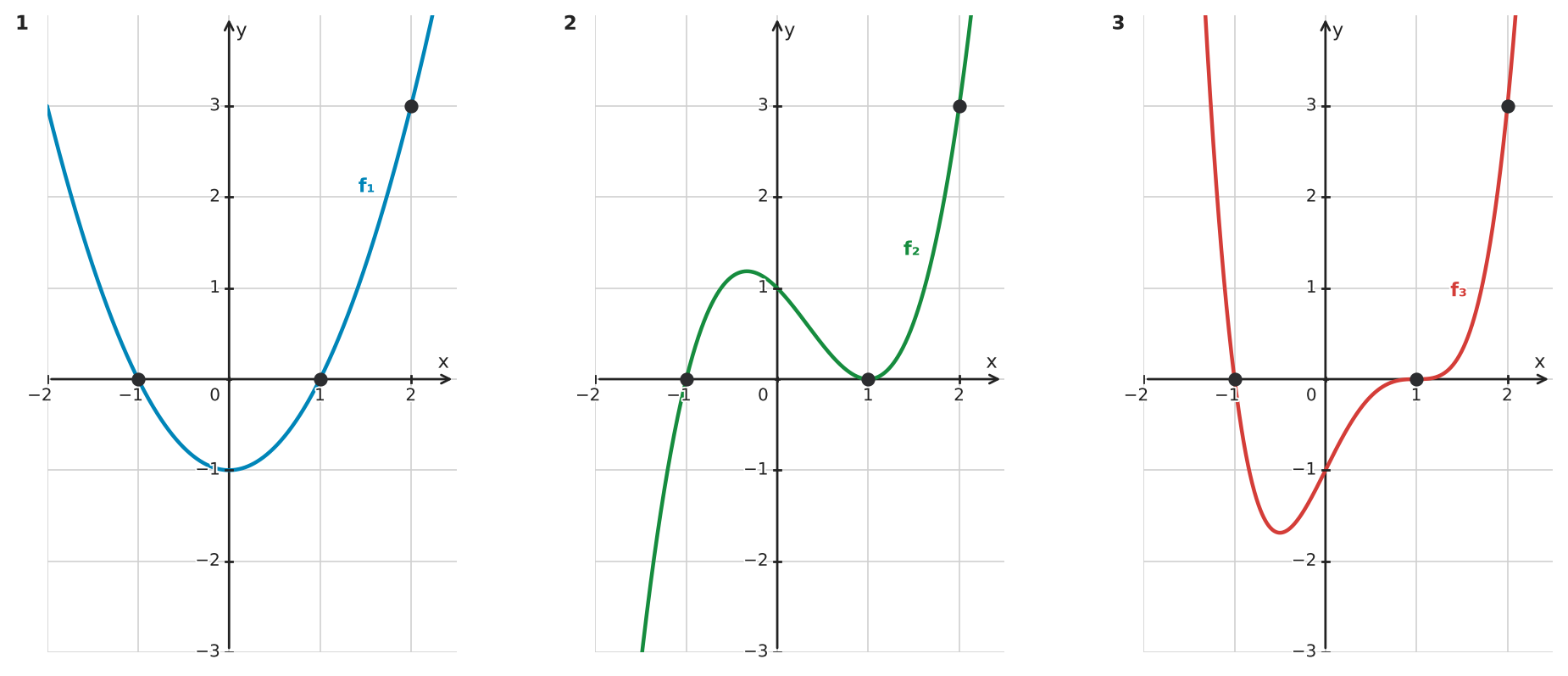
Figure for problem 532342

Hints

- Substitute the x-coordinate of a point to check whether it lies on every graph. - Evaluate \((x - 1)^n\) at \(x = 1\) and \(x = 2\). - To rule out other common points, compare two members of the family with different exponents. - Relate odd and even multiplicities to crossing and touching behavior. - Near \(x = 1\), compare \(u^4\) and \(u^2\) for small values of \(|u|\).

Solution

1. Substitute each x-coordinate. For every positive integer \(n\), \(f_n(-1) = 0\), \(f_n(1) = 0\), and \(f_n(2) = 3\). Therefore, all graphs pass through \(P\), \(Q\), and \(R\). 2. Any point common to every graph must, in particular, lie on both \(f_1\) and \(f_2\). Solve \((x + 1)(x - 1) = (x + 1)(x - 1)^2\). This simplifies to \((x + 1)(x - 1)(x - 2) = 0\), so \(x = -1\), \(x = 1\), or \(x = 2\). These are exactly the three common points already found. 3. At \(x = 1\), the multiplicity is \(n\). For \(n = 1\), the graph crosses the x-axis with nonzero slope. For \(n = 2\), it touches the x-axis and does not change sign. For \(n = 3\), it crosses the x-axis with a horizontal tangent. 4. In general, a zero of odd multiplicity produces a sign change, while a zero of even multiplicity does not. Multiplicity greater than 1 produces a horizontal tangent at the zero. 5. For \(f_4\), \(x = 1\) is a zero of multiplicity 4, so the graph touches the x-axis without changing sign. Near \(x = 1\), \((x - 1)^4\) is smaller in magnitude than \((x - 1)^2\), so \(f_4\) stays closer to the x-axis and has flatter contact than \(f_2\).

Answer

a) Every graph contains \(P(-1, 0)\), \(Q(1, 0)\), and \(R(2, 3)\). Comparing \(f_1\) and \(f_2\) shows that no other x-values can be common to the entire family. b) At \(x = 1\), \(f_1\) crosses with nonzero slope, \(f_2\) touches without crossing, and \(f_3\) crosses with a horizontal tangent. Odd multiplicity gives a sign change; even multiplicity does not. c) The zero \(x = 1\) has multiplicity 4, so there is no sign change. Near the zero, \(f_4\) has flatter contact with the x-axis than \(f_2\).

53394211
For each graph, find a possible polynomial equation of lowest possible degree. Determine the minimum possible multiplicity of each zero from the graph, then use another characteristic point to determine the leading factor.
Figure for problem 533942

Hints

- At each intercept, distinguish ordinary crossing, touching, and a crossing that visibly flattens. - Since the requested polynomial has lowest possible degree, choose the smallest multiplicity compatible with each observed behavior. - Use a convenient exact point to determine the remaining scale factor, then check the end behavior.

Solution

1. For Graph a), the graph touches at \(x = -1\), so the minimum possible multiplicity there is \(2\). It crosses at \(x = 1\) and \(x = 3\), so the minimum possible multiplicity at each of those zeros is \(1\). Thus, the lowest-degree form is \(h(x) = a(x + 1)^2(x - 1)(x - 3)\). 2. The graph passes through \((0, 1)\). Thus, \(1 = a(1)^2(-1)(-3) = 3a\), so \(a = \frac{1}{3}\). Therefore, \(h(x) = \frac{1}{3}(x + 1)^2(x - 1)(x - 3)\). 3. For Graph b), the graph crosses with flattening at \(x = -2\), so the minimum possible odd multiplicity is \(3\). It crosses normally at \(x = 2\), so the minimum possible multiplicity there is \(1\). Thus, the lowest-degree form is \(p(x) = a(x + 2)^3(x - 2)\). 4. The graph passes through \((0, 4)\). Thus, \(4 = a(2)^3(-2) = -16a\), so \(a = -0.25\). Therefore, \(p(x) = -0.25(x + 2)^3(x - 2)\).

Answer

a) \(h(x) = \frac{1}{3}(x + 1)^2(x - 1)(x - 3)\) b) \(p(x) = -0.25(x + 2)^3(x - 2)\)
53398011
Analyze the zeros of the polynomial graph shown. a) Give the coordinates of the zeros and classify each as a crossing, a touch, or a flattened crossing. b) State the minimum possible multiplicity of each zero. c) What is the minimum possible degree of \(f\)? Explain.
Figure for problem 533980

Hints

- Describe exactly how the graph meets the x-axis at each zero before assigning any multiplicity. - For each local behavior, ask for the smallest multiplicity that could produce it. - Once the minimum multiplicities are established, connect their total to the least possible polynomial degree.

Solution

1. The zeros are \((-2, 0)\), \((0, 0)\), and \((2, 0)\). 2. At \(x = -2\), the graph touches the x-axis and turns around, so the minimum multiplicity is 2. 3. At \(x = 0\), the graph crosses the x-axis without flattening, so the minimum multiplicity is 1. 4. At \(x = 2\), the graph crosses the x-axis with flattening, so the minimum multiplicity is 3. 5. The minimum possible degree is the sum of these minimum multiplicities: \(2 + 1 + 3 = 6\).

Answer

a) \((-2, 0)\): touch; \((0, 0)\): crossing; \((2, 0)\): flattened crossing b) Minimum multiplicities: \(2\), \(1\), and \(3\), respectively c) Minimum degree: \(6\)
53412011
The graph shows four functions \(f\), \(g\), \(h\), and \(j\). a) Approximately which x-values satisfy \(f(x)=j(x)\)? b) Points \(A\) and \(B\) mark the intersections of \(g\) and \(j\). What equation would you solve to find these x-values algebraically? c) Define a new function \(m\) by combining two displayed functions so that its graph has zeros at exactly \(x=2\) and \(x=-1\). Give one possible formula.
Figure for problem 534120

Hints

- Read the intersections of \(f\) and \(j\) from the graph. - Intersections occur where two function values are equal. - A product is zero when at least one factor is zero.

Solution

1. The intersections of \(f\) and \(j\) occur at \(x=2\) and approximately \(x=-2.8\). 2. Set the formulas for \(g\) and \(j\) equal: \(-x+2=-x^2+4\). 3. Function \(g\) has zero \(2\), and function \(h\) has zero \(-1\). Their product has both zeros: \(m(x)=g(x)h(x)=(-x+2)(x+1)\).

Answer

a) \(x=2\) and \(x\approx-2.8\) b) \(-x+2=-x^2+4\) c) One answer is \(m(x)=(-x+2)(x+1)\).

All problems may be used, copied and printed free of charge for school and tutoring, including paid tutoring. Commercial adaptations as well as publication or redistribution on the internet are not permitted.