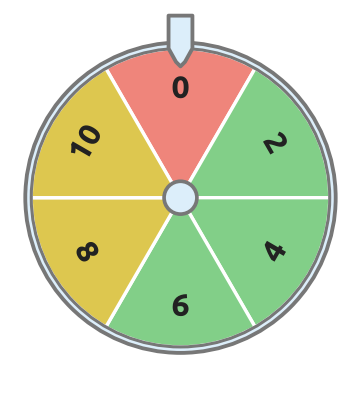
Before playing, a player chooses a maximum of \(n\) independent spins of the spinner. If a spin lands on \(0\), the game ends immediately with a payout of \(\$0\). If none of the \(n\) spins lands on \(0\), the payout is the sum of all the numbers spun, in dollars.
The expected payout has the form \(E(n)=anb^n\).
a) Find \(a\) and \(b\).
b) Find \(E(3)\) and \(E(4)\), rounded to the nearest cent.
c) Show that two consecutive positive integer values of \(n\) give exactly the same expected payout, and identify them.
Hints
- Determine the chance of avoiding the stopping value on one spin.
- Find the average result of a spin given that it does not stop the game.
- Think about the probability that all permitted spins avoid the stopping value.
- For part c, compare the expectation for consecutive choices of \(n\).
Solution
1. The probability of avoiding \(0\) on one spin is \(b=\frac{5}{6}\).
2. Conditional on avoiding \(0\), the possible values are \(2,4,6,8,10\), each equally likely, with mean \(a=6\).
3. If all \(n\) spins are nonzero, their expected sum is \(6n\), and this event has probability \(\left(\frac{5}{6}\right)^n\). Thus, \(E(n)=6n\left(\frac{5}{6}\right)^n\).
4. \(E(3)=\frac{125}{12}\approx\$10.42\) and \(E(4)=\frac{625}{54}\approx\$11.57\).
5. Solving \(E(n)=E(n+1)\) gives \(n=\frac{5}{6}(n+1)\), hence \(n=5\).
6. Therefore, \(E(5)=E(6)\).
Answer
a) \(a=6\) and \(b=\frac{5}{6}\).
b) \(E(3)\approx\$10.42\) and \(E(4)\approx\$11.57\).
c) With \(E(n)=6n(\frac56)^n\), equality of consecutive expectations is \(6n(\frac56)^n=6(n+1)(\frac56)^{n+1}\). Dividing by \(6(\frac56)^n>0\) gives \(n=\frac56(n+1)\), hence \(6n=5n+5\) and \(n=5\). Therefore \(E(5)=E(6)\), for consecutive positive integers \(5\) and \(6\).