Aimathic
Login | English | Deutsch

Free math worksheets

Build your own math worksheets from 30,000+ problems for grades 3 to 12, from fractions to AP Calculus. Every problem comes with step-by-step solutions.

Radian measure on the unit circle

Click problems to add them to your worksheet.

51010011
The radian measure \(\frac{5\pi}{12}\) is equivalent to which angle in degrees? a) \(68^\circ\) b) \(75^\circ\) c) \(78^\circ\) d) \(80^\circ\)

Hints

- What conversion factor changes radians to degrees? - Think about what fraction of a full rotation, \(2\pi\), the given angle represents. - Recall that \(\pi\) radians equals \(180^\circ\).

Solution

1. Use the conversion formula \(\theta = x \cdot \frac{180^\circ}{\pi}\). 2. Substitute \(x = \frac{5\pi}{12}\): \(\theta = \frac{5\pi}{12} \cdot \frac{180^\circ}{\pi}\). 3. Cancel \(\pi\) and simplify: \(\theta = \frac{5 \cdot 180^\circ}{12} = 75^\circ\).

Answer

b) \(75^\circ\)
55052411
On a unit circle, a central angle cuts off an arc of length \(1.3\,\text{units}\). What is the measure of the angle in radians? Briefly explain why.

Hints

- What is the radius of a unit circle? - How is radian measure defined using arc length and radius? - Check whether the numerical value changes when the radius is \(1\).

Solution

1. Radian measure is the arc length divided by the circle's radius. 2. The radius of a unit circle is \(1\), so the angle measure is \(\frac{1.3}{1}=1.3\) radians.

Answer

\(1.3\) radians. On a unit circle, the radian measure equals the intercepted arc length.
55052711
On a unit circle, a central angle intercepts an arc of length \(\frac{5\pi}{6}\). What is the angle measure in radians?

Hints

- Recall how radian measure is defined on a unit circle. - The circle's radius is \(1\), so compare the numerical arc length directly with the angle measure.

Solution

1. On a unit circle, the radian measure of a central angle equals the length of its intercepted arc. 2. The arc length is \(\frac{5\pi}{6}\), so the angle measure is \(\frac{5\pi}{6}\) radians.

Answer

\(\frac{5\pi}{6}\) radians
55053011
On a unit circle, what does an angle measure of exactly \(1\) radian mean geometrically? State the relationship between the radius and the intercepted arc.

Hints

- Focus on the definition of one radian rather than a degree conversion. - Ask what ratio of arc length to radius gives an angle measure of \(1\).

Solution

1. Radian measure compares intercepted arc length with the circle's radius. 2. An angle of \(1\) radian intercepts an arc whose length equals one radius. 3. On a unit circle, both lengths are \(1\) unit.

Answer

An angle of \(1\) radian intercepts an arc whose length equals the radius. On a unit circle, that arc is \(1\) unit long.
52367311
Convert each angle from degrees to radians. Give each exact answer in terms of \(\pi\). a) \(30^\circ\) b) \(135^\circ\) c) \(-210^\circ\) d) \(315^\circ\) e) \(1080^\circ\)

Hints

- Determine what fraction of a full rotation, \(360^\circ\), each angle represents. - How many radians are in a half rotation of \(180^\circ\)? - Simplify each fraction completely before writing the result in terms of \(\pi\).

Solution

1. Use the conversion formula \(x = \theta \cdot \frac{\pi}{180^\circ}\) for each angle. 2. For a): \(30^\circ \cdot \frac{\pi}{180^\circ} = \frac{\pi}{6}\). 3. For b): \(135^\circ \cdot \frac{\pi}{180^\circ} = \frac{3\pi}{4}\). 4. For c): \(-210^\circ \cdot \frac{\pi}{180^\circ} = -\frac{7\pi}{6}\). 5. For d): \(315^\circ \cdot \frac{\pi}{180^\circ} = \frac{7\pi}{4}\). 6. For e): \(1080^\circ \cdot \frac{\pi}{180^\circ} = 6\pi\).

Answer

a) \(\frac{\pi}{6}\) b) \(\frac{3\pi}{4}\) c) \(-\frac{7\pi}{6}\) d) \(\frac{7\pi}{4}\) e) \(6\pi\)
52367411
Convert each angle from radians to degrees. Round part e) to the nearest tenth of a degree. a) \(\frac{2\pi}{3}\) b) \(\frac{7\pi}{4}\) c) \(-\frac{3\pi}{2}\) d) \(4.5\pi\) e) \(1\)

Hints

- Recall that \(\pi\) radians equals \(180^\circ\). - When the radian measure contains \(\pi\), it will often cancel with the \(\pi\) in the conversion factor. - When the radian measure does not contain \(\pi\), use a decimal approximation for \(\pi\). - What does a negative sign indicate about the direction of rotation?

Solution

1. Use the conversion formula \(\theta = x \cdot \frac{180^\circ}{\pi}\). 2. For a): \(\frac{2\pi}{3} \cdot \frac{180^\circ}{\pi} = 120^\circ\). 3. For b): \(\frac{7\pi}{4} \cdot \frac{180^\circ}{\pi} = 315^\circ\). 4. For c): \(-\frac{3\pi}{2} \cdot \frac{180^\circ}{\pi} = -270^\circ\). 5. For d): \(4.5\pi \cdot \frac{180^\circ}{\pi} = 810^\circ\). 6. For e): \(1 \cdot \frac{180^\circ}{\pi} \approx 57.2958^\circ\), so the angle is approximately \(57.3^\circ\).

Answer

a) \(120^\circ\) b) \(315^\circ\) c) \(-270^\circ\) d) \(810^\circ\) e) \(57.3^\circ\)
52367711
Convert each angle between degree measure and radian measure. a) \(120^\circ=\square\) radians b) \(\frac{5\pi}{6}\) radians \(=\square^\circ\) c) \(225^\circ=\square\) radians d) \(\frac{5\pi}{3}\) radians \(=\square^\circ\)

Hints

- Determine what fraction of a full rotation, \(360^\circ\) or \(2\pi\), each angle represents. - Use the fact that \(180^\circ\) equals \(\pi\) radians. - Simplify each fraction in radians completely.

Solution

1. Convert \(120^\circ\) to radians: \(120^\circ \cdot \frac{\pi}{180^\circ} = \frac{2\pi}{3}\). 2. Convert \(\frac{5\pi}{6}\) to degrees: \(\frac{5\pi}{6} \cdot \frac{180^\circ}{\pi} = 150^\circ\). 3. Convert \(225^\circ\) to radians: \(225^\circ \cdot \frac{\pi}{180^\circ} = \frac{5\pi}{4}\). 4. Convert \(\frac{5\pi}{3}\) to degrees: \(\frac{5\pi}{3} \cdot \frac{180^\circ}{\pi} = 300^\circ\).

Answer

a) \(\frac{2\pi}{3}\) b) \(150^\circ\) c) \(\frac{5\pi}{4}\) d) \(300^\circ\)
52367811
Compare each pair of angles without using a calculator. Use the unit circle to determine which angle is greater. a) \(240^\circ\) and \(\frac{5\pi}{4}\) b) \(\frac{11\pi}{6}\) and \(320^\circ\) c) \(1.5\pi\) and \(280^\circ\)

Hints

- Rewrite both angles in each pair using the same unit. - Use benchmark angles on the unit circle, such as \(45^\circ\), \(90^\circ\), and \(180^\circ\). - Recall that \(\pi\) radians equals \(180^\circ\).

Solution

1. For a), \(\frac{5\pi}{4} = 225^\circ\). Since \(240^\circ > 225^\circ\), \(240^\circ\) is greater. 2. For b), \(\frac{11\pi}{6} = 330^\circ\). Since \(330^\circ > 320^\circ\), \(\frac{11\pi}{6}\) is greater. 3. For c), \(1.5\pi = \frac{3\pi}{2} = 270^\circ\). Since \(280^\circ > 270^\circ\), \(280^\circ\) is greater.

Answer

a) \(240^\circ > \frac{5\pi}{4}\) b) \(\frac{11\pi}{6} > 320^\circ\) c) \(280^\circ > 1.5\pi\)
52368911
Convert each angle from degrees to radians. Write each answer as a simplified multiple of \(\pi\). a) \(120^\circ\) b) \(315^\circ\) c) \(-30^\circ\) d) \(270^\circ\) e) \(72^\circ\)

Hints

- Determine what fraction of a full rotation, \(360^\circ\), each angle represents. - Recall that \(180^\circ\) equals \(\pi\) radians. - Simplify the fraction formed by dividing the degree measure by \(180\).

Solution

1. Use the conversion formula \(x = \theta \cdot \frac{\pi}{180^\circ}\). 2. For a): \(120^\circ \cdot \frac{\pi}{180^\circ} = \frac{2\pi}{3}\). 3. For b): \(315^\circ \cdot \frac{\pi}{180^\circ} = \frac{7\pi}{4}\). 4. For c): \(-30^\circ \cdot \frac{\pi}{180^\circ} = -\frac{\pi}{6}\). 5. For d): \(270^\circ \cdot \frac{\pi}{180^\circ} = \frac{3\pi}{2}\). 6. For e): \(72^\circ \cdot \frac{\pi}{180^\circ} = \frac{2\pi}{5}\).

Answer

a) \(\frac{2\pi}{3}\) b) \(\frac{7\pi}{4}\) c) \(-\frac{\pi}{6}\) d) \(\frac{3\pi}{2}\) e) \(\frac{2\pi}{5}\)
52369011
Convert each angle to the other unit. Round to the nearest hundredth when necessary. a) \(2.4\) radians b) \(100^\circ\) c) \(-\frac{3\pi}{4}\) radians d) \(6\) radians e) \(12.5^\circ\)

Hints

- First identify whether the given measure is in degrees or radians. - When a radian measure does not contain \(\pi\), use a decimal approximation for \(\pi\). - As a reasonableness check, \(1\) radian is about \(57.3^\circ\). - Keep the sign of the angle when you convert.

Solution

1. Use \(\theta = x \cdot \frac{180^\circ}{\pi}\) to convert radians to degrees and \(x = \theta \cdot \frac{\pi}{180^\circ}\) to convert degrees to radians. 2. For a): \(2.4 \cdot \frac{180^\circ}{\pi} \approx 137.51^\circ\). 3. For b): \(100^\circ \cdot \frac{\pi}{180^\circ} \approx 1.75\) radians. 4. For c): \(-\frac{3\pi}{4} \cdot \frac{180^\circ}{\pi} = -135^\circ\). 5. For d): \(6 \cdot \frac{180^\circ}{\pi} \approx 343.77^\circ\). 6. For e): \(12.5^\circ \cdot \frac{\pi}{180^\circ} \approx 0.22\) radians.

Answer

a) \(137.51^\circ\) b) \(1.75\) radians c) \(-135^\circ\) d) \(343.77^\circ\) e) \(0.22\) radians
52369111
Convert each angle to the other unit. Write radian measures as exact multiples of \(\pi\). a) \(72^\circ\) b) \(-210^\circ\) c) \(\frac{4\pi}{9}\) radians d) \(-1.5\pi\) radians

Hints

- What are the degree and radian measures of one full rotation? - Use the relationship \(180^\circ = \pi\) radians. - Choose the conversion factor that cancels the unit you were given. - The sign of an angle does not change during conversion.

Solution

1. To convert degrees to radians, use \(x = \theta \cdot \frac{\pi}{180^\circ}\). 2. For a): \(72^\circ \cdot \frac{\pi}{180^\circ} = \frac{2\pi}{5}\). 3. For b): \(-210^\circ \cdot \frac{\pi}{180^\circ} = -\frac{7\pi}{6}\). 4. To convert radians to degrees, use \(\theta = x \cdot \frac{180^\circ}{\pi}\). 5. For c): \(\frac{4\pi}{9} \cdot \frac{180^\circ}{\pi} = 80^\circ\). 6. For d): \(-1.5\pi \cdot \frac{180^\circ}{\pi} = -270^\circ\).

Answer

a) \(\frac{2\pi}{5}\) b) \(-\frac{7\pi}{6}\) c) \(80^\circ\) d) \(-270^\circ\)
52369211
Find each missing degree measure or radian measure. a) \(150^\circ=\square\) radians b) \(\frac{5\pi}{4}\) radians \(=\square^\circ\) c) \(-40^\circ=\square\) radians d) \(-0.2\pi\) radians \(=\square^\circ\)

Hints

- Compare each angle with a half rotation of \(180^\circ\) or \(\pi\) radians. - Choose a conversion factor that introduces or cancels \(\pi\). - Simplify all fractions completely.

Solution

1. For a), \(150^\circ \cdot \frac{\pi}{180^\circ} = \frac{5\pi}{6}\). 2. For b), \(\frac{5\pi}{4} \cdot \frac{180^\circ}{\pi} = 225^\circ\). 3. For c), \(-40^\circ \cdot \frac{\pi}{180^\circ} = -\frac{2\pi}{9}\). 4. For d), \(-0.2\pi \cdot \frac{180^\circ}{\pi} = -36^\circ\).

Answer

a) \(\frac{5\pi}{6}\) b) \(225^\circ\) c) \(-\frac{2\pi}{9}\) d) \(-36^\circ\)
52856111
Complete each angle conversion. Give every radian measure both as an exact value in terms of \(\pi\) and as a decimal rounded to the nearest hundredth. a) \(45^\circ\) b) \(\frac{3\pi}{5}\) radians c) \(240^\circ\) d) \(-60^\circ\)

Hints

- Compare each angle with a full rotation of \(360^\circ\) or \(2\pi\) radians. - Use the relationship \(180^\circ = \pi\) radians. - Check the third decimal place when rounding to the nearest hundredth. - Convert negative angles in the same way as positive angles, keeping the negative sign.

Solution

1. For \(45^\circ\): \(45^\circ \cdot \frac{\pi}{180^\circ} = \frac{\pi}{4} \approx 0.79\). 2. For \(\frac{3\pi}{5}\): \(\frac{3\pi}{5} \cdot \frac{180^\circ}{\pi} = 108^\circ\), and \(\frac{3\pi}{5} \approx 1.88\). 3. For \(240^\circ\): \(240^\circ \cdot \frac{\pi}{180^\circ} = \frac{4\pi}{3} \approx 4.19\). 4. For \(-60^\circ\): \(-60^\circ \cdot \frac{\pi}{180^\circ} = -\frac{\pi}{3} \approx -1.05\).

Answer

a) \(45^\circ=\frac{\pi}{4}\approx0.79\) radians b) \(\frac{3\pi}{5}\) radians \(=108^\circ\), and \(\frac{3\pi}{5}\approx1.88\) c) \(240^\circ=\frac{4\pi}{3}\approx4.19\) radians d) \(-60^\circ=-\frac{\pi}{3}\approx-1.05\) radians
52856311
Convert each radian measure to degrees. Round each answer to the nearest hundredth of a degree. a) \(0.5\) b) \(2.4\) c) \(4.8\) d) \(5.9\)

Hints

- A full rotation is \(2\pi\) radians or \(360^\circ\). - Use the fraction of a full rotation represented by each radian measure. - Multiply by \(\frac{180^\circ}{\pi}\) and round only at the end.

Solution

1. Use the conversion formula \(\theta = x \cdot \frac{180^\circ}{\pi}\). 2. For a): \(0.5 \cdot \frac{180^\circ}{\pi} \approx 28.65^\circ\). 3. For b): \(2.4 \cdot \frac{180^\circ}{\pi} \approx 137.51^\circ\). 4. For c): \(4.8 \cdot \frac{180^\circ}{\pi} \approx 275.02^\circ\). 5. For d): \(5.9 \cdot \frac{180^\circ}{\pi} \approx 338.05^\circ\).

Answer

a) \(28.65^\circ\) b) \(137.51^\circ\) c) \(275.02^\circ\) d) \(338.05^\circ\)
52856511
Convert each angle from degrees to radians. Round each answer to the nearest hundredth. a) \(24^\circ\) b) \(165^\circ\) c) \(212.5^\circ\) d) \(333^\circ\)

Hints

- Determine what fraction of a full rotation, \(360^\circ\), each angle represents. - A full rotation equals \(2\pi\) radians. - Use the relationship \(180^\circ = \pi\) radians. - Keep full calculator precision until the final rounding step.

Solution

1. Use the conversion formula \(x = \theta \cdot \frac{\pi}{180^\circ}\). 2. For a): \(24^\circ \cdot \frac{\pi}{180^\circ} \approx 0.42\). 3. For b): \(165^\circ \cdot \frac{\pi}{180^\circ} \approx 2.88\). 4. For c): \(212.5^\circ \cdot \frac{\pi}{180^\circ} \approx 3.71\). 5. For d): \(333^\circ \cdot \frac{\pi}{180^\circ} \approx 5.81\).

Answer

a) \(0.42\) radians b) \(2.88\) radians c) \(3.71\) radians d) \(5.81\) radians
52856911
Complete the table by converting each angle to the other unit. Round decimal answers to the nearest tenth when necessary. <table> <tr><th>Degree measure</th><th>Radian measure</th></tr> <tr><td>\(72^\circ\)</td><td></td></tr> <tr><td></td><td>\(1.5\)</td></tr> <tr><td>\(-210^\circ\)</td><td></td></tr> <tr><td></td><td>\(\frac{3\pi}{4}\)</td></tr> <tr><td></td><td>\(5\)</td></tr> </table>

Hints

- A full rotation is \(360^\circ\) or \(2\pi\) radians. - Use a conversion factor that cancels the unit you were given. - Keep exact values involving \(\pi\) until you need a decimal approximation. - Compare your result with the benchmark \(180^\circ=\pi\) radians to check whether its size is reasonable.

Solution

1. Convert \(72^\circ\) to radians: \(72^\circ \cdot \frac{\pi}{180^\circ} = \frac{2\pi}{5} \approx 1.3\). 2. Convert \(1.5\) radians to degrees: \(1.5 \cdot \frac{180^\circ}{\pi} \approx 85.9^\circ\). 3. Convert \(-210^\circ\) to radians: \(-210^\circ \cdot \frac{\pi}{180^\circ} = -\frac{7\pi}{6} \approx -3.7\). 4. Convert \(\frac{3\pi}{4}\) to degrees: \(\frac{3\pi}{4} \cdot \frac{180^\circ}{\pi} = 135^\circ\). 5. Convert \(5\) radians to degrees: \(5 \cdot \frac{180^\circ}{\pi} \approx 286.5^\circ\).

Answer

<table> <tr><th>Degree measure</th><th>Radian measure</th></tr> <tr><td>\(72^\circ\)</td><td>\(1.3\)</td></tr> <tr><td>\(85.9^\circ\)</td><td>\(1.5\)</td></tr> <tr><td>\(-210^\circ\)</td><td>\(-3.7\)</td></tr> <tr><td>\(135^\circ\)</td><td>\(\frac{3\pi}{4}\)</td></tr> <tr><td>\(286.5^\circ\)</td><td>\(5\)</td></tr> </table>
55052511
A central angle on a unit circle cuts off exactly one quarter of the circle's circumference. Find the angle's radian measure without converting from degrees.

Hints

- Start with the circumference of a circle whose radius is \(1\). - What fraction of that circumference is intercepted? - On a unit circle, how is intercepted arc length related to radian measure?

Solution

1. The circumference of a unit circle is \(2\pi\). 2. One quarter of that circumference has length \(\frac{1}{4}\cdot 2\pi=\frac{\pi}{2}\). 3. On a unit circle, arc length equals radian measure, so the angle measures \(\frac{\pi}{2}\) radians.

Answer

\(\frac{\pi}{2}\) radians
55052611
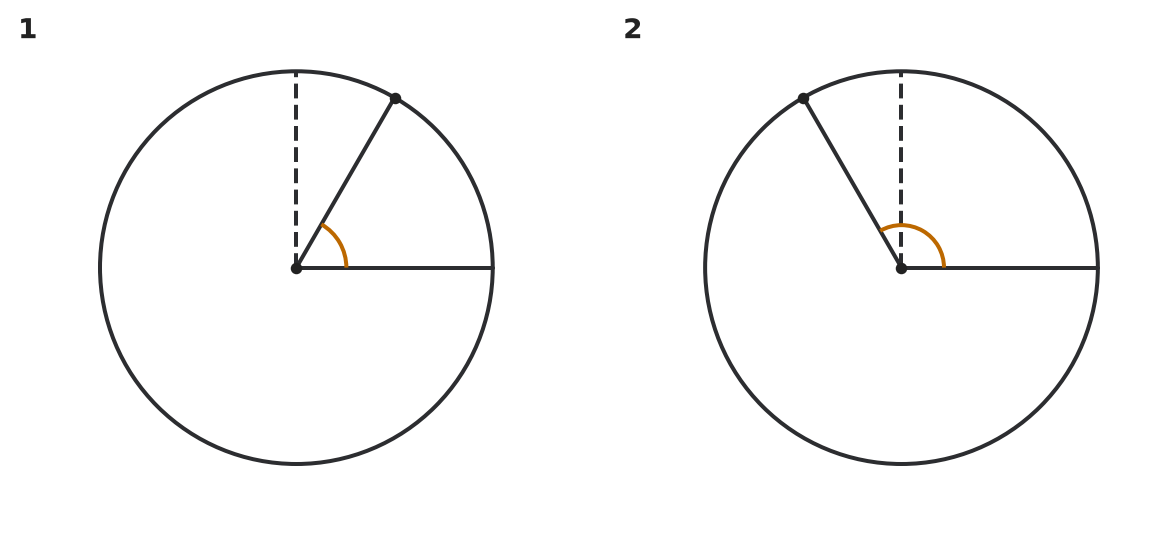
Both diagrams show a unit circle. In each panel, the solid starting radius points to the right, and the dashed radius marks a \(\frac{\pi}{2}\) turn from that starting radius. a) Is the marked central angle in panel a) less than, equal to, or greater than \(\frac{\pi}{2}\)? b) Is the marked central angle in panel b) less than, equal to, or greater than \(\frac{\pi}{2}\)? c) Which panel has the larger radian measure? Explain using the unit circle.
Figure for problem 550526

Hints

- Use the dashed radius as the \(\frac{\pi}{2}\) benchmark. - Compare where each terminal radius falls relative to that benchmark. - On a unit circle, a larger counterclockwise intercepted arc means a larger radian measure.

Solution

1. In panel a), the terminal radius lies before the dashed \(\frac{\pi}{2}\) radius, so the marked angle is less than \(\frac{\pi}{2}\). 2. In panel b), the terminal radius lies beyond the dashed \(\frac{\pi}{2}\) radius, so the marked angle is greater than \(\frac{\pi}{2}\). 3. The marked angle in panel b) cuts off a longer counterclockwise arc on the unit circle, so it has the larger radian measure.

Answer

a) Less than \(\frac{\pi}{2}\) b) Greater than \(\frac{\pi}{2}\) c) Panel b) has the larger radian measure because it intercepts the longer unit-circle arc.
55052811
A central angle on a unit circle intercepts three quarters of the circle. Find its radian measure without first converting to degrees.

Hints

- Start with the circumference of the unit circle. - Take the stated fraction of that circumference. - Connect the resulting arc length to radian measure.

Solution

1. The circumference of a unit circle is \(2\pi\). 2. Three quarters of the circumference is \(\frac{3}{4}\cdot 2\pi=\frac{3\pi}{2}\). 3. On a unit circle, intercepted arc length equals radian measure, so the angle measures \(\frac{3\pi}{2}\) radians.

Answer

\(\frac{3\pi}{2}\) radians
55052911
A central angle on a unit circle measures \(2.4\) radians. a) What is the length of the intercepted arc? b) Is the angle less than or greater than a semicircle? Explain without converting to degrees.

Hints

- On a unit circle, what quantity has the same numerical value as the radian measure? - A semicircle corresponds to half of a circumference of \(2\pi\). - Compare \(2.4\) with that benchmark rather than converting units.

Solution

1. On a unit circle, arc length equals radian measure, so the intercepted arc has length \(2.4\) units. 2. A semicircle on a unit circle has arc length \(\pi\), and \(2.4<\pi\). 3. Therefore, the angle is less than a semicircle.

Answer

a) \(2.4\) units b) Less than a semicircle, because \(2.4<\pi\).
55053111
A student says, “An angle of \(2\) radians on the unit circle must intercept an arc of length \(2\pi\), because radian measures always involve \(\pi\).” Identify the error and give the correct arc length.

Hints

- Radian measures can be ordinary real numbers as well as multiples of \(\pi\). - Use the unit-circle definition directly. - Check what arc length would correspond to a full turn before accepting \(2\pi\).

Solution

1. A radian measure does not have to be written as a multiple of \(\pi\). 2. On a unit circle, the numerical radian measure equals the intercepted arc length. 3. Therefore, an angle of \(2\) radians intercepts an arc of length \(2\) units, not \(2\pi\) units.

Answer

The error is assuming every radian measure must contain \(\pi\). The intercepted arc length is \(2\) units.
55053211
A point travels counterclockwise around a unit circle for \(2.5\) complete rotations. a) What total angle has the point swept through in radians? b) What total arc length has the point traveled along the unit circle?

Hints

- Convert complete rotations directly to radians using one full turn. - Think of the total swept angle, not only the final terminal position. - On a unit circle, connect total radian measure with total arc length traveled.

Solution

1. One complete rotation is \(2\pi\) radians. 2. The total angle is \(2.5\cdot 2\pi=5\pi\) radians. 3. On a unit circle, total arc length equals the total radian measure, so the traveled arc length is \(5\pi\) units.

Answer

a) \(5\pi\) radians b) \(5\pi\) units
55053311
Without converting to degrees, locate an angle of \(2.2\) radians relative to the benchmark angles \(\frac{\pi}{2}\), \(\pi\), and \(\frac{3\pi}{2}\). Between which two consecutive benchmarks does it lie, and what quadrant is its terminal side in?

Hints

- Use approximate sizes of the standard radian benchmarks rather than changing units. - Compare \(2.2\) first with \(\frac{\pi}{2}\) and \(\pi\). - Connect the interval between those benchmarks with a quadrant on the unit circle.

Solution

1. \(\frac{\pi}{2}\approx1.57\) and \(\pi\approx3.14\). 2. Since \(1.57<2.2<3.14\), the angle lies between \(\frac{\pi}{2}\) and \(\pi\). 3. Therefore, its terminal side is in Quadrant II.

Answer

It lies between \(\frac{\pi}{2}\) and \(\pi\), so its terminal side is in Quadrant II.
55053411
The diagram shows a unit circle. The solid horizontal radius is the starting radius, the dashed radius points in the direction of an angle of \(\pi\) radians, and the third radius is the terminal radius of \(\theta\). Decide whether \(\theta\) lies in \((0,\pi)\), \((\pi,\frac{3\pi}{2})\), or \((\frac{3\pi}{2},2\pi)\). Explain from the diagram.
Figure for problem 550534

Hints

- Use the dashed half-turn radius as the \(\pi\) benchmark. - Compare the terminal radius with the downward direction corresponding to three quarters of a turn. - The angle is measured counterclockwise from the starting radius.

Solution

1. The dashed radius marks a half-turn, or \(\pi\) radians. 2. The terminal radius is past that half-turn but before the downward radius that would mark \(\frac{3\pi}{2}\). 3. Therefore, \(\pi<\theta<\frac{3\pi}{2}\).

Answer

\(\theta\in(\pi,\frac{3\pi}{2})\)
55053511
The terminal radius in the diagram lies halfway between the negative x-axis direction and the downward direction on a unit circle. Which radian measure matches the marked counterclockwise angle from the positive x-axis? \(\frac{3\pi}{4}\), \(\frac{5\pi}{4}\), or \(\frac{7\pi}{4}\)
Figure for problem 550535

Hints

- Identify the two standard radian directions that bound the terminal radius. - The terminal radius is halfway between those two directions. - Compare each answer choice with a half-turn and a three-quarter turn.

Solution

1. The terminal radius is in Quadrant III, halfway between \(\pi\) and \(\frac{3\pi}{2}\). 2. The midpoint of those benchmark angles is \(\frac{\pi+\frac{3\pi}{2}}{2}=\frac{5\pi}{4}\). 3. Therefore, the marked angle is \(\frac{5\pi}{4}\).

Answer

\(\frac{5\pi}{4}\)
52856011
Consider the four radian measures \(x_1=\frac{\pi}{3}\), \(x_2=\frac{7\pi}{3}\), \(x_3=-\frac{5\pi}{3}\), and \(x_4=\frac{4\pi}{3}\). a) Convert each angle to degrees. b) Determine which angles have the same terminal side on the unit circle. Explain your reasoning.

Hints

- A full rotation is \(360^\circ\), or \(2\pi\) radians. - Convert radians to degrees by multiplying by \(\frac{180^\circ}{\pi}\). - Add or subtract full rotations to compare terminal sides. - Reduce each angle to the interval \([0^\circ, 360^\circ)\).

Solution

1. Multiply each radian measure by \(\frac{180^\circ}{\pi}\): \(x_1=60^\circ\), \(x_2=420^\circ\), \(x_3=-300^\circ\), and \(x_4=240^\circ\). 2. Coterminal angles differ by a multiple of \(360^\circ\), or equivalently by a multiple of \(2\pi\). 3. Since \(420^\circ-360^\circ=60^\circ\) and \(-300^\circ+360^\circ=60^\circ\), the angles \(x_1\), \(x_2\), and \(x_3\) have the same terminal side. The angle \(x_4=240^\circ\) has a different terminal side.

Answer

a) \(x_1=60^\circ\), \(x_2=420^\circ\), \(x_3=-300^\circ\), \(x_4=240^\circ\) b) \(x_1\), \(x_2\), and \(x_3\) have the same terminal side because their measures differ by integer multiples of \(360^\circ\). The angle \(x_4\) does not.
52856211
Order the following angle measures from least to greatest. Convert each measure to radians and round to the nearest hundredth to compare. \(75^\circ\), \(1.2\) radians, \(\frac{2\pi}{3}\) radians, \(210^\circ\), \(4\) radians

Hints

- Convert all angle measures to the same unit before comparing them. - The values explicitly labeled in radians are already in the comparison unit. - Use the \(\pi\) key on your calculator before rounding.

Solution

1. Express each angle as a decimal radian measure: - \(75^\circ \cdot \frac{\pi}{180^\circ} \approx 1.31\) - \(1.2\) is already in radians. - \(\frac{2\pi}{3} \approx 2.09\) - \(210^\circ \cdot \frac{\pi}{180^\circ} \approx 3.67\) - \(4\) is already in radians. 2. Compare the values: \(1.2 < 1.31 < 2.09 < 3.67 < 4\). 3. Match the decimal values to the original angles.

Answer

\(1.2\text{ radians} < 75^\circ < \frac{2\pi}{3}\text{ radians} < 210^\circ < 4\text{ radians}\)
52857011
Order the angle measures from least to greatest. Convert them to the same unit and round to the nearest tenth when necessary. \(\alpha = 155^\circ\) \(\beta = 2.7\) radians \(\gamma = \frac{5\pi}{6}\) radians \(\delta = 2.8\) radians

Hints

- Convert every angle to the same unit before comparing. - Estimate with \(\pi \approx 3.14\) to check the relative sizes. - To convert radians to degrees, multiply by \(\frac{180^\circ}{\pi}\).

Solution

1. Convert each radian measure to degrees. 2. \(\alpha = 155^\circ\) is already in degrees. 3. \(\beta = 2.7\) radians gives \(2.7 \cdot \frac{180^\circ}{\pi} \approx 154.7^\circ\). 4. \(\gamma = \frac{5\pi}{6}\) radians gives \(\frac{5\pi}{6} \cdot \frac{180^\circ}{\pi} = 150^\circ\). 5. \(\delta = 2.8\) radians gives \(2.8 \cdot \frac{180^\circ}{\pi} \approx 160.4^\circ\). 6. Therefore, \(150^\circ < 154.7^\circ < 155^\circ < 160.4^\circ\).

Answer

\(\gamma < \beta < \alpha < \delta\)
52857511
A point \(P\) on the unit circle is determined by \(\alpha=\frac{2\pi}{3}\). Find all radian measures \(\alpha\) in the interval \([-3\pi, 3\pi]\) that determine the same point.

Hints

- A point returns to the same location after a rotation of \(2\pi\). - Write a formula using integer multiples of \(2\pi\). - Test both positive and negative integer values. - Check every result against the interval endpoints.

Solution

1. All coterminal angles have the form \(\alpha=\frac{2\pi}{3}+2\pi k\), where \(k\) is an integer. 2. For \(k=-1\), \(\alpha=-\frac{4\pi}{3}\), which lies in the interval. 3. For \(k=0\), \(\alpha=\frac{2\pi}{3}\), which lies in the interval. 4. For \(k=1\), \(\alpha=\frac{8\pi}{3}\), which lies in the interval. 5. The next values, obtained with \(k=-2\) and \(k=2\), lie outside the interval.

Answer

\(\alpha \in \left\{-\frac{4\pi}{3}, \frac{2\pi}{3}, \frac{8\pi}{3}\right\}\)

All problems may be used, copied and printed free of charge for school and tutoring, including paid tutoring. Commercial adaptations as well as publication or redistribution on the internet are not permitted.