Aimathic
Login | English | Deutsch

Free math worksheets

Build your own math worksheets from 30,000+ problems for grades 3 to 12, from fractions to AP Calculus. Every problem comes with step-by-step solutions.

Measure angles with a protractor

Click problems to add them to your worksheet.

5511784
Triangle \(ABC\) is shown. Use a protractor to measure \(\angle ABC\) to the nearest degree.
Figure for problem 551178

Hints

- The vertex of the angle is \(B\). - Align the protractor with one side of the angle before reading the scale. - Check that your answer matches the acute appearance of the angle.

Solution

1. Place the protractor's center at \(B\). 2. Align the baseline with ray \(BA\). 3. Ray \(BC\) crosses the correct scale at \(42^\circ\).

Answer

\(42^\circ\)
5522384
Use a protractor to measure the smaller angle between rays \(a\) and \(b\).
Figure for problem 552238

Hints

- Place the center mark of the protractor at \(V\). - Align the zero line with ray \(a\). - Read the scale that starts at zero on ray \(a\).

Solution

1. Center the protractor at \(V\) and align its baseline with ray \(a\). 2. Ray \(b\) meets the correct scale at \(64^\circ\).

Answer

\(64^\circ\)
5543454
Place the protractor's center at \(O\) and align its \(0^\circ\) line with ray \(a\). Measure the smaller angle from ray \(a\) to ray \(b\).
Figure for problem 554345

Hints

- Put the center mark of the protractor at the angle's vertex. - Align the zero line with one ray before reading the other ray. - Choose the scale that starts at zero on the aligned ray.

Solution

1. Place the protractor's center at \(O\) and align its baseline with ray \(a\). 2. Read the scale where ray \(b\) crosses it. 3. The smaller angle measures \(35^\circ\).

Answer

\(35^\circ\)
5511794
Two fence boards meet at point \(P\), as shown. Use a protractor to measure the smaller angle between the boards to the nearest degree.
Figure for problem 551179

Hints

- The boards form an obtuse angle. - Rotate the protractor so one baseline follows one board. - Use the scale that starts at \(0^\circ\) on the aligned board.

Solution

1. Center the protractor at \(P\). 2. Align a baseline with either board. 3. The smaller angle measures \(118^\circ\).

Answer

\(118^\circ\)
5511834
For this exercise, a design rule says the opening between the two arms of the stand should be between \(95^\circ\) and \(110^\circ\), inclusive. Measure the opening at joint \(J\) with a protractor. Does it meet the stated rule?
Figure for problem 551183

Hints

- Measure the opening at the joint before checking the interval. - Use the smaller angle formed by the two arms. - Compare your measurement with both endpoints of the stated range.

Solution

1. Measure the angle between the two arms at \(J\). 2. The opening measures \(103^\circ\). 3. Since \(103^\circ\) is between \(95^\circ\) and \(110^\circ\), it meets the stated exercise rule.

Answer

\(103^\circ\); yes, it meets the stated rule.
5522394
Use a protractor to measure the smaller angle between rays \(a\) and \(b\).
Figure for problem 552239

Hints

- The baseline of the protractor does not have to be horizontal. - Align the zero line with ray \(a\), even though that ray is tilted. - Read the scale that increases away from the zero on ray \(a\).

Solution

1. Center the protractor at \(V\) and rotate it so its baseline follows ray \(a\). 2. Use the scale that begins at zero on ray \(a\). 3. Ray \(b\) meets that scale at \(75^\circ\).

Answer

\(75^\circ\)
5543464
Neither ray is horizontal. Use a protractor to measure the smaller angle between rays \(a\) and \(b\).
Figure for problem 554346

Hints

- The baseline is tilted, so the page's horizontal direction is not the protractor's zero line. - Align the protractor with one of the rays rather than with the edge of the page. - Check whether your reading should be acute or obtuse from the visible opening.

Solution

1. Center the protractor at \(O\) and align its baseline with either ray. 2. Read from the zero that lies on the aligned ray. 3. The rays are \(120^\circ\) apart, so the smaller angle measures \(120^\circ\).

Answer

\(120^\circ\)
5543474
Lena measures the smaller angle between rays \(a\) and \(b\) and reports \(115^\circ\). Use a protractor to check her measurement. Is she correct? Explain.
Figure for problem 554347

Hints

- Decide which ray should line up with zero before reading a number. - A standard protractor often shows two numbers at the same tick. - Use the visible size of the smaller angle to test which reading is reasonable.

Solution

1. Align the protractor's baseline with ray \(a\) and start from the zero on that ray. 2. Ray \(b\) gives a reading of \(65^\circ\) on the correct scale. 3. Lena used the opposite scale, so \(115^\circ\) is not the smaller angle.

Answer

No. The smaller angle is \(65^\circ\); Lena read the opposite protractor scale.
5543494
Ray \(s\) is the starting ray. Use a protractor to determine which candidate ray—\(a\), \(b\), or \(c\)—forms a \(70^\circ\) angle with ray \(s\).
Figure for problem 554349

Hints

- Treat ray \(s\) as the protractor's zero direction. - Measure each candidate from the same starting ray. - Select the ray whose measurement matches the requested angle.

Solution

1. Align the protractor's zero line with ray \(s\). 2. Ray \(a\) is at \(70^\circ\), ray \(b\) is at \(62^\circ\), and ray \(c\) is at \(78^\circ\) from ray \(s\). 3. Therefore ray \(a\) forms the requested \(70^\circ\) angle.

Answer

Ray \(a\)
5511804
Measure the angle at \(A\) in figure a) and the angle at \(P\) in figure b) with a protractor. Which figure has the greater angle, and by how many degrees?
Figure for problem 551180

Hints

- Measure the named vertex angle in each panel separately. - Do not compare the drawings by appearance alone. - After measuring, subtract the smaller angle from the larger one.

Solution

1. In figure a), the angle at \(A\) measures \(67^\circ\). 2. In figure b), the angle at \(P\) measures \(104^\circ\). 3. Figure b) has the greater angle. 4. The difference is \(104^\circ - 67^\circ = 37^\circ\).

Answer

Figure b), by \(37^\circ\).
5511814
Jordan measures the acute angle where two paths cross and records \(52^\circ\). Use a protractor to check the acute angle at the intersection. Is Jordan's measurement correct?
Figure for problem 551181

Hints

- Measure the acute angle, not the obtuse angle beside it. - Keep the protractor's center exactly at the crossing point. - Compare your measured value with Jordan's recorded value.

Solution

1. Center the protractor at the intersection point and align its baseline with either path. 2. The acute angle measures \(58^\circ\). 3. Jordan's measurement is \(58^\circ - 52^\circ = 6^\circ\) too small.

Answer

No. The acute angle is \(58^\circ\), so Jordan's measurement is \(6^\circ\) too small.
5511824
Three rays \(a\), \(b\), and \(c\) meet at \(V\). Use a protractor to measure the angle between rays \(a\) and \(b\) and the angle between rays \(b\) and \(c\). Then find the angle between rays \(a\) and \(c\) by addition and check it with a direct protractor measurement.
Figure for problem 551182

Hints

- Measure the two smaller adjacent angles first. - Keep the protractor centered at \(V\) each time. - Add the two measured angles before checking the whole angle directly.

Solution

1. The angle between rays \(a\) and \(b\) measures \(36^\circ\). 2. The angle between rays \(b\) and \(c\) measures \(53^\circ\). 3. Their sum is \(36^\circ+53^\circ=89^\circ\). 4. A direct measurement of the angle between rays \(a\) and \(c\) also gives \(89^\circ\).

Answer

The angle between rays \(a\) and \(b\) is \(36^\circ\), the angle between rays \(b\) and \(c\) is \(53^\circ\), and the angle between rays \(a\) and \(c\) is \(89^\circ\).
5522404
Use a protractor to measure the smaller angle between rays \(a\) and \(b\). Then find how many degrees less than a straight angle it is.
Figure for problem 552240

Hints

- Measure the smaller opening between the two rays, even though it is close to a straight angle. - Check that you are reading from the scale whose zero is aligned with ray \(a\). - After measuring, compare the angle with the degree measure of a straight angle.

Solution

1. The smaller angle between the rays measures \(153^\circ\). 2. A straight angle measures \(180^\circ\). 3. The difference is \(180^\circ-153^\circ=27^\circ\).

Answer

The angle is \(153^\circ\), which is \(27^\circ\) less than a straight angle.
5543484
Measure the smaller angle in each panel with a protractor. Which angle is greater, and by how many degrees?
Figure for problem 554348

Hints

- Measure each panel independently before comparing the angles. - For each angle, align the protractor with one ray and read from the matching zero. - After measuring both, subtract the smaller measure from the larger one.

Solution

1. Panel a) measures \(48^\circ\). 2. Panel b) measures \(132^\circ\). 3. Panel b) is greater by \(132^\circ - 48^\circ = 84^\circ\).

Answer

a) \(48^\circ\) b) \(132^\circ\) Panel b) is greater by \(84^\circ\).
5522414
Jordan measures the smaller angle between rays \(a\) and \(b\) and reports \(52^\circ\). Use a protractor to determine the correct measure. Explain the likely scale-reading mistake and how you can tell Jordan's answer is not reasonable.
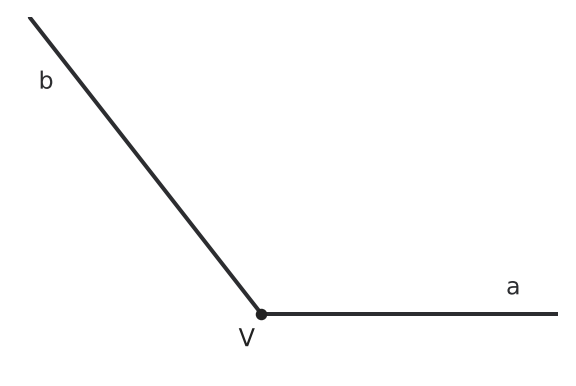
Figure for problem 552241

Hints

- Decide from the picture whether the angle should be acute, right, or obtuse before trusting a scale reading. - Start with the protractor scale whose zero is on ray \(a\). - At one protractor tick, the two printed scales give supplementary readings; choose the one consistent with the opening shown.

Solution

1. Align the protractor's zero with ray \(a\). Ray \(b\) meets the correct scale at \(128^\circ\). 2. The other scale at the same tick reads \(52^\circ\), so Jordan likely read the scale that starts from the opposite side. 3. The drawn angle is obtuse, while \(52^\circ\) is acute, so the reported measure is not reasonable.

Answer

\(128^\circ\). Jordan likely read the opposite protractor scale; \(52^\circ\) is acute, but the drawn angle is obtuse.

All problems may be used, copied and printed free of charge for school and tutoring, including paid tutoring. Commercial adaptations as well as publication or redistribution on the internet are not permitted.