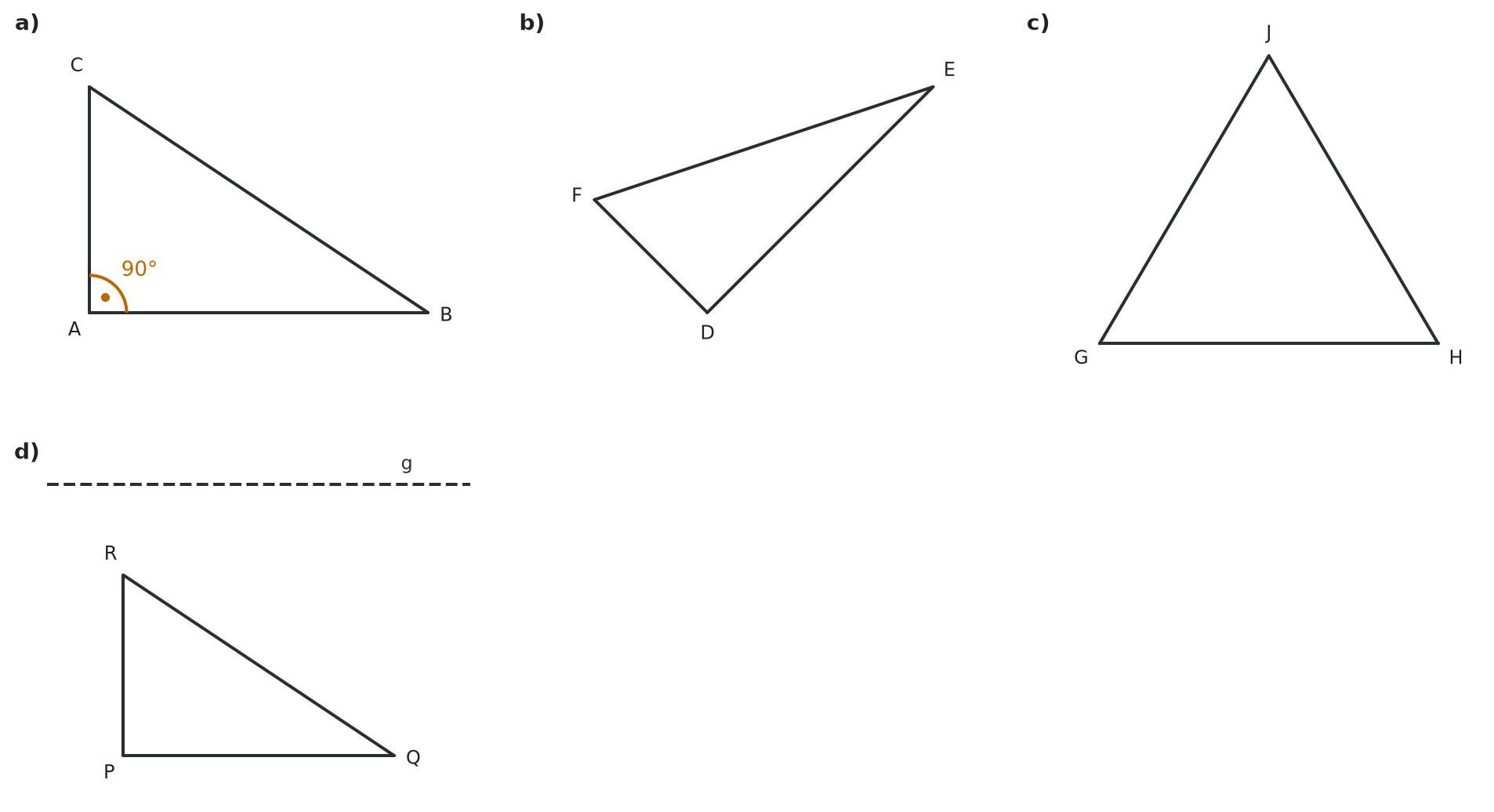
Determine which of the four triangles are right triangles. Use the different evidence shown or stated for each figure.
- In b), sides \(\overline{DE}\) and \(\overline{DF}\) are perpendicular.
- In c), all three angles are acute.
- In d), side \(\overline{PQ}\) is parallel to line \(g\), and side \(\overline{PR}\) is perpendicular to line \(g\).
Hints
- Treat each triangle independently; the evidence is different in each panel.
- Translate perpendicular sides into a right-angle fact.
- For d), first use the parallel relationship to compare the direction of \(\overline{PQ}\) with line \(g\).
Solution
1. In a), the marked \(90^\circ\) angle shows directly that the triangle is right.
2. In b), perpendicular sides \(\overline{DE}\) and \(\overline{DF}\) make a right angle at \(D\), so b) is right.
3. In c), all three angles are acute, so c) has no right angle and is not right.
4. In d), \(\overline{PQ}\) has the same direction as line \(g\). Since \(\overline{PR}\) is perpendicular to \(g\), \(\overline{PR}\) is also perpendicular to \(\overline{PQ}\). Thus d) has a right angle at \(P\).
Therefore a), b), and d) are right triangles.
Answer
a), b), and d)