Aimathic
Login | English | Deutsch

Free math worksheets

Build your own math worksheets from 30,000+ problems for grades 3 to 12, from fractions to AP Calculus. Every problem comes with step-by-step solutions.

Line plots with fraction data

Click problems to add them to your worksheet.

5511844
The line plot shows craft-stick lengths measured to the nearest \(\frac{1}{4}\) inch. How many sticks are \(1\frac{3}{4}\) inches long?
Figure for problem 551184

Hints

- Follow the evenly spaced quarter-inch ticks to the requested measurement. - Each X-mark represents one craft stick. - Count only the X-marks directly above \(1\frac{3}{4}\).

Solution

1. Locate \(1\frac{3}{4}\) inches on the number line. 2. Count the stacked X-marks above that tick. There are \(2\) X-marks.

Answer

\(2\) sticks
5522424
The line plot shows ribbon lengths measured to the nearest \(\frac{1}{4}\) inch. What ribbon length occurs most often?
Figure for problem 552242

Hints

- Look for the tick with the greatest number of stacked X-marks. - Read the fractional measurement directly below that stack. - The question asks for a length, not the number of X-marks.

Solution

1. Find the tallest stack of X-marks. 2. The tallest stack is above \(2\) inches, so \(2\) inches is the most frequent length.

Answer

\(2\,\text{in}\)
5548624
The line plot shows ribbon lengths measured to the nearest \(\frac{1}{2}\) inch. Which length has exactly \(3\) ribbons?
Figure for problem 554862

Hints

- Count the X-marks in each stack until you find a stack of exactly \(3\). - Then read the measurement at the tick directly below that stack. - Give the measurement, not the frequency.

Solution

1. Find the stack containing exactly \(3\) X-marks. 2. That stack is above \(1\frac{1}{2}\) inches.

Answer

\(1\frac{1}{2}\,\text{in}\)
5511854
The line plot shows seedling heights measured to the nearest \(\frac{1}{2}\) inch. Which height occurs most often, and how many more seedlings have that height than are \(5\) inches tall?
Figure for problem 551185

Hints

- Read the measurement under the tallest stack. - Then find the stack above \(5\) inches. - Compare the two frequencies, not the two height values.

Solution

1. The tallest stack is above \(6\frac{1}{2}\) inches, with \(4\) X-marks. 2. The stack above \(5\) inches has \(2\) X-marks. 3. The difference is \(4 - 2 = 2\) seedlings.

Answer

\(6\frac{1}{2}\) inches; \(2\) more seedlings
5511864
The line plot shows cord lengths measured to the nearest \(\frac{1}{8}\) yard. Add the least length that occurs and the greatest length that occurs.
Figure for problem 551186

Hints

- Use the number-line positions to find the leftmost and rightmost measurements that actually occur. - Express both lengths in eighths before adding. - Check whether the fractional parts combine to a whole yard.

Solution

1. The leftmost tick with an X-mark is \(\frac{5}{8}\) yard. 2. The rightmost tick with an X-mark is \(1\frac{3}{8}\) yards. 3. Add: \(\frac{5}{8} + 1\frac{3}{8} = 2\) yards.

Answer

\(2\,\text{yd}\)
5511874
The line plot shows shell lengths measured to the nearest \(\frac{1}{4}\) inch. What is the range of the shell lengths?
Figure for problem 551187

Hints

- Find the leftmost and rightmost ticks that have X-marks above them. - Range means greatest measurement minus least measurement. - Rewrite the measurements with fourths if that helps you subtract.

Solution

1. The least represented length is \(2\frac{1}{2}\) inches. 2. The greatest represented length is \(4\frac{1}{4}\) inches. 3. The range is \(4\frac{1}{4} - 2\frac{1}{2} = 1\frac{3}{4}\) inches.

Answer

\(1\frac{3}{4}\,\text{in}\)
5511904
Aisha measured the widths of ten wood strips to the nearest \(\frac{1}{4}\) inch: <table> <tr><th>Width</th><th>Number of strips</th></tr> <tr><td>\(1\frac{1}{2}\,\text{in}\)</td><td>2</td></tr> <tr><td>\(1\frac{3}{4}\,\text{in}\)</td><td>1</td></tr> <tr><td>\(2\,\text{in}\)</td><td>4</td></tr> <tr><td>\(2\frac{1}{2}\,\text{in}\)</td><td>2</td></tr> <tr><td>\(2\frac{3}{4}\,\text{in}\)</td><td>1</td></tr> </table> The blank line plot has consecutive quarter-inch ticks. One tick is labeled A instead of with its measurement. What measurement belongs at A, and how many X-marks should be placed above each tick?
Figure for problem 551190

Hints

- Use the equal spacing on the blank number line to determine the value at A. - Then match each measured width to its tick. - A tick remains on the line plot even when its frequency is zero.

Solution

1. The ticks increase by \(\frac{1}{4}\) inch, so A is \(2\frac{1}{4}\) inches. 2. Use the table for the listed widths and include zero for the missing width. 3. From left to right, the frequencies are \(2, 1, 4, 0, 2, 1\).

Answer

A = \(2\frac{1}{4}\,\text{in}\) From left to right: \(2, 1, 4, 0, 2, 1\) X-marks.
5543584
Seven strips have these widths: \(\frac{3}{8}\,\text{in}\), \(\frac{1}{2}\,\text{in}\), \(\frac{1}{2}\,\text{in}\), \(\frac{5}{8}\,\text{in}\), \(\frac{5}{8}\,\text{in}\), \(\frac{5}{8}\,\text{in}\), and \(\frac{7}{8}\,\text{in}\). The blank line plot has equally spaced eighth-inch ticks from \(\frac{3}{8}\) inch through \(\frac{7}{8}\) inch. The three interior ticks are labeled A, B, and C. Which lettered tick should have \(3\) X-marks, and what measurement does that tick represent?
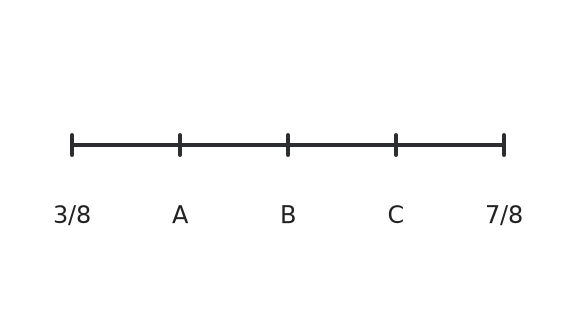
Figure for problem 554358

Hints

- First identify which width occurs three times in the data. - Use the equal tick spacing to count by eighths from \(\frac{3}{8}\) to \(\frac{7}{8}\). - Match the repeated width to the correct lettered position on the blank line plot.

Solution

1. The value occurring \(3\) times is \(\frac{5}{8}\) inch. 2. Starting at \(\frac{3}{8}\), the consecutive eighth-inch ticks are \(\frac{3}{8}, \frac{1}{2}, \frac{5}{8}, \frac{3}{4}, \frac{7}{8}\). 3. The middle interior tick B represents \(\frac{5}{8}\), so B should have \(3\) X-marks.

Answer

B; \(\frac{5}{8}\,\text{in}\)

5548634
The line plot shows pencil lengths measured to the nearest \(\frac{1}{4}\) inch. How many more pencils are \(2\frac{1}{4}\) inches long than \(1\frac{3}{4}\) inches long?
Figure for problem 554863

Hints

- Locate both specified fractional measurements on the number line. - Count the X-marks at each of those ticks. - Subtract the two frequencies, not the two length values.

Solution

1. There are \(4\) X-marks at \(2\frac{1}{4}\) inches and \(2\) X-marks at \(1\frac{3}{4}\) inches. 2. The difference is \(4 - 2 = 2\).

Answer

\(2\) more pencils
5548644
The line plot shows board lengths measured to the nearest \(\frac{1}{8}\) foot. What is the range of the lengths?
Figure for problem 554864

Hints

- Find the first and last ticks on the number line that have X-marks above them. - Range is greatest value minus least value. - Rewrite both measurements in eighths before subtracting.

Solution

1. The leftmost plotted measurement is \(\frac{5}{8}\) foot. 2. The rightmost plotted measurement is \(1\frac{1}{8}\) feet, which is \(\frac{9}{8}\) feet. 3. The range is \(\frac{9}{8} - \frac{5}{8} = \frac{1}{2}\) foot.

Answer

\(\frac{1}{2}\,\text{ft}\)
5548654
Seven strips have these widths: \(\frac{3}{8}\,\text{in}\), \(\frac{1}{2}\,\text{in}\), \(\frac{1}{2}\,\text{in}\), \(\frac{5}{8}\,\text{in}\), \(\frac{5}{8}\,\text{in}\), \(\frac{5}{8}\,\text{in}\), and \(\frac{7}{8}\,\text{in}\). The blank line plot has equally spaced eighth-inch ticks from \(\frac{3}{8}\) inch through \(\frac{7}{8}\) inch. The three interior ticks are labeled A, B, and C. Which lettered tick should have \(3\) X-marks, and what measurement does that tick represent?
Figure for problem 554865

Hints

- First identify which width occurs three times in the data. - Use the equal tick spacing to count by eighths from \(\frac{3}{8}\) to \(\frac{7}{8}\). - Match the repeated width to the correct lettered position on the blank line plot.

Solution

1. The value occurring \(3\) times is \(\frac{5}{8}\) inch. 2. Starting at \(\frac{3}{8}\), the consecutive eighth-inch ticks are \(\frac{3}{8}, \frac{1}{2}, \frac{5}{8}, \frac{3}{4}, \frac{7}{8}\). 3. The middle interior tick B represents \(\frac{5}{8}\), so B should have \(3\) X-marks.

Answer

B; \(\frac{5}{8}\,\text{in}\)

5511884
The line plot shows seven jump distances measured to the nearest \(\frac{1}{2}\) foot. One eighth jump distance was erased from the record. The total distance of all eight jumps was \(52\) feet. What was the erased jump distance?
Figure for problem 551188

Hints

- Read every X-mark as one measurement at the tick directly below it. - Include a repeated measurement once for each stacked X-mark. - Compare the subtotal of the visible jumps with the total for all eight jumps.

Solution

1. Read the seven plotted measurements: \(5, 5\frac{1}{2}, 6, 6, 7, 7\frac{1}{2}, 8\) feet. 2. Their total is \(45\) feet. 3. The erased jump is \(52 - 45 = 7\) feet.

Answer

\(7\,\text{ft}\)
5511894
A class recorded these button diameters, in inches: \(\frac{3}{8}, \frac{1}{2}, \frac{1}{2}, \frac{5}{8}, \frac{7}{8}, 1\). The line plot was made from the data, but exactly one X-mark was placed on the wrong tick. Which X-mark should be moved, and where should it go?
Figure for problem 551189

Hints

- Tally the raw measurements first. - Compare those tallies with the stacked X-marks at the corresponding fractional ticks. - One tick has one extra X-mark and another has one missing X-mark.

Solution

1. The data require one X-mark at \(\frac{3}{8}\), two at \(\frac{1}{2}\), one at \(\frac{5}{8}\), one at \(\frac{7}{8}\), and one at \(1\). 2. The plot has one X-mark too few at \(\frac{1}{2}\) and one too many at \(\frac{5}{8}\). 3. Move one X-mark from \(\frac{5}{8}\) inch to \(\frac{1}{2}\) inch.

Answer

Move one X-mark from \(\frac{5}{8}\,\text{in}\) to \(\frac{1}{2}\,\text{in}\).
5522434
The line plot shows board lengths measured to the nearest \(\frac{1}{8}\) foot. The two shortest boards are joined end to end. How much longer is their combined length than the longest board?
Figure for problem 552243

Hints

- Use horizontal position on the number line to identify the two shortest observations and the longest observation. - Add the two shortest measurements before comparing with the longest. - Express the measurements in compatible fractional units before subtracting.

Solution

1. The two shortest boards are the two leftmost plotted observations: \(\frac{5}{8}\) foot and \(\frac{7}{8}\) foot. 2. Their combined length is \(\frac{5}{8} + \frac{7}{8} = 1\frac{1}{2}\) feet. 3. The rightmost plotted observation is \(1\frac{1}{4}\) feet. 4. The difference is \(1\frac{1}{2} - 1\frac{1}{4} = \frac{1}{4}\) foot.

Answer

\(\frac{1}{4}\,\text{ft}\)
5548664
The line plot shows wire lengths measured to the nearest \(\frac{1}{4}\) inch. One new wire that is \(1\frac{1}{2}\) inches long is added to the data. Does the range change? What happens to the most frequent length?
Figure for problem 554866

Hints

- Range depends only on the leftmost and rightmost plotted measurements. - Decide whether the added wire changes either extreme. - Then examine the stack at \(1\frac{1}{2}\) inches and compare its frequency with the other stacks.

Solution

1. Before the new wire is added, the leftmost plotted length is \(1\) inch and the rightmost is \(2\) inches, so the range is \(1\) inch. 2. Adding another \(1\frac{1}{2}\)-inch wire does not create a new minimum or maximum, so the range stays \(1\) inch. 3. The tallest stack was already at \(1\frac{1}{2}\) inches. Its frequency rises from \(3\) to \(4\), so it remains the most frequent length.

Answer

The range does not change; it stays \(1\,\text{in}\). The most frequent length remains \(1\frac{1}{2}\,\text{in}\), and its frequency becomes \(4\).
5511914
The line plot shows metal-pin lengths measured to the nearest \(\frac{1}{8}\) inch. Every pin longer than \(1\frac{1}{4}\) inches will be trimmed to exactly \(1\frac{1}{4}\) inches. How much metal will be trimmed off altogether?
Figure for problem 551191

Hints

- Use the number line to identify every stack to the right of \(1\frac{1}{4}\) inches. - For each affected tick, find how much one pin must be shortened. - Multiply each trimming amount by the number of X-marks in that stack before combining the results.

Solution

1. The affected stacks are at \(1\frac{3}{8}\), \(1\frac{1}{2}\), and \(1\frac{5}{8}\) inches. 2. Two \(1\frac{3}{8}\)-inch pins each lose \(\frac{1}{8}\) inch, for \(\frac{1}{4}\) inch total. 3. One \(1\frac{1}{2}\)-inch pin loses \(\frac{1}{4}\) inch. 4. Two \(1\frac{5}{8}\)-inch pins each lose \(\frac{3}{8}\) inch, for \(\frac{3}{4}\) inch total. 5. The total trimmed length is \(\frac{1}{4} + \frac{1}{4} + \frac{3}{4} = 1\frac{1}{4}\) inches.

Answer

\(1\frac{1}{4}\,\text{in}\)

All problems may be used, copied and printed free of charge for school and tutoring, including paid tutoring. Commercial adaptations as well as publication or redistribution on the internet are not permitted.