Aimathic
Login | English | Deutsch

Free math worksheets

Build your own math worksheets from 30,000+ problems for grades 3 to 12, from fractions to AP Calculus. Every problem comes with step-by-step solutions.

Number line with positives and negatives

Click problems to add them to your worksheet.

5174896
How many integers lie strictly between \(-6\) and \(3\) on a number line? List all of them.

Hints

- List the integers to the right of \(-6\) and to the left of \(3\). - Include zero when it lies in the interval. - Do not include the endpoints.

Solution

1. The integers greater than \(-6\) and less than \(3\) are \(-5,-4,-3,-2,-1,0,1,2\). 2. There are \(8\) integers in the list.

Answer

There are \(8\) integers: \(-5,-4,-3,-2,-1,0,1,2\).
5174946
Which integers lie strictly between \(-103\) and \(-97\) on a number line? List all of them.

Hints

- Look for integers to the right of \(-103\) and to the left of \(-97\). - Do not include the endpoints. - As negative integers increase, their absolute values decrease.

Solution

1. The integers must be greater than \(-103\) and less than \(-97\). 2. Listing the consecutive integers gives \(-102,-101,-100,-99,-98\).

Answer

\(-102,-101,-100,-99,-98\)
5175046
For each integer \(-15\), \(-1\), and \(0\), find the integer immediately before it and the integer immediately after it.

Hints

- Picture the integers on a number line. - Which integer is one unit to the left? - Which integer is one unit to the right? - Subtract or add \(1\) as appropriate.

Solution

1. The integer immediately before \(x\) is \(x-1\), and the integer immediately after \(x\) is \(x+1\). 2. For \(-15\), the integers are \(-16\) and \(-14\). 3. For \(-1\), the integers are \(-2\) and \(0\). 4. For \(0\), the integers are \(-1\) and \(1\).

Answer

For \(-15\): before \(-16\), after \(-14\) For \(-1\): before \(-2\), after \(0\) For \(0\): before \(-1\), after \(1\)
5542586
The number line is marked in intervals of \(0.25\). To plot \(-1.75\) starting from \(0\), in which direction should you move, and how many tick intervals should you count?
Figure for problem 554258

Hints

- Use the sign to decide which side of zero the point belongs on. - Determine how much distance one tick interval represents. - Count equal intervals from zero until the total distance is \(1.75\).

Solution

1. Negative numbers lie to the left of \(0\), so move left. 2. Each tick interval represents \(0.25\). Seven intervals represent \(7\times0.25=1.75\). 3. Move \(7\) tick intervals left from \(0\) to reach \(-1.75\).

Answer

Move left \(7\) tick intervals; the point is at \(-1.75\).
5100386
Which pair of numbers has the greatest distance between them on a number line? a) \(-12\) and \(1\) b) \(-13\) and \(-1\) c) \(-10\) and \(2\) d) \(-5\) and \(7\)

Hints

- Decide whether each pair lies on the same side of zero or on opposite sides. - Use distances from zero to determine each separation. - Compare the four distances.

Solution

1. In a), the points are on opposite sides of zero, so the distance is \(12+1=13\). 2. In b), both points are negative. Their distances from zero are \(13\) and \(1\), so the distance between them is \(13-1=12\). 3. In c), the points are on opposite sides of zero, so the distance is \(10+2=12\). 4. In d), the points are on opposite sides of zero, so the distance is \(5+7=12\). 5. The greatest distance is \(13\).

Answer

a) \(-12\) and \(1\)
5103856
Find the nearest integer to each rational number. a) \(12\frac{4}{9}\) b) \(-8.7\) c) \(-\frac{21}{5}\) d) \(-\frac{15}{4}\)

Hints

- Locate each number between two consecutive integers. - Convert a fraction to a decimal when useful. - Compare the distances to the two neighboring integers.

Solution

1. For a), \(12\frac{4}{9}\) lies between \(12\) and \(13\). Since \(\frac{4}{9}<\frac{1}{2}\), it is closer to \(12\). 2. For b), \(-8.7\) is \(0.3\) from \(-9\) and \(0.7\) from \(-8\), so the nearest integer is \(-9\). 3. For c), \(-\frac{21}{5}=-4.2\), which is \(0.2\) from \(-4\), so the nearest integer is \(-4\). 4. For d), \(-\frac{15}{4}=-3.75\), which is \(0.25\) from \(-4\), so the nearest integer is \(-4\).

Answer

a) \(12\) b) \(-9\) c) \(-4\) d) \(-4\)
5174196
Which pair of numbers has \(-5\) exactly halfway between them on a number line? Check each pair. Pair A: \(-12\) and \(0\) Pair B: \(-9\) and \(-1\) Pair C: \(-7\) and \(-1\)

Hints

- A midpoint is the same distance from both endpoints. - Find the distance from \(-5\) to each number in a pair. - Which pair gives equal distances?

Solution

1. For Pair A, the distance from \(-5\) to \(-12\) is \(7\), while the distance from \(-5\) to \(0\) is \(5\). The distances are not equal. 2. For Pair B, the distance from \(-5\) to \(-9\) is \(4\), and the distance from \(-5\) to \(-1\) is also \(4\). The distances are equal. 3. For Pair C, the distance from \(-5\) to \(-7\) is \(2\), while the distance from \(-5\) to \(-1\) is \(4\). The distances are not equal.

Answer

Pair B: \(-9\) and \(-1\)
5174206
On a number line, each interval between consecutive integers is \(1\,\text{cm}\). a) Find the physical length of the segment from \(-14\) to \(6\). b) Which number is exactly halfway between \(-14\) and \(6\)?

Hints

- Use zero as an intermediate point to count the full distance. - The physical scale is \(1\,\text{cm}\) per unit interval. - The midpoint is half the total number of intervals from either endpoint.

Solution

1. From \(-14\) to \(0\) is \(14\) intervals, and from \(0\) to \(6\) is \(6\) more, for \(20\) intervals total. The segment is \(20\,\text{cm}\) long. 2. Half of \(20\) intervals is \(10\). Counting \(10\) intervals right from \(-14\) lands at \(-4\).

Answer

a) \(20\,\text{cm}\) b) \(-4\)
5174216
Early one winter morning, the temperature is \(-9\,\text{°F}\). By noon, it has risen to \(3\,\text{°F}\). a) By how many degrees Fahrenheit did the temperature rise? b) What temperature is exactly halfway between the morning and noon temperatures?

Hints

- Picture the temperatures on a vertical number line. - Use zero to split the total rise into two easy parts. - The halfway temperature is the midpoint of the two positions.

Solution

1. From \(-9\) to \(0\) is a rise of \(9\) degrees, and from \(0\) to \(3\) is \(3\) more, so the total rise is \(12\,\text{°F}\). 2. Half of \(12\) degrees is \(6\) degrees. Starting at \(-9\) and moving halfway toward \(3\) lands at \(-3\,\text{°F}\).

Answer

a) \(12\,\text{°F}\) b) \(-3\,\text{°F}\)
5174836
Complete the table by entering the missing integers. <table border="1"> <tr> <th>Previous integer</th> <th>Integer</th> <th>Next integer</th> </tr> <tr> <td> </td> <td>\(-45\)</td> <td> </td> </tr> <tr> <td>\(-101\)</td> <td> </td> <td> </td> </tr> <tr> <td> </td> <td> </td> <td>\(1\)</td> </tr> </table>

Hints

- Picture consecutive integers on a number line. - The previous integer is one unit to the left. - Complete one row at a time from the value already shown.

Solution

1. In Row 1, the integer immediately before \(-45\) is \(-46\), and the integer immediately after it is \(-44\). 2. In Row 2, the integer after \(-101\) is \(-100\), and the next integer is \(-99\). 3. In Row 3, the integer before \(1\) is \(0\), and the integer before \(0\) is \(-1\).

Answer

Row 1: \(-46,-45,-44\) Row 2: \(-101,-100,-99\) Row 3: \(-1,0,1\)
5174906
Answer each question about integers on a number line. a) Which integer is exactly halfway between \(-5\) and \(1\)? b) Is there an integer strictly between \(-40\) and \(-39\)? Explain.

Hints

- For part a), find the total distance and move halfway from one endpoint. - What does it mean for two integers to be consecutive?

Solution

1. The distance from \(-5\) to \(1\) is \(6\) units. Half of \(6\) is \(3\), and \(-5+3=-2\). 2. The integers \(-40\) and \(-39\) are consecutive, so no integer lies strictly between them.

Answer

a) \(-2\) b) No. The numbers \(-40\) and \(-39\) are consecutive integers.
5174916
Consider two pairs of integers. Pair A: \(-10\) and \(-7\) Pair B: \(-2\) and \(2\) Which pair has more integers strictly between its endpoints? Find the number of integers between each pair.

Hints

- List the integers between the endpoints of each pair. - Do not include the endpoints themselves. - Compare the two counts.

Solution

1. Between \(-10\) and \(-7\) are \(-9\) and \(-8\), so Pair A has \(2\) integers between its endpoints. 2. Between \(-2\) and \(2\) are \(-1,0,1\), so Pair B has \(3\) integers between its endpoints. 3. Since \(3>2\), Pair B has more integers between its endpoints.

Answer

Pair B has more integers between its endpoints. Pair A has \(2\), and Pair B has \(3\).
5182926
Find the distance between each pair of numbers on a number line. a) \(-7\) and \(-22\) b) \(18\) and \(-12\) c) \(-55\) and \(55\) d) \(-140\) and \(-95\)

Hints

- Decide whether each pair lies on the same side of zero or on opposite sides. - Across zero, add the two distances to zero. - On the same side, compare the magnitudes.

Solution

1. In a), both points are negative. Their distances from zero are \(7\) and \(22\), so the separation is \(22-7=15\). 2. In b), the segment crosses zero, so the distance is \(18+12=30\). 3. In c), the points are opposites, each \(55\) units from zero, so the distance is \(55+55=110\). 4. In d), both points are negative. Their magnitudes differ by \(140-95=45\), so the distance is \(45\).

Answer

a) \(15\) b) \(30\) c) \(110\) d) \(45\)
5190966
A signed number line has point \(A\) at \(-90\). Starting at \(A\), move \(4\) equal intervals to the right. Each interval represents \(15\) units. a) What coordinate do you reach? b) From that new coordinate, how many more \(15\)-unit intervals are needed to reach \(0\)?

Hints

- Find the distance represented by the first \(4\) equal intervals. - Moving right means the coordinate increases. - For part b, compare the remaining distance to zero with the size of one interval.

Solution

1. Moving right on a number line moves toward greater numbers. 2. Four intervals of \(15\) units cover \(4\times15=60\) units. 3. Starting at \(-90\) and moving \(60\) units right reaches \(-30\). 4. From \(-30\) to \(0\) is \(30\) units, which is \(2\) more intervals of \(15\) units.

Answer

a) \(-30\) b) \(2\) intervals
5317526
The number line shows four rational numbers labeled \(A\), \(B\), \(C\), and \(D\). Find the value of each labeled point.
Figure for problem 531752

Hints

- Determine the value of one small interval first. - Values to the left of \(0\) are negative, and values to the right are positive. - Count from the nearest labeled tick.

Solution

1. From \(0\) to \(1\), there are \(10\) equal intervals, so each small interval represents \(1\div10=0.1\). 2. Point \(A\) is two intervals left of \(-1\), so \(A=-1-2\times0.1=-1.2\). 3. Point \(B\) is four intervals left of \(0\), so \(B=-0.4\). 4. Point \(C\) is three intervals right of \(0\), so \(C=0.3\). 5. Point \(D\) is one interval right of \(1\), so \(D=1.1\).

Answer

\(A=-1.2\), \(B=-0.4\), \(C=0.3\), \(D=1.1\)
5317576
The number line shows points \(A\) and \(B\). Which integers are represented by the two points?
Figure for problem 531757

Hints

- Use the labeled ticks to determine the value of one small interval. - A point left of zero represents a negative number, and a point right of zero represents a positive number. - Count from a nearby labeled value to each point.

Solution

1. There are \(5\) equal intervals from \(0\) to \(5\), so each tick interval represents \(1\). 2. Point \(A\) is \(7\) units left of \(0\), so \(A=-7\). 3. Point \(B\) is \(3\) units right of \(0\), so \(B=3\).

Answer

Point \(A\) represents \(-7\), and point \(B\) represents \(3\).
5317736
Find the rational numbers represented by points \(P\), \(Q\), \(R\), and \(S\) on the number line. Write each value as a decimal.
Figure for problem 531773

Hints

- Count the intervals between two consecutive integers. - Points left of \(0\) have negative values. - Count small intervals from the nearest labeled integer.

Solution

1. Each interval between consecutive integers is divided into \(10\) equal parts, so each small interval represents \(0.1\). 2. Point \(P\) is seven intervals left of \(-1\), so \(P=-1.7\). 3. Point \(Q\) is eight intervals left of \(0\), so \(Q=-0.8\). 4. Point \(R\) is three intervals left of \(0\), so \(R=-0.3\). 5. Point \(S\) is four intervals right of \(0\), so \(S=0.4\).

Answer

\(P=-1.7\), \(Q=-0.8\), \(R=-0.3\), \(S=0.4\)
5317906
What rational numbers are represented by points \(P\), \(Q\), \(R\), \(S\), and \(T\) on the number line? Pay close attention to the scale and the signs.
Figure for problem 531790

Hints

- Determine the value of one small interval. - Values left of \(0\) are negative. - Count from the nearest labeled integer.

Solution

1. From \(0\) to \(1\), there are \(10\) equal intervals, so each small interval represents \(0.1\). 2. Point \(P\) is two intervals right of \(-2\), so \(P=-1.8\). 3. Point \(Q\) is three intervals right of \(-1\), so \(Q=-0.7\). 4. Point \(R\) is one interval left of \(0\), so \(R=-0.1\). 5. Point \(S\) is six intervals right of \(0\), so \(S=0.6\). 6. Point \(T\) is three intervals right of \(1\), so \(T=1.3\).

Answer

\(P=-1.8\), \(Q=-0.7\), \(R=-0.1\), \(S=0.6\), \(T=1.3\)
5317966
Write the decimal represented by each letter on the number line.
Figure for problem 531796

Hints

- Count the equal intervals from \(0\) to \(1\). - Determine the value of one small interval. - Use the point’s direction from \(0\) to determine its sign.

Solution

1. There are \(5\) equal intervals from \(0\) to \(1\), so each small interval represents \(\frac{1}{5}=0.2\). 2. Point \(A\) is two intervals left of \(-1\), so \(A=-1-2\times0.2=-1.4\). 3. Point \(B\) is three intervals left of \(0\), so \(B=-3\times0.2=-0.6\). 4. Point \(C\) is four intervals right of \(0\), so \(C=4\times0.2=0.8\).

Answer

\(A=-1.4\), \(B=-0.6\), \(C=0.8\)
5351406
The number line shows four labeled points. Identify the integer represented by each of \(A\), \(B\), \(C\), and \(D\).
Figure for problem 535140

Hints

- Determine the value of one small tick interval. - Points left of zero are negative. - Count from zero or from the nearest labeled tick. - Values decrease as you move left.

Solution

1. There are \(10\) equal intervals from \(0\) to \(10\), so each small interval represents \(1\). 2. Counting from nearby labeled ticks gives \(A=-14\), \(B=-2\), \(C=8\), and \(D=17\).

Answer

\(A=-14\), \(B=-2\), \(C=8\), and \(D=17\)
5353126
Find the rational numbers represented by the letters on the number line. Write each value as a decimal.
Figure for problem 535312

Hints

- Count the equal intervals between consecutive integers. - Values left of \(0\) are negative. - Count from the nearest labeled integer.

Solution

1. There are \(10\) equal intervals between consecutive integers, so each small interval represents \(0.1\). 2. Point \(A\) is six intervals left of \(-1\), so \(A=-1.6\). 3. Point \(B\) is three intervals left of \(0\), so \(B=-0.3\). 4. Point \(C\) is five intervals right of \(0\), so \(C=0.5\). 5. Point \(D\) is two intervals right of \(1\), so \(D=1.2\). 6. Point \(E\) is nine intervals right of \(1\), so \(E=1.9\).

Answer

\(A=-1.6\), \(B=-0.3\), \(C=0.5\), \(D=1.2\), \(E=1.9\)
5353176
Write the values of \(X\), \(Y\), and \(Z\) on the number line as fractions in simplest form.
Figure for problem 535317

Hints

- Determine the fraction represented by one interval. - Values left of \(0\) are negative. - Simplify each fraction.

Solution

1. The interval from \(0\) to \(1\) is divided into \(4\) equal parts, so each interval represents \(\frac{1}{4}\). 2. Point \(X\) is three intervals left of \(0\), so \(X=-\frac{3}{4}\). 3. Point \(Y\) is one interval left of \(0\), so \(Y=-\frac{1}{4}\). 4. Point \(Z\) is two intervals right of \(0\), so \(Z=\frac{2}{4}=\frac{1}{2}\).

Answer

\(X=-\frac{3}{4}\), \(Y=-\frac{1}{4}\), \(Z=\frac{1}{2}\)
5353926
Find the fraction marked by each letter on the number lines. Write every fraction in simplest form.
Figure for problem 535392

Hints

- Count the equal intervals between the labeled whole numbers. - Count from \(0\) to each marker. - Use a negative sign for points to the left of \(0\), then simplify.

Solution

1. In a), the interval from \(0\) to \(1\) is divided into tenths. Thus, \(A=\frac{3}{10}\), \(B=\frac{5}{10}=\frac{1}{2}\), and \(C=\frac{8}{10}=\frac{4}{5}\). 2. In b), the interval from \(-1\) to \(0\) is divided into fourths. Thus, \(D=-\frac{3}{4}\), \(E=-\frac{2}{4}=-\frac{1}{2}\), and \(F=-\frac{1}{4}\).

Answer

a) \(A=\frac{3}{10}\), \(B=\frac{1}{2}\), \(C=\frac{4}{5}\) b) \(D=-\frac{3}{4}\), \(E=-\frac{1}{2}\), \(F=-\frac{1}{4}\)
5411516
The scale is in degrees Celsius. What temperature is marked by \(P\)?
Figure for problem 541151

Hints

- Use two labeled ticks to determine the value of one interval. - Values decrease as you move left on the number line. - Count the intervals from a labeled value to \(P\).

Solution

1. The labeled values \(-4\) and \(0\) are two tick intervals apart, so each interval represents \(2\,\text{°C}\). 2. Point \(P\) is three intervals to the left of \(-4\). Counting left by twos gives \(-6,-8,-10\). 3. Therefore, \(P\) marks \(-10\,\text{°C}\).

Answer

\(-10\,\text{°C}\)
5542596
Maya wants to plot a point that is \(1.2\) units to the left of \(0.4\) on a number line. Without using signed subtraction, explain how to locate the point and give its coordinate.
Figure for problem 554259

Hints

- Decide whether the move crosses zero. - Use part of the distance to reach zero first. - Place the remaining distance on the correct side of zero.

Solution

1. From \(0.4\), move \(0.4\) unit left to reach \(0\). 2. Of the \(1.2\)-unit move, \(0.8\) unit remains. 3. Move \(0.8\) unit farther left from \(0\). The coordinate is \(-0.8\).

Answer

Move \(0.4\) unit left to \(0\), then \(0.8\) unit farther left. The point is at \(-0.8\).
5103866
Consider \(-\frac{11}{4}\), \(-\frac{7}{3}\), \(-\frac{13}{5}\), and \(-\frac{9}{4}\). Which numbers are closer to \(-2\) than to \(-3\)? Justify your choices by comparing distances.

Hints

- Find the point halfway between \(-2\) and \(-3\). - Use that midpoint to sort the candidates by which endpoint is nearer. - Describe each selected fraction's distance from both neighboring integers.

Solution

1. The point halfway between \(-2\) and \(-3\) is \(-2.5\). Numbers to the right of \(-2.5\) are closer to \(-2\), and numbers to the left are closer to \(-3\). 2. Convert or estimate the fractions: \(-\frac{11}{4}=-2.75\), \(-\frac{7}{3}=-2\frac{1}{3}\), \(-\frac{13}{5}=-2.6\), and \(-\frac{9}{4}=-2.25\). 3. The values to the right of \(-2.5\) are \(-\frac{7}{3}\) and \(-\frac{9}{4}\). 4. The number \(-\frac{7}{3}\) is \(\frac{1}{3}\) unit from \(-2\) and \(\frac{2}{3}\) unit from \(-3\). The number \(-\frac{9}{4}\) is \(\frac{1}{4}\) unit from \(-2\) and \(\frac{3}{4}\) unit from \(-3\). Each is therefore closer to \(-2\).

Answer

\(-\frac{7}{3}\) and \(-\frac{9}{4}\)
5103876
For each number, find its distance from the nearest integer. Give each answer as a decimal or a fraction in simplest form. a) \(3.8\) b) \(-1\frac{1}{4}\) c) \(-\frac{22}{7}\) d) \(0.45\)

Hints

- Locate each number between its two neighboring integers. - Decide which neighboring integer is closer. - Express the gap as a nonnegative distance.

Solution

1. For a), \(3.8\) is between \(3\) and \(4\) and is \(0.2\) unit from \(4\), so the distance is \(0.2\). 2. For b), \(-1\frac{1}{4}=-1.25\). It is one quarter unit from \(-1\), so the distance is \(0.25\). 3. For c), \(-\frac{22}{7}=-3\frac{1}{7}\). It is \(\frac{1}{7}\) unit to the left of \(-3\), so the distance is \(\frac{1}{7}\). 4. For d), \(0.45\) is closer to \(0\) than to \(1\), and its distance from \(0\) is \(0.45\).

Answer

a) \(0.2\) b) \(0.25\) c) \(\frac{1}{7}\) d) \(0.45\)
5104496
Which number in each pair is closer to \(1\)? a) \(\frac{3}{7}\) or \(1.6\) b) \(-\frac{1}{4}\) or \(2.1\)

Hints

- Think of distance as the length of the interval between each number and \(1\). - If an interval crosses zero, split the distance at zero. - Compare the two nonnegative distances in each part.

Solution

1. For a), \(\frac{3}{7}\) is \(\frac{4}{7}\approx0.571\) unit from \(1\), while \(1.6\) is \(0.6\) unit from \(1\). Since \(\frac{4}{7}<0.6\), \(\frac{3}{7}\) is closer. 2. For b), the distance from \(-\frac{1}{4}\) to \(0\) is \(\frac{1}{4}\), and from \(0\) to \(1\) is \(1\), for a total of \(1\frac{1}{4}\) units. The distance from \(2.1\) to \(1\) is \(1.1\) units. 3. Since \(1.1<1.25\), \(2.1\) is closer to \(1\).

Answer

a) \(\frac{3}{7}\) b) \(2.1\)
5104506
Let \(A=-\frac{7}{3}\), \(B=-1.65\), \(C=-2.2\), and \(D=-175\%\). Which number is closest to \(-2\)?

Hints

- Convert the percent and fraction to forms that make their positions near \(-2\) easy to see. - Describe how far each point lies to the left or right of \(-2\). - The smallest distance identifies the closest number.

Solution

1. Write the values in useful forms: \(A=-2\frac{1}{3}\) and \(D=-1.75\). 2. Point \(A\) is \(\frac{1}{3}\approx0.333\) unit from \(-2\). Point \(B\) is \(0.35\) unit from \(-2\). Point \(C\) is \(0.2\) unit from \(-2\). Point \(D\) is \(0.25\) unit from \(-2\). 3. The smallest distance is \(0.2\), so \(C=-2.2\) is closest to \(-2\).

Answer

\(C=-2.2\)
5105936
Five rational numbers are given. Which number is closest to \(-2\) on the number line? \(A=-\frac{9}{4}\) \(B=-1.8\) \(C=-210\%\) \(D=-\frac{11}{5}\) \(E=-1.95\)

Hints

- Write every value as a decimal so their positions are easy to compare. - Picture each value near \(-2\) on a number line. - Compare the lengths of the small intervals from each value to \(-2\).

Solution

1. Write each value as a decimal: \(A=-2.25\), \(B=-1.8\), \(C=-2.1\), \(D=-2.2\), and \(E=-1.95\). 2. Their distances from \(-2\) are \(0.25\), \(0.2\), \(0.1\), \(0.2\), and \(0.05\), respectively, as seen from their positions around \(-2\) on a number line. 3. The smallest distance is \(0.05\), so \(E=-1.95\) is closest to \(-2\).

Answer

The number \(E=-1.95\) is closest to \(-2\).
5174116
On a number line, the distance between consecutive integers is \(2\,\text{cm}\). Find the physical length of the segment between each pair of points. a) \(-5\) and \(+8\) b) \(-12\) and \(-3\)

Hints

- First find how many integer intervals lie between the two values. - Use zero as an intermediate point when the values have different signs. - Each number-line interval represents \(2\,\text{cm}\).

Solution

1. In a), the segment crosses zero. There are \(5\) unit intervals from \(-5\) to \(0\) and \(8\) from \(0\) to \(8\), for \(13\) intervals total. The physical length is \(13\times2\,\text{cm}=26\,\text{cm}\). 2. In b), both points are left of zero. Their magnitudes differ by \(12-3=9\), so they are \(9\) unit intervals apart. The physical length is \(9\times2\,\text{cm}=18\,\text{cm}\).

Answer

a) \(26\,\text{cm}\) b) \(18\,\text{cm}\)
5174126
Point \(P\) is at \(-14\) on a number line. Point \(Q\) is exactly \(25\) units from \(P\). What are the two possible coordinates of \(Q\)?

Hints

- A fixed distance can extend in either direction from a point. - Use zero as a reference when a move crosses from negative to positive. - Moving left from a negative number increases its distance from zero.

Solution

1. Moving \(25\) units to the right from \(-14\), it takes \(14\) units to reach \(0\) and \(11\) more units to reach \(11\). 2. Moving \(25\) units to the left makes the distance from zero \(14+25=39\), so the coordinate is \(-39\).

Answer

The two possible coordinates are \(11\) and \(-39\).
5174136
Points \(R(-18)\), \(S(4)\), and \(T(22)\) lie on a number line. a) Which point, \(R\) or \(T\), is farther from \(S\)? Justify your answer by calculating both distances. b) What is the distance between \(R\) and \(T\)?

Hints

- Decide whether each segment crosses zero. - Across zero, combine the two distances to zero. - On the same side of zero, compare the two magnitudes.

Solution

1. From \(R=-18\) to \(S=4\), the segment crosses zero, so the distance is \(18+4=22\) units. 2. From \(S=4\) to \(T=22\), both points are on the positive side, so the distance is \(22-4=18\) units. 3. Since \(22>18\), point \(R\) is farther from \(S\). 4. From \(R=-18\) to \(T=22\), the segment crosses zero, so the distance is \(18+22=40\) units.

Answer

a) Point \(R\) is farther from \(S\): \(22\) units compared with \(18\) units. b) \(40\) units
5174176
Find the integer exactly halfway between each pair of numbers on a number line. a) \(-14\) and \(-2\) b) \(-3\) and \(9\) c) \(-1\) and \(1\) d) \(-10\) and \(20\)

Hints

- Picture each pair on a number line. - Find the total number of unit intervals between the endpoints. - The midpoint is half that many intervals from either endpoint.

Solution

1. In a), the endpoints are \(12\) unit intervals apart. Half is \(6\) intervals, and counting six intervals right from \(-14\) lands at \(-8\). 2. In b), the distance is \(3+9=12\) units across zero. Half is \(6\) units, and the halfway point is \(3\). 3. In c), the endpoints are opposites, so their midpoint is \(0\). 4. In d), the distance is \(10+20=30\) units across zero. Half is \(15\) units, placing the midpoint at \(5\).

Answer

a) \(-8\) b) \(3\) c) \(0\) d) \(5\)
5174186
Points \(A\) and \(B\) lie on a number line, and point \(M\) is exactly halfway between them. Point \(A\) is at \(-6\), and point \(M\) is at \(2\). Find the coordinate of point \(B\).

Hints

- If \(M\) is the midpoint, the distances \(AM\) and \(MB\) are equal. - Use zero to find the distance from \(A\) to \(M\). - Continue the same distance and direction from \(M\).

Solution

1. From \(-6\) to \(0\) is \(6\) units, and from \(0\) to \(2\) is \(2\) more, so \(A\) and \(M\) are \(8\) units apart. 2. Because \(M\) is the midpoint, \(B\) must be \(8\) units on the other side of \(M\). 3. Counting \(8\) units right from \(2\) gives \(10\).

Answer

Point \(B\) is at \(10\).
5175066
Find every integer \(z\) that meets both conditions: 1. It lies strictly between \(-45\) and \(-39\) on a number line. 2. It is even.

Hints

- First list all integers between the two endpoints. - An even integer is divisible by \(2\). - Check each integer in your list.

Solution

1. The integers strictly between \(-45\) and \(-39\) are \(-44,-43,-42,-41,-40\). 2. The even integers in this list are \(-44,-42,-40\).

Answer

\(-44,-42,-40\)
5182946
Let \(a=-32\), \(b=12\), and \(c=-58\). a) Find the distance between \(a\) and \(b\). b) Find the distance between \(b\) and \(c\). c) Which number is farthest from \(0\)? Justify your answer using absolute value.

Hints

- Use zero as an intermediate point for distances between opposite signs. - Absolute value gives a number's distance from zero. - Compare the three absolute values in part c).

Solution

1. The points \(-32\) and \(12\) lie on opposite sides of zero, so their distance is \(32+12=44\). 2. The points \(12\) and \(-58\) lie on opposite sides of zero, so their distance is \(12+58=70\). 3. The distances from zero are \(|a|=32\), \(|b|=12\), and \(|c|=58\). Since \(58\) is greatest, \(c\) is farthest from zero.

Answer

a) \(44\) b) \(70\) c) \(c=-58\), because \(|-58|=58\) is the greatest absolute value.
5227066
On a number line, which integer is exactly halfway between \(-8\) and \(4\)? Also determine how many integers lie strictly between \(-8\) and \(4\).

Hints

- Split the distance at \(0\) to find how far apart the endpoints are. - Move half of that distance from one endpoint to find the midpoint. - When counting integers between the endpoints, do not include the endpoints.

Solution

1. From \(-8\) to \(0\) is \(8\) units, and from \(0\) to \(4\) is \(4\) units, so the endpoints are \(12\) units apart. 2. Half of \(12\) is \(6\). Moving \(6\) units right from \(-8\) reaches \(-2\), so \(-2\) is the midpoint. 3. The integers strictly between the endpoints are \(-7,-6,-5,-4,-3,-2,-1,0,1,2,3\), for a total of \(11\).

Answer

The midpoint is \(-2\), and \(11\) integers lie strictly between the endpoints.
5317296
Which integers are marked by \(P\), \(Q\), \(R\), and \(S\) on the number line? Pay close attention to each point's position relative to \(0\).
Figure for problem 531729

Hints

- Determine the value of one tick interval. - Points to the left of zero are negative, and points to the right are positive. - Start at a nearby labeled tick and count intervals to each marker.

Solution

1. There are \(5\) equal intervals from \(0\) to \(5\), so each tick interval represents \(1\). 2. Point \(P\) is \(2\) units left of \(-10\), so \(P=-12\). 3. Point \(Q\) is \(1\) unit right of \(-5\), so \(Q=-4\). 4. Point \(R\) is \(3\) units right of \(0\), so \(R=3\). 5. Point \(S\) is \(1\) unit right of \(10\), so \(S=11\).

Answer

\(P=-12\) \(Q=-4\) \(R=3\) \(S=11\)
5318156
The number line labels \(-0.8\) and \(-0.2\). Find the rational numbers at points \(A\) and \(B\).
Figure for problem 531815

Hints

- Find the distance between the two labeled values. - Count the equal intervals between them to determine the scale. - Count right or left from a labeled point.

Solution

1. From \(-0.8\) to \(-0.2\) there are \(6\) equal intervals, and the values increase by \(0.6\) altogether, so each interval represents \(0.1\). 2. Starting at \(-0.2\), count seven intervals to the right: \(-0.1, 0, 0.1, 0.2, 0.3, 0.4, 0.5\). Thus, \(A=0.5\). 3. Starting at \(-0.8\), count five intervals to the left: \(-0.9,-1.0,-1.1,-1.2,-1.3\). Thus, \(B=-1.3\).

Answer

\(A=0.5\) and \(B=-1.3\)
5318406
Identify the integers marked by \(A\), \(B\), \(C\), and \(D\) on number line a), and by \(E\), \(F\), \(G\), and \(H\) on number line b).
Figure for problem 531840

Hints

- Use the labeled major ticks to find the difference between them. - Count the equal small intervals between two labeled ticks. - Divide the major-tick difference by the number of intervals. - Count left for lesser values and right for greater values.

Solution

1. On number line a), consecutive labeled values differ by \(10\), with \(5\) equal intervals between them. Each small interval represents \(10\div5=2\). 2. Reading the markers gives \(A=-46\), \(B=-18\), \(C=4\), and \(D=32\). 3. On number line b), consecutive labeled values differ by \(50\), with \(5\) equal intervals between them. Each small interval represents \(50\div5=10\). 4. Reading the markers gives \(E=-730\), \(F=-610\), \(G=-550\), and \(H=-480\).

Answer

a) \(A=-46\), \(B=-18\), \(C=4\), \(D=32\) b) \(E=-730\), \(F=-610\), \(G=-550\), \(H=-480\)
5351426
Four rational numbers are marked on the number line. Find the values of points \(P\), \(Q\), \(R\), and \(S\).
Figure for problem 535142

Hints

- Determine the value of one small interval. - Use the labeled tenths to count by hundredths. - Points left of \(0\) are negative.

Solution

1. The interval from \(0\) to \(0.1\) is divided into \(5\) equal parts, so each small interval represents \(0.02\). 2. Point \(P\) is three intervals to the right of \(-0.5\): \(-0.48,-0.46,-0.44\). Thus, \(P=-0.44\). 3. Point \(Q\) is one interval to the right of \(-0.2\), so \(Q=-0.18\). 4. Point \(R\) is three intervals to the right of \(0\), so \(R=0.06\). 5. Point \(S\) is one interval to the right of \(0.3\), so \(S=0.32\).

Answer

\(P=-0.44\), \(Q=-0.18\), \(R=0.06\), \(S=0.32\)
5351776
Points \(P\), \(Q\), and \(R\) are marked on a measurement scale in centimeters. Compare the lengths of segments \(PQ\) and \(QR\). Which segment is longer, and by how many centimeters?
Figure for problem 535177

Hints

- Read the coordinate of each marked point. - For points on the same side of zero, compare their distances from zero. - For a segment that crosses zero, split its length at zero. - Compare the two segment lengths after finding them.

Solution

1. Read the coordinates: \(P=-12\), \(Q=-4\), and \(R=9\). 2. Points \(P\) and \(Q\) are on the same side of zero. Their distances from zero are \(12\) and \(4\), so \(PQ\) is \(12-4=8\,\text{cm}\). 3. Segment \(QR\) crosses zero. It is \(4\,\text{cm}\) from \(Q\) to zero and \(9\,\text{cm}\) from zero to \(R\), so \(QR\) is \(4+9=13\,\text{cm}\). 4. Since \(13-8=5\), segment \(QR\) is \(5\,\text{cm}\) longer.

Answer

Segment \(QR\) is \(5\,\text{cm}\) longer than segment \(PQ\).
5353136
Write each marked value on the number line as a fraction in simplest form or a mixed number.
Figure for problem 535313

Hints

- The number of equal parts from \(0\) to \(1\) gives the denominator. - Values left of \(0\) are negative. - Simplify fractions when possible.

Solution

1. The interval from \(0\) to \(1\) is divided into \(4\) equal parts, so each small interval represents \(\frac{1}{4}\). 2. Point \(P\) is at \(-1\frac{3}{4}\). 3. Point \(Q\) is at \(-\frac{2}{4}=-\frac{1}{2}\). 4. Point \(R\) is at \(\frac{3}{4}\). 5. Point \(S\) is at \(1\frac{1}{4}\).

Answer

\(P=-1\frac{3}{4}\), \(Q=-\frac{1}{2}\), \(R=\frac{3}{4}\), \(S=1\frac{1}{4}\)
5353866
Two negative rational numbers are marked on the number line. a) What value does one interval represent? b) Where is \(0\)? State how many intervals and in which direction you must move from point \(D\).
Figure for problem 535386

Hints

- Find the difference in magnitude between the two labeled values. - Divide that change by the number of intervals between them. - Decide whether \(0\) lies to the left or right of the negative values.

Solution

1. From \(C=-0.12\) to \(D=-0.04\), the values increase by \(0.08\) across \(8\) equal intervals. 2. Therefore, each interval represents \(0.01\). 3. Starting from \(D=-0.04\), four intervals to the right give \(-0.03,-0.02,-0.01,0\). Thus, \(0\) is four intervals to the right of \(D\).

Answer

a) \(0.01\) b) \(0\) is \(4\) intervals to the right of \(D\).
5353916
Find the rational number represented by each letter. Pay close attention to the scale on each number line.
Figure for problem 535391

Hints

- Determine the value of one small interval on each number line separately. - Count from a nearby labeled value. - Values to the left of \(0\) are negative.

Solution

1. On number line a), consecutive labeled thousands are divided into \(4\) equal intervals, so each small interval represents \(1000\div4=250\). 2. Therefore, \(A=-2250\), \(B=-750\), \(C=500\), and \(D=1750\). 3. On number line b), consecutive labeled tenths are divided into \(2\) equal intervals, so each small interval represents \(0.1\div2=0.05\). 4. Therefore, \(E=-0.35\), \(F=-0.15\), \(G=0.1\), and \(H=0.45\).

Answer

a) \(A=-2250\), \(B=-750\), \(C=500\), \(D=1750\) b) \(E=-0.35\), \(F=-0.15\), \(G=0.1\), \(H=0.45\)
5353936
Read the decimal value of each point \(P\), \(Q\), and \(R\) on the number line. Then write each value as a fraction in simplest form.
Figure for problem 535393

Hints

- Find the value represented by one minor tick mark. - Read each marker carefully, including its sign. - Write each decimal as a fraction with denominator \(10\). - Simplify each fraction.

Solution

1. The minor tick marks are spaced by \(0.1\). Reading the marked locations gives \(P = -1.2\), \(Q = -0.4\), and \(R = 0.8\). 2. Convert \(P\): \(-1.2 = -\frac{12}{10} = -\frac{6}{5}\). 3. Convert \(Q\): \(-0.4 = -\frac{4}{10} = -\frac{2}{5}\). 4. Convert \(R\): \(0.8 = \frac{8}{10} = \frac{4}{5}\).

Answer

\(P = -1.2 = -\frac{6}{5}\) \(Q = -0.4 = -\frac{2}{5}\) \(R = 0.8 = \frac{4}{5}\)
5354026
Several points are marked on two number lines. a) Find the coordinates of \(A\), \(B\), \(C\), and \(D\). Use the labels \(0\) and \(3\) to determine the value of one tick interval. b) Find the coordinates of \(E\), \(F\), \(G\), and \(H\). Use the labels \(0\) and \(20\). c) Which of the eight points has the least coordinate?
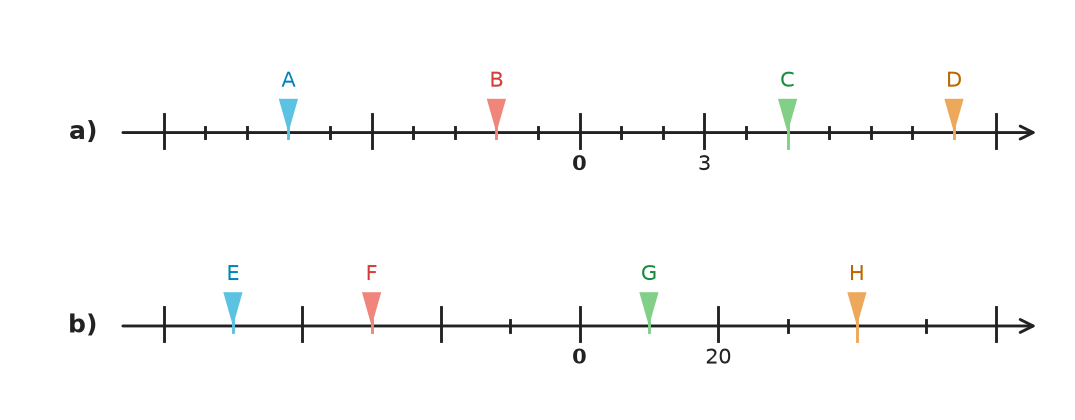
Figure for problem 535402

Hints

- Count the equal intervals between the given labeled values. - Determine the value of one tick interval on each number line. - Values to the left of zero are negative. - The farther left a value lies, the less it is.

Solution

1. On number line a), there are \(3\) intervals from \(0\) to \(3\), so each interval represents \(1\). Therefore, \(A=-7\), \(B=-2\), \(C=5\), and \(D=9\). 2. On number line b), there are \(2\) intervals from \(0\) to \(20\), so each interval represents \(10\). Therefore, \(E=-50\), \(F=-30\), \(G=10\), and \(H=40\). 3. The least coordinate is \(-50\), so point \(E\) has the least coordinate.

Answer

a) \(A=-7\), \(B=-2\), \(C=5\), \(D=9\) b) \(E=-50\), \(F=-30\), \(G=10\), \(H=40\) c) Point \(E\), with coordinate \(-50\)

5354036
Use the two number lines. a) What decimals are represented by points \(P\), \(Q\), and \(R\)? b) What numbers are represented by points \(S\), \(T\), and \(U\)? Give each value as a decimal or fraction. c) Which point in part b) represents the opposite of \(0.5\)?
Figure for problem 535403

Hints

- Determine the value of one small interval on each number line. - Values to the left of \(0\) are negative. - Opposite numbers have equal distance from \(0\) on different sides.

Solution

1. On number line a), each small interval represents \(0.2\). Therefore, \(P=-1.2\), \(Q=-0.6\), and \(R=0.8\). 2. On number line b), each small interval represents \(0.25=\frac{1}{4}\). Therefore, \(S=-1.75=-1\frac{3}{4}\), \(T=-0.5=-\frac{1}{2}\), and \(U=0.5=\frac{1}{2}\). 3. The opposite of \(0.5\) is \(-0.5\), which is point \(T\).

Answer

a) \(P=-1.2\), \(Q=-0.6\), \(R=0.8\) b) \(S=-1.75=-1\frac{3}{4}\), \(T=-0.5=-\frac{1}{2}\), \(U=0.5=\frac{1}{2}\) c) Point \(T\)
5411536
Point \(B\) is \(0.75\) unit to the right of \(A\). a) Find the coordinate of \(B\). b) List \(A\), \(B\), and \(C\) from left to right.
Figure for problem 541153

Hints

- Read the coordinates of \(A\) and \(C\) from the number line. - Convert \(0.75\) unit into a number of tick intervals. - Find \(B\) before ordering all three points.

Solution

1. Point \(A\) is at \(-0.5\), and each tick interval represents \(0.25\) unit. 2. A move of \(0.75\) unit is three tick intervals. Counting three intervals right from \(A\) gives \(-0.25,0,0.25\), so \(B=0.25\). 3. Point \(C\) is at \(-1.25\). Reading the number line from left to right gives \(C,A,B\).

Answer

a) \(B=0.25\) b) \(C, A, B\)
5411546
What number is marked by \(P\)? Write the answer as a decimal and as a fraction in simplest form.
Figure for problem 541154

Hints

- Use the labeled ticks to determine the value of one interval. - Count how many intervals separate \(A\) and \(P\). - Convert the final decimal to a fraction using place value, then simplify.

Solution

1. The labeled values show that each tick interval represents \(0.25=\frac{1}{4}\) unit. 2. Point \(P\) is six intervals to the right of \(A=-2.25\). Counting by fourths gives \(-2,-1.75,-1.5,-1.25,-1,-0.75\). 3. Therefore, \(P=-0.75=-\frac{3}{4}\).

Answer

\(-0.75=-\frac{3}{4}\)
5411556
Point \(S\) is \(\frac{4}{5}\) unit to the left of \(R\). Find the coordinate of \(S\).
Figure for problem 541155

Hints

- Use the number line to identify the direction of the movement. - Rewrite \(\frac{4}{5}\) in tenths to match the tick spacing. - Count the required number of intervals from \(R\), then simplify the final coordinate as a fraction.

Solution

1. Rewrite \(\frac{4}{5}\) as \(\frac{8}{10}\). On the displayed number line, that is eight tick intervals. 2. Point \(R\) is at \(0.3\). Counting eight intervals left gives \(0.2,0.1,0,-0.1,-0.2,-0.3,-0.4,-0.5\). 3. Thus, \(S=-0.5=-\frac{1}{2}\).

Answer

\(-\frac{1}{2}\)
5411566
Find the coordinate halfway between \(A\) and \(B\).
Figure for problem 541156

Hints

- Count the equal tick intervals between the endpoints. - A midpoint splits that count into two equal parts. - Count half the intervals from the left endpoint.

Solution

1. The tick spacing is \(\frac{1}{6}\) unit. From \(A=-\frac{5}{6}\) to \(B=\frac{1}{6}\) there are six equal intervals. 2. Halfway is three intervals from either endpoint. 3. Counting three intervals right from \(-\frac{5}{6}\) gives \(-\frac{4}{6},-\frac{3}{6},-\frac{2}{6}\). Therefore, the midpoint is \(-\frac{2}{6}=-\frac{1}{3}\).

Answer

\(-\frac{1}{3}\)
5411576
Use the number line. a) Find the value of one tick interval. b) Find the coordinate of \(K\).
Figure for problem 541157

Hints

- Use the two labeled values to find the total distance. - Count the equal intervals between those labels. - Count from a labeled value to \(K\) in the correct direction.

Solution

1. From \(-2.7\) to \(0.9\), the number line spans \(3.6\) units across nine equal tick intervals. 2. One interval therefore represents \(3.6\div9=0.4\) unit. 3. Point \(K\) is four intervals to the left of \(0.9\). Counting left by \(0.4\) gives \(0.5,0.1,-0.3,-0.7\). 4. Therefore, \(K=-0.7\).

Answer

a) \(0.4\) b) \(-0.7\)
5174226
On a number line drawing, \(1\,\text{cm}\) represents \(2\) units. A segment is \(6\,\text{cm}\) long, and \(-5\) is exactly at its midpoint. Find the two integers at the endpoints of the segment.

Hints

- Convert the physical length to number-line units first. - Each endpoint is the same distance from the midpoint. - Count the same number of units left and right from \(-5\).

Solution

1. A \(6\,\text{cm}\) segment represents \(6\times2=12\) number-line units. 2. Each endpoint is half of \(12\), or \(6\) units, from the midpoint. 3. Counting \(6\) units left from \(-5\) gives \(-11\). Counting \(6\) units right from \(-5\) gives \(1\).

Answer

The endpoints are \(-11\) and \(1\).
5353536
A scale has tick marks numbered from left to right, beginning with tick \(0\) at the far left. The labeled value \(2\) is at tick \(20\), and point \(A\) is at tick \(12\). For each possible value of point \(A\), determine the tick number where \(0\) must be located. a) \(A=0.4\) b) \(A=1.2\) c) \(A=-2\)
Figure for problem 535353

Hints

- Count the intervals between point \(A\) and the tick labeled \(2\). - For each case, divide the value difference by that number of intervals. - Use the interval value to determine how far and in which direction to move from \(A\) to \(0\).

Solution

1. There are \(8\) intervals from tick \(12\) to tick \(20\). 2. For a), the values from \(0.4\) to \(2\) span \(1.6\), so each interval is \(0.2\). Two intervals left of \(0.4\) reaches \(0\), so \(0\) is at tick \(10\). 3. For b), the values from \(1.2\) to \(2\) span \(0.8\), so each interval is \(0.1\). Twelve intervals left of \(1.2\) reaches \(0\), so \(0\) is at tick \(0\). 4. For c), moving from \(-2\) to \(2\) spans \(4\) units across the same \(8\) intervals, so each interval is \(0.5\). Four intervals right of \(-2\) reaches \(0\), so \(0\) is at tick \(16\).

Answer

a) Tick \(10\) b) Tick \(0\) c) Tick \(16\)
5411526
Point \(M\) is the midpoint of segment \(AB\). Find the coordinate of \(B\).
Figure for problem 541152

Hints

- Read the coordinates of \(A\) and \(M\) from the number line. - A midpoint is the same distance from both endpoints. - Count the same number of tick intervals from \(M\) in the direction away from \(A\).

Solution

1. On the number line, there are six equal tick intervals from \(A=-2.4\) to \(M=-0.6\). 2. Because \(M\) is the midpoint, point \(B\) must be six equal tick intervals to the right of \(M\). 3. Counting six intervals right from \(-0.6\) gives \(-0.3,0,0.3,0.6,0.9,1.2\). Therefore, \(B=1.2\).

Answer

\(B=1.2\)

All problems may be used, copied and printed free of charge for school and tutoring, including paid tutoring. Commercial adaptations as well as publication or redistribution on the internet are not permitted.