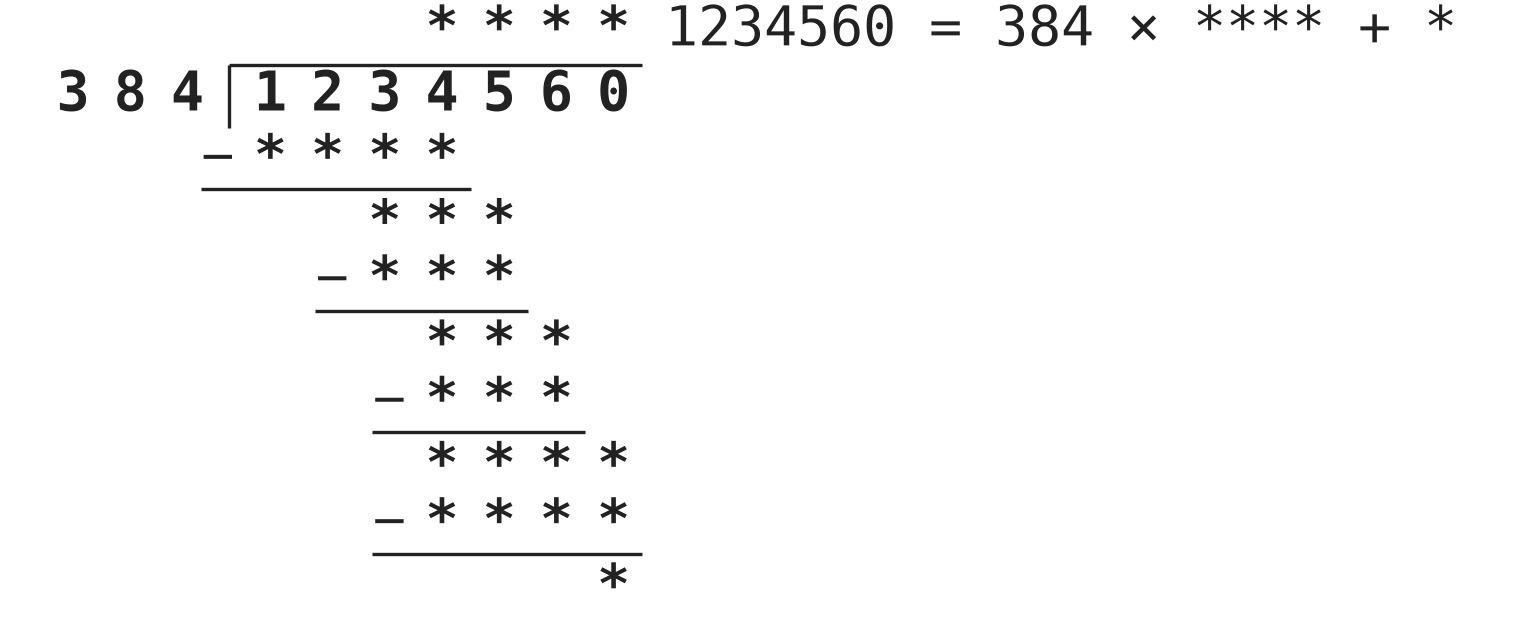
Complete the hidden work in the written division for \(1{,}234{,}560\div384\).
Give the quotient, the four subtrahends in order, the three later partial dividends after bringing down the next digit, and the remainder. Then verify the quotient by multiplication.
Hints
- For each quotient place, estimate how many groups of \(384\) fit in the current partial dividend.
- Multiply \(384\) by that quotient digit to fill the hidden subtrahend, subtract, and then bring down the next dividend digit.
- Use the multiplication check only after you have completed the hidden long-division rows.
Solution
1. The first usable partial dividend is \(1234\). Since \(3\times384=1152\) and \(4\times384>1234\), the first quotient digit is \(3\). Subtracting gives \(82\), then bringing down \(5\) gives \(825\).
2. Since \(2\times384=768\), the next quotient digit is \(2\). Subtracting gives \(57\), then bringing down \(6\) gives \(576\).
3. Since \(1\times384=384\), the next quotient digit is \(1\). Subtracting gives \(192\), then bringing down \(0\) gives \(1920\).
4. Since \(5\times384=1920\), the final quotient digit is \(5\), leaving remainder \(0\).
5. Therefore, the quotient is \(3215\). Check: \(3215\times384=1{,}234{,}560\).
Answer
Quotient: \(3215\)
Subtrahends: \(1152,768,384,1920\)
Later partial dividends: \(825,576,1920\)
Remainder: \(0\)