Aimathic
Login | English | Deutsch

Free math worksheets

Build your own math worksheets from 30,000+ problems for grades 3 to 12, from fractions to AP Calculus. Every problem comes with step-by-step solutions.

Scale drawings

Click problems to add them to your worksheet.

5164357
A small kitchen table is actually \(150\,\text{cm}\) long. In a scale drawing, it is \(15\,\text{cm}\) long. What scale was used?

Hints

- Compare the actual length with the drawing length. - Determine how many times the drawing length fits into the actual length. - Write the drawing-to-actual relationship as a scale.

Solution

1. Compare the actual length with the drawing length: \(150\,\text{cm} \div 15\,\text{cm} = 10\). 2. The actual table is \(10\) times as long as the drawing, so the scale is \(1{:}10\).

Answer

\(1{:}10\)
5519427
On a scale drawing, a wall segment that is \(2.5\,\text{inches}\) long represents an actual wall that is \(15\,\text{feet}\) long. State the scale in the form “\(1\,\text{inch}\) represents ___ feet,” and explain how you determined it.

Hints

- Compare the actual length with the corresponding drawing length. - The requested scale asks for the actual number of feet corresponding to one drawing inch. - Find the unit rate in feet per drawing inch.

Solution

1. Divide the actual length by the drawing length: \(15\div2.5=6\). 2. Therefore, each \(1\,\text{inch}\) on the drawing represents \(6\,\text{feet}\) in the actual room.

Answer

\(1\,\text{inch}\) represents \(6\,\text{feet}\).
5545427
A floor plan for Cedar Grove Library uses the scale \(1\,\text{inch}\) represents \(5\,\text{feet}\). A wall measures \(3.5\,\text{inches}\) on the plan. How long is the actual wall?

Hints

- Decide whether the actual wall should be longer or shorter than its drawing length. - Use the number of actual feet represented by each drawing inch. - Apply the scale to the \(3.5\)-inch drawing length.

Solution

1. Each drawing inch represents \(5\,\text{ft}\). 2. Compute \(3.5\cdot5=17.5\).

Answer

The actual wall is \(17.5\,\text{ft}\) long.
5545437
A trail map uses the scale \(1\,\text{cm}\) represents \(4\,\text{km}\). A trail segment is actually \(18\,\text{km}\) long. How long should that segment be on the map?

Hints

- This time the actual length is known and the drawing length is unknown. - Ask how many groups of \(4\,\text{km}\) fit into \(18\,\text{km}\). - The answer should be a length on the map, measured in centimeters.

Solution

1. Each \(1\,\text{cm}\) on the map represents \(4\,\text{km}\) in reality. 2. Compute \(18\div4=4.5\).

Answer

The segment should be \(4.5\,\text{cm}\) long on the map.
5108617
A photograph shows an ant at \(12\) times its actual size. The ant measures \(5.4\,\text{cm}\) in the photograph. What is the ant's actual length in millimeters?

Hints

- A magnification of \(12\) means the image length is \(12\) times the actual length. - Decide whether the actual ant should be longer or shorter than the image. - Convert centimeters to millimeters after finding the actual length.

Solution

1. Divide the image length by the scale factor: \(5.4\div12=0.45\,\text{cm}\). 2. Convert centimeters to millimeters: \(0.45\,\text{cm}=4.5\,\text{mm}\).

Answer

The ant is \(4.5\,\text{mm}\) long.
5108627
A microorganism is actually \(0.25\,\text{mm}\) long. a) How long does it appear under \(40\)-times magnification? Give the answer in centimeters. b) Arjun wants the image to be exactly \(2\,\text{cm}\) long. What magnification factor is needed?

Hints

- Relate actual length, image length, and magnification factor. - Use the same length unit before forming a scale factor. - For part b), compare the desired image length with the actual length.

Solution

1. For a), multiply the actual length by the scale factor: \(0.25\cdot40=10\,\text{mm}\). 2. Convert \(10\,\text{mm}\) to \(1\,\text{cm}\). 3. For b), convert the desired image length: \(2\,\text{cm}=20\,\text{mm}\). 4. Divide image length by actual length: \(20\div0.25=80\).

Answer

a) \(1\,\text{cm}\) b) \(80\)-times magnification
5108637
A technical part is only \(0.08\,\text{mm}\) thick. In a design drawing, it is shown as \(4\,\text{mm}\) thick. a) Find the scale factor of the drawing. b) A second part is \(0.12\,\text{mm}\) thick. How thick will it appear in the same drawing? c) If the first part is enlarged by a factor of \(1000\), how thick will it appear in centimeters?

Hints

- Compare the drawn thickness with the actual thickness to find the scale factor. - Apply the same scale factor to the second part. - Convert millimeters to centimeters after applying the factor in part c).

Solution

1. For a), divide drawing thickness by actual thickness: \(4\div0.08=50\). The scale factor is \(50\). 2. For b), apply the same factor: \(0.12\cdot50=6\,\text{mm}\). 3. For c), \(0.08\cdot1000=80\,\text{mm}=8\,\text{cm}\).

Answer

a) \(50\) b) \(6\,\text{mm}\) c) \(8\,\text{cm}\)
5208017
Three maps of a city use these scales: Map A: \(1:2000\) Map B: \(1:25{,}000\) Map C: \(1:250{,}000\) a) On which map does \(1\,\text{cm}\) represent the greatest actual distance? b) Which map is best for seeing details such as individual buildings and street names? Explain. c) How many meters does \(1\,\text{cm}\) represent on Map B?

Hints

- Compare the numbers after the colon. - A larger scale denominator means a larger actual area is compressed onto the map. - Convert centimeters to meters for c).

Solution

1. A larger denominator means a greater reduction. Therefore, \(1\,\text{cm}\) represents the greatest actual distance on Map C. 2. A smaller denominator shows objects at a larger size and with more detail. Therefore, Map A is best for individual buildings and street names. 3. On Map B, \(1\,\text{cm}\) represents \(25{,}000\,\text{cm}\). Convert to meters: \(25{,}000\div 100=250\,\text{m}\).

Answer

a) Map C b) Map A, because it has the least reduction and shows the most detail. c) \(250\,\text{m}\)
5208067
A school campus is \(200\,\text{m}\) long. It will be drawn using two scales. Drawing A uses \(1:1000\). Drawing B uses \(1:2500\). a) Find the campus length in each drawing, in centimeters. b) Which drawing shows the campus as a smaller image? Explain without doing another calculation.

Hints

- Convert the actual length to centimeters. - Divide by each scale denominator. - A larger denominator creates a smaller drawing.

Solution

1. Convert the actual length: \(200\,\text{m}=20{,}000\,\text{cm}\). 2. Drawing A has length \(20{,}000\div 1000=20\,\text{cm}\). 3. Drawing B has length \(20{,}000\div 2500=8\,\text{cm}\). 4. Drawing B is smaller because a larger scale denominator means a greater reduction.

Answer

a) Drawing A: \(20\,\text{cm}\) Drawing B: \(8\,\text{cm}\) b) Drawing B, because \(1:2500\) reduces the actual length more than \(1:1000\).
5502177
The figure is a scale drawing of a rectangular reading nook. The scale is \(1\,\text{inch}\) in the drawing for every \(2.5\,\text{feet}\) in the actual room. a) Find the actual length and width. b) Find the actual floor area.
Figure for problem 550217

Hints

- Use the labeled drawing dimensions rather than measuring the image. - Apply the same scale relationship to each length. - Find the actual area only after converting both dimensions to actual lengths.

Solution

1. The drawing measures \(4\,\text{in}\times3\,\text{in}\). 2. The actual dimensions are \(4\cdot2.5=10\,\text{ft}\) and \(3\cdot2.5=7.5\,\text{ft}\). 3. The actual floor area is \(10\cdot7.5=75\,\text{ft}^2\).

Answer

a) \(10\,\text{ft}\times7.5\,\text{ft}\) b) \(75\,\text{ft}^2\)
5502187
Each grid step represents \(1\,\text{drawing unit}\). Figure a) is the original drawing. Which of figures b) or c) is a scale copy of figure a)? Give the scale factor from a) to the matching figure and explain your choice.
Figure for problem 550218

Hints

- Compare corresponding horizontal and vertical lengths between the figures. - A scale copy must use one common multiplier for every corresponding length. - Test more than one pair of corresponding lengths before deciding.

Solution

1. In figure a), the base is \(2\,\text{units}\) and the height is \(2\,\text{units}\). 2. In figure b), the corresponding base and height are \(4\,\text{units}\) and \(4\,\text{units}\), so both are multiplied by \(2\). 3. In figure c), the base is multiplied by \(2\) but the height is only \(3\,\text{units}\), so the same scale factor is not used for all corresponding lengths. 4. Therefore figure b) is the scale copy with scale factor \(2\).

Answer

Figure b) is the scale copy of figure a), with scale factor \(2\).
5502207
The figure is a \(1{:}6\) scale drawing of a rectangular sign. A second drawing of the same sign will use a \(1{:}4\) scale. a) What dimensions should the second drawing have? b) By what factor are the side lengths in the second drawing larger than the corresponding side lengths in the first drawing?
Figure for problem 550220

Hints

- Use the first scale to determine the actual dimensions represented by the figure. - Then apply the new scale to those same actual dimensions. - Compare corresponding side lengths from the two drawings to find the enlargement factor.

Solution

1. The first drawing measures \(6\,\text{in}\times4\,\text{in}\), so the actual sign measures \(36\,\text{in}\times24\,\text{in}\). 2. At a \(1{:}4\) scale, the second drawing measures \(36 \div 4=9\,\text{in}\) by \(24 \div 4=6\,\text{in}\). 3. The side-length factor from the first drawing to the second is \(9 \div 6=1.5\), which also matches \(6 \div 4=1.5\).

Answer

a) \(9\,\text{in}\times6\,\text{in}\) b) The side lengths are multiplied by \(1.5\).
5545397
The geoboard shows a scale drawing of a banner shape. Treat the lower-left vertex of the shown polygon as \((0,0)\). One peg spacing is \(1\) unit, positive x is to the right, and positive y is upward. A second drawing must reproduce the same shape at a scale factor of \(2\), with its corresponding lower-left vertex also at \((0,0)\). a) Starting at the lower-left vertex and moving counterclockwise, list the coordinates of the vertices in the shown drawing. b) List the coordinates of the corresponding vertices in the second drawing. c) Explain how the scale factor changes every side length.
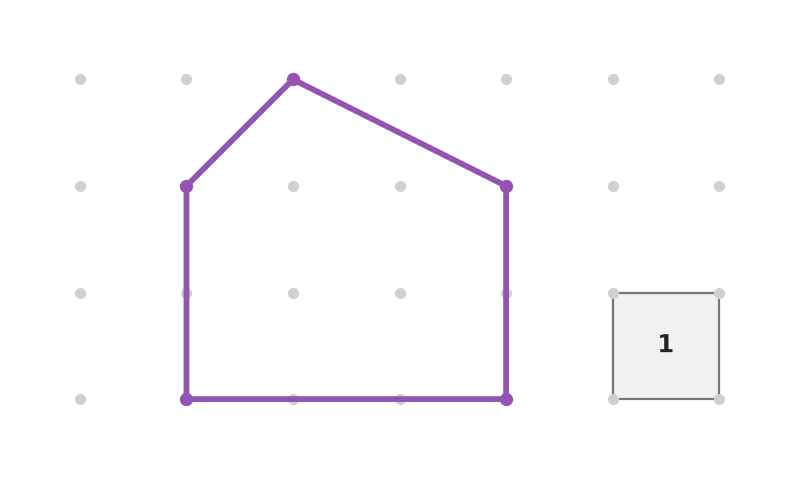
Figure for problem 554539

Hints

- Use peg spacings, not physical measurements of the displayed image. - Record each vertex relative to the stated lower-left origin before changing the scale. - A scale factor changes coordinate displacements from the origin by the same multiplicative factor.

Solution

1. Counting peg spacings from the lower-left vertex, the shown vertices are \((0,0)\), \((3,0)\), \((3,2)\), \((1,3)\), and \((0,2)\). 2. A scale factor of \(2\) doubles each coordinate measured from the common origin. 3. The second drawing therefore has vertices \((0,0)\), \((6,0)\), \((6,4)\), \((2,6)\), and \((0,4)\). 4. Because every coordinate displacement is doubled, every side length is doubled and the shape is reproduced at the required scale.

Answer

a) \((0,0)\), \((3,0)\), \((3,2)\), \((1,3)\), \((0,2)\) b) \((0,0)\), \((6,0)\), \((6,4)\), \((2,6)\), \((0,4)\) c) Every side length is multiplied by \(2\).

5502197
The figure is a scale drawing of an L-shaped room. The scale is \(1\,\text{inch}\) in the drawing for every \(4\,\text{feet}\) in the actual room. Find the actual floor area of the room.
Figure for problem 550219

Hints

- Break the L-shape into a larger rectangle and a missing rectangle. - First determine the area represented on the drawing from the labeled dimensions. - Remember that changing every length by a scale factor changes area by more than that same factor.

Solution

1. View the drawing as a \(5\,\text{in}\times4\,\text{in}\) rectangle with a \(3\,\text{in}\times2\,\text{in}\) rectangle missing. 2. The drawing area is \(5\cdot4-3\cdot2=14\,\text{in}^2\). 3. Each drawing length is multiplied by \(4\), so area is multiplied by \(4^2=16\). 4. The actual area is \(14\cdot16=224\,\text{ft}^2\).

Answer

The actual floor area is \(224\,\text{ft}^2\).

All problems may be used, copied and printed free of charge for school and tutoring, including paid tutoring. Commercial adaptations as well as publication or redistribution on the internet are not permitted.