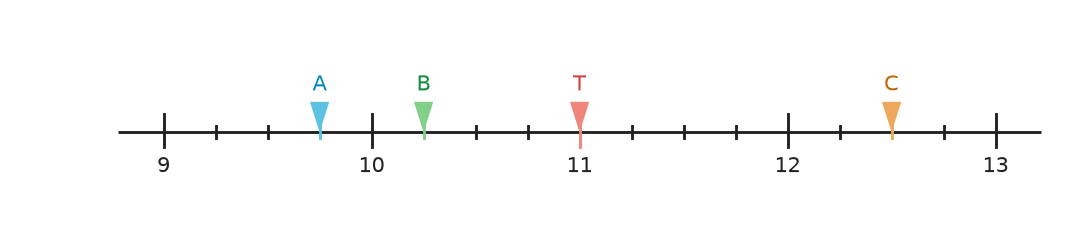
The number line shows a target \(T\) and three machine readings \(A\), \(B\), and \(C\). A reading is acceptable when its distance from the target is at most \(1.25\) units.
a) Read the values of \(T\), \(A\), \(B\), and \(C\).
b) For each reading, compute its absolute difference from \(T\) and decide whether it is acceptable.
c) The target is recalibrated \(0.5\) unit to the right. The three readings do not move. Determine which readings are now acceptable, and explain which acceptance decisions change.
Hints
- Read each marked value by using the quarter-unit tick spacing.
- The distance from a reading to the target can be represented by the absolute value of their difference.
- “At most” includes a distance equal to the stated tolerance.
- For the recalibrated case, change only the target value; keep the three reading values fixed.
Solution
1. The number line shows \(T=11\), \(A=9.75\), \(B=10.25\), and \(C=12.5\).
2. For \(A\), \(|9.75-11|=1.25\), so \(A\) is acceptable. For \(B\), \(|10.25-11|=0.75\), so \(B\) is acceptable. For \(C\), \(|12.5-11|=1.5\), so \(C\) is not acceptable.
3. Moving the target \(0.5\) unit right gives a new target of \(11.5\). Then \(|9.75-11.5|=1.75\), so \(A\) is not acceptable; \(|10.25-11.5|=1.25\), so \(B\) is acceptable; and \(|12.5-11.5|=1\), so \(C\) is acceptable.
4. The status of \(A\) changes from acceptable to not acceptable, the status of \(C\) changes from not acceptable to acceptable, and \(B\) remains acceptable.
Answer
a) \(T=11\), \(A=9.75\), \(B=10.25\), \(C=12.5\)
b) \(A\): distance \(1.25\), acceptable; \(B\): distance \(0.75\), acceptable; \(C\): distance \(1.5\), not acceptable.
c) New target: \(11.5\). \(A\): distance \(1.75\), not acceptable; \(B\): distance \(1.25\), acceptable; \(C\): distance \(1\), acceptable. \(A\) and \(C\) change status; \(B\) does not.