Aimathic
Login | English | Deutsch

Free math worksheets

Build your own math worksheets from 30,000+ problems for grades 3 to 12, from fractions to AP Calculus. Every problem comes with step-by-step solutions.

Subtract unlike denominators

Click problems to add them to your worksheet.

5100515
\(\frac{5}{27} - \frac{1}{6} =\)

Hints

- How can you subtract fractions with different denominators? - What is the smallest number that is a multiple of both \(27\) and \(6\)? - When you make an equivalent fraction, multiply the numerator and denominator by the same number.

Solution

1. Find a common denominator. The least common multiple of \(27\) and \(6\) is \(54\). 2. Rewrite the fractions: \(\frac{5}{27} = \frac{10}{54}\) and \(\frac{1}{6} = \frac{9}{54}\). 3. Subtract: \(\frac{10}{54} - \frac{9}{54} = \frac{1}{54}\).

Answer

\(\frac{1}{54}\)
5111025
Describe the steps needed to calculate \(\frac{5}{6}-\frac{1}{4}\). Explain how the least common denominator and equivalent fractions are used, and give the final answer.

Hints

- What is the smallest common multiple of \(6\) and \(4\)? - How can you rewrite a fraction without changing its value? - Once the denominators match, which parts of the fractions are subtracted?

Solution

1. Find the least common denominator of \(6\) and \(4\), which is \(12\). 2. Rewrite the fractions as equivalent fractions with denominator \(12\): \(\frac{5}{6}=\frac{10}{12}\) and \(\frac{1}{4}=\frac{3}{12}\). 3. Subtract the numerators: \(\frac{10}{12}-\frac{3}{12}=\frac{7}{12}\).

Answer

Use the least common denominator \(12\), rewrite the fractions as \(\frac{10}{12}\) and \(\frac{3}{12}\), and subtract. The result is \(\frac{7}{12}\).
5142665
Subtract and write each result in simplest form. a) \(\frac{3}{4}-\frac{1}{6}\) b) \(\frac{7}{5}-\frac{2}{3}\) c) \(2-\frac{5}{8}\)

Hints

- Find a common denominator before subtracting fractions with different denominators. - Rewrite whole numbers as fractions when needed. - Simplify each final answer.

Solution

1. For a), use denominator \(12\): \(\frac{3}{4}-\frac{1}{6}=\frac{9}{12}-\frac{2}{12}=\frac{7}{12}\). 2. For b), use denominator \(15\): \(\frac{7}{5}-\frac{2}{3}=\frac{21}{15}-\frac{10}{15}=\frac{11}{15}\). 3. For c), rewrite \(2\) as \(\frac{16}{8}\): \(\frac{16}{8}-\frac{5}{8}=\frac{11}{8}\).

Answer

a) \(\frac{7}{12}\) b) \(\frac{11}{15}\) c) \(\frac{11}{8}\)
5409315
Bar a) represents how full a tank is. Bar b) represents the amount of a full tank that is used. What fraction of the full tank remains?
Figure for problem 540931

Hints

- Both bars represent fractions of the same full tank. - Rewrite fifteenths and twentieths as equal-sized parts. - Subtract the amount used from the amount initially in the tank.

Solution

1. Subtract the fraction used from the fraction initially in the tank: \(\frac{13}{15}-\frac{7}{20}\). 2. The least common denominator is \(60\). 3. Rewrite: \(\frac{13}{15}=\frac{52}{60}\) and \(\frac{7}{20}=\frac{21}{60}\). 4. Subtract: \(\frac{52}{60}-\frac{21}{60}=\frac{31}{60}\).

Answer

\(\frac{31}{60}\) of the full tank remains.
5409445
Find \(\frac{5}{6}-\frac{7}{15}\) and write the answer in simplest form.

Hints

- Think about a denominator that can represent both fractions exactly. - Rewrite each fraction without changing its value. - After subtracting, check whether the result is already in simplest form.

Solution

1. Use denominator \(30\): \(\frac{5}{6}=\frac{25}{30}\) and \(\frac{7}{15}=\frac{14}{30}\). 2. Subtract: \(\frac{25}{30}-\frac{14}{30}=\frac{11}{30}\).

Answer

\(\frac{11}{30}\)
5409555
Find \(3\frac{1}{4}-1\frac{5}{6}\). Write the difference as a mixed number.

Hints

- Converting to improper fractions can handle the needed regrouping automatically. - Use a common denominator before subtracting. - Convert the improper result back to a mixed number.

Solution

1. Rewrite the mixed numbers as improper fractions: \(3\frac{1}{4}=\frac{13}{4}\) and \(1\frac{5}{6}=\frac{11}{6}\). 2. Use denominator \(12\): \(\frac{39}{12}-\frac{22}{12}=\frac{17}{12}\). 3. \(\frac{17}{12}=1\frac{5}{12}\).

Answer

\(1\frac{5}{12}\)
5410125
Find \(6\frac{1}{3}-2\frac{7}{12}\). Write the difference as a mixed number in simplest form.

Hints

- Rewrite the fractional parts with a common denominator. - Check whether the fractional part of the first mixed number is large enough to subtract the second fractional part. - Regroup one whole if needed, then simplify the final fraction.

Solution

1. Rewrite the fractional parts with denominator \(12\): \(\frac{1}{3}=\frac{4}{12}\). 2. Since \(\frac{4}{12}<\frac{7}{12}\), regroup \(6\frac{4}{12}=5\frac{16}{12}\). 3. Subtract: \(5\frac{16}{12}-2\frac{7}{12}=3\frac{9}{12}\). 4. Simplify \(\frac{9}{12}=\frac{3}{4}\), giving \(3\frac{3}{4}\).

Answer

\(3\frac{3}{4}\).
5410555
Find \(2\frac{5}{9}-1\frac{7}{12}\). Write the difference in simplest form.

Hints

- Find a common denominator for ninths and twelfths. - Compare the fractional parts after rewriting them. - Regroup one whole if the first fractional part is too small to subtract the second.

Solution

1. Rewrite the fractional parts with denominator \(36\): \(\frac{5}{9}=\frac{20}{36}\) and \(\frac{7}{12}=\frac{21}{36}\). 2. Since \(\frac{20}{36}<\frac{21}{36}\), regroup \(2\frac{20}{36}=1\frac{56}{36}\). 3. Subtract: \(1\frac{56}{36}-1\frac{21}{36}=\frac{35}{36}\). 4. The result is already in simplest form.

Answer

\(\frac{35}{36}\).
5544375
Panels a) and b) show the two fractions in a subtraction. Panels c) and d) are fourths-bar candidates for renaming the amount in panel b). Exactly one candidate has the same shaded length as panel b). a) Read the two original fractions. b) Which candidate, c) or d), preserves the shaded amount in panel b)? State the equivalent fraction and explain what happened to each half when the bar was repartitioned into fourths. c) Use the common-unit form to find the difference.
Figure for problem 554437

Hints

- Compare the total shaded length, not just the number of shaded pieces. - Ask how many fourths occupy the same length as one half. - Subtract only after both amounts are expressed in fourths.

Solution

1. Panel a) shows \(\frac{3}{4}\), and panel b) shows \(\frac{1}{2}\). 2. Panel d) has the same shaded length as panel b). Repartitioning each half into \(2\) equal pieces makes \(4\) equal parts altogether, so \(\frac{1}{2}=\frac{2}{4}\). 3. Therefore \(\frac{3}{4}-\frac{2}{4}=\frac{1}{4}\).

Answer

a) \(\frac{3}{4}\) and \(\frac{1}{2}\) b) d), because \(\frac{1}{2}=\frac{2}{4}\); each half is split into two fourths. c) \(\frac{1}{4}\)
5544385
Panels a) and b) show the two fractions in a subtraction. Panels c) through f) all use the same \(6\times4\) common grid. Panels c) and d) are candidates for panel a); panels e) and f) are candidates for panel b). a) Read the original fractions. b) Select the matching common-grid model from each pair. For each selected grid, describe the complete rows or columns that preserve the original fraction. c) State both equivalent fractions in twenty-fourths and find the difference in simplest form.
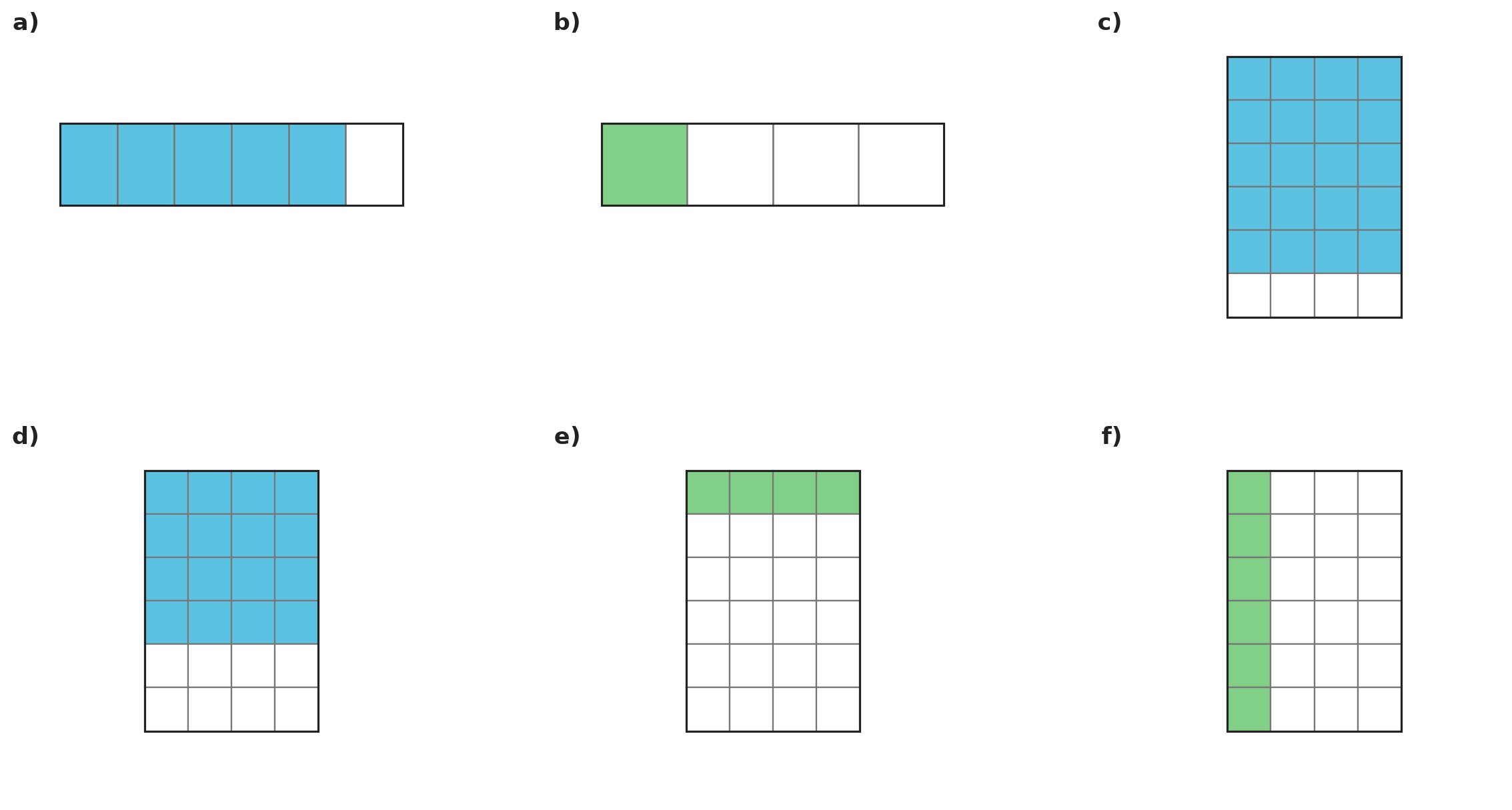
Figure for problem 554438

Hints

- A \(6\times4\) grid can show sixths with full rows and fourths with full columns. - Inspect which candidates preserve the same portion of the whole as each original bar. - Use the \(24\) equal cells as the common unit before subtracting.

Solution

1. Panel a) shows \(\frac{5}{6}\), and panel b) shows \(\frac{1}{4}\). 2. Panel c) shades \(5\) full rows out of \(6\), so it represents \(\frac{5}{6}=\frac{20}{24}\). Panel f) shades \(1\) full column out of \(4\), so it represents \(\frac{1}{4}=\frac{6}{24}\). 3. The difference is \(\frac{20}{24}-\frac{6}{24}=\frac{14}{24}=\frac{7}{12}\).

Answer

a) \(\frac{5}{6}\) and \(\frac{1}{4}\) b) c) matches panel a) because it shades \(5\) of \(6\) full rows. f) matches panel b) because it shades \(1\) of \(4\) full columns. c) \(\frac{5}{6}=\frac{20}{24}\), \(\frac{1}{4}=\frac{6}{24}\), and the difference is \(\frac{7}{12}\).

5106445
Calculate \(5 \frac{1}{6}-2 \frac{3}{4}\) in two ways. a) First rewrite both mixed numbers as improper fractions, then subtract. b) Subtract the whole-number and fractional parts by regrouping one whole from the first mixed number as \(\frac{6}{6}\). Use a common denominator for the fractional parts. Compare the two methods. Which method seems less likely to lead to an error for you?

Hints

- After rewriting the mixed numbers as improper fractions, find a common denominator. - In part b), what can you do when the first fractional part is smaller than the second? - Compare the number and type of steps in the two methods.

Solution

1. For a), rewrite the mixed numbers: \(5 \frac{1}{6}=\frac{31}{6}\) and \(2 \frac{3}{4}=\frac{11}{4}\). 2. Use denominator \(12\): \(\frac{31}{6}-\frac{11}{4}=\frac{62}{12}-\frac{33}{12}=\frac{29}{12}=2 \frac{5}{12}\). 3. For b), regroup \(5 \frac{1}{6}\) as \(4 \frac{7}{6}\). 4. Use denominator \(12\) for the fractional parts: \(4 \frac{14}{12}-2 \frac{9}{12}=2 \frac{5}{12}\). Both methods give the same result; the preferred method can depend on which steps you find easier to track accurately.

Answer

a) \(2 \frac{5}{12}\) b) \(2 \frac{5}{12}\) Both methods are correct. Which one is less error-prone depends on the student's reasoning and organization.
5114405
Given \(\frac{1}{5}=\frac{1}{6}+\frac{1}{x}\), find the positive whole number \(x\). Verify the equation using a common denominator.

Hints

- Subtract \(\frac{1}{6}\) from both sides. - Find a common denominator for \(\frac{1}{5}\) and \(\frac{1}{6}\). - Match the resulting unit fraction to \(\frac{1}{x}\).

Solution

1. Isolate the unknown fraction: \(\frac{1}{x}=\frac{1}{5}-\frac{1}{6}\). 2. Subtract using denominator \(30\): \(\frac{1}{5}-\frac{1}{6}=\frac{6}{30}-\frac{5}{30}=\frac{1}{30}\). Therefore, \(x=30\). 3. Check: \(\frac{1}{6}+\frac{1}{30}=\frac{5}{30}+\frac{1}{30}=\frac{6}{30}=\frac{1}{5}\).

Answer

\(x=30\)
5142675
Compare the results of calculations \(A\) and \(B\). Which result is greater? \(A=\frac{5}{2}-\frac{3}{4}\) \(B=\frac{11}{6}-\frac{1}{3}\)

Hints

- Calculate each difference separately. - Then rewrite the two results in a form that makes them easy to compare.

Solution

1. Calculate \(A\): \(\frac{5}{2}-\frac{3}{4}=\frac{10}{4}-\frac{3}{4}=\frac{7}{4}\). 2. Calculate \(B\): \(\frac{11}{6}-\frac{1}{3}=\frac{11}{6}-\frac{2}{6}=\frac{9}{6}=\frac{3}{2}\). 3. Rewrite \(\frac{3}{2}\) as \(\frac{6}{4}\). Since \(\frac{7}{4}>\frac{6}{4}\), \(A>B\).

Answer

\(A>B\), because \(\frac{7}{4}>\frac{3}{2}\).
5408555
A number satisfies \(\frac{7}{9}-x=\frac{5}{12}\). Find \(x\) and check your answer in the original equation.

Hints

- Think about what quantity must be removed from the first fraction to leave the second. - Rewrite the two known fractions using equal-sized parts. - Check the missing value by placing it back into the original equation.

Solution

1. Rearrange the relationship as \(x=\frac{7}{9}-\frac{5}{12}\). 2. Use denominator \(36\): \(\frac{28}{36}-\frac{15}{36}=\frac{13}{36}\). 3. Substituting \(\frac{13}{36}\) gives \(\frac{28}{36}-\frac{13}{36}=\frac{15}{36}=\frac{5}{12}\).

Answer

\(x=\frac{13}{36}\).
5408655
Find \(\frac{11}{12}-\frac{5}{18}\). Then decide whether the difference is greater than or less than \(\frac{2}{3}\).

Hints

- Rewrite both fractions so their parts are the same size. - After subtracting, compare the result with an equivalent form of the benchmark fraction.

Solution

1. Use denominator \(36\): \(\frac{11}{12}=\frac{33}{36}\) and \(\frac{5}{18}=\frac{10}{36}\). 2. Subtract: \(\frac{33}{36}-\frac{10}{36}=\frac{23}{36}\). 3. Since \(\frac{2}{3}=\frac{24}{36}\), the difference is less than \(\frac{2}{3}\).

Answer

The difference is \(\frac{23}{36}\), which is less than \(\frac{2}{3}\).
5408745
Which difference is greater: \(\frac{5}{6}-\frac{1}{5}\) or \(\frac{5}{6}-\frac{1}{4}\)? First explain without calculating, then find both exact differences to check.

Hints

- When the starting value is the same, compare how much is being taken away. - Then use common denominators to verify the exact differences.

Solution

1. Both expressions start with \(\frac{5}{6}\). Subtracting \(\frac{1}{5}\) removes less than subtracting \(\frac{1}{4}\), so the first difference is greater. 2. \(\frac{5}{6}-\frac{1}{5}=\frac{25}{30}-\frac{6}{30}=\frac{19}{30}\). 3. \(\frac{5}{6}-\frac{1}{4}=\frac{10}{12}-\frac{3}{12}=\frac{7}{12}\), and \(\frac{19}{30}>\frac{7}{12}\).

Answer

\(\frac{5}{6}-\frac{1}{5}\) is greater; the differences are \(\frac{19}{30}\) and \(\frac{7}{12}\).
5408875
Lucía writes \(\frac{3}{4}-\frac{1}{6}=\frac{2}{-2}\). Explain her error and find the correct difference.

Hints

- Check whether the original fractional parts have the same size. - Think about what must be true of the denominators before the numerators can be subtracted. - After renaming the fractions, compare your result with the size of the original fractions.

Solution

1. Lucía subtracted the numerators and denominators separately, but fourths and sixths are different-sized parts, so they must first be renamed with a common denominator. 2. Rewrite with denominator \(12\): \(\frac{3}{4}=\frac{9}{12}\) and \(\frac{1}{6}=\frac{2}{12}\). 3. Subtract: \(\frac{9}{12}-\frac{2}{12}=\frac{7}{12}\).

Answer

Lucía subtracted the numerators and denominators separately even though the fractions name different-sized parts. After using a common denominator, the correct difference is \(\frac{7}{12}\).
5409005
A board is \(4\frac{5}{6}\,\text{ft}\) long. A piece measuring \(2\frac{3}{10}\,\text{ft}\) is cut from it. How much of the board remains? Write the length as a mixed number in simplest form.

Hints

- Subtract the cut length from the original board length. - Rewrite the fractional parts using equal-sized pieces. - Simplify the fractional part and keep the length unit.

Solution

1. Subtract the cut length from the original length: \(4\frac{5}{6}-2\frac{3}{10}\). 2. Use denominator \(30\): \(\frac{5}{6}=\frac{25}{30}\) and \(\frac{3}{10}=\frac{9}{30}\). 3. Subtract: \(4\frac{25}{30}-2\frac{9}{30}=2\frac{16}{30}=2\frac{8}{15}\).

Answer

\(2\frac{8}{15}\,\text{ft}\) of the board remains.
5409105
Compare \(A=1-\frac{5}{12}\) and \(B=\frac{7}{8}-\frac{1}{3}\). Find both differences and state which is greater and by how much.

Hints

- Rewrite the whole number as a fraction for the first difference. - Use a common denominator for the second difference. - Compare the two results using the same denominator.

Solution

1. \(A=\frac{12}{12}-\frac{5}{12}=\frac{7}{12}=\frac{14}{24}\). 2. \(B=\frac{21}{24}-\frac{8}{24}=\frac{13}{24}\). 3. \(A-B=\frac{14}{24}-\frac{13}{24}=\frac{1}{24}\).

Answer

\(A\) is greater than \(B\) by \(\frac{1}{24}\).
5409215
Find the mixed number \(x\) that makes \(x+\frac{7}{8}=2\frac{1}{5}\) true. Explain how subtraction gives the missing addend.

Hints

- Think about which operation undoes adding the known fraction. - Rewrite the quantities with a common denominator before subtracting. - Check your result by adding it to the known addend.

Solution

1. The missing addend is \(x=2\frac{1}{5}-\frac{7}{8}\). 2. Rewrite \(2\frac{1}{5}=\frac{11}{5}=\frac{88}{40}\) and \(\frac{7}{8}=\frac{35}{40}\). 3. Subtract: \(x=\frac{88}{40}-\frac{35}{40}=\frac{53}{40}=1\frac{13}{40}\).

Answer

\(x=1\frac{13}{40}\)
5409585
A student estimates that \(1\frac{1}{6}-\frac{5}{8}\) is a little more than \(\frac{1}{2}\). Find the exact difference and decide whether the estimate is reasonable.

Hints

- Think about a common denominator that works for sixths and eighths. - Compare the exact difference with a familiar benchmark fraction after you subtract.

Solution

1. Rewrite \(1\frac{1}{6}=\frac{7}{6}\). 2. Use denominator \(24\): \(\frac{7}{6}=\frac{28}{24}\) and \(\frac{5}{8}=\frac{15}{24}\). 3. Subtract: \(\frac{28}{24}-\frac{15}{24}=\frac{13}{24}\). 4. Since \(\frac{13}{24}\) is just greater than \(\frac{12}{24}=\frac{1}{2}\), the estimate is reasonable.

Answer

The exact difference is \(\frac{13}{24}\), so the estimate is reasonable.
5409675
Jordan tries to find \(2\frac{1}{4}-1\frac{5}{6}\) by subtracting the whole numbers and then subtracting \(\frac{1}{4}-\frac{5}{6}\). Explain why regrouping is needed, then find the correct difference.

Hints

- Compare the two fractional parts before subtracting them. - Think about rewriting one whole as an equivalent fractional amount. - After regrouping, use equivalent fractions with a common denominator.

Solution

1. Since \(\frac{1}{4}<\frac{5}{6}\), the fractional parts cannot be subtracted directly while keeping the whole-number difference unchanged. 2. Rewrite \(2\frac{1}{4}=1\frac{5}{4}\). 3. Use twelfths: \(\frac{5}{4}=\frac{15}{12}\) and \(\frac{5}{6}=\frac{10}{12}\). 4. Subtract: \(1\frac{15}{12}-1\frac{10}{12}=\frac{5}{12}\).

Answer

Regrouping is needed because \(\frac{1}{4}<\frac{5}{6}\). The correct difference is \(\frac{5}{12}\).
5409845
Order these differences from least to greatest. If two are equal, show that clearly. \(A=\frac{3}{4}-\frac{1}{6}\) \(B=\frac{5}{6}-\frac{1}{4}\) \(C=\frac{7}{8}-\frac{1}{3}\)

Hints

- Find each difference using equivalent fractions with like denominators. - Before ordering, rewrite the final differences with comparable denominators if needed. - Be alert to the possibility that two different-looking expressions have the same value.

Solution

1. \(A=\frac{9}{12}-\frac{2}{12}=\frac{7}{12}\). 2. \(B=\frac{10}{12}-\frac{3}{12}=\frac{7}{12}\). 3. \(C=\frac{21}{24}-\frac{8}{24}=\frac{13}{24}\). 4. Rewrite \(\frac{7}{12}=\frac{14}{24}\). Since \(\frac{13}{24}<\frac{14}{24}\), the order is \(C<A=B\).

Answer

\(C<A=B\). Specifically, \(C=\frac{13}{24}\) and \(A=B=\frac{7}{12}\).
5409965
Compare \(A=\frac{7}{10}-\frac{2}{3}\) and \(B=\frac{5}{6}-\frac{4}{5}\). Which difference is closer to \(0\), or are they equally close? Find both exact differences.

Hints

- Each subtraction involves fractions that are close together. - Find a common denominator for each pair and look at the gap between the equivalent numerators. - Compare the exact differences after simplifying.

Solution

1. \(A=\frac{21}{30}-\frac{20}{30}=\frac{1}{30}\). 2. \(B=\frac{25}{30}-\frac{24}{30}=\frac{1}{30}\). 3. The two differences are equal, so they are equally close to \(0\).

Answer

\(A=B=\frac{1}{30}\), so they are equally close to \(0\).
5410045
Which of these differences are equal to \(\frac{1}{2}\)? Select all that apply and justify each choice. a) \(\frac{5}{6}-\frac{1}{3}\) b) \(\frac{7}{10}-\frac{1}{5}\) c) \(\frac{11}{12}-\frac{1}{3}\)

Hints

- Rewrite the subtrahend in each expression with the same denominator as the minuend. - Compare each simplified difference with an equivalent form of \(\frac{1}{2}\). - Do not assume expressions with similar-looking numbers have the same value.

Solution

1. a) \(\frac{5}{6}-\frac{1}{3}=\frac{5}{6}-\frac{2}{6}=\frac{3}{6}=\frac{1}{2}\). 2. b) \(\frac{7}{10}-\frac{1}{5}=\frac{7}{10}-\frac{2}{10}=\frac{5}{10}=\frac{1}{2}\). 3. c) \(\frac{11}{12}-\frac{1}{3}=\frac{11}{12}-\frac{4}{12}=\frac{7}{12}\), so it is not \(\frac{1}{2}\). 4. Therefore a) and b) are the correct choices.

Answer

a) and b). For a), \(\frac{5}{6}-\frac{1}{3}=\frac{3}{6}=\frac{1}{2}\). For b), \(\frac{7}{10}-\frac{1}{5}=\frac{5}{10}=\frac{1}{2}\). Choice c) equals \(\frac{7}{12}\), not \(\frac{1}{2}\).
5410205
Mateo rewrites \(1\frac{1}{5}-\frac{7}{10}\) as \(1\frac{2}{10}-\frac{7}{10}\), then takes the difference of \(7\) and \(2\) and reports \(1\frac{5}{10}\). Explain his error and find the correct difference.

Hints

- Compare the two fractional parts after they have a common denominator. - Think about whether a whole needs to be regrouped into tenths. - Subtraction is directional; do not replace it with an absolute difference.

Solution

1. After rewriting, the fractional part \(\frac{2}{10}\) is smaller than \(\frac{7}{10}\), so Mateo cannot take an absolute difference while keeping the whole \(1\). 2. Regroup \(1\frac{2}{10}=\frac{12}{10}\). 3. Subtract: \(\frac{12}{10}-\frac{7}{10}=\frac{5}{10}=\frac{1}{2}\).

Answer

Mateo failed to regroup and incorrectly used an absolute difference. The correct difference is \(\frac{1}{2}\).
5410285
Compare \(A=2-\frac{7}{12}\) and \(B=1\frac{1}{3}-\frac{1}{4}\). Find both differences, determine which is greater, and state by how much.

Hints

- Rewrite each subtraction so the fractions being subtracted have like denominators. - Keep each difference separate until both are simplified. - Compare the two final values and subtract them to find the gap.

Solution

1. \(A=\frac{24}{12}-\frac{7}{12}=\frac{17}{12}=1\frac{5}{12}\). 2. \(B=\frac{4}{3}-\frac{1}{4}=\frac{16}{12}-\frac{3}{12}=\frac{13}{12}=1\frac{1}{12}\). 3. The difference between the results is \(\frac{17}{12}-\frac{13}{12}=\frac{4}{12}=\frac{1}{3}\). 4. Therefore \(A\) is greater by \(\frac{1}{3}\).

Answer

\(A=1\frac{5}{12}\), \(B=1\frac{1}{12}\), and \(A\) is greater by \(\frac{1}{3}\).
5410365
Which benchmark is \(\frac{17}{12}-\frac{5}{8}\) closer to: \(\frac{3}{4}\) or \(1\)? Find the exact difference and justify your choice.

Hints

- Use equivalent fractions so the subtraction and both comparisons use the same denominator. - After finding the difference, measure its distance from each benchmark. - The smaller distance identifies the closer benchmark.

Solution

1. Use denominator \(24\): \(\frac{17}{12}=\frac{34}{24}\) and \(\frac{5}{8}=\frac{15}{24}\). 2. The difference is \(\frac{19}{24}\). 3. Its distance from \(\frac{3}{4}=\frac{18}{24}\) is \(\frac{1}{24}\), while its distance from \(1=\frac{24}{24}\) is \(\frac{5}{24}\). 4. Therefore, the difference is closer to \(\frac{3}{4}\).

Answer

The difference is \(\frac{19}{24}\), and it is closer to \(\frac{3}{4}\).
5410465
Is \(\frac{13}{18}-\frac{5}{12}\) greater than \(\frac{1}{4}\)? Find the exact difference and state how far above or below \(\frac{1}{4}\) it lies.

Hints

- Use equivalent fractions so the subtraction and benchmark comparison share a denominator. - Find the exact difference before deciding its position relative to the benchmark. - Subtract the benchmark from the result to measure the gap.

Solution

1. Use denominator \(36\): \(\frac{13}{18}=\frac{26}{36}\) and \(\frac{5}{12}=\frac{15}{36}\). 2. The difference is \(\frac{11}{36}\). 3. Since \(\frac{1}{4}=\frac{9}{36}\), the difference is greater than \(\frac{1}{4}\) by \(\frac{2}{36}=\frac{1}{18}\).

Answer

The difference is \(\frac{11}{36}\), which is \(\frac{1}{18}\) greater than \(\frac{1}{4}\).
5410635
Mateo tries to subtract \(5\frac{1}{8}-2\frac{5}{6}\) by subtracting the whole numbers and then the fractions, but he gets stuck because \(\frac{1}{8}<\frac{5}{6}\). What regrouping is needed, and what is the correct difference?

Hints

- Notice whether the fractional part of the first mixed number is large enough to subtract the second fractional part. - One whole can be rewritten as a fraction with the same denominator as the fractional part. - After regrouping, use equivalent fractions with a common denominator.

Solution

1. Regroup \(5\frac{1}{8}\) as \(4\frac{9}{8}\). 2. Use denominator \(24\): \(\frac{9}{8}=\frac{27}{24}\) and \(\frac{5}{6}=\frac{20}{24}\). 3. Subtract: \(4\frac{27}{24}-2\frac{20}{24}=2\frac{7}{24}\).

Answer

Regroup \(5\frac{1}{8}\) as \(4\frac{9}{8}\). The difference is \(2\frac{7}{24}\).
5410715
Before calculating exactly, estimate \(\frac{11}{12}-\frac{2}{5}\) using benchmark fractions. Then find the exact difference and decide whether your estimate was reasonable.

Hints

- Compare each fraction with a familiar benchmark before doing exact arithmetic. - Use a common denominator for the exact subtraction. - Compare the result with your benchmark estimate to assess reasonableness.

Solution

1. \(\frac{11}{12}\) is close to \(1\), and \(\frac{2}{5}\) is close to \(\frac{1}{2}\), so a difference near \(\frac{1}{2}\) is reasonable. 2. Use denominator \(60\): \(\frac{11}{12}=\frac{55}{60}\) and \(\frac{2}{5}=\frac{24}{60}\). 3. Subtract: \(\frac{55}{60}-\frac{24}{60}=\frac{31}{60}\). 4. Since \(\frac{31}{60}\) is just greater than \(\frac{30}{60}=\frac{1}{2}\), the estimate was reasonable.

Answer

The exact difference is \(\frac{31}{60}\), which is close to \(\frac{1}{2}\).
5410815
Determine whether \(\frac{7}{8}-\frac{5}{14}\) is just below or just above \(\frac{1}{2}\). Find the exact difference and the exact distance from \(\frac{1}{2}\).

Hints

- Rewrite both fractions with a denominator that also makes the benchmark easy to compare. - Find the difference first. - Compare the numerator of the result with the numerator representing one half.

Solution

1. Compare the expression directly with \(\frac{1}{2}\): \(\frac{7}{8}-\frac{1}{2}=\frac{3}{8}=\frac{21}{56}\). 2. Also, \(\frac{5}{14}=\frac{20}{56}\), so subtracting \(\frac{5}{14}\) removes \(\frac{1}{56}\) less than the amount that would bring \(\frac{7}{8}\) down to \(\frac{1}{2}\). 3. Therefore the difference is \(\frac{1}{56}\) above \(\frac{1}{2}\), so it equals \(\frac{29}{56}\).

Answer

The difference is \(\frac{29}{56}\), which is \(\frac{1}{56}\) above \(\frac{1}{2}\).
5410895
Is \(4\frac{7}{10}-3\frac{5}{12}\) greater than or less than \(1\frac{1}{4}\)? Find the exact difference and state how far it is from \(1\frac{1}{4}\).

Hints

- Use one denominator that works for the fractional parts and for the benchmark. - Find the exact difference before making the final comparison. - Subtract the two nearby values to find how far apart they are.

Solution

1. Subtract using denominator \(60\): \(\frac{7}{10}=\frac{42}{60}\) and \(\frac{5}{12}=\frac{25}{60}\). 2. The difference is \(1\frac{17}{60}=\frac{77}{60}\). 3. Since \(1\frac{1}{4}=\frac{75}{60}\), the difference is greater by \(\frac{2}{60}=\frac{1}{30}\).

Answer

The difference is \(1\frac{17}{60}\), which is \(\frac{1}{30}\) greater than \(1\frac{1}{4}\).
5411145
Find the mixed number \(x\) that makes \(1\frac{11}{15}+x=3\frac{7}{8}\) true. Use subtraction to determine \(x\), and write it in simplest form.

Hints

- Think about which operation undoes the addition in the equation. - Keep the whole-number and fractional parts organized as you compare equivalent fractions. - Check the result by adding it back to the known addend.

Solution

1. Subtract \(1\frac{11}{15}\) from \(3\frac{7}{8}\): \(x=3\frac{7}{8}-1\frac{11}{15}\). 2. Use denominator \(120\): \(\frac{7}{8}=\frac{105}{120}\) and \(\frac{11}{15}=\frac{88}{120}\). 3. Subtract to get \(x=2\frac{17}{120}\).

Answer

\(x=2\frac{17}{120}\)
5411185
Before calculating exactly, decide whether \(1\frac{11}{12}-\frac{7}{15}\) is greater than \(1\). Then find the exact difference to check your reasoning.

Hints

- Compare the two fractional parts before doing exact arithmetic. - Use equivalent fractions to make the exact subtraction possible. - Check whether the fractional part that remains is positive.

Solution

1. Because \(\frac{11}{12}>\frac{7}{15}\), subtracting \(\frac{7}{15}\) from the fractional part still leaves a positive fraction, so the result is greater than \(1\). 2. Use denominator \(60\): \(\frac{11}{12}=\frac{55}{60}\) and \(\frac{7}{15}=\frac{28}{60}\). 3. Subtract: \(1\frac{55}{60}-\frac{28}{60}=1\frac{27}{60}=1\frac{9}{20}\).

Answer

It is greater than \(1\). The exact difference is \(1\frac{9}{20}\).
5544395
Panels a) and b) show the two fractions in a subtraction. Panels c) and d) show those same amounts on grids with a common partition. Maya subtracts the numerators and denominators she reads from panels a) and b) separately and gets \(1\). a) Read the two original fractions. b) What common unit does one cell in panels c) and d) represent? c) Use the common-partition grids to explain Maya's error and find the correct difference.
Figure for problem 554439

Hints

- Read the original fractions from shaded parts over total parts in a) and b). - Count all cells in either common grid to identify the common unit. - Compare the shaded-cell counts only after both fractions are shown with that same unit.

Solution

1. Panel a) shows \(\frac{7}{8}\), and panel b) shows \(\frac{2}{3}\). 2. Each common grid has \(24\) equal cells, so one cell represents \(\frac{1}{24}\) of a whole. 3. Panel c) shows \(21\) shaded cells, so \(\frac{7}{8}=\frac{21}{24}\). Panel d) shows \(16\) shaded cells, so \(\frac{2}{3}=\frac{16}{24}\). 4. Eighths and thirds are different-sized parts, so their original numerator counts cannot be subtracted directly. With common units, the difference is \(\frac{21}{24}-\frac{16}{24}=\frac{5}{24}\).

Answer

a) \(\frac{7}{8}\) and \(\frac{2}{3}\) b) Each common-grid cell is \(\frac{1}{24}\). c) The original parts are different sizes. The grids show \(\frac{21}{24}-\frac{16}{24}=\frac{5}{24}\).
5106455
A student writes: \(8 \frac{1}{4}-3 \frac{5}{8}=8 \frac{2}{8}-3 \frac{5}{8}=(8-3)+\frac{2-5}{8}=5 \frac{3}{8}\). 1. Identify the step where the error occurs. 2. Explain what is wrong. 3. Calculate the correct result.

Hints

- Look closely at the order of the numbers in \(2-5\). - Is the first fractional part large enough to subtract \(\frac{5}{8}\) from it directly? - How can one whole be regrouped as eighths?

Solution

1. The error occurs in the last step, where the student changes \((8-3)+\frac{2-5}{8}\) into \(5 \frac{3}{8}\). 2. The fractional subtraction \(\frac{2}{8}-\frac{5}{8}\) cannot become positive \(\frac{3}{8}\). Because \(\frac{2}{8}<\frac{5}{8}\), one whole must be regrouped before subtracting the fractional parts. 3. Rewrite \(8 \frac{2}{8}\) as \(7 \frac{10}{8}\). Then \(7 \frac{10}{8}-3 \frac{5}{8}=4 \frac{5}{8}\).

Answer

The error is in the last step: the student treats \(\frac{2}{8}-\frac{5}{8}\) as positive \(\frac{3}{8}\). After regrouping one whole, the correct result is \(4 \frac{5}{8}\).
5114394
In the greedy method for unit fractions, choose the greatest unit fraction that does not exceed the current fraction, subtract it, and repeat with the remainder. Use the greedy method to write \(\frac{3}{14}\) as a sum of unit fractions. 1) Find the greatest unit fraction \(\frac{1}{k}\) that is less than \(\frac{3}{14}\). 2) Subtract that unit fraction and write the complete decomposition.

Hints

- Estimate the reciprocal of \(\frac{3}{14}\) to find the first denominator. - Use a common denominator to subtract the fractions. - Check whether the remainder is a unit fraction.

Solution

1. Since \(14\div3\approx4.67\), the smallest integer denominator that gives a unit fraction less than \(\frac{3}{14}\) is \(5\). Thus, the first term is \(\frac{1}{5}\). 2. Subtract: \(\frac{3}{14}-\frac{1}{5}=\frac{15}{70}-\frac{14}{70}=\frac{1}{70}\). 3. Therefore, \(\frac{3}{14}=\frac{1}{5}+\frac{1}{70}\).

Answer

\(\frac{3}{14}=\frac{1}{5}+\frac{1}{70}\)
5114454
The greedy method writes a fraction as a sum of unit fractions by repeatedly subtracting the greatest unit fraction that is less than or equal to the current remainder. Apply the greedy method to \(\frac{4}{5}\) until you obtain a sum of three different unit fractions. Show your steps.

Hints

- At each stage, choose the greatest unit fraction that does not exceed the current amount. - Use common denominators for each subtraction. - Stop when the remainder is a unit fraction.

Solution

1. The greatest unit fraction less than \(\frac{4}{5}\) is \(\frac{1}{2}\). 2. Subtract: \(\frac{4}{5}-\frac{1}{2}=\frac{8}{10}-\frac{5}{10}=\frac{3}{10}\). 3. The greatest unit fraction less than \(\frac{3}{10}\) is \(\frac{1}{4}\), because \(\frac{1}{3}>\frac{3}{10}\). 4. Subtract: \(\frac{3}{10}-\frac{1}{4}=\frac{6}{20}-\frac{5}{20}=\frac{1}{20}\). 5. Therefore, \(\frac{4}{5}=\frac{1}{2}+\frac{1}{4}+\frac{1}{20}\).

Answer

\(\frac{4}{5}=\frac{1}{2}+\frac{1}{4}+\frac{1}{20}\)

All problems may be used, copied and printed free of charge for school and tutoring, including paid tutoring. Commercial adaptations as well as publication or redistribution on the internet are not permitted.