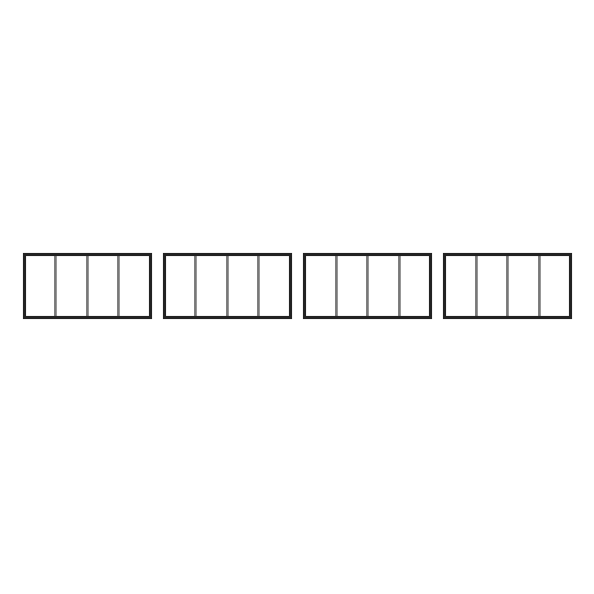
Each whole bar in the model represents \(1\) yard of ribbon. A display needs \(10\) equal pieces, each the size of one small part shown in the model.
a) From the model, determine the total ribbon length and the length of one small piece.
b) Write and evaluate the whole-number ÷ unit-fraction expression for the number of available pieces.
c) Is there enough ribbon for \(10\) pieces? If so, how much ribbon remains after \(10\) pieces are used?
Hints
- Count the whole bars and the equal parts in each whole directly from the model.
- The divisor is the size of one small part, not the number of parts.
- After finding the available piece count, convert any leftover pieces back into a ribbon length.
Solution
1. The model shows \(3\) whole bars, so there are \(3\) yards in all. Each whole is divided into \(4\) equal parts, so one small piece is \(\frac{1}{4}\) yard.
2. The number of pieces is \(3\div\frac{1}{4}=12\).
3. Since \(12\ge10\), there is enough ribbon. Two quarter-yard pieces remain, and \(2\times\frac{1}{4}=\frac{1}{2}\) yard.
Answer
a) \(3\) yards total; each piece is \(\frac{1}{4}\) yard.
b) \(3\div\frac{1}{4}=12\).
c) Yes; \(\frac{1}{2}\) yard remains.