Aimathic
Login | English | Deutsch

Free math worksheets

Build your own math worksheets from 30,000+ problems for grades 3 to 12, from fractions to AP Calculus. Every problem comes with step-by-step solutions.

Plot and interpret points

Click problems to add them to your worksheet.

5331655
Each small shape is centered on a grid point. Which geometric shape is centered at \((3, 2)\)?
Figure for problem 533165

Hints

- Read the x-coordinate first. - Then move to the y-coordinate. - Identify the shape centered at that grid location.

Solution

1. Locate x-coordinate \(3\) on the horizontal axis. 2. Move to y-coordinate \(2\). 3. The shape centered at \((3, 2)\) is a triangle.

Answer

The triangle.
5331695
Each small shape is centered on a grid point. What are the coordinates of the center of the pentagon?
Figure for problem 533169

Hints

- Find the shape with five sides. - Read the horizontal coordinate first and the vertical coordinate second.

Solution

1. Identify the shape with five sides. 2. Its center aligns with x-coordinate \(7\) and y-coordinate \(2\). 3. Therefore, the center is at \((7, 2)\).

Answer

\((7, 2)\)
5504755
Point \(K\) is shown on the coordinate plane. What are the coordinates of \(K\)?
Figure for problem 550475

Hints

- Read the horizontal position first. - Then read the vertical position. - Write the two values as an ordered pair.

Solution

1. Point \(K\) is \(4\) units to the right of the y-axis and \(3\) units above the x-axis. 2. Therefore, \(K=(4, 3)\).

Answer

\((4, 3)\)
5504765
Three points are plotted on the coordinate plane. Which labeled point is at \((2, 6)\)?
Figure for problem 550476

Hints

- Locate x-coordinate \(2\) on the horizontal axis. - Then look at height \(6\). - Match that location to a label.

Solution

1. The point at x-coordinate \(2\) and y-coordinate \(6\) is point \(B\).

Answer

\(B\)
5504775
Start at point \(P(3, 4)\). Move \(2\) units to the right without moving up or down. What ordered pair gives the new location?

Hints

- Decide which coordinate changes during a horizontal move. - Keep the other coordinate fixed. - Check that the final point is farther right than the starting point.

Solution

1. A rightward move changes only the x-coordinate. 2. The new x-coordinate is \(3+2=5\), and the y-coordinate remains \(4\). 3. The new location is \((5, 4)\).

Answer

\((5, 4)\)
5122774
Four fraction cards are labeled: \(A:\frac{1}{2}\), \(B:\frac{3}{4}\), \(C:\frac{3}{6}\), and \(D:\frac{5}{10}\). Which cards represent equivalent fractions? Explain using equivalent-fraction reasoning.

Hints

- Simplify each fraction when possible. - Fractions that reduce to the same value are equivalent. - You can also check whether the numerator and denominator were multiplied by the same factor.

Solution

1. Card A shows \(\frac{1}{2}\). 2. Simplify card C: \(\frac{3}{6}=\frac{1}{2}\). 3. Simplify card D: \(\frac{5}{10}=\frac{1}{2}\). 4. Card B shows \(\frac{3}{4}\), which is not equal to \(\frac{1}{2}\). 5. Therefore, cards A, C, and D are equivalent.

Answer

Cards A, C, and D are equivalent; each represents \(\frac{1}{2}\).
5190745
A trail map uses a coordinate grid. The first number is the x-coordinate, and the second number is the y-coordinate. The Old Oak is at \(E(2, 3)\), and the Rock Cave is at \(H(7, 1)\). a) A hiker starts at the Old Oak, moves \(4\) units right, and then moves \(2\) units up. At what coordinates does the hiker stop? b) A supply box is buried \(3\) units left of the Rock Cave and \(4\) units above it. Find the coordinates of the box, \(S\).

Hints

- Decide which coordinate changes when you move right or left. - Decide which coordinate changes when you move up or down. - Picture the coordinate grid or make a quick sketch.

Solution

1. Starting at \(E(2, 3)\), moving \(4\) units right changes the x-coordinate to \(2+4=6\). Moving \(2\) units up changes the y-coordinate to \(3+2=5\). The endpoint is \((6, 5)\). 2. Starting at \(H(7, 1)\), moving \(3\) units left changes the x-coordinate to \(7-3=4\). Moving \(4\) units up changes the y-coordinate to \(1+4=5\). Therefore, \(S=(4, 5)\).

Answer

a) \((6, 5)\) b) \(S=(4, 5)\)
5190755
Four friends’ homes are located on a coordinate grid: - Alex: \(A(2, 8)\) - Bea: \(B(5, 3)\) - Carl: \(C(10, 8)\) - Dana: \(D(5, 8)\) Use the coordinates to answer each question. a) Who lives farthest to the right? b) Which friends live on the same horizontal line? c) Who lives exactly \(5\) units north of Bea?

Hints

- For part a), decide which coordinate controls left-to-right position. - For part b), compare the coordinates of homes that could line up horizontally. - For part c), think about what changes and what stays fixed when you move north on a coordinate grid.

Solution

1. Compare the x-coordinates \(2, 5, 10,\) and \(5\). The greatest is \(10\), so Carl lives farthest to the right. 2. Alex, Carl, and Dana all have y-coordinate \(8\), so their homes lie on the same horizontal line. 3. Moving \(5\) units north from \(B(5, 3)\) gives \((5, 3+5)=(5, 8)\), which is Dana’s location.

Answer

a) Carl b) Alex, Carl, and Dana c) Dana
5190855
A surveyor records four landmarks on a coordinate map: \(P_1(4.5, 2)\), \(P_2(12, 6.5)\), \(P_3(7, 9)\), and \(P_4(2, 5.5)\). Larger x-values are farther east, and larger y-values are farther north. Find the coordinates of the point that is: a) farthest east. b) farthest north. c) farthest west. d) farthest south.

Hints

- East and west are determined by x-coordinates. - North and south are determined by y-coordinates. - Compare the decimal values carefully.

Solution

1. The greatest x-coordinate is \(12\), so \(P_2(12, 6.5)\) is farthest east. 2. The greatest y-coordinate is \(9\), so \(P_3(7, 9)\) is farthest north. 3. The least x-coordinate is \(2\), so \(P_4(2, 5.5)\) is farthest west. 4. The least y-coordinate is \(2\), so \(P_1(4.5, 2)\) is farthest south.

Answer

a) \(P_2(12, 6.5)\) b) \(P_3(7, 9)\) c) \(P_4(2, 5.5)\) d) \(P_1(4.5, 2)\)
5321725
A theme park map shows several attractions on a coordinate grid: - \(R\): Ferris wheel - \(A\): roller coaster - \(K\): carousel - \(G\): haunted house - \(S\): swinging ship Use the map to answer each question. a) Which attraction is located at \((5, 2)\)? b) What are the coordinates of the haunted house, \(G\)?
Figure for problem 532172

Hints

- Read the x-coordinate before the y-coordinate. - The first coordinate gives the horizontal position. - The second coordinate gives the vertical position.

Solution

1. The point at \((5, 2)\) is labeled \(A\), so it represents the roller coaster. 2. Point \(G\) is \(3\) units right and \(1\) unit up from the origin, so its coordinates are \((3, 1)\).

Answer

a) The roller coaster, point \(A\) b) \((3, 1)\)
5321765
Five points, \(A\), \(B\), \(C\), \(D\), and \(E\), are shown on a coordinate grid. a) What are the coordinates of point \(A\)? b) Which point is located at \((4, 2)\)? c) Start at point \(B\). Move \(2\) units left and \(3\) units up. Which labeled point do you reach?
Figure for problem 532176

Hints

- Read the horizontal coordinate before the vertical coordinate. - Think about how a leftward move changes a point's position. - Think about how an upward move changes a point's position.

Solution

1. Point \(A\) has x-coordinate \(1\) and y-coordinate \(4\), so \(A=(1, 4)\). 2. The point at \((4, 2)\) is \(B\). 3. Starting at \(B(4, 2)\), moving \(2\) units left and \(3\) units up gives \((4-2, 2+3)=(2, 5)\), which is point \(D\).

Answer

a) \((1, 4)\) b) \(B\) c) \(D\)
5331456
The graph shows points \(A\), \(B\), \(C\), \(D\), and \(E\) connected in alphabetical order, with \(E\) connected back to \(A\). a) What geometric name describes the closed outline? b) Which two sides are vertical, and what is the length of each vertical side? c) What are the coordinates of the highest vertex?
Figure for problem 533145

Hints

- Count the sides of the closed outline. - A vertical side has endpoints with the same x-coordinate; use the y-coordinates to find its length. - The highest vertex has the greatest y-coordinate.

Solution

1. The closed outline has five sides, so it is a pentagon. 2. Sides \(BC\) and \(EA\) are vertical because each pair of endpoints has the same x-coordinate. Each extends from \(y=-2\) to \(y=1\), so each has length \(3\) units. 3. The highest vertex is \(D=(0, 3)\).

Answer

a) Pentagon b) \(BC\) and \(EA\); each is \(3\) units long. c) \((0, 3)\)
5331466
The graph shows ten labeled points connected by segments. a) Which labeled points lie on either coordinate axis? b) Write the coordinates of points \(3\), \(6\), and \(9\).
Figure for problem 533146

Hints

- Points on the x-axis have y-coordinate \(0\); points on the y-axis have x-coordinate \(0\). - Use the labels to locate the requested points. - Read the x-coordinate before the y-coordinate.

Solution

1. A point lies on the y-axis when its x-coordinate is \(0\), and it lies on the x-axis when its y-coordinate is \(0\). 2. From the graph, points \(1\) and \(6\) lie on the y-axis, while points \(4\) and \(8\) lie on the x-axis. 3. Reading the requested coordinates gives point \(3=(4,2)\), point \(6=(0,-1)\), and point \(9=(-4,2)\).

Answer

a) Points \(1,4,6,8\) b) Point \(3\) is \((4,2)\), point \(6\) is \((0,-1)\), and point \(9\) is \((-4,2)\).
5504785
A coordinate map shows a library \(L\) and a school \(S\). Each coordinate unit represents one city block east or north from the starting corner. a) What are the coordinates of the library? b) How many blocks east and north is the library from the starting corner? c) Which place is farther east, the library or the school?
Figure for problem 550478

Hints

- Read the library's horizontal and vertical positions from the axes. - Connect the first coordinate with east-west position. - Compare horizontal coordinates for part c).

Solution

1. The library is plotted at \((3, 5)\). 2. This means it is \(3\) blocks east and \(5\) blocks north of the starting corner. 3. The school has x-coordinate \(7\), which is greater than the library's x-coordinate \(3\), so the school is farther east.

Answer

a) \((3, 5)\) b) \(3\) blocks east and \(5\) blocks north c) The school
5504795
Four labeled points are shown on the coordinate plane. Start at point \(A\). Move \(3\) units right and then \(4\) units up. Which labeled point do you reach?
Figure for problem 550479

Hints

- Track the horizontal move before the vertical move. - Change only one coordinate for each move. - Match the endpoint to the labels on the graph.

Solution

1. Point \(A\) is at \((2, 2)\). 2. Moving \(3\) units right gives \((5, 2)\). 3. Moving \(4\) units up gives \((5, 6)\), which is point \(C\).

Answer

\(C\)
5504805
Point \(A\) is at \((3, 7)\). Point \(B\) has coordinates \((8, y)\) and lies on the same horizontal line as \(A\). What is the value of \(y\)?

Hints

- Picture two points lined up left to right. - Decide which part of their ordered pairs must match. - Use the known coordinate from point \(A\).

Solution

1. Points on the same horizontal line have the same y-coordinate. 2. Point \(A\) has y-coordinate \(7\), so \(B\) must also have y-coordinate \(7\). 3. Therefore, \(y=7\).

Answer

\(y=7\)
5504815
Point \(C\) is at \((6, 2)\). Point \(D\) has coordinates \((x, 9)\) and lies on the same vertical line as \(C\). What is the value of \(x\)?

Hints

- Picture two points lined up above and below each other. - Decide which part of their ordered pairs must match. - Use the known coordinate from point \(C\).

Solution

1. Points on the same vertical line have the same x-coordinate. 2. Point \(C\) has x-coordinate \(6\), so point \(D\) must also have x-coordinate \(6\). 3. Therefore, \(x=6\).

Answer

\(x=6\)
5504825
Four points are shown on the coordinate plane. a) Which point is farthest to the right? b) Which point is highest? c) Explain which coordinate you compared for each question.
Figure for problem 550482

Hints

- Separate the question about horizontal position from the question about vertical position. - Use one coordinate for left-right comparisons. - Use the other coordinate for up-down comparisons.

Solution

1. The x-coordinates are \(1, 5, 4,\) and \(7\). The greatest is \(7\), so point \(D\) is farthest to the right. 2. The y-coordinates are \(6, 3, 7,\) and \(5\). The greatest is \(7\), so point \(C\) is highest. 3. Horizontal position is compared with x-coordinates; vertical position is compared with y-coordinates.

Answer

a) \(D\) b) \(C\) c) Compare x-coordinates for rightmost position and y-coordinates for highest position.
5504835
On a park map, locations are measured in blocks east and north from the entrance. A garden is \(4\) blocks east and \(6\) blocks north of the entrance. a) Write the garden's location as an ordered pair. b) A fountain is at the same east-west position as the garden but \(2\) blocks farther south. What are the fountain's coordinates?

Hints

- Translate the east and north distances into the two parts of an ordered pair. - Decide which coordinate stays fixed when two places have the same east-west position. - A southward move lowers one coordinate.

Solution

1. The first coordinate gives blocks east and the second gives blocks north, so the garden is at \((4, 6)\). 2. The fountain keeps x-coordinate \(4\). Moving \(2\) blocks south changes the y-coordinate from \(6\) to \(4\). 3. The fountain is at \((4, 4)\).

Answer

a) \((4, 6)\) b) \((4, 4)\)
5122795
The point \(P(3, 2)\) represents the fraction \(\frac{2}{3}\), where the x-coordinate is the denominator and the y-coordinate is the numerator. a) Give the coordinates of the points that represent the fractions obtained by multiplying the numerator and denominator by \(2\), \(3\), and \(4\). b) Describe how to move from one point to the next without recalculating each fraction.

Hints

- Multiply both coordinates by each scale factor. - Compare consecutive x-coordinates and consecutive y-coordinates. - Look for a constant horizontal and vertical change.

Solution

1. Multiplying by \(2\) gives \(\frac{4}{6}\), so the point is \((6, 4)\). 2. Multiplying by \(3\) gives \(\frac{6}{9}\), so the point is \((9, 6)\). 3. Multiplying by \(4\) gives \(\frac{8}{12}\), so the point is \((12, 8)\). 4. From one point to the next, add \((3, 2)\): move \(3\) units right and \(2\) units up.

Answer

a) \((6, 4)\), \((9, 6)\), and \((12, 8)\) b) Move \(3\) units right and \(2\) units up each time.
5504845
A campground map uses coordinates in hundreds of feet east and north from the ranger station. - Cabin A: \((2, 7)\) - Cabin B: \((6, 7)\) - Cabin C: \((6, 3)\) - Cabin D: \((4, 5)\) a) Which cabins are the same distance north of the ranger station? b) Which two cabins are directly above and below each other? c) How far apart are Cabin B and Cabin C in the north-south direction?

Hints

- Compare coordinates that represent north-south position for part a). - Directly above and below means the east-west position does not change. - Use the map's scale after finding the coordinate difference.

Solution

1. Cabins A and B both have y-coordinate \(7\), so they are the same distance north. 2. Cabins B and C both have x-coordinate \(6\), so they are directly above and below each other. 3. Their y-coordinates differ by \(7-3=4\) coordinate units. Each unit is \(100\) feet, so they are \(400\) feet apart north to south.

Answer

a) Cabins A and B b) Cabins B and C c) \(400\,\text{ft}\)
5504855
A student was asked to plot point \(T(4, 6)\). The graph shows the student's plotted point \(T\). a) What coordinates are actually shown? b) Is the x-coordinate correct, the y-coordinate correct, both, or neither? c) Describe how to correct the plotted point.
Figure for problem 550485

Hints

- Read the plotted point before comparing it with the requested ordered pair. - Compare the two coordinates one at a time. - Decide which direction changes only the incorrect coordinate.

Solution

1. The shown point is at \((4, 5)\). 2. Its x-coordinate \(4\) is correct, but its y-coordinate should be \(6\), not \(5\). 3. Move the point \(1\) unit up to \((4, 6)\).

Answer

a) \((4, 5)\) b) The x-coordinate is correct; the y-coordinate is not. c) Move \(T\) \(1\) unit up to \((4, 6)\).
5504865
Start at \(P(2, 3)\). Move \(4\) units right, then \(2\) units up, then \(1\) unit left. a) What are the coordinates after the first move and after the second move? b) What are the coordinates of the final point after the third move?

Hints

- Handle one move at a time instead of combining them immediately. - A horizontal move changes one coordinate, while a vertical move changes the other. - Check the direction of the final move before finding part b).

Solution

1. After moving \(4\) units right, the point is \((6, 3)\). 2. After moving \(2\) units up, the point is \((6, 5)\). 3. After moving \(1\) unit left, the final point is \((5, 5)\).

Answer

a) \((6, 3)\), then \((6, 5)\) b) \((5, 5)\)
5504875
Point \(A\) is shown, point \(B\) is shown, and two dashed guide segments meet at point \(P\). Point \(P\) is directly to the right of \(A\) and directly above \(B\). What are the coordinates of \(P\)? Explain how the two alignments determine its coordinates.
Figure for problem 550487

Hints

- Use the horizontal guide to determine one coordinate. - Use the vertical guide to determine the other coordinate. - Combine one coordinate from each labeled point.

Solution

1. Point \(A\) is at \((2, 6)\). Because \(P\) is directly to the right of \(A\), \(P\) has y-coordinate \(6\). 2. Point \(B\) is at \((7, 3)\). Because \(P\) is directly above \(B\), \(P\) has x-coordinate \(7\). 3. Therefore, \(P=(7, 6)\).

Answer

\(P(7, 6)\)
5504885
Two students start at \(S(2, 2)\). - Route A: move \(3\) units right, \(4\) units up, then \(1\) unit left. - Route B: move \(2\) units right, then \(4\) units up. Do the two routes end at the same point? Show the endpoint of each route.

Hints

- Track each route independently from the same starting point. - Record the ordered pair after every move. - Compare the two final ordered pairs rather than the route lengths.

Solution

1. Route A goes from \((2, 2)\) to \((5, 2)\), then \((5, 6)\), then \((4, 6)\). 2. Route B goes from \((2, 2)\) to \((4, 2)\), then \((4, 6)\). 3. Both routes end at \((4, 6)\), so they reach the same point.

Answer

Yes. Both routes end at \((4, 6)\).
5504896
Three corners of a rectangle are plotted at \(A(2, 2)\), \(B(7, 2)\), and \(C(2, 6)\). The sides from \(A\) to \(B\) and from \(A\) to \(C\) are shown. a) What coordinates must the fourth corner \(D\) have so that \(D\) is directly above \(B\) and directly to the right of \(C\)? b) Find the horizontal and vertical side lengths of the rectangle. c) Find its perimeter.
Figure for problem 550489

Hints

- Use the vertical alignment with \(B\) to determine one coordinate of \(D\). - Use the horizontal alignment with \(C\) to determine the other coordinate. - After locating \(D\), read side lengths from coordinate differences.

Solution

1. Being directly above \(B(7, 2)\) gives \(D\) x-coordinate \(7\). Being directly right of \(C(2, 6)\) gives \(D\) y-coordinate \(6\). Thus, \(D=(7, 6)\). 2. The horizontal side length is \(7-2=5\) units. The vertical side length is \(6-2=4\) units. 3. The perimeter is \(5+4+5+4=18\) units.

Answer

a) \(D(7, 6)\) b) \(5\) units by \(4\) units c) \(18\) units
5504905
A meeting station has whole-number coordinates. - It lies on the same horizontal line as \(A(2, 7)\). - It lies strictly between the vertical line through \(B(6, 3)\) and the vertical line through \(C(9, 4)\). - It is closer to the vertical line through \(C\) than to the vertical line through \(B\). What are the station's coordinates? Explain how each condition narrows the possibilities.

Hints

- First use the horizontal-line condition to determine one coordinate. - Then list the whole-number x-positions strictly between the two vertical lines. - Compare each remaining position's horizontal distance to the two vertical lines.

Solution

1. The same horizontal line as \(A(2, 7)\) gives y-coordinate \(7\). 2. The station lies strictly between the vertical lines \(x=6\) and \(x=9\). With a whole-number x-coordinate, the possibilities are \(7\) and \(8\). 3. At \(x=7\), the station is \(1\) unit from \(x=6\) and \(2\) units from \(x=9\), so it is closer to \(B\)'s vertical line. 4. At \(x=8\), it is \(2\) units from \(x=6\) and \(1\) unit from \(x=9\), so it is closer to \(C\)'s vertical line. 5. Therefore, the station is at \((8, 7)\).

Answer

\((8, 7)\)
5542985
Three panels show attempts to plot the same four points: \(A(1, 2)\), \(B(1, 6)\), \(C(5, 6)\), and \(D(7, 3)\). a) Which panel shows all four points plotted correctly? b) For each incorrect panel, identify the misplaced point and give the coordinates actually shown for it.
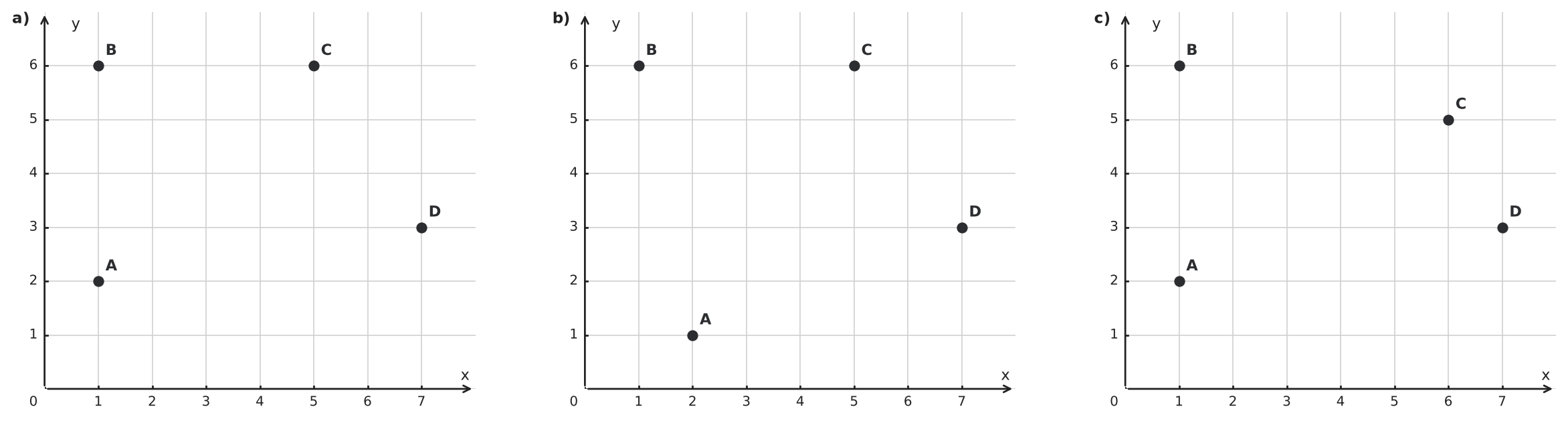
Figure for problem 554298

Hints

- Check each labeled point against its ordered pair one coordinate at a time. - Do not decide from the overall shape of the four points. - In an incorrect panel, read the misplaced point's actual x- and y-coordinates from the axes.

Solution

1. In panel a), \(A\), \(B\), \(C\), and \(D\) are all at their stated ordered pairs. 2. In panel b), \(A\) is shown at \((2, 1)\) instead of \((1, 2)\). The other three points are correctly placed. 3. In panel c), \(C\) is shown at \((6, 5)\) instead of \((5, 6)\). The other three points are correctly placed. 4. Therefore, panel a) is the correct plot.

Answer

a) Panel a) b) Panel b): \(A\) is shown at \((2, 1)\). Panel c): \(C\) is shown at \((6, 5)\).

5542995
A student tried to plot \(U(4, 2)\), \(V(8, 6)\), and \(W(2, 8)\). On the graph, numbered tick labels increase by \(2\), while each small grid space represents \(1\) unit. a) Which labeled points are plotted correctly? b) Which point is misplaced? Give the coordinates where it is actually shown and the coordinates where it should be.
Figure for problem 554299

Hints

- Use the numbered tick values rather than counting labeled intervals as single units. - Read the x-coordinate and y-coordinate of each shown point separately. - Compare each shown ordered pair with the target ordered pair in the text.

Solution

1. Read positions from the numbered axes while remembering that each small grid space is \(1\) unit. 2. \(U\) is shown at \((4, 2)\), so \(U\) is correct. 3. \(W\) is shown at \((2, 8)\), so \(W\) is correct. 4. \(V\) is shown at \((4, 3)\), not \((8, 6)\). 5. Therefore, \(V\) is the misplaced point and should be moved to \((8, 6)\).

Answer

a) \(U\) and \(W\) b) \(V\) is shown at \((4, 3)\) and should be at \((8, 6)\).
5543005
A science club records how much water has collected after a faucet is turned on. <table> <tr><th>Record</th><th>Time after start (minutes)</th><th>Water collected (liters)</th></tr> <tr><td>A</td><td>1</td><td>2</td></tr> <tr><td>B</td><td>2</td><td>3</td></tr> <tr><td>C</td><td>3</td><td>5</td></tr> <tr><td>D</td><td>4</td><td>8</td></tr> </table> The graph shows a student's plot of records A–D. a) Which plotted record does not match the table? b) What coordinates should that point have? c) What does the corrected point mean in this situation?
Figure for problem 554300

Hints

- Match each graph label with the table row carrying the same letter. - For each record, time is the x-coordinate and water collected is the y-coordinate. - After finding the mismatch, interpret the corrected ordered pair using the axis meanings.

Solution

1. Compare each table row with the plotted point carrying the same letter. 2. A is plotted at \((1, 2)\), B at \((2, 3)\), and D at \((4, 8)\), matching the table. 3. C is plotted at \((3, 4)\), but the table gives time \(3\) and water \(5\). 4. Therefore, C should be at \((3, 5)\). 5. The corrected point means that after \(3\) minutes, \(5\,\text{liters}\) of water had collected.

Answer

a) Record C b) \((3, 5)\) c) After \(3\) minutes, \(5\,\text{liters}\) of water had collected.

All problems may be used, copied and printed free of charge for school and tutoring, including paid tutoring. Commercial adaptations as well as publication or redistribution on the internet are not permitted.