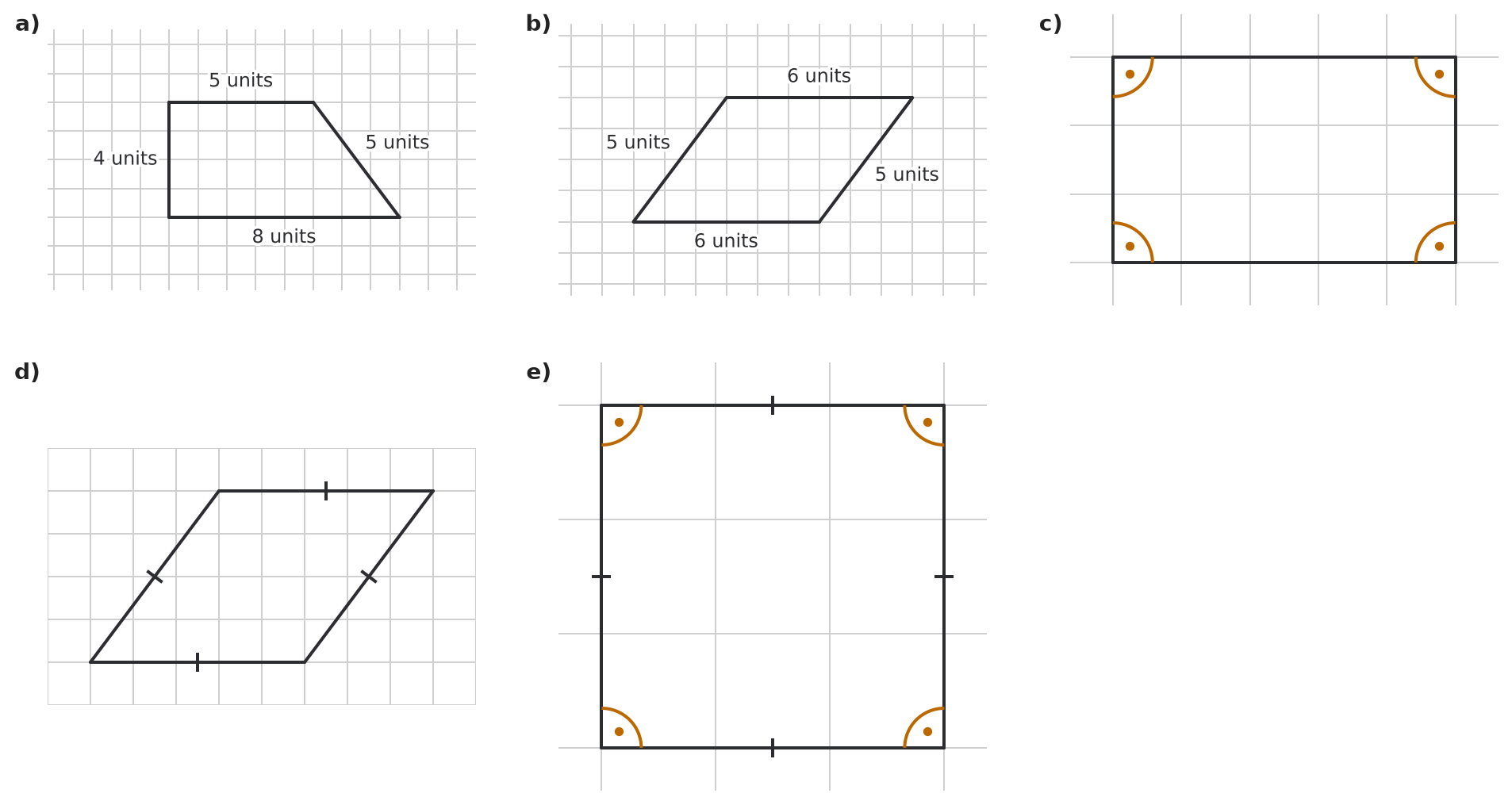
Each grid cell represents \(1\) unit. For each figure a)–e), list every name that applies from this list:
trapezoid, parallelogram, rectangle, rhombus, kite, square
Use these inclusive definitions:
- A trapezoid has at least one pair of parallel sides.
- A kite has at least two pairs of adjacent congruent sides.
For each figure, also give the requested exact diagram evidence. Category names without the requested evidence are not enough.
a) State the directions of the two nonhorizontal sides and the four labeled side lengths.
b) State the horizontal and vertical move of each slanted side and the two different adjacent side lengths.
c) State one horizontal side length, one vertical side length, and the angle-mark information.
d) State the horizontal and vertical move of each slanted side, the side-mark information, and why a right angle is not guaranteed by the grid.
e) State the side-mark information and the angle-mark information.
Hints
- Treat the requested move counts, side lengths, and markings as evidence you must report, not as decorative details.
- Establish parallel-side information before using the quadrilateral hierarchy.
- Then use side congruence and right-angle evidence to decide which more specific names are justified and which are ruled out.
Solution
1. Figure a) has horizontal top and bottom sides. One other side is vertical, while the other moves \(3\) units horizontally and \(4\) units vertically, so those two sides are not parallel. The labeled side lengths are \(8,5,5,4\), giving only one adjacent congruent pair. Thus, only trapezoid applies.
2. In figure b), each slanted side moves \(3\) units horizontally and \(4\) units vertically when followed from the lower base to the upper base, so the slanted sides are parallel; the horizontal bases are also parallel. Thus, it is a parallelogram and trapezoid. Adjacent side lengths are \(6\) and \(5\), so rhombus and kite are not guaranteed. A slanted side is not vertical to a horizontal base, so rectangle and square do not apply.
3. Figure c) has horizontal side length \(5\) and vertical side length \(3\). The four angle marks are right angles. Thus, it is a rectangle, parallelogram, and trapezoid. Because adjacent side lengths differ, it is not a rhombus, kite, or square.
4. In figure d), each slanted side moves \(3\) units horizontally and \(4\) units vertically, while the top and bottom are horizontal, so both pairs of opposite sides are parallel. All four sides have matching congruence ticks, so it is a rhombus and kite as well as a parallelogram and trapezoid. A slanted side has a nonzero horizontal move, so it is not perpendicular to the horizontal base; rectangle and square do not apply.
5. Figure e) has matching congruence ticks on all four sides and right-angle marks at all four vertices. Thus, square, rectangle, rhombus, kite, parallelogram, and trapezoid all apply.
Answer
a) trapezoid. Evidence: the top and bottom are horizontal; one other side is vertical and the other moves \(3\) horizontally and \(4\) vertically; the side lengths are \(8,5,5,4\).
b) trapezoid, parallelogram. Evidence: each slanted side moves \(3\) horizontally and \(4\) vertically; adjacent side lengths are \(6\) and \(5\).
c) trapezoid, parallelogram, rectangle. Evidence: a horizontal side is \(5\) units, a vertical side is \(3\) units, and all four angles are marked right.
d) trapezoid, parallelogram, rhombus, kite. Evidence: each slanted side moves \(3\) horizontally and \(4\) vertically, all four sides share a congruence mark, and a slanted side is not vertical to the horizontal base.
e) trapezoid, parallelogram, rectangle, rhombus, kite, square. Evidence: all four sides share a congruence mark and all four angles are marked right.