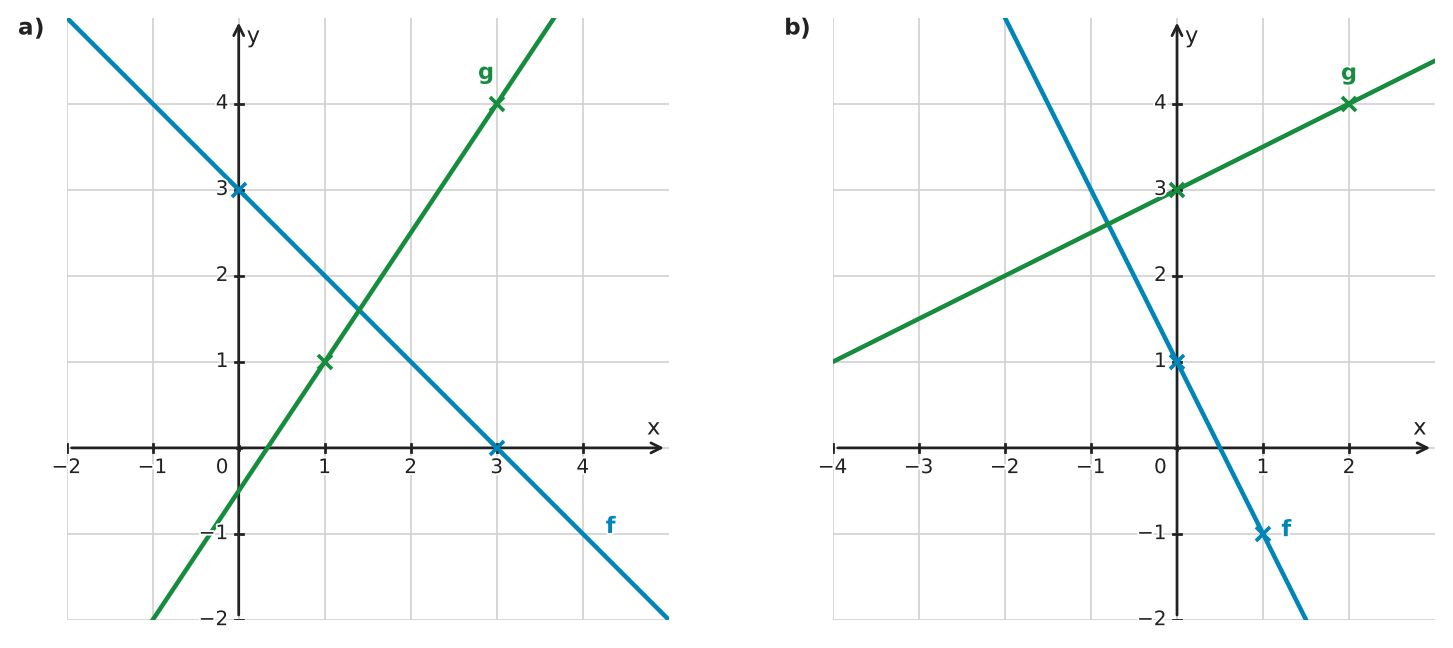
Graphs a) and b) each show two lines, \(f\) and \(g\), that intersect at point \(S\). Several useful points are marked on the lines.
1) For each graph, estimate the coordinates of \(S\).
2) For each graph, determine the equations of \(f\) and \(g\).
3) For each graph, calculate the exact coordinates of \(S\) by setting the function expressions equal.
Hints
- Check the axis scales before estimating each intersection.
- Use the marked points to find the slope and y-intercept of each line.
- Recall the slope-intercept form \(y = mx + b\). How can two points be used to find \(m\)?
- To find an exact intersection, set the two function expressions equal and solve for \(x\).
- Substitute the x-coordinate into either equation to find the corresponding y-coordinate.
Solution
1. In graph a), the intersection is about \((1.4, 1.6)\). In graph b), the intersection is about \((-0.8, 2.6)\).
2. For graph a), \(f\) passes through \((0, 3)\) and \((3, 0)\), so its slope is \(-1\) and \(f(x) = -x + 3\). Line \(g\) passes through \((1, 1)\) and \((3, 4)\), so its slope is \(\frac{4 - 1}{3 - 1} = 1.5\). Using \((1, 1)\) gives a y-intercept of \(-0.5\), so \(g(x) = 1.5x - 0.5\).
3. For graph a), set the equations equal: \(-x + 3 = 1.5x - 0.5\). Then \(3.5 = 2.5x\), so \(x = 1.4\). Substitution gives \(y = 1.6\). Thus, \(S = (1.4, 1.6)\).
4. For graph b), \(f\) passes through \((0, 1)\) and \((1, -1)\), so \(f(x) = -2x + 1\). Line \(g\) passes through \((0, 3)\) and \((2, 4)\), so its slope is \(0.5\) and \(g(x) = 0.5x + 3\).
5. For graph b), set the equations equal: \(-2x + 1 = 0.5x + 3\). Then \(-2 = 2.5x\), so \(x = -0.8\). Substitution gives \(y = 2.6\). Thus, \(S = (-0.8, 2.6)\).
Answer
1) a) About \((1.4, 1.6)\); b) about \((-0.8, 2.6)\).
2) a) \(f(x) = -x + 3\) and \(g(x) = 1.5x - 0.5\); b) \(f(x) = -2x + 1\) and \(g(x) = 0.5x + 3\).
3) a) \(S = (1.4, 1.6)\); b) \(S = (-0.8, 2.6)\).