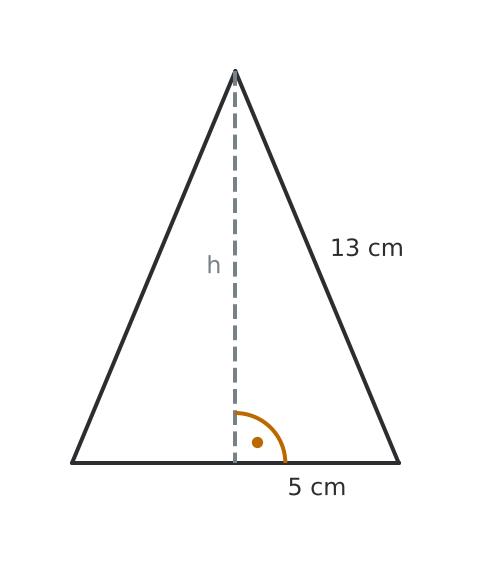
The diagram is an axial cross-section of a right circular cone. A proposed calculation uses the labeled slanted edge as the height \(h\) in \(V=\frac{1}{3}\pi r^2h\).
a) Explain why that choice of \(h\) is incorrect.
b) Find the cone's perpendicular height.
c) Find the cone's exact volume in terms of \(\pi\).
Hints
- Which segment in the cross-section meets the base at a right angle?
- Relate the radius, the unknown perpendicular height, and the labeled slanted edge in the right triangle.
- Use the cone volume formula only after identifying the perpendicular height.
Solution
1. The height in the cone volume formula is the perpendicular distance from the apex to the base plane, not the slanted edge from the apex to the rim.
2. In the cross-section, the radius, perpendicular height, and slanted edge form a right triangle. With radius \(5\,\text{cm}\) and slanted edge \(13\,\text{cm}\), \(h^2+5^2=13^2\).
3. Thus \(h^2=144\), so \(h=12\,\text{cm}\).
4. The cone volume is \(V=\frac{1}{3}\pi(5)^2(12)=100\pi\,\text{cm}^3\).
Answer
a) The slanted edge is not perpendicular to the base, so it is not the height used in the volume formula.
b) \(12\,\text{cm}\)
c) \(100\pi\,\text{cm}^3\)