Aimathic
Login | English | Deutsch

Free math worksheets

Build your own math worksheets from 30,000+ problems for grades 3 to 12, from fractions to AP Calculus. Every problem comes with step-by-step solutions.

Distance formula from Pythagorean

Click problems to add them to your worksheet.

5521988
Points \(A\) and \(B\) are shown on the coordinate plane. What are the horizontal distance and the vertical distance between the two points?
Figure for problem 552198

Hints

- Read both ordered pairs from the graph. - Compare the x-coordinates for the horizontal distance and the y-coordinates for the vertical distance.

Solution

1. From the graph, \(A(-2,1)\) and \(B(1,5)\). 2. The horizontal distance is \(|1-(-2)|=3\), and the vertical distance is \(|5-1|=4\).

Answer

Horizontal distance: \(3\) units; vertical distance: \(4\) units
5521998
The graph shows points \(P\) and \(Q\). Write a Pythagorean expression for the straight-line distance \(PQ\). Do not evaluate the square root.
Figure for problem 552199

Hints

- Treat the dashed horizontal and vertical segments as perpendicular legs. - Use the coordinate grid to determine the two leg lengths. - The straight segment \(PQ\) is the hypotenuse of that right triangle.

Solution

The dashed horizontal and vertical segments have lengths \(8\) and \(6\), so \(PQ=\sqrt{8^2+6^2}\).

Answer

\(PQ=\sqrt{8^2+6^2}\)
5155968
A Wi-Fi router is located at \(R(2, 3)\) on a coordinate grid measured in meters. Its outdoor signal reaches points up to \(5\,\text{m}\) from the router. Use the distance formula to determine whether a laptop at \(L(-2, 6)\) is within range. Justify your answer.

Hints

- Interpret the range as a maximum allowable distance. - Substitute both ordered pairs into the distance formula. - Be careful when subtracting a negative coordinate.

Solution

1. Use the distance formula: \(d=\sqrt{(-2-2)^2+(6-3)^2}\). 2. Simplify: \(d=\sqrt{(-4)^2+3^2}=\sqrt{16+9}=\sqrt{25}=5\,\text{m}\). 3. The distance is exactly the router's maximum range, so the laptop is within range.

Answer

Yes. The laptop is exactly \(5\,\text{m}\) from the router, so it is within range.
5334818
A drone flies directly from \(K(-6, -4)\) to \(L(5, 2)\). Find the length of the flight path to the nearest tenth of a coordinate unit.

Hints

- Find the horizontal and vertical changes from the ordered pairs. - Those two changes form perpendicular legs of a right triangle whose hypotenuse is the direct path. - Keep the square root unrounded until the requested precision.

Solution

1. The horizontal change is \(5-(-6)=11\), and the vertical change is \(2-(-4)=6\). 2. The flight path is the hypotenuse of the right triangle formed by those changes, so \(KL=\sqrt{11^2+6^2}=\sqrt{157}\approx12.530\). 3. Rounded to the nearest tenth, the flight path is \(12.5\) coordinate units.

Answer

The flight path is approximately \(12.5\) coordinate units long.
5364478
Points \(A\), \(B\), and \(C\) are shown on the coordinate plane, with \(C\) forming a right triangle that can be used to find the distance from \(A\) to \(B\). a) Read the coordinates and find the leg lengths \(AC\) and \(BC\). b) Use them to find the hypotenuse length \(AB\).
Figure for problem 536447

Hints

- Read each labeled point's coordinates from the graph. - Compare the x-coordinates and y-coordinates to find the two perpendicular leg lengths. - What relationship connects the two perpendicular legs to the diagonal segment?

Solution

1. From the graph, \(A(1, 1)\), \(B(13, 6)\), and \(C(13, 1)\). 2. The horizontal leg has length \(AC=|13-1|=12\), and the vertical leg has length \(BC=|6-1|=5\). 3. Then \(AB=\sqrt{12^2+5^2}=\sqrt{169}=13\).

Answer

a) \(AC=12\) and \(BC=5\) b) \(AB=13\)
5364508
Two boundary markers are at \(G_1(-2, 1)\) and \(G_2(3, 5)\). How far apart are the markers? Round to the nearest hundredth.

Hints

- Picture the direct segment as the hypotenuse of a right triangle. - Find the horizontal and vertical changes from the coordinates. - Take the square root and round only at the end.

Solution

1. The horizontal change is \(3-(-2)=5\), and the vertical change is \(5-1=4\). 2. The distance is \(d=\sqrt{5^2+4^2}=\sqrt{41}\). 3. Since \(\sqrt{41}\approx6.4031\), the distance rounds to \(6.40\) units.

Answer

The markers are approximately \(6.40\) units apart.
5368828
Points \(A\), \(B\), and \(C\) are shown on the coordinate plane. Compare the lengths of \(\overline{AB}\) and \(\overline{AC}\). Which segment is longer?
Figure for problem 536882

Hints

- Read the coordinates of the labeled points from the graph. - A horizontal segment can be measured from its x-coordinates. - Use a right triangle or the distance formula for the oblique segment.

Solution

1. From the graph, \(A(1,1)\), \(B(5,1)\), and \(C(3,4)\). 2. Since \(A\) and \(B\) have the same y-coordinate, \(AB=|5-1|=4\). 3. Also, \(AC=\sqrt{(3-1)^2+(4-1)^2}=\sqrt{13}\approx3.61\). 4. Since \(4>3.61\), \(\overline{AB}\) is longer.

Answer

\(\overline{AB}\) is longer because \(AB=4\) and \(AC=\sqrt{13}\approx3.61\).
5369168
Segments \(\overline{AB}\) and \(\overline{CD}\) are shown on the coordinate plane. Determine whether they have the same length. Justify your answer from the coordinates in the graph.
Figure for problem 536916

Hints

- Read all four endpoints from the graph. - Find the horizontal and vertical changes for each segment. - Compare the two exact distances before using decimals.

Solution

1. From the graph, \(A(0,0)\), \(B(2,3)\), \(C(4,1)\), and \(D(7,3)\). 2. For \(\overline{AB}\), the changes are \(2\) and \(3\), so \(AB=\sqrt{2^2+3^2}=\sqrt{13}\). 3. For \(\overline{CD}\), the changes are \(3\) and \(2\), so \(CD=\sqrt{3^2+2^2}=\sqrt{13}\). 4. Therefore, the segments have the same length.

Answer

Yes. Both segments have length \(\sqrt{13}\).
5155958
Triangle \(ABC\) has vertices \(A(-2, 1)\), \(B(4, 1)\), and \(C(1, 6)\). a) Find the exact perimeter of triangle \(ABC\). b) Determine whether the triangle is isosceles. Justify your answer using the side lengths.

Hints

- One side is horizontal, so its length can be read from the x-coordinates. - For each slanted side, compare both the horizontal and vertical coordinate changes. - An isosceles conclusion needs evidence that two side lengths are equal.

Solution

1. Since \(A\) and \(B\) have the same y-coordinate, \(AB=|4-(-2)|=6\). 2. The other two side lengths are \(AC=\sqrt{(1-(-2))^2+(6-1)^2}=\sqrt{34}\) and \(BC=\sqrt{(1-4)^2+(6-1)^2}=\sqrt{34}\). 3. Therefore, the perimeter is \(6+2\sqrt{34}\) units. 4. Since \(AC=BC=\sqrt{34}\), triangle \(ABC\) is isosceles.

Answer

a) \(6+2\sqrt{34}\) units b) Yes. The triangle is isosceles because \(AC=BC=\sqrt{34}\).
5241558
Points \(A(2, 2)\), \(B(8, 2)\), and \(C(5, 6)\) form triangle \(ABC\). a) Find the length of \(\overline{AB}\). b) Use the Pythagorean theorem to find the lengths of \(\overline{AC}\) and \(\overline{BC}\). c) Classify the triangle by its side lengths.

Hints

- A horizontal segment's length is the difference of its x-coordinates. - Use the horizontal and vertical changes as the legs of a right triangle. - A triangle with two equal side lengths has a special classification.

Solution

1. Segment \(\overline{AB}\) is horizontal, so \(AB=8-2=6\) units. 2. From \(A\) to \(C\), the horizontal change is \(3\) and the vertical change is \(4\), so \(AC=\sqrt{3^2+4^2}=5\) units. From \(B\) to \(C\), the horizontal change has magnitude \(3\) and the vertical change is \(4\), so \(BC=5\) units. 3. Since \(AC=BC\), the triangle is isosceles.

Answer

a) \(AB=6\) units b) \(AC=5\) units and \(BC=5\) units c) The triangle is isosceles.
5322408
A digital coordinate map shows Mia at point \(P\), Ben at point \(Q\), and point \(R\), which forms right triangle \(PQR\). One coordinate unit represents exactly \(10\,\text{m}\). a) Read the coordinates from the graph and find the actual straight-line distance between Mia and Ben in meters. b) Find the actual area of triangle \(PQR\) in square meters.
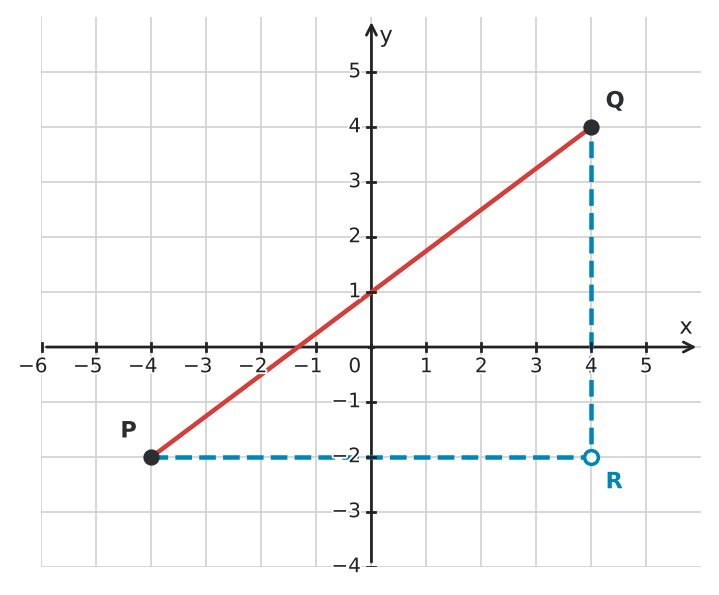
Figure for problem 532240

Hints

- Read the coordinates of the labeled points from the graph first. - Use the horizontal and vertical changes as the legs of a right triangle. - Convert coordinate units to meters before calculating the real-world area. - Use the area formula for a right triangle.

Solution

1. From the graph, \(P(-4, -2)\), \(Q(4, 4)\), and \(R(4, -2)\). The horizontal and vertical leg lengths are \(8\) and \(6\) coordinate units, so \(PQ=\sqrt{8^2+6^2}=10\) coordinate units. Since each unit represents \(10\,\text{m}\), the actual distance is \(100\,\text{m}\). 2. The actual leg lengths are \(80\,\text{m}\) and \(60\,\text{m}\). Thus, \(A=\frac{1}{2}\cdot80\cdot60=2400\,\text{m}^2\).

Answer

a) \(100\,\text{m}\) b) \(2400\,\text{m}^2\)

5369158
The graph shows the starting point \(A\) of an arrow. The arrow has length \(\sqrt{34}\), points up and to the right, and has a horizontal change of \(3\) units to the right. How many units does it rise? Find the coordinates of its endpoint \(B\).
Figure for problem 536915

Hints

- Read the starting point from the graph. - The horizontal change, vertical change, and total arrow length form a right triangle. - Use the arrow's direction to choose the sign of the vertical change. - Apply both coordinate changes to the starting point after finding the rise.

Solution

1. From the graph, the starting point is \(A(1, 2)\). 2. Let the vertical change be \(\Delta y\). Then \((\sqrt{34})^2=3^2+(\Delta y)^2\), so \((\Delta y)^2=25\). Because the arrow points upward, \(\Delta y=5\). 3. Add the changes to the starting coordinates: \(B=(1+3, 2+5)=(4, 7)\).

Answer

The arrow rises \(5\) units, and its endpoint is \(B(4, 7)\).
5546208
Points \(P(x_1, y_1)\) and \(Q(x_2, y_2)\) are any two points in the coordinate plane. Derive a formula for the distance \(d\) between \(P\) and \(Q\) by using the horizontal change, the vertical change, and the Pythagorean theorem. Then explain why the formula still works if one or both coordinate differences are negative.

Hints

- Express the horizontal and vertical changes symbolically before introducing the distance. - Think of those two changes as perpendicular legs of a right triangle. - After writing the squared relationship, use the fact that a distance cannot be negative.

Solution

1. The horizontal change from \(P\) to \(Q\) is \(x_2-x_1\), and the vertical change is \(y_2-y_1\). 2. These changes can be used as the legs of a right triangle whose hypotenuse has length \(d\). 3. By the Pythagorean theorem, \(d^2=(x_2-x_1)^2+(y_2-y_1)^2\). 4. Distance is nonnegative, so \(d=\sqrt{(x_2-x_1)^2+(y_2-y_1)^2}\). 5. If a coordinate difference is negative, squaring it gives the same value as squaring its positive magnitude, so the formula is unchanged.

Answer

\(d=\sqrt{(x_2-x_1)^2+(y_2-y_1)^2}\). Negative coordinate differences do not change the distance because they are squared.
5155978
Points \(A(1, 2)\) and \(B(k, 6)\) are exactly \(7\) units apart. Find all possible exact values of \(k\).

Hints

- The unknown x-coordinate controls only the horizontal change between the points. - Use the stated distance together with the known vertical change. - Why should there be one possible point to the left and another to the right?

Solution

1. The horizontal change is \(k-1\), and the vertical change is \(6-2=4\). 2. The distance condition gives \(7^2=(k-1)^2+4^2\). 3. Thus \(49=(k-1)^2+16\), so \((k-1)^2=33\). 4. Therefore, \(k-1=\sqrt{33}\) or \(k-1=-\sqrt{33}\), giving \(k=1+\sqrt{33}\) or \(k=1-\sqrt{33}\).

Answer

\(k=1+\sqrt{33}\) or \(k=1-\sqrt{33}\).
5371868
Triangle \(OAB\) is shown on the coordinate plane. a) Read the coordinates and find the lengths of all three sides. b) Use the side lengths to determine \(\angle AOB\). Justify your conclusion.
Figure for problem 537186

Hints

- Read the three coordinates from the graph before calculating. - Compare the squares of the side lengths to test for a right angle. - Equal side lengths imply equal opposite angles. - Use the angle sum of a triangle after identifying the right angle.

Solution

1. From the graph, \(O(0, 0)\), \(A(3, 1)\), and \(B(1, 2)\). 2. The side lengths are \(OA=\sqrt{3^2+1^2}=\sqrt{10}\), \(OB=\sqrt{1^2+2^2}=\sqrt{5}\), and \(AB=\sqrt{(3-1)^2+(1-2)^2}=\sqrt{5}\). 3. Since \(OB^2+AB^2=5+5=10=OA^2\), the triangle is right with the right angle at \(B\). 4. Also, \(OB=AB\), so the two acute angles are equal. They sum to \(90^\circ\), so \(\angle AOB=45^\circ\).

Answer

a) \(OA=\sqrt{10}\), \(OB=\sqrt{5}\), and \(AB=\sqrt{5}\) b) \(\angle AOB=45^\circ\)

All problems may be used, copied and printed free of charge for school and tutoring, including paid tutoring. Commercial adaptations as well as publication or redistribution on the internet are not permitted.