Aimathic
Login | English | Deutsch

Free math worksheets

Build your own math worksheets from 30,000+ problems for grades 3 to 12, from fractions to AP Calculus. Every problem comes with step-by-step solutions.

Even, odd, and cofunction identities

Click problems to add them to your worksheet.

51507012
Consider a right triangle with an acute angle of \(25^\circ\). 1. Explain geometrically why \(\sin(25^\circ)=\cos(65^\circ)\). 2. Given \(\sin(25^\circ)\approx 0.4226\) and \(\cos(25^\circ)\approx 0.9063\), find \(\tan(25^\circ)\) to four decimal places.

Hints

- What is the sum of the two acute angles in a right triangle? - Compare the side used as the opposite leg for one angle with the side used as the adjacent leg for the other. - Which identity relates tangent to sine and cosine?

Solution

1. The other acute angle is \(90^\circ-25^\circ=65^\circ\). The side opposite the \(25^\circ\) angle is the side adjacent to the \(65^\circ\) angle, and both ratios use the same hypotenuse. Therefore, \(\sin(25^\circ)=\cos(65^\circ)\). 2. Use \(\tan(\theta)=\frac{\sin(\theta)}{\cos(\theta)}\). 3. Then \(\tan(25^\circ)\approx\frac{0.4226}{0.9063}\approx 0.4663\).

Answer

1. The side opposite \(25^\circ\) is the side adjacent to \(65^\circ\), and both ratios use the same hypotenuse. 2. \(\tan(25^\circ)\approx 0.4663\)
51508412
Consider a right triangle with acute angles \(\alpha\) and \(\beta\). 1. Use side ratios to explain why \(\sin(\alpha)=\cos(\beta)\). 2. Express \(\beta\) in terms of \(\alpha\). 3. Verify \(\sin(\alpha)=\cos(90^\circ-\alpha)\) for \(\alpha=30^\circ\).

Hints

- Label the sides of one right triangle relative to both acute angles. - How many degrees do the two acute angles total? - Use the exact sine and cosine values for \(30^\circ\) and \(60^\circ\).

Solution

1. The leg opposite \(\alpha\) is the same leg that is adjacent to \(\beta\). Both sine and cosine ratios use the same hypotenuse, so \(\sin(\alpha)=\cos(\beta)\). 2. The two acute angles of a right triangle are complementary, so \(\alpha+\beta=90^\circ\) and \(\beta=90^\circ-\alpha\). 3. For \(\alpha=30^\circ\), \(\sin(30^\circ)=\frac{1}{2}\) and \(\cos(60^\circ)=\frac{1}{2}\). Therefore, the identity is true in this example.

Answer

1. The leg opposite \(\alpha\) is adjacent to \(\beta\), so the two ratios are equal. 2. \(\beta=90^\circ-\alpha\) 3. \(\sin(30^\circ)=\cos(60^\circ)=\frac{1}{2}\)
51516112
Given that \(\sin(40^\circ) \approx 0.643\), use unit-circle symmetry to find each value without a calculator. a) \(\sin(140^\circ)\) b) \(\sin(220^\circ)\) c) \(\sin(320^\circ)\)

Hints

- Express each angle using \(40^\circ\) and a benchmark angle such as \(180^\circ\) or \(360^\circ\). - Identify the reflection or rotation relating each point to the point for \(40^\circ\). - Determine whether the y-coordinate changes sign.

Solution

1. Since \(140^\circ=180^\circ-40^\circ\), \(\sin(140^\circ)=\sin(40^\circ) \approx 0.643\). 2. Since \(220^\circ=180^\circ+40^\circ\), \(\sin(220^\circ)=-\sin(40^\circ) \approx -0.643\). 3. Since \(320^\circ=360^\circ-40^\circ\), \(\sin(320^\circ)=-\sin(40^\circ) \approx -0.643\).

Answer

a) \(0.643\) b) \(-0.643\) c) \(-0.643\)
52858412
Decide whether each equation is true or false. Briefly justify each answer using unit-circle symmetry, quadrant signs, or a trigonometric identity. a) \(\sin\left(\frac{\pi}{3}\right)=\cos\left(\frac{\pi}{6}\right)\) b) \(\sin\left(\frac{3\pi}{4}\right)=\cos\left(\frac{3\pi}{4}\right)\) c) \(\cos\left(\frac{5\pi}{3}\right)=\cos\left(\frac{\pi}{3}\right)\)

Hints

- Use unit-circle symmetries to compare the values. - Identify each angle’s quadrant and the signs of sine and cosine there. - Consider the cofunction identity and reflection symmetry. - Use the positions of the corresponding unit-circle points to check your reasoning.

Solution

1. For a), \(\sin\left(\frac{\pi}{3}\right)=\frac{\sqrt{3}}{2}\) and \(\cos\left(\frac{\pi}{6}\right)=\frac{\sqrt{3}}{2}\). The equation is true. It also follows from the cofunction identity \(\sin(x)=\cos\left(\frac{\pi}{2}-x\right)\). 2. For b), \(\frac{3\pi}{4}\) is in Quadrant II, where sine is positive and cosine is negative. In fact, \(\sin\left(\frac{3\pi}{4}\right)=\frac{\sqrt{2}}{2}\) while \(\cos\left(\frac{3\pi}{4}\right)=-\frac{\sqrt{2}}{2}\). The equation is false. 3. For c), the angles \(\frac{5\pi}{3}\) and \(\frac{\pi}{3}\) are reflections across the x-axis on the unit circle, so they have the same x-coordinate. Thus both cosine values equal \(\frac{1}{2}\), and the equation is true.

Answer

a) True; both sides equal \(\frac{\sqrt{3}}{2}\). b) False; \(\frac{\sqrt{2}}{2}\ne-\frac{\sqrt{2}}{2}\). c) True; both sides equal \(\frac{1}{2}\).
52863112
Complete the table. Round each missing sine or cosine value to the nearest hundredth. <table> <tr> <td>\(\alpha\)</td> <td>\(12^\circ\)</td> <td>\(28^\circ\)</td> <td>\(45^\circ\)</td> <td>\(62^\circ\)</td> <td>\(78^\circ\)</td> </tr> <tr> <td>\(\sin(\alpha)\)</td> <td></td> <td>\(0.47\)</td> <td></td> <td>\(0.88\)</td> <td></td> </tr> <tr> <td>\(\cos(\alpha)\)</td> <td>\(0.98\)</td> <td></td> <td>\(0.71\)</td> <td></td> <td>\(0.21\)</td> </tr> </table> What pattern do you notice among the completed values?

Hints

- Use degree mode when evaluating the functions. - Compare pairs of angles that add to \(90^\circ\). - Look for repeated decimal values in opposite rows.

Solution

1. The missing values are \(\sin(12^\circ)\approx0.21\), \(\cos(28^\circ)\approx0.88\), \(\sin(45^\circ)\approx0.71\), \(\cos(62^\circ)\approx0.47\), and \(\sin(78^\circ)\approx0.98\). 2. The completed sine row is \(0.21, 0.47, 0.71, 0.88, 0.98\), while the completed cosine row is \(0.98, 0.88, 0.71, 0.47, 0.21\). 3. The rows reverse because \(\sin(\alpha)=\cos(90^\circ-\alpha)\). For example, \(\sin(12^\circ)=\cos(78^\circ)\), and \(\sin(28^\circ)=\cos(62^\circ)\). At \(45^\circ\), sine and cosine are equal.

Answer

Missing values: \(\sin(12^\circ)\approx0.21\), \(\cos(28^\circ)\approx0.88\), \(\sin(45^\circ)\approx0.71\), \(\cos(62^\circ)\approx0.47\), and \(\sin(78^\circ)\approx0.98\) Pattern: The values reverse because \(\sin(\alpha)=\cos(90^\circ-\alpha)\).
52863912
Rewrite each sine value as an equal cosine value. a) \(\sin(18^\circ)\) b) \(\sin(155^\circ)\) c) \(\sin(-40^\circ)\) d) \(\sin(245^\circ)\)

Hints

- Use the cofunction identity relating sine and cosine. - Simplify negative cosine angles using the even symmetry of cosine. - Several equivalent cosine expressions may be possible.

Solution

1. Use \(\sin(\theta)=\cos(90^\circ-\theta)\). 2. For a), \(\sin(18^\circ)=\cos(72^\circ)\). 3. For b), \(\sin(155^\circ)=\cos(-65^\circ)=\cos(65^\circ)\). 4. For c), \(\sin(-40^\circ)=\cos(130^\circ)\). 5. For d), \(\sin(245^\circ)=\cos(-155^\circ)=\cos(155^\circ)\).

Answer

a) \(\cos(72^\circ)\) b) \(\cos(65^\circ)\) c) \(\cos(130^\circ)\) d) \(\cos(155^\circ)\)
52864012
Rewrite each cosine value as an equal sine value. a) \(\cos(77^\circ)\) b) \(\cos(112^\circ)\) c) \(\cos(-15^\circ)\) d) \(\cos(195^\circ)\)

Hints

- Use the cofunction identity relating cosine and sine. - Simplify negative cosine angles using the even symmetry of cosine. - Check the sign of each value from its quadrant.

Solution

1. Use \(\cos(\theta)=\sin(90^\circ-\theta)\). 2. For a), \(\cos(77^\circ)=\sin(13^\circ)\). 3. For b), \(\cos(112^\circ)=\sin(-22^\circ)\). 4. For c), \(\cos(-15^\circ)=\cos(15^\circ)=\sin(75^\circ)\). 5. For d), \(\cos(195^\circ)=\sin(-105^\circ)\).

Answer

a) \(\sin(13^\circ)\) b) \(\sin(-22^\circ)\) c) \(\sin(75^\circ)\) d) \(\sin(-105^\circ)\)
55070012
Determine whether \(f(x)=\sin(x)\cos(x)\) is even, odd, or neither. Justify your answer using the parity identities for sine and cosine.

Hints

- Replace \(x\) with \(-x\). - Recall which of sine and cosine changes sign when its input changes sign. - Compare the result with \(f(x)\) and \(-f(x)\).

Solution

1. Evaluate \(f(-x)=\sin(-x)\cos(-x)\). 2. Use \(\sin(-x)=-\sin(x)\) and \(\cos(-x)=\cos(x)\). 3. Then \(f(-x)=-\sin(x)\cos(x)=-f(x)\), so \(f\) is odd.

Answer

\(f(x)=\sin(x)\cos(x)\) is odd.
55084812
The diagram shows right triangle \(ABC\). Angle \(A\) is \(\alpha\), angle \(C\) is \(\beta\), and the sides are labeled \(a\), \(b\), and \(c\). Use the side labels in the diagram to show that \(\sin(\alpha)=\cos(\beta)\), \(\cos(\alpha)=\sin(\beta)\), and \(\tan(\alpha)\tan(\beta)=1\).
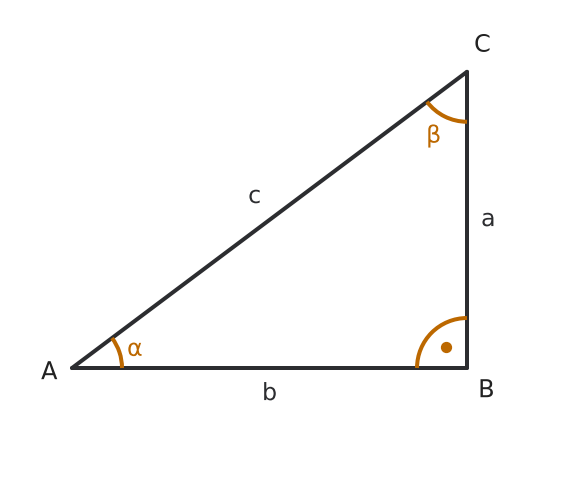
Figure for problem 550848

Hints

- Describe each labeled side once relative to \(\alpha\) and again relative to \(\beta\). - The same leg can be opposite one acute angle and adjacent to the other. - Compare the resulting side ratios before simplifying the tangent product.

Solution

1. Relative to \(\alpha\), the opposite side is \(a\), the adjacent leg is \(b\), and the hypotenuse is \(c\). Thus, \(\sin(\alpha)=\frac{a}{c}\), \(\cos(\alpha)=\frac{b}{c}\), and \(\tan(\alpha)=\frac{a}{b}\). 2. Relative to \(\beta\), the opposite side is \(b\), the adjacent leg is \(a\), and the hypotenuse is \(c\). Thus, \(\cos(\beta)=\frac{a}{c}\), \(\sin(\beta)=\frac{b}{c}\), and \(\tan(\beta)=\frac{b}{a}\). 3. Therefore, \(\sin(\alpha)=\cos(\beta)\) and \(\cos(\alpha)=\sin(\beta)\). 4. Also, \(\tan(\alpha)\tan(\beta)=\frac{a}{b}\cdot\frac{b}{a}=1\).

Answer

\(\sin(\alpha)=\cos(\beta)\), \(\cos(\alpha)=\sin(\beta)\), and \(\tan(\alpha)\tan(\beta)=1\)

55084912
In the unit-circle diagram, \(OR\) is the positive horizontal radius. Point \(P\) is at angle \(\alpha\) above \(OR\), and \(Q\) is the reflection of \(P\) across the horizontal diameter. If the coordinates of \(P\) are \((\cos(\alpha),\sin(\alpha))\), determine the coordinates of \(Q\). Use the reflection to justify the identities for \(\cos(-\alpha)\) and \(\sin(-\alpha)\).
Figure for problem 550849

Hints

- A horizontal reflection changes only one coordinate. - Match the reflected point to the unit-circle angle below the positive horizontal radius. - Compare the coordinate descriptions of \(P\) and \(Q\) component by component.

Solution

1. Reflection across the horizontal diameter keeps the horizontal coordinate unchanged and reverses the sign of the vertical coordinate. 2. Therefore, \(Q=(\cos(\alpha),-\sin(\alpha))\). 3. Point \(Q\) represents the angle \(-\alpha\), so its coordinates are also \((\cos(-\alpha),\sin(-\alpha))\). 4. Comparing coordinates gives \(\cos(-\alpha)=\cos(\alpha)\) and \(\sin(-\alpha)=-\sin(\alpha)\).

Answer

\(Q=(\cos(\alpha),-\sin(\alpha))\) \(\cos(-\alpha)=\cos(\alpha)\) \(\sin(-\alpha)=-\sin(\alpha)\)
51009312
Three of the functions are equivalent, and one is different. Which one is different? a) \(y=\sin(2x)\) b) \(y=\sin(2(x+\pi))\) c) \(y=\cos\left(2x-\frac{\pi}{2}\right)\) d) \(y=\cos\left(2x+\frac{\pi}{2}\right)\)

Hints

- Use the period \(2\pi\) of sine and cosine. - Recall the phase-shift relationships between sine and cosine. - Check the signs in the identities involving shifts by \(\frac{\pi}{2}\).

Solution

1. For part b, \(\sin(2(x+\pi))=\sin(2x+2\pi)=\sin(2x)\) by periodicity. 2. For part c, use \(\cos\left(\alpha-\frac{\pi}{2}\right)=\sin(\alpha)\). Thus, \(\cos\left(2x-\frac{\pi}{2}\right)=\sin(2x)\). 3. For part d, \(\cos\left(\alpha+\frac{\pi}{2}\right)=-\sin(\alpha)\). Thus, \(\cos\left(2x+\frac{\pi}{2}\right)=-\sin(2x)\), which is different.

Answer

d) \(y=\cos\left(2x+\frac{\pi}{2}\right)\)
51510712
For an acute angle \(\beta\) in a right triangle, \(\tan(\beta)=\frac{15}{8}\). Find \(\sin(\beta)\) and \(\cos(\beta)\) without finding \(\beta\). Then find \(\sin(90^\circ-\beta)\) and \(\cos(90^\circ-\beta)\).

Hints

- Interpret tangent as a ratio of the legs. - Use the Pythagorean theorem to find the hypotenuse. - Recall the cofunction relationships for complementary angles.

Solution

1. Use proportional leg lengths \(15\) and \(8\). The hypotenuse is \(\sqrt{15^2+8^2}=17\). 2. Therefore, \(\sin(\beta)=\frac{15}{17}\) and \(\cos(\beta)=\frac{8}{17}\). 3. By the cofunction identities, \(\sin(90^\circ-\beta)=\cos(\beta)=\frac{8}{17}\) and \(\cos(90^\circ-\beta)=\sin(\beta)=\frac{15}{17}\).

Answer

\(\sin(\beta)=\frac{15}{17}\) \(\cos(\beta)=\frac{8}{17}\) \(\sin(90^\circ-\beta)=\frac{8}{17}\) \(\cos(90^\circ-\beta)=\frac{15}{17}\)
51512812
Simplify the expression completely. State the identities used. \(\sin(90^\circ-\beta)\cos(\beta)+\cos(90^\circ-\beta)\sin(\beta)\)

Hints

- Replace the trigonometric functions of the complementary angles. - Look for the Pythagorean identity after substitution. - The cofunction relationships come from the complementary acute angles in a right triangle.

Solution

1. Use the cofunction identities: \(\sin(90^\circ-\beta)=\cos(\beta)\) and \(\cos(90^\circ-\beta)=\sin(\beta)\). 2. The expression becomes \(\cos^2(\beta)+\sin^2(\beta)\). 3. By the Pythagorean identity, the result is \(1\).

Answer

\(1\)
51513412
In a right triangle, \(\alpha\) and \(\beta\) are the two acute angles. a) Use the tangent ratios to prove that \(\tan(\alpha)\tan(\beta)=1\). b) Given \(\tan(22.5^\circ)\approx 0.4142\), find \(\tan(67.5^\circ)\) without using the tangent key again.

Hints

- View the two legs from each acute angle. - What happens when a nonzero fraction is multiplied by its reciprocal? - How are \(22.5^\circ\) and \(67.5^\circ\) related?

Solution

1. If the legs are \(a\) and \(b\), then \(\tan(\alpha)=\frac{a}{b}\) and \(\tan(\beta)=\frac{b}{a}\). 2. Their product is \(\frac{a}{b}\cdot\frac{b}{a}=1\). 3. Since \(22.5^\circ\) and \(67.5^\circ\) are complementary, their tangent values are reciprocals. 4. Thus, \(\tan(67.5^\circ)=\frac{1}{0.4142}\approx 2.4143\).

Answer

a) \(\tan(\alpha)\tan(\beta)=\frac{a}{b}\cdot\frac{b}{a}=1\) b) \(\tan(67.5^\circ)\approx 2.4143\)
51513812
Let \(\alpha\) be any angle in Quadrant I, and let \(\gamma = 360^\circ-\alpha\). a) Compare \(\sin(\alpha)\) and \(\sin(360^\circ-\alpha)\). b) Compare \(\cos(\alpha)\) and \(\cos(360^\circ-\alpha)\). c) Justify your results by describing the positions of the corresponding points on the unit circle.

Hints

- Picture one angle measured counterclockwise from the positive x-axis and the other just below that axis. - Which axis is the line of symmetry between the two points? - How do the coordinates of reflected points compare?

Solution

1. The point for \(\alpha\) has coordinates \((\cos(\alpha), \sin(\alpha))\). 2. The angle \(360^\circ-\alpha\) produces the reflection of this point across the x-axis. 3. Reflection across the x-axis keeps the x-coordinate and reverses the sign of the y-coordinate. 4. Therefore, \(\cos(360^\circ-\alpha)=\cos(\alpha)\). 5. Also, \(\sin(360^\circ-\alpha)=-\sin(\alpha)\).

Answer

a) \(\sin(360^\circ-\alpha)=-\sin(\alpha)\) b) \(\cos(360^\circ-\alpha)=\cos(\alpha)\) c) The two unit-circle points are reflections across the x-axis, so their x-coordinates are equal and their y-coordinates are opposites.
51515612
For an acute angle \(\alpha\), \(\sin(\alpha)=0.28\). a) Use the Pythagorean identity to find \(\cos(\alpha)\). b) Find \(\sin(180^\circ-\alpha)\) and \(\cos(360^\circ-\alpha)\).

Hints

- Which identity relates sine and cosine of the same angle? - How do unit-circle coordinates change under reflection across the y-axis or x-axis? - In which quadrant does \(360^\circ-\alpha\) lie when \(\alpha\) is acute?

Solution

1. Use \(\sin^2(\alpha)+\cos^2(\alpha)=1\): \(0.28^2+\cos^2(\alpha)=1\). 2. Then \(\cos^2(\alpha)=1-0.0784=0.9216\). Because \(\alpha\) is acute, cosine is positive, so \(\cos(\alpha)=\sqrt{0.9216}=0.96\). 3. Supplementary angles have equal sine values, so \(\sin(180^\circ-\alpha)=\sin(\alpha)=0.28\). 4. The angles \(\alpha\) and \(360^\circ-\alpha\) have equal cosine values, so \(\cos(360^\circ-\alpha)=\cos(\alpha)=0.96\).

Answer

a) \(\cos(\alpha)=0.96\) b) \(\sin(180^\circ-\alpha)=0.28\) and \(\cos(360^\circ-\alpha)=0.96\)
51516412
Use unit-circle symmetry and known exact values to solve each part without a calculator. a) Evaluate \(x=\sin(150^\circ)+\cos(60^\circ)\) exactly. b) Let \(\alpha=120^\circ\). Find an angle \(\beta\) with \(180^\circ<\beta<270^\circ\) that has the same cosine value as \(\alpha\). c) Explain without calculation why \(\sin(\alpha)=\cos(\alpha)\) has exactly one solution in \(0^\circ<\alpha<90^\circ\), namely \(\alpha=45^\circ\).

Hints

- Use \(\sin(180^\circ-\theta)=\sin(\theta)\). - Recall the exact values for \(30^\circ\), \(45^\circ\), and \(60^\circ\). - Find the Quadrant III angle with the same x-coordinate as the point for \(120^\circ\). - When does a point have equal x- and y-coordinates?

Solution

1. \(\sin(150^\circ)=\sin(30^\circ)=\frac{1}{2}\), and \(\cos(60^\circ)=\frac{1}{2}\). Therefore, \(x=1\). 2. The cosine of \(120^\circ\) is \(-\frac{1}{2}\). In Quadrant III, the angle with reference angle \(60^\circ\) is \(180^\circ+60^\circ=240^\circ\), so \(\beta=240^\circ\). 3. On the unit circle, sine and cosine are the y- and x-coordinates. Equality requires \(y=x\). In Quadrant I, the line \(y=x\) meets the unit circle at the point corresponding to \(45^\circ\).

Answer

a) \(x=1\) b) \(\beta=240^\circ\) c) Equality requires the unit-circle point to lie on \(y=x\), which occurs in Quadrant I only at \(45^\circ\).
51516812
Given that \(\sin(10^\circ) \approx 0.1736\), find the following without using the sine key on a calculator. a) \(\cos(80^\circ)\) b) \(\sin(170^\circ)\) and \(\sin(190^\circ)\) c) All angles \(\gamma\) in \(0^\circ \le \gamma < 360^\circ\) such that \(\cos(90^\circ-\gamma)=-\sin(10^\circ)\)

Hints

- Use the cofunction relationship between sine and cosine of complementary angles. - Express \(170^\circ\) and \(190^\circ\) in terms of \(10^\circ\) and \(180^\circ\). - Simplify \(\cos(90^\circ-\gamma)\) before solving.

Solution

1. By the cofunction identity, \(\cos(80^\circ)=\sin(10^\circ) \approx 0.1736\). 2. Since \(170^\circ=180^\circ-10^\circ\), \(\sin(170^\circ)=\sin(10^\circ) \approx 0.1736\). 3. Since \(190^\circ=180^\circ+10^\circ\), \(\sin(190^\circ)=-\sin(10^\circ) \approx -0.1736\). 4. Rewrite \(\cos(90^\circ-\gamma)\) as \(\sin(\gamma)\). Thus, solve \(\sin(\gamma)=-\sin(10^\circ)\). 5. Using the reference angle \(10^\circ\), the solutions are \(180^\circ+10^\circ=190^\circ\) and \(360^\circ-10^\circ=350^\circ\).

Answer

a) \(\cos(80^\circ) \approx 0.1736\) b) \(\sin(170^\circ) \approx 0.1736\); \(\sin(190^\circ) \approx -0.1736\) c) \(\gamma=190^\circ\) or \(\gamma=350^\circ\)
51545912
Let \(\delta\) be an acute angle. a) Simplify \(\frac{\sin(\delta)}{\cos(90^\circ-\delta)}\). b) Prove that \(\tan(\delta)\tan(90^\circ-\delta)=1\).

Hints

- Use the cofunction relationships for complementary angles. - Rewrite each tangent as a quotient of sine and cosine.

Solution

1. By the cofunction identity, \(\cos(90^\circ-\delta)=\sin(\delta)\). Therefore, the expression in part a equals \(1\). 2. Also, \(\tan(\delta)=\frac{\sin(\delta)}{\cos(\delta)}\) and \(\tan(90^\circ-\delta)=\frac{\cos(\delta)}{\sin(\delta)}\). 3. Their product is \(\frac{\sin(\delta)}{\cos(\delta)}\cdot\frac{\cos(\delta)}{\sin(\delta)}=1\).

Answer

a) \(1\) b) The tangent values are reciprocals, so their product is \(1\).
52183112
Find all \(c\in[0, 2\pi]\) for which \(f(x)=\cos(x+c)\) is odd.

Hints

- Use the value an odd function must have at \(x=0\). - Solve \(\cos(c)=0\) on the given interval. - Verify each candidate by rewriting the shifted cosine as a sine function.

Solution

1. An odd function that is defined at \(0\) must satisfy \(f(0)=0\). 2. Here, \(f(0)=\cos(c)\), so \(\cos(c)=0\). 3. On \([0, 2\pi]\), the solutions are \(c=\frac{\pi}{2}\) and \(c=\frac{3\pi}{2}\). 4. Verify: when \(c=\frac{\pi}{2}\), \(f(x)=-\sin(x)\), which is odd. When \(c=\frac{3\pi}{2}\), \(f(x)=\sin(x)\), which is also odd.

Answer

\(c\in\left\{\frac{\pi}{2}, \frac{3\pi}{2}\right\}\)
52362212
Given that \(\cos(35^\circ) \approx 0.819\), use unit-circle symmetry and periodicity to find each value without a calculator. a) \(\cos(325^\circ)\) b) \(\cos(145^\circ)\) c) \(\cos(-35^\circ)\) d) \(\cos(395^\circ)\)

Hints

- Consider the point for \(35^\circ\) on the unit circle. - Express each angle in terms of \(35^\circ\), \(180^\circ\), or \(360^\circ\). - Which unit-circle coordinate represents cosine? - Recall the period and even symmetry of cosine.

Solution

1. Since \(325^\circ=360^\circ-35^\circ\), \(\cos(325^\circ)=\cos(35^\circ) \approx 0.819\). 2. Since \(145^\circ=180^\circ-35^\circ\), \(\cos(145^\circ)=-\cos(35^\circ) \approx -0.819\). 3. Cosine is even, so \(\cos(-35^\circ)=\cos(35^\circ) \approx 0.819\). 4. Cosine has period \(360^\circ\), so \(\cos(395^\circ)=\cos(35^\circ) \approx 0.819\).

Answer

a) \(0.819\) b) \(-0.819\) c) \(0.819\) d) \(0.819\)
52365712
Six cards show trigonometric expressions for \(0^\circ\le\alpha<360^\circ\). A: \(\sin(180^\circ+\alpha)\) B: \(\cos(270^\circ+\alpha)\) C: \(\sin(360^\circ-\alpha)\) D: \(\cos(90^\circ-\alpha)\) E: \(\sin(180^\circ-\alpha)\) F: \(\cos(270^\circ-\alpha)\) Sort the cards into two groups of three so that all expressions in each group are equal for every angle \(\alpha\).

Hints

- Use unit-circle identities for shifts by \(90^\circ\), \(180^\circ\), and \(270^\circ\). - Track whether sine and cosine switch roles and whether the sign changes. - Testing a simple angle such as \(10^\circ\) can help you check a proposed grouping.

Solution

1. Rewrite each expression using unit-circle identities: - A: \(\sin(180^\circ+\alpha)=-\sin(\alpha)\) - B: \(\cos(270^\circ+\alpha)=\sin(\alpha)\) - C: \(\sin(360^\circ-\alpha)=-\sin(\alpha)\) - D: \(\cos(90^\circ-\alpha)=\sin(\alpha)\) - E: \(\sin(180^\circ-\alpha)=\sin(\alpha)\) - F: \(\cos(270^\circ-\alpha)=-\sin(\alpha)\) 2. Therefore, B, D, and E all equal \(\sin(\alpha)\), while A, C, and F all equal \(-\sin(\alpha)\).

Answer

Group 1: B, D, E Group 2: A, C, F
52365812
Determine which equations are identities for every angle \(0^\circ\le\alpha<360^\circ\). 1. \(\cos(180^\circ-\alpha)=\cos(180^\circ+\alpha)\) 2. \(\sin(90^\circ+\alpha)=\sin(90^\circ-\alpha)\) 3. \(\cos(90^\circ+\alpha)=\sin(180^\circ+\alpha)\) 4. \(\sin(270^\circ-\alpha)=\cos(180^\circ-\alpha)\) 5. \(\cos(360^\circ-\alpha)=-\cos(\alpha)\)

Hints

- Use symmetry identities for sine and cosine. - Recall how shifts by \(90^\circ\) and \(270^\circ\) relate sine and cosine. - A single counterexample, such as \(\alpha=0^\circ\), is enough to disprove an identity.

Solution

1. Both sides of equation 1 equal \(-\cos(\alpha)\), so it is an identity. 2. Both sides of equation 2 equal \(\cos(\alpha)\), so it is an identity. 3. Both sides of equation 3 equal \(-\sin(\alpha)\), so it is an identity. 4. Both sides of equation 4 equal \(-\cos(\alpha)\), so it is an identity. 5. The left side of equation 5 is \(\cos(\alpha)\), not \(-\cos(\alpha)\) for every angle, so equation 5 is not an identity.

Answer

Equations 1, 2, 3, and 4 are identities. Equation 5 is not.
52367112
For each angle \(\alpha\), find all angles \(\beta\) with \(0^\circ \le \beta < 360^\circ\) and \(\beta \ne \alpha\) such that \(\cos(\beta)=\cos(\alpha)\). a) \(\alpha=130^\circ\) b) \(\alpha=310^\circ\) c) \(\alpha=-45^\circ\)

Hints

- Reflecting a unit-circle point across the x-axis keeps its x-coordinate unchanged. - Use \(\cos(\theta)=\cos(-\theta)\). - Add or subtract \(360^\circ\) to place an angle in the required interval.

Solution

1. Cosine is even and has period \(360^\circ\), so reflecting an angle across the x-axis preserves its cosine value. 2. For a), \(\beta=360^\circ-130^\circ=230^\circ\). 3. For b), \(\beta=360^\circ-310^\circ=50^\circ\). 4. For c), \(\cos(-45^\circ)=\cos(45^\circ)\), so \(\beta=45^\circ\) works. The coterminal angle \(315^\circ\) also works.

Answer

a) \(\beta=230^\circ\) b) \(\beta=50^\circ\) c) \(\beta=45^\circ\) or \(\beta=315^\circ\)
52372912
Let \(f(x)=2.5\cos\left(x-\frac{\pi}{4}\right)-1\). Write an equivalent function in the form \(g(x)=a\sin(x-c)+d\), and identify \(a\), \(c\), and \(d\).

Hints

- The amplitude and vertical shift do not change when converting between sine and cosine forms. - Recall the phase-shift identity relating cosine to sine. - Rewrite an addition inside the argument as subtraction of a negative value.

Solution

1. The amplitude and vertical shift remain \(a=2.5\) and \(d=-1\). 2. Use \(\cos(\alpha)=\sin\left(\alpha+\frac{\pi}{2}\right)\), with \(\alpha=x-\frac{\pi}{4}\). 3. Then \(f(x)=2.5\sin\left(x-\frac{\pi}{4}+\frac{\pi}{2}\right)-1=2.5\sin\left(x+\frac{\pi}{4}\right)-1\). 4. Since \(x+\frac{\pi}{4}=x-\left(-\frac{\pi}{4}\right)\), \(c=-\frac{\pi}{4}\).

Answer

\(g(x)=2.5\sin\left(x+\frac{\pi}{4}\right)-1\); \(a=2.5\), \(c=-\frac{\pi}{4}\), \(d=-1\)
52373012
Two functions are defined by \(f(x)=\cos(x-c)\) and \(g(x)=\sin(x-c_2)\). 1. Use \(\cos(x)=\sin\left(x+\frac{\pi}{2}\right)\) to derive a formula for one value of \(c_2\) that makes the two functions identical for a given \(c\). 2. Find \(c_2\) when \(c=\frac{3\pi}{4}\).

Hints

- Replace the cosine expression with an equivalent shifted sine expression. - For the functions to match for every \(x\), their sine inputs can be matched modulo \(2\pi\). - Use a common denominator when subtracting fractions involving \(\pi\).

Solution

1. Apply the identity to the full argument: \(\cos(x-c)=\sin\left(x-c+\frac{\pi}{2}\right)\). 2. Match the sine arguments: \(x-c_2=x-c+\frac{\pi}{2}\). Therefore, \(c_2=c-\frac{\pi}{2}\). Equivalent values differ by integer multiples of \(2\pi\). 3. When \(c=\frac{3\pi}{4}\), \(c_2=\frac{3\pi}{4}-\frac{\pi}{2}=\frac{\pi}{4}\).

Answer

1. \(c_2=c-\frac{\pi}{2}\), up to integer multiples of \(2\pi\) 2. \(c_2=\frac{\pi}{4}\)
52375512
A point \(P(x, y)\) on the unit circle corresponds to \(\alpha=115^\circ\). a) Approximate the coordinates of \(P\) to the nearest hundredth. b) Find another angle \(\beta\) between \(0^\circ\) and \(360^\circ\) such that \(\sin(\beta)=\sin(\alpha)\). c) Find another angle \(\gamma\) between \(0^\circ\) and \(360^\circ\) such that \(\cos(\gamma)=\cos(\alpha)\).

Hints

- How do the coordinates of a unit-circle point relate to sine and cosine? - Which reflection preserves the y-coordinate? - Which reflection preserves the x-coordinate?

Solution

1. A unit-circle point has coordinates \((\cos(\alpha), \sin(\alpha))\). Since \(\cos(115^\circ)\approx-0.42\) and \(\sin(115^\circ)\approx0.91\), \(P\approx(-0.42, 0.91)\). 2. Angles reflected across the y-axis have the same sine. Thus, \(\beta=180^\circ-115^\circ=65^\circ\). 3. Angles reflected across the x-axis have the same cosine. Thus, \(\gamma=360^\circ-115^\circ=245^\circ\).

Answer

a) \(P(-0.42, 0.91)\) b) \(\beta=65^\circ\) c) \(\gamma=245^\circ\)
52378412
Use unit-circle symmetry to justify each equation. a) \(\cos(200^\circ)=\cos(160^\circ)\) b) \(\sin(200^\circ)=-\sin(20^\circ)\)

Hints

- Which coordinate represents sine, and which represents cosine? - Express \(200^\circ\) and \(160^\circ\) using \(180^\circ\pm20^\circ\). - Track how reflections across an axis or through the origin change coordinates.

Solution

1. The angles \(200^\circ=180^\circ+20^\circ\) and \(160^\circ=180^\circ-20^\circ\) correspond to points reflected across the x-axis. Their x-coordinates are equal, so \(\cos(200^\circ)=\cos(160^\circ)\). 2. The point for \(200^\circ\) is the reflection of the point for \(20^\circ\) through the origin. This changes the sign of the y-coordinate, so \(\sin(200^\circ)=-\sin(20^\circ)\).

Answer

a) The unit-circle points are reflections across the x-axis, so their x-coordinates, and therefore their cosine values, are equal. b) The unit-circle points are opposites through the origin, so their y-coordinates, and therefore their sine values, have opposite signs.
52863212
For an acute angle \(\alpha\), \(\sin(\alpha)=0.8\). a) Find \(\cos(\alpha)\) without first finding the angle. Use \(\sin^2(\alpha)+\cos^2(\alpha)=1\). b) Find the angle \(\beta\) between \(0^\circ\) and \(90^\circ\) for which \(\cos(\beta)=0.8\). What is the relationship between \(\alpha\) and \(\beta\)?

Hints

- Use the Pythagorean identity to relate sine and cosine. - Because the angle is acute, choose the positive square root. - Sine and cosine interchange for complementary angles.

Solution

1. Substitute \(\sin(\alpha)=0.8\) into the Pythagorean identity: \((0.8)^2+\cos^2(\alpha)=1\). 2. Then \(\cos^2(\alpha)=1-0.64=0.36\). 3. Because \(\alpha\) is acute, cosine is positive, so \(\cos(\alpha)=\sqrt{0.36}=0.6\). 4. Since \(\cos(\beta)=0.8\), \(\beta=\cos^{-1}(0.8)\approx36.87^\circ\). 5. Also, \(\sin(\alpha)=\cos(90^\circ-\alpha)\), so \(\beta=90^\circ-\alpha\). The two angles are complementary.

Answer

a) \(\cos(\alpha)=0.6\) b) \(\beta\approx36.87^\circ\), and \(\alpha+\beta=90^\circ\).
52864412
Rewrite \(y=-2\cos(0.5x+\pi)\) in the form \(y=a\sin(b(x+c))\).

Hints

- You may keep the outside coefficient negative. - Recall the phase shift that converts cosine to sine. - Factor the coefficient of \(x\) from the entire input.

Solution

1. Use \(\cos(u)=\sin\left(u+\frac{\pi}{2}\right)\): \(y=-2\sin\left(0.5x+\frac{3\pi}{2}\right)\). 2. Factor out \(0.5\): \(y=-2\sin\left(0.5(x+3\pi)\right)\). 3. By periodicity, an equivalent form is \(y=-2\sin\left(0.5(x-\pi)\right)\).

Answer

\(y=-2\sin\left(0.5(x+3\pi)\right)\); equivalently, \(y=-2\sin\left(0.5(x-\pi)\right)\)
52864512
Given \(\sin(34^\circ)\approx0.56\) and \(\cos(21^\circ)\approx0.93\), use unit-circle identities to find each value without a calculator. a) \(\sin(146^\circ)\) b) \(\cos(159^\circ)\) c) \(\sin(69^\circ)\) d) \(\cos(-21^\circ)\)

Hints

- Identify each angle’s quadrant or complementary relationship. - Use identities involving angles that sum to \(90^\circ\) or \(180^\circ\). - Recall the even symmetry of cosine.

Solution

1. Since \(146^\circ=180^\circ-34^\circ\), \(\sin(146^\circ)=\sin(34^\circ)\approx0.56\). 2. Since \(159^\circ=180^\circ-21^\circ\), \(\cos(159^\circ)=-\cos(21^\circ)\approx-0.93\). 3. Since \(69^\circ=90^\circ-21^\circ\), \(\sin(69^\circ)=\cos(21^\circ)\approx0.93\). 4. Cosine is even, so \(\cos(-21^\circ)=\cos(21^\circ)\approx0.93\).

Answer

a) \(0.56\) b) \(-0.93\) c) \(0.93\) d) \(0.93\)
53357612
The graph of \(g\) is a horizontal shift of the parent function \(f(x)=\sin(x)\). a) Use the graph to determine \(g(x)\). b) Give the coordinates of the first maximum point of \(g\) for \(x \geq 0\).
Figure for problem 533576

Hints

- Compare corresponding zeros or maximum points of the two graphs. - A shift right appears as subtraction inside the function input. - Shift the location of the parent sine function's first maximum by the same amount.

Solution

1. The graph of \(g\) crosses the x-axis with positive slope at \(x=\frac{\pi}{2}\), so the parent sine graph has been shifted right by \(\frac{\pi}{2}\). 2. Therefore, \(g(x)=\sin\left(x-\frac{\pi}{2}\right)\), which is also \(-\cos(x)\). 3. The first maximum of \(\sin(x)\) occurs at \(x=\frac{\pi}{2}\). After the shift, it occurs at \(x=\pi\), with y-coordinate \(1\).

Answer

a) \(g(x)=\sin\left(x-\frac{\pi}{2}\right)\), equivalently \(g(x)=-\cos(x)\) b) \((\pi, 1)\)
53385112
Two trigonometric graphs and six equations are given. Match each graph with the two equivalent equations that represent it. A: \(f(x)=2\sin(0.5\pi x)+1\) B: \(f(x)=2\cos(0.5\pi(x-1))+1\) C: \(f(x)=2\sin(0.5\pi(x-1))+1\) D: \(f(x)=-2\cos(0.5\pi x)+1\) E: \(f(x)=1.5\sin(\pi x)+1\) F: \(f(x)=2\sin(0.5\pi x)-1\)
Figure for problem 533851

Hints

- Find each graph's midline, amplitude, and period. - Check for horizontal shifts and reflections. - Use identities that relate sine and cosine after a phase shift.

Solution

1. Graph (1) has midline \(y=1\), amplitude \(2\), period \(4\), and an increasing midline crossing at \(x=0\). Thus, equation A matches. 2. In equation B, \(0.5\pi(x-1)=0.5\pi x-\frac{\pi}{2}\), and \(\cos\left(\theta-\frac{\pi}{2}\right)=\sin(\theta)\). Therefore, B is equivalent to A and also matches graph (1). 3. Graph (2) has the same midline, amplitude, and period but is shifted right \(1\) unit. Thus, equation C matches. 4. Since \(-\cos(\theta)=\sin\left(\theta-\frac{\pi}{2}\right)\), equation D is equivalent to C and also matches graph (2).

Answer

(1) A and B; (2) C and D
53405712
The graph shows \(f(x)=\cos(x+c)\). Find the least positive value of \(c \in [0, 2\pi]\) that makes the graph symmetric about the origin. Use the location of the first minimum for \(x>0\).
Figure for problem 534057

Hints

- An odd function must pass through the origin. - Compare the graph with the parent sine function and its reflection. - Recall the phase-shift relationship between sine and cosine. - Express the minimum location near \(1.57\) as a multiple of \(\pi\).

Solution

1. A graph symmetric about the origin must be an odd function. The graph passes through the origin and decreases for small positive \(x\), so it matches \(-\sin(x)\). 2. Use \(\cos\left(x+\frac{\pi}{2}\right)=-\sin(x)\). 3. The first minimum of \(-\sin(x)\) occurs at \(x=\frac{\pi}{2}\), matching the graph. 4. Therefore, the least positive value is \(c=\frac{\pi}{2}\).

Answer

\(c=\frac{\pi}{2}\)
55070112
A student writes, “Because cosine is even, \(\cos(\pi-x)=\cos(x)\).” Explain the error and give the correct identity for \(\cos(\pi-x)\).

Hints

- What exact input change appears in the even-function identity for cosine? - Compare \(-x\) with \(\pi-x\). - You can check the sign by thinking about the unit-circle reflection across the y-axis.

Solution

1. The even-function identity applies to \(\cos(-x)\), not to \(\cos(\pi-x)\). 2. Use the subtraction identity: \(\cos(\pi-x)=\cos(\pi)\cos(x)+\sin(\pi)\sin(x)\). 3. Since \(\cos(\pi)=-1\) and \(\sin(\pi)=0\), \(\cos(\pi-x)=-\cos(x)\).

Answer

The student applied evenness to the wrong transformed angle. The correct identity is \(\cos(\pi-x)=-\cos(x)\).
51517412
Use unit-circle symmetry to investigate relationships among trigonometric values. a) Calculate \(\sin(70^\circ)\) and \(\sin(110^\circ)\) to four decimal places. What do you notice? b) Explain the relationship for any angle \(\alpha\) with \(0^\circ<\alpha<90^\circ\) using unit-circle symmetry. c) Determine whether \(\cos(\alpha)=\cos(180^\circ-\alpha)\) is also true in general.

Hints

- Calculate the first two values and compare them. - Picture the two unit-circle points and identify their line of symmetry. - Which coordinate represents sine, and which represents cosine? - How does reflection across the y-axis change an ordered pair?

Solution

1. \(\sin(70^\circ) \approx 0.9397\) and \(\sin(110^\circ) \approx 0.9397\), so the values are equal. 2. The point for \(180^\circ-\alpha\) is the reflection of the point for \(\alpha\) across the y-axis. The y-coordinate does not change, so \(\sin(180^\circ-\alpha)=\sin(\alpha)\). 3. The x-coordinate changes sign under this reflection, so \(\cos(180^\circ-\alpha)=-\cos(\alpha)\). 4. For example, \(\cos(70^\circ) \approx 0.3420\), while \(\cos(110^\circ) \approx -0.3420\). Therefore, the proposed cosine equation is not true in general.

Answer

a) \(\sin(70^\circ)=\sin(110^\circ) \approx 0.9397\) b) \(\sin(180^\circ-\alpha)=\sin(\alpha)\) c) No. In general, \(\cos(180^\circ-\alpha)=-\cos(\alpha)\).
55070212
Let \(f(x)=a\sin(x)+b\cos(x)\). Suppose that both conditions hold for every real \(x\): \(f(-x)=-f(x)\) and \(f\left(\frac{\pi}{2}-x\right)=2\cos(x)\). Find \(a\) and \(b\).

Hints

- Use the first condition to determine the parity of \(f\). - Think about which linear combination of an odd function and an even function can itself be odd for every \(x\). - After using the first condition, apply the cofunction identity to the second condition.

Solution

1. The condition \(f(-x)=-f(x)\) says that \(f\) is odd. 2. Since \(\sin(x)\) is odd and \(\cos(x)\) is even, the cosine term must vanish, so \(b=0\). 3. Then \(f\left(\frac{\pi}{2}-x\right)=a\sin\left(\frac{\pi}{2}-x\right)=a\cos(x)\). 4. Because this equals \(2\cos(x)\) for every \(x\), \(a=2\).

Answer

\(a=2\) and \(b=0\)

All problems may be used, copied and printed free of charge for school and tutoring, including paid tutoring. Commercial adaptations as well as publication or redistribution on the internet are not permitted.