Aimathic
Login | English | Deutsch

Free math worksheets

Build your own math worksheets from 30,000+ problems for grades 3 to 12, from fractions to AP Calculus. Every problem comes with step-by-step solutions.

Angle addition and subtraction identities

Click problems to add them to your worksheet.

55070312
Use an angle-addition identity to find the exact value of \(\sin(75^\circ)\).

Hints

- Express \(75^\circ\) as a sum of two familiar special angles. - Choose the sine addition formula. - Keep the result exact rather than converting to a decimal.

Solution

1. Write \(75^\circ=45^\circ+30^\circ\). 2. Use \(\sin(A+B)=\sin(A)\cos(B)+\cos(A)\sin(B)\). 3. Then \(\sin(75^\circ)=\frac{\sqrt{2}}{2}\cdot\frac{\sqrt{3}}{2}+\frac{\sqrt{2}}{2}\cdot\frac{1}{2}=\frac{\sqrt{6}+\sqrt{2}}{4}\).

Answer

\(\frac{\sqrt{6}+\sqrt{2}}{4}\)
55070412
Use an angle-addition identity to find the exact value of \(\cos(105^\circ)\).

Hints

- Split \(105^\circ\) into two special angles. - Pay attention to the subtraction sign in the cosine addition formula. - The sign of the final value should agree with the quadrant of \(105^\circ\).

Solution

1. Write \(105^\circ=60^\circ+45^\circ\). 2. Use \(\cos(A+B)=\cos(A)\cos(B)-\sin(A)\sin(B)\). 3. Then \(\cos(105^\circ)=\frac{1}{2}\cdot\frac{\sqrt{2}}{2}-\frac{\sqrt{3}}{2}\cdot\frac{\sqrt{2}}{2}=\frac{\sqrt{2}-\sqrt{6}}{4}\).

Answer

\(\frac{\sqrt{2}-\sqrt{6}}{4}\)
55070512
Use the tangent addition identity to find the exact value of \(\tan(75^\circ)\).

Hints

- Use a decomposition of \(75^\circ\) involving \(45^\circ\) and \(30^\circ\). - The tangent addition formula has a denominator that can affect the sign. - Simplify the exact fraction without using a decimal approximation.

Solution

1. Write \(75^\circ=45^\circ+30^\circ\). 2. Use \(\tan(A+B)=\frac{\tan(A)+\tan(B)}{1-\tan(A)\tan(B)}\). 3. Substitute the special-angle values: \(\tan(75^\circ)=\frac{1+\frac{1}{\sqrt{3}}}{1-\frac{1}{\sqrt{3}}}\). 4. Simplifying gives \(\tan(75^\circ)=2+\sqrt{3}\).

Answer

\(2+\sqrt{3}\)
55070612
Angles \(\alpha\) and \(\beta\) are acute. Suppose \(\sin(\alpha)=\frac{3}{5}\), \(\cos(\alpha)=\frac{4}{5}\), \(\sin(\beta)=\frac{5}{13}\), and \(\cos(\beta)=\frac{12}{13}\). Find the exact value of \(\sin(\alpha+\beta)\).

Hints

- Identify which addition formula directly uses all four given values. - Keep a common denominator when combining the two products. - Check that the result lies between \(-1\) and \(1\).

Solution

1. Use \(\sin(\alpha+\beta)=\sin(\alpha)\cos(\beta)+\cos(\alpha)\sin(\beta)\). 2. Substitute the given values: \(\frac{3}{5}\cdot\frac{12}{13}+\frac{4}{5}\cdot\frac{5}{13}\). 3. The result is \(\frac{36}{65}+\frac{20}{65}=\frac{56}{65}\).

Answer

\(\frac{56}{65}\)
55070712
Use an angle-addition identity to verify that \(\cos\left(x+\frac{\pi}{2}\right)=-\sin(x)\) for every real \(x\).

Hints

- Treat \(x\) and \(\frac{\pi}{2}\) as the two angles in a cosine addition formula. - Substitute the exact sine and cosine values at \(\frac{\pi}{2}\). - Check the sign in the cosine addition formula carefully.

Solution

1. Use \(\cos(A+B)=\cos(A)\cos(B)-\sin(A)\sin(B)\). 2. Then \(\cos\left(x+\frac{\pi}{2}\right)=\cos(x)\cos\left(\frac{\pi}{2}\right)-\sin(x)\sin\left(\frac{\pi}{2}\right)\). 3. Since \(\cos\left(\frac{\pi}{2}\right)=0\) and \(\sin\left(\frac{\pi}{2}\right)=1\), the expression equals \(-\sin(x)\).

Answer

\(\cos\left(x+\frac{\pi}{2}\right)=-\sin(x)\)
52183212
Let \(f(x)=\sin\left(\frac{1}{2}x+c\right)\). Find all \(c\in[0, 2\pi]\) for which \(f\) is even.

Hints

- Expand the shifted sine using an angle-addition identity. - Identify which resulting term is even and which is odd. - Set the coefficient of the odd term equal to \(0\).

Solution

1. An even function must satisfy \(f(-x)=f(x)\) for every \(x\). 2. Use the angle-addition identity: \(f(x)=\sin(c)\cos\left(\frac{x}{2}\right)+\cos(c)\sin\left(\frac{x}{2}\right)\). 3. The cosine term is even and the sine term is odd. For the entire function to be even, the coefficient of the odd term must be \(0\): \(\cos(c)=0\). 4. On \([0, 2\pi]\), this gives \(c=\frac{\pi}{2}\) or \(c=\frac{3\pi}{2}\). 5. These choices produce \(f(x)=\cos\left(\frac{x}{2}\right)\) and \(f(x)=-\cos\left(\frac{x}{2}\right)\), respectively, and both are even.

Answer

\(c\in\left\{\frac{\pi}{2}, \frac{3\pi}{2}\right\}\)
53015112
Consider the family of functions \(f_k(x)=(k+2)\sin(x)+k\cos(x)\), where \(k\in\mathbb{R}\). a) Show that each function can be written as \(f_k(x)=A(k)\sin(x+\phi)\), and find the amplitude \(A(k)\). b) For \(k=1\), find the amplitude and a phase angle \(\phi\in[0, 2\pi)\). Round the angle to the nearest hundredth. c) Find all values of \(k\) for which the amplitude is \(\sqrt{20}\).

Hints

- Expand \(\sin(x+\phi)\) with the angle-addition identity. - Compare the sine and cosine coefficients. - Use the signs of both coefficients to choose the correct quadrant. - Square the amplitude equation to solve for \(k\).

Solution

1. Expanding \(A\sin(x+\phi)\) gives \(A\cos(\phi)\sin(x)+A\sin(\phi)\cos(x)\). Therefore, \(A\cos(\phi)=k+2\) and \(A\sin(\phi)=k\). 2. Squaring and adding gives \(A(k)=\sqrt{(k+2)^2+k^2}=\sqrt{2k^2+4k+4}\). 3. For \(k=1\), \(A=\sqrt{10}\). Also, \(\cos(\phi)=\frac{3}{\sqrt{10}}\) and \(\sin(\phi)=\frac{1}{\sqrt{10}}\), so \(\phi\approx0.32\) radians. 4. Set \(\sqrt{2k^2+4k+4}=\sqrt{20}\). Squaring and simplifying gives \(k^2+2k-8=0\), so \(k=2\) or \(k=-4\).

Answer

a) \(A(k)=\sqrt{2k^2+4k+4}\) b) \(A=\sqrt{10}\), \(\phi\approx0.32\) radians c) \(k=2\) or \(k=-4\)
53230712
The graph shows two periodic functions \(f\) and \(g\) on \([-4, 4]\), where \(f(x)=\sin\left(\frac{\pi}{2}x\right)\). a) Describe how a horizontal shift of the graph of \(f\) can produce the graph of \(g\). Give two equivalent shifts, one left and one right. b) Write \(g\) in the form \(g(x)=\sin\left(\frac{\pi}{2}(x-d)\right)\) using the least positive shift \(d\). c) Verify at \(x=0\) and \(x=1\) that \(k(x)=\cos\left(\frac{\pi}{2}x\right)\) has the same values as \(g\). Then use an angle-addition identity to show that the expressions are equivalent for every \(x\).
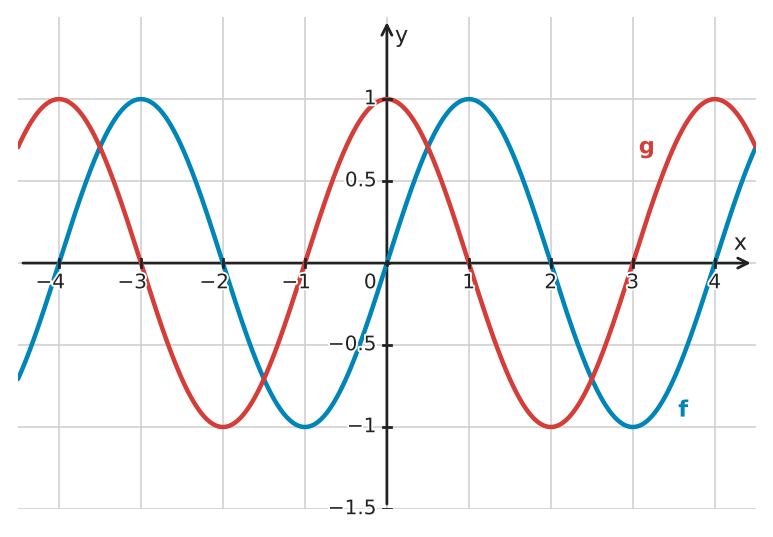
Figure for problem 532307

Hints

- Compare corresponding maximum points and zeros. - Recall how left and right shifts appear inside a function. - Determine the period of \(f(x)=\sin\left(\frac{\pi}{2}x\right)\). - Matching two values is only a check; use \(\sin\left(u+\frac{\pi}{2}\right)=\cos(u)\) for a general argument.

Solution

1. Comparing corresponding maximum points and zeros shows that \(g\) is obtained by shifting \(f\) left \(1\) unit. Since the period is \(4\), this is equivalent to shifting right \(3\) units. 2. The least positive right shift is \(d=3\), so \(g(x)=\sin\left(\frac{\pi}{2}(x-3)\right)\). 3. At \(x=0\), \(g(0)=\sin\left(-\frac{3\pi}{2}\right)=1\) and \(k(0)=\cos(0)=1\). At \(x=1\), \(g(1)=\sin(-\pi)=0\) and \(k(1)=\cos\left(\frac{\pi}{2}\right)=0\). 4. For every \(x\), \(g(x)=\sin\left(\frac{\pi}{2}x-\frac{3\pi}{2}\right)=\sin\left(\frac{\pi}{2}x+\frac{\pi}{2}\right)=\cos\left(\frac{\pi}{2}x\right)\), using periodicity and \(\sin\left(u+\frac{\pi}{2}\right)=\cos(u)\).

Answer

a) Shift left \(1\) unit or right \(3\) units. b) \(g(x)=\sin\left(\frac{\pi}{2}(x-3)\right)\), with \(d=3\) c) The values agree at \(x=0\) and \(x=1\), and the identity shows \(g(x)=\cos\left(\frac{\pi}{2}x\right)\) for all \(x\).

55070812
Use an angle-subtraction identity to find the exact value of \(\sin(15^\circ)\).

Hints

- Express \(15^\circ\) as a difference of special angles. - Use the sine subtraction formula rather than a decimal approximation. - The result should be positive and smaller than \(\frac{1}{2}\).

Solution

1. Write \(15^\circ=45^\circ-30^\circ\). 2. Use \(\sin(A-B)=\sin(A)\cos(B)-\cos(A)\sin(B)\). 3. Then \(\sin(15^\circ)=\frac{\sqrt{2}}{2}\cdot\frac{\sqrt{3}}{2}-\frac{\sqrt{2}}{2}\cdot\frac{1}{2}=\frac{\sqrt{6}-\sqrt{2}}{4}\).

Answer

\(\frac{\sqrt{6}-\sqrt{2}}{4}\)
55070912
Angle \(\alpha\) is in Quadrant I and angle \(\beta\) is in Quadrant IV. Suppose \(\cos(\alpha)=\frac{12}{13}\) and \(\sin(\beta)=-\frac{4}{5}\). Find the exact value of \(\cos(\alpha-\beta)\).

Hints

- First recover the missing sine and cosine values using the quadrants. - The cosine subtraction formula contains a plus sign between its two products. - Track the negative sign from the Quadrant IV sine value.

Solution

1. Since \(\alpha\) is in Quadrant I, \(\sin(\alpha)=\frac{5}{13}\). 2. Since \(\beta\) is in Quadrant IV, \(\cos(\beta)=\frac{3}{5}\). 3. Use \(\cos(\alpha-\beta)=\cos(\alpha)\cos(\beta)+\sin(\alpha)\sin(\beta)\). 4. Thus, \(\cos(\alpha-\beta)=\frac{12}{13}\cdot\frac{3}{5}+\frac{5}{13}\cdot\left(-\frac{4}{5}\right)=\frac{16}{65}\).

Answer

\(\frac{16}{65}\)
55071012
Rewrite \(\sin(x)\cos(30^\circ)+\cos(x)\sin(30^\circ)\) as a single trigonometric function of one angle.

Hints

- Look for the structure of a sine sum rather than expanding anything. - Match the order of the sine and cosine factors to the addition formula. - The final answer should contain one trigonometric function, not a sum.

Solution

1. Compare the expression with \(\sin(A+B)=\sin(A)\cos(B)+\cos(A)\sin(B)\). 2. Taking \(A=x\) and \(B=30^\circ\) gives \(\sin(x+30^\circ)\).

Answer

\(\sin(x+30^\circ)\)
55071112
Angles \(\alpha\) and \(\beta\) are acute, with \(\tan(\alpha)=\frac{1}{2}\) and \(\tan(\beta)=\frac{1}{3}\). Find the exact value of \(\tan(\alpha+\beta)\).

Hints

- Use the tangent addition formula directly with the two given tangent values. - Simplify the numerator and denominator separately before dividing. - Check that the denominator of the addition formula is nonzero.

Solution

1. Use \(\tan(\alpha+\beta)=\frac{\tan(\alpha)+\tan(\beta)}{1-\tan(\alpha)\tan(\beta)}\). 2. The numerator is \(\frac{1}{2}+\frac{1}{3}=\frac{5}{6}\). 3. The denominator is \(1-\frac{1}{6}=\frac{5}{6}\). 4. Therefore, \(\tan(\alpha+\beta)=1\).

Answer

\(1\)
55071212
Find the constant \(k\) so that \(\sin\left(x+\frac{\pi}{6}\right)=k\sin(x)+\frac{1}{2}\cos(x)\) is an identity for every real \(x\).

Hints

- Expand the shifted sine using an addition identity. - Evaluate the special-angle coefficients exactly. - Compare the coefficient of \(\sin(x)\) on both sides.

Solution

1. Expand the left side: \(\sin\left(x+\frac{\pi}{6}\right)=\sin(x)\cos\left(\frac{\pi}{6}\right)+\cos(x)\sin\left(\frac{\pi}{6}\right)\). 2. Substitute the exact values to get \(\frac{\sqrt{3}}{2}\sin(x)+\frac{1}{2}\cos(x)\). 3. Therefore, \(k=\frac{\sqrt{3}}{2}\).

Answer

\(k=\frac{\sqrt{3}}{2}\)
55071312
A student expands \(\cos\left(x-\frac{\pi}{3}\right)\) as \(\cos(x)\cos\left(\frac{\pi}{3}\right)-\sin(x)\sin\left(\frac{\pi}{3}\right)\). Identify the error and write the correct simplified expansion.

Hints

- Compare the cosine addition and cosine subtraction formulas. - The sign in the angle and the sign between the two products do not match in the same way as they do for sine. - After correcting the formula, substitute exact values at \(\frac{\pi}{3}\).

Solution

1. The cosine subtraction identity is \(\cos(A-B)=\cos(A)\cos(B)+\sin(A)\sin(B)\), so the middle sign should be plus. 2. Therefore, \(\cos\left(x-\frac{\pi}{3}\right)=\frac{1}{2}\cos(x)+\frac{\sqrt{3}}{2}\sin(x)\).

Answer

The sign is incorrect. The correct expansion is \(\frac{1}{2}\cos(x)+\frac{\sqrt{3}}{2}\sin(x)\).
55071412
Simplify \(\sin(x+y)+\sin(x-y)\) using angle addition and subtraction identities.

Hints

- Expand both compound-angle terms before combining them. - Compare the two middle terms after expansion. - Look for cancellation rather than evaluating any angles.

Solution

1. Expand both terms: \(\sin(x+y)=\sin(x)\cos(y)+\cos(x)\sin(y)\) and \(\sin(x-y)=\sin(x)\cos(y)-\cos(x)\sin(y)\). 2. Add the expansions. The \(\cos(x)\sin(y)\) terms cancel. 3. The result is \(2\sin(x)\cos(y)\).

Answer

\(2\sin(x)\cos(y)\)
55085012
The unit-circle diagram shows point \(P\) at a central angle of \(75^\circ\). A helper ray \(OQ\) splits the angle into \(45^\circ\) and \(30^\circ\). The perpendicular from \(P\) to the positive horizontal radius \(OA\) meets it at \(H\), and the horizontal and vertical legs are labeled \(x\) and \(y\). Use angle-addition identities to find the exact values of \(\sin(75^\circ)\) and \(\cos(75^\circ)\). Then give the exact coordinates of \(P\).
Figure for problem 550850

Hints

- Read the angle decomposition directly from the diagram. - Keep the sine-addition and cosine-addition formulas separate. - On the unit circle, the horizontal coordinate is cosine and the vertical coordinate is sine.

Solution

1. The diagram shows \(75^\circ=45^\circ+30^\circ\). 2. Use the sine addition identity: \(\sin(75^\circ)=\sin(45^\circ)\cos(30^\circ)+\cos(45^\circ)\sin(30^\circ)=\frac{\sqrt{2}}{2}\cdot\frac{\sqrt{3}}{2}+\frac{\sqrt{2}}{2}\cdot\frac{1}{2}=\frac{\sqrt{6}+\sqrt{2}}{4}\). 3. Use the cosine addition identity: \(\cos(75^\circ)=\cos(45^\circ)\cos(30^\circ)-\sin(45^\circ)\sin(30^\circ)=\frac{\sqrt{2}}{2}\cdot\frac{\sqrt{3}}{2}-\frac{\sqrt{2}}{2}\cdot\frac{1}{2}=\frac{\sqrt{6}-\sqrt{2}}{4}\). 4. On the unit circle, \(P=(\cos(75^\circ),\sin(75^\circ))\). 5. Therefore, \(P=\left(\frac{\sqrt{6}-\sqrt{2}}{4},\frac{\sqrt{6}+\sqrt{2}}{4}\right)\).

Answer

\(\sin(75^\circ)=\frac{\sqrt{6}+\sqrt{2}}{4}\) \(\cos(75^\circ)=\frac{\sqrt{6}-\sqrt{2}}{4}\) \(P=\left(\frac{\sqrt{6}-\sqrt{2}}{4},\frac{\sqrt{6}+\sqrt{2}}{4}\right)\)
52183812
Let \(f(x)=\cos(x-b)+a\), where \(a, b\in\mathbb{R}\) and \(a\ne0\). Find all ordered pairs \((a, b)\) for which \(f\) is even. Then explain why \(f\) cannot be odd when \(a\ne0\).

Hints

- Expand \(\cos(x-b)\) and \(\cos(-x-b)\). - For an identity to hold for every \(x\), the coefficients of the variable trigonometric terms must satisfy the required conditions. - Test odd symmetry by adding \(f(-x)\) and \(f(x)\).

Solution

1. Even symmetry requires \(f(-x)=f(x)\). Using angle identities, \(f(-x)-f(x)=-2\sin(b)\sin(x)\). 2. This expression is \(0\) for every \(x\) exactly when \(\sin(b)=0\), so \(b=k\pi\) for some integer \(k\). The vertical shift \(a\) may be any nonzero real number. 3. Odd symmetry would require \(f(-x)+f(x)=0\) for every \(x\). But \(f(-x)+f(x)=2a+2\cos(b)\cos(x)\). 4. For this expression to vanish for every \(x\), both \(a=0\) and \(\cos(b)=0\) would be necessary. Since \(a\ne0\), \(f\) cannot be odd.

Answer

Even: \((a, k\pi)\), where \(a\in\mathbb{R}\setminus\{0\}\) and \(k\in\mathbb{Z}\) Odd: impossible when \(a\ne0\)
53015212
Consider the family of functions \(g_t(x)=t\sin(x)+\sqrt{11}\cos(x)\), where \(t\in\mathbb{R}\). a) Find the maximum and minimum values in terms of \(t\). b) For \(t=\sqrt{5}\), write \(g_{\sqrt{5}}(x)=A\sin(x+\alpha)\), where \(A>0\) and \(\alpha\in[0, 2\pi)\). Find \(A\) and round \(\alpha\) to the nearest hundredth. c) Find \(t>0\) so that the first maximum in \([0, 2\pi)\) occurs at \(x=\frac{\pi}{3}\).

Hints

- Use the amplitude formula for a sine-cosine combination. - Match coefficients after expanding \(A\sin(x+\alpha)\). - The sine function reaches a maximum when its argument is \(\frac{\pi}{2}\). - Relate the phase angle to the coefficient ratio with tangent.

Solution

1. The amplitude of \(p\sin(x)+q\cos(x)\) is \(\sqrt{p^2+q^2}\). Thus the maximum is \(\sqrt{t^2+11}\), and the minimum is \(-\sqrt{t^2+11}\). 2. For \(t=\sqrt{5}\), \(A=\sqrt{5+11}=4\). Matching coefficients gives \(\cos(\alpha)=\frac{\sqrt{5}}{4}\) and \(\sin(\alpha)=\frac{\sqrt{11}}{4}\). Both are positive, so \(\alpha\approx0.98\) radians. 3. A maximum of \(A\sin(x+\alpha)\) occurs when \(x+\alpha=\frac{\pi}{2}\). Requiring the first maximum at \(x=\frac{\pi}{3}\) gives \(\alpha=\frac{\pi}{6}\). 4. Since \(\tan(\alpha)=\frac{\sqrt{11}}{t}\), \(\frac{1}{\sqrt{3}}=\frac{\sqrt{11}}{t}\). Therefore, \(t=\sqrt{33}\).

Answer

a) Maximum: \(\sqrt{t^2+11}\); minimum: \(-\sqrt{t^2+11}\) b) \(A=4\), \(\alpha\approx0.98\) radians c) \(t=\sqrt{33}\)
53405812
The graph of \(f(x)=\sin(2(x-c))\) is symmetric about the y-axis. a) Find the least positive value of \(c\). The graph shown uses this value. b) In general, determine the condition on \(c\) that makes \(\sin(b(x-c))\), where \(b \neq 0\), symmetric about the y-axis.
Figure for problem 534058

Hints

- An even graph has a maximum or minimum on the y-axis. - Identify whether the graph matches a cosine function or its reflection. - Read the value of the function at \(x=0\). - For part b, use an angle-subtraction formula and separate the even and odd components.

Solution

1. The graph has a minimum of \(-1\) at \(x=0\), so it is \(-\cos(2x)\). 2. Since \(\sin\left(2x-\frac{\pi}{2}\right)=-\cos(2x)\), set \(2(x-c)=2x-\frac{\pi}{2}\). This gives \(c=\frac{\pi}{4}\). 3. In general, use the subtraction formula: \(\sin(b(x-c))=\sin(bx)\cos(bc)-\cos(bx)\sin(bc)\). 4. The function is even exactly when the coefficient of the odd term \(\sin(bx)\) is zero. Thus, \(\cos(bc)=0\), so \(bc=\frac{\pi}{2}+k\pi\), where \(k\) is an integer. 5. Therefore, \(c=\frac{\pi/2+k\pi}{b}\).

Answer

a) \(c=\frac{\pi}{4}\) b) \(bc=\frac{\pi}{2}+k\pi\), so \(c=\frac{\pi/2+k\pi}{b}\), where \(k \in \mathbb{Z}\)
55071512
The graph shows \(f(x)=\sin\left(x+\frac{\pi}{4}\right)\) and \(g(x)=\frac{\sqrt{2}}{2}\bigl(\sin(x)+\cos(x)\bigr)\). a) What does the graph suggest about \(f\) and \(g\)? b) Verify the relationship algebraically using an angle-addition identity.
Figure for problem 550715

Hints

- Compare the locations of peaks, zeros, and troughs of the two curves. - For the algebraic part, expand only the shifted sine. - Use exact values at \(\frac{\pi}{4}\).

Solution

1. The two graphs coincide, suggesting that \(f(x)=g(x)\) for every \(x\). 2. Expand \(f(x)\): \(\sin\left(x+\frac{\pi}{4}\right)=\sin(x)\cos\left(\frac{\pi}{4}\right)+\cos(x)\sin\left(\frac{\pi}{4}\right)\). 3. Since both special-angle values equal \(\frac{\sqrt{2}}{2}\), \(f(x)=\frac{\sqrt{2}}{2}\sin(x)+\frac{\sqrt{2}}{2}\cos(x)=g(x)\).

Answer

a) The graphs coincide, so they suggest \(f(x)=g(x)\) for every \(x\). b) \(\sin\left(x+\frac{\pi}{4}\right)=\frac{\sqrt{2}}{2}\bigl(\sin(x)+\cos(x)\bigr)\).
55071612
Prove the identity \(\sin(\alpha+\beta)\sin(\alpha-\beta)=\sin^2(\alpha)-\sin^2(\beta)\).

Hints

- Expand both compound-angle factors first. - After expansion, look for a difference-of-squares structure. - Use the Pythagorean identity only after the product has been simplified.

Solution

1. Expand both sine factors: \(\sin(\alpha+\beta)=\sin(\alpha)\cos(\beta)+\cos(\alpha)\sin(\beta)\) and \(\sin(\alpha-\beta)=\sin(\alpha)\cos(\beta)-\cos(\alpha)\sin(\beta)\). 2. Multiply as a difference of squares: \(\sin^2(\alpha)\cos^2(\beta)-\cos^2(\alpha)\sin^2(\beta)\). 3. Replace \(\cos^2(\beta)\) with \(1-\sin^2(\beta)\) and \(\cos^2(\alpha)\) with \(1-\sin^2(\alpha)\). 4. The mixed terms cancel, leaving \(\sin^2(\alpha)-\sin^2(\beta)\).

Answer

\(\sin(\alpha+\beta)\sin(\alpha-\beta)=\sin^2(\alpha)-\sin^2(\beta)\)
55071712
Find constants \(A\) and \(B\) so that \(A\sin\left(x+\frac{\pi}{4}\right)+B\sin\left(x-\frac{\pi}{4}\right)=2\cos(x)\) is an identity for every real \(x\).

Hints

- Expand both shifted sine expressions before comparing sides. - Group the \(\sin(x)\) terms and the \(\cos(x)\) terms separately. - For an identity, the corresponding coefficients must agree for every \(x\).

Solution

1. Expand both shifted sines. 2. The left side becomes \(\frac{\sqrt{2}}{2}(A+B)\sin(x)+\frac{\sqrt{2}}{2}(A-B)\cos(x)\). 3. Matching the sine coefficient with \(0\) gives \(A+B=0\). 4. Matching the cosine coefficient with \(2\) gives \(\frac{\sqrt{2}}{2}(A-B)=2\). 5. Solving the two equations gives \(A=\sqrt{2}\) and \(B=-\sqrt{2}\).

Answer

\(A=\sqrt{2}\) and \(B=-\sqrt{2}\)
55071812
A student claims that \(\sin\left(x-\frac{\pi}{3}\right)=\frac{\sqrt{3}}{2}\sin(x)-\frac{1}{2}\cos(x)\). The graph shows the left side as \(f\) and the claimed right side as \(g\). a) What does the graph tell you about the claim? b) Use the subtraction identity to write the correct expansion.
Figure for problem 550718

Hints

- If two expressions are identical, their graphs must coincide everywhere. - In the sine subtraction formula, track which special-angle value multiplies \(\sin(x)\) and which multiplies \(\cos(x)\). - Compare the exact values of sine and cosine at \(\frac{\pi}{3}\).

Solution

1. The graphs do not coincide, so the claimed identity is false. 2. Use \(\sin(A-B)=\sin(A)\cos(B)-\cos(A)\sin(B)\). 3. Therefore, \(\sin\left(x-\frac{\pi}{3}\right)=\frac{1}{2}\sin(x)-\frac{\sqrt{3}}{2}\cos(x)\). 4. The student interchanged the coefficients from \(\cos\left(\frac{\pi}{3}\right)\) and \(\sin\left(\frac{\pi}{3}\right)\).

Answer

a) The graph shows that the two expressions are not identical. b) \(\sin\left(x-\frac{\pi}{3}\right)=\frac{1}{2}\sin(x)-\frac{\sqrt{3}}{2}\cos(x)\).
55071912
Simplify \(\left[\sin(x+y)+\sin(x-y)\right]^2+\left[\cos(x+y)-\cos(x-y)\right]^2\) to an expression involving only \(x\).

Hints

- First simplify each bracket using angle addition and subtraction formulas. - Do not expand the outer squares until each bracket has a simpler form. - After factoring, look for a Pythagorean identity involving \(y\).

Solution

1. Expanding the sine terms gives \(\sin(x+y)+\sin(x-y)=2\sin(x)\cos(y)\). 2. Expanding the cosine terms gives \(\cos(x+y)-\cos(x-y)=-2\sin(x)\sin(y)\). 3. Squaring and adding gives \(4\sin^2(x)\cos^2(y)+4\sin^2(x)\sin^2(y)\). 4. Factor to get \(4\sin^2(x)\left(\cos^2(y)+\sin^2(y)\right)\). 5. By the Pythagorean identity, the result is \(4\sin^2(x)\).

Answer

\(4\sin^2(x)\)

All problems may be used, copied and printed free of charge for school and tutoring, including paid tutoring. Commercial adaptations as well as publication or redistribution on the internet are not permitted.