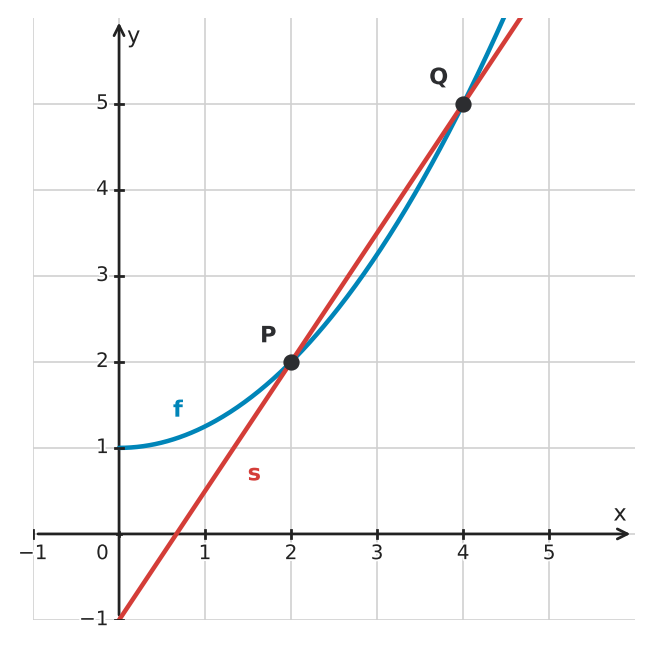
The graph shows \(f(x)=0.25x^2+1\) for \(x\ge0\), together with secant lines through \(P=(2,2)\) and two points on the curve.
a) Find the slope of the secant through \(P\) and \(Q=(4,5)\), and the slope of the secant through \(P\) and \(Q_1=(3,f(3))\).
b) Let \(Q_h=(2+h,f(2+h))\), where \(h\ne0\). Starting from the secant-slope expression \(\frac{f(2+h)-f(2)}{h}\), simplify it in terms of \(h\).
c) Use the limit as \(h\to0\) to find \(f'(2)\). Explain how the two numerical secant slopes in part a) are consistent with this limit.
Hints
- Use rise over run for each displayed secant.
- For the variable point, keep \(h\) symbolic and simplify the difference quotient before taking a limit.
- Connect the numerical secants to particular positive values of \(h\).
- The derivative value is the limiting secant slope as the horizontal separation approaches \(0\).
Solution
1. The slope through \(P=(2,2)\) and \(Q=(4,5)\) is \(\frac{5-2}{4-2}=\frac32\). Also, \(f(3)=0.25(3)^2+1=3.25\), so the slope through \(P\) and \(Q_1=(3,3.25)\) is \(\frac{3.25-2}{3-2}=\frac54\).
2. Evaluate \(f(2+h)=0.25(2+h)^2+1=2+h+0.25h^2\). Therefore,
\(\frac{f(2+h)-f(2)}{h}=\frac{h+0.25h^2}{h}=1+0.25h\) for \(h\ne0\).
3. Taking the limit gives \(f'(2)=\lim_{h\to0}(1+0.25h)=1\). The two displayed secants correspond to \(h=2\) and \(h=1\), giving slopes \(1.5\) and \(1.25\); both are moving toward \(1\) as \(h\) decreases toward \(0\).
Answer
a) \(\frac32\) and \(\frac54\)
b) \(1+\frac{h}{4}\)
c) \(f'(2)=1\); the secant slopes \(1.5\) and \(1.25\) move toward \(1\) as the second point moves toward \(P\).