Aimathic
Login | English | Deutsch

Free math worksheets

Build your own math worksheets from 30,000+ problems for grades 3 to 12, from fractions to AP Calculus. Every problem comes with step-by-step solutions.

Absolute value inequalities

Click problems to add them to your worksheet.

5509859
Solve \(\lvert x\rvert<4\). Write the solution in interval notation and describe it as a distance from 0.

Hints

- Interpret absolute value as distance from 0. - “Less than” a positive distance describes points between two boundary values. - Decide whether the boundary points themselves are included.

Solution

The inequality asks for numbers whose distance from 0 is less than 4. Therefore, \(-4<x<4\), which is the interval \((-4, 4)\).

Answer

\(-4<x<4\), or \((-4, 4)\). These are the numbers less than 4 units from 0.
5244899
A number \(x\) satisfies \(|x| < 2.5\) and \(x > -1\). Describe all possible values of \(x\) with a compound inequality of the form \(a < x < b\).

Hints

- Rewrite the absolute value inequality as a compound inequality. - Represent the second condition on the same number line. - Find the overlap of the two solution sets.

Solution

1. The condition \(|x| < 2.5\) is equivalent to \(-2.5 < x < 2.5\). 2. The second condition requires \(x > -1\). 3. The intersection of the two conditions is \(-1 < x < 2.5\).

Answer

\(-1 < x < 2.5\)
5244959
Find the solution set of \(|x-2|\le4\) over the real numbers. Explain your result by interpreting absolute value as distance on the number line.

Hints

- Interpret \(|x-2|\) as distance from \(2\). - Locate the two boundary points exactly \(4\) units from \(2\). - Because the inequality includes equality, decide what that means for the endpoints.

Solution

1. The expression \(|x-2|\) is the distance from \(x\) to \(2\). 2. The condition says this distance is at most \(4\), so \(-4\le x-2\le4\). 3. Add \(2\) to all three parts: \(-2\le x\le6\). 4. Therefore, every real number in \([-2,6]\) is a solution.

Answer

\([-2,6]\)
5509869
The solution set is the interval \([-2, 6]\). Write an equivalent absolute-value inequality of the form \(\lvert x-a\rvert\le b\). Explain how the interval determines \(a\) and \(b\).

Hints

- Find the midpoint of the two interval endpoints. - Compare the midpoint's distance to either endpoint. - Use the brackets to decide whether the boundary distance is included.

Solution

The center of the interval is the midpoint of \(-2\) and 6: \(a=\frac{-2+6}{2}=2\). The distance from the center to either endpoint is 4, so \(b=4\). Because both endpoints are included, the equivalent inequality is \(\lvert x-2\rvert\le4\).

Answer

\(\lvert x-2\rvert\le4\), with center \(a=2\) and distance \(b=4\).
5548769
Solve \(|2x-5|\ge-3\). Explain why the solution is not split into two boundary regions as it would be for \(|2x-5|\ge3\).

Hints

- What is the smallest possible value of an absolute value? - Compare that minimum with the right side \(-3\). - Decide whether any real x-value could make the inequality false.

Solution

1. Absolute value is always nonnegative, so \(|2x-5|\ge0\) for every real \(x\). 2. Every nonnegative number is greater than or equal to \(-3\). 3. Therefore, every real number satisfies the inequality. There are no boundary points because the right side is negative.

Answer

All real numbers, \((-\infty,\infty)\).
5241029
Find all integers \(z\) that satisfy both conditions: 1. \(-3 < z < 5\) 2. \(|z| > 2\)

Hints

- List the integers satisfying the first condition. - Interpret absolute value as distance from \(0\). - Keep only values whose distance is strictly greater than \(2\).

Solution

1. The integers satisfying \(-3 < z < 5\) are \(-2, -1, 0, 1, 2, 3, 4\). 2. The condition \(|z| > 2\) means that the distance from \(0\) is greater than \(2\). 3. Among the listed integers, only \(3\) and \(4\) have absolute value greater than \(2\).

Answer

\(S = \{3, 4\}\)
5241049
Analyze each absolute value condition. a) Rewrite \(|x| < 7\) as a compound inequality without absolute value symbols. b) Write \(|x| \le 3.5\) in interval notation. c) Write an absolute value inequality whose solution set is \((-9.2, 9.2)\). d) Explain why \(|x| < -1\) has no solution.

Hints

- Interpret absolute value as distance from \(0\). - A distance less than a positive number creates a symmetric interval. - Decide whether each endpoint is included. - A distance cannot be negative.

Solution

a) The condition \(|x| < 7\) means the distance from \(x\) to \(0\) is less than \(7\), so \(-7 < x < 7\). b) \(|x| \le 3.5\) means \(-3.5 \le x \le 3.5\), so the interval is \([-3.5, 3.5]\). c) The symmetric open interval \((-9.2, 9.2)\) is represented by \(|x| < 9.2\). d) Absolute value represents distance and is always nonnegative. It cannot be less than \(-1\), so there is no solution.

Answer

a) \(-7 < x < 7\) b) \([-3.5, 3.5]\) c) \(|x| < 9.2\) d) No solution; \(|x|\) cannot be negative.
5244909
Two students discuss an unknown number \(z\). Ethan says, “The absolute value of \(z\) is at most \(6\).” Maya says, “The distance from \(z\) to \(4\) on the number line is at most \(3\).” Does every number that satisfies Maya's statement also satisfy Ethan's statement? Determine both solution sets and justify your answer.

Hints

- Rewrite each absolute-value statement as an interval. - Interpret \(|z-4|\) as distance from \(4\). - Compare the endpoints of the two intervals and look for a counterexample if one interval is not contained in the other.

Solution

1. Ethan's statement is \(|z|\le6\), which is equivalent to \(-6\le z\le6\). 2. Maya's statement is \(|z-4|\le3\), which is equivalent to \(1\le z\le7\). 3. Maya's interval extends to \(7\), while Ethan's interval ends at \(6\). 4. The number \(7\) is a counterexample: it is \(3\) units from \(4\), but \(|7|=7>6\). 5. Therefore, not every number satisfying Maya's statement satisfies Ethan's statement.

Answer

No. Maya's solution set is \([1,7]\), while Ethan's is \([-6,6]\). For example, \(z=7\) satisfies Maya's condition but not Ethan's.
5244969
Find each solution set over the real numbers. a) \(|2x+6|<10\) b) \(4|x-1|-5\ge7\)

Hints

- In each part, isolate the absolute-value expression before translating it into ordinary inequalities. - A strict “less than” absolute-value inequality describes an inside interval. - An “at least” absolute-value inequality describes two outside regions.

Solution

1. In (a), rewrite as \(-10<2x+6<10\). Subtract \(6\): \(-16<2x<4\). Divide by \(2\): \(-8<x<2\). 2. In (b), add \(5\): \(4|x-1|\ge12\). Divide by \(4\): \(|x-1|\ge3\). 3. A distance of at least \(3\) from \(1\) means \(x-1\le-3\) or \(x-1\ge3\). 4. Therefore, \(x\le-2\) or \(x\ge4\).

Answer

a) \((-8,2)\) b) \((-\infty,-2]\cup[4,\infty)\)
5509879
A student solves \(\lvert x+1\rvert>5\) by writing \(-5<x+1<5\), so the student concludes \(-6<x<4\). a) Explain the student's error. b) Solve the inequality correctly and give the solution in interval notation.

Hints

- Interpret the inequality as a statement about distance from the center \(-1\). - Decide whether “greater than 5” describes points between the boundaries or outside them. - For an outside solution set, consider the two separate directions from the center.

Solution

a) The student used an inside interval, which corresponds to an absolute value being less than 5. The symbol \(>\) asks for points whose distance from \(-1\) is greater than 5, so the solutions lie outside the two boundary points and require an OR statement. b) Write \(x+1<-5\) or \(x+1>5\). Subtract 1 in each inequality: \(x<-6\) or \(x>4\). In interval notation, the solution is \((-\infty, -6)\cup(4, \infty)\).

Answer

a) The student used an AND/inside condition instead of the required OR/outside condition. b) \(x<-6\) or \(x>4\); \((-\infty, -6)\cup(4, \infty)\)
5509889
The graph shows a V-shaped function \(f\) and a horizontal function \(g\). a) Read the vertex of \(f\) and the y-value of \(g\), then write formulas for both functions. b) Use the graph to determine the x-values for which \(f(x)\le g(x)\). Give the answer as an interval. c) Write the corresponding absolute-value inequality and solve it algebraically to verify the interval from part b).
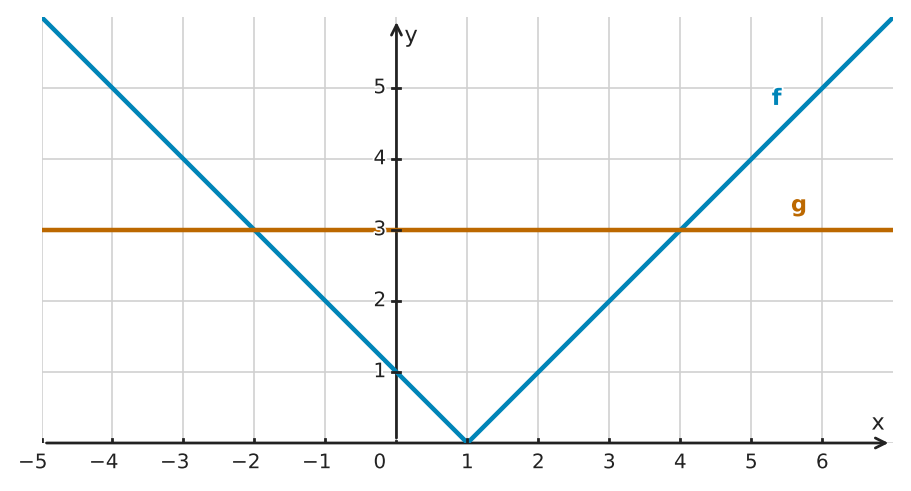
Figure for problem 550988

Hints

- Use the V's vertex to identify its horizontal shift. - The horizontal line's y-value gives the comparison level. - For the algebraic check, translate the absolute-value inequality into a compound inequality.

Solution

1. The V-shaped graph has vertex \((1,0)\), so \(f(x)=|x-1|\). The horizontal graph is at \(y=3\), so \(g(x)=3\). 2. The graphs intersect at \(x=-2\) and \(x=4\). Between these values, including the intersections, \(f\) is at or below \(g\). Thus, the interval is \([-2,4]\). 3. The corresponding inequality is \(|x-1|\le3\). 4. Rewrite it as \(-3\le x-1\le3\). Add \(1\) to all three parts: \(-2\le x\le4\), confirming \([-2,4]\).

Answer

a) \(f(x)=|x-1|\) and \(g(x)=3\) b) \([-2,4]\) c) \(|x-1|\le3\), which gives \(-2\le x\le4\)

5548779
A bottling machine is set to fill each bottle with \(16\,\text{fl oz}\). A bottle passes inspection when its fill amount \(v\) is within \(0.3\,\text{fl oz}\) of the target, including the tolerance limits. a) Write an absolute-value inequality for acceptable fill amounts. b) Solve it and give the interval of acceptable values. c) Describe the number-line graph using endpoint type and shading.

Hints

- Translate “within” into a statement about distance from the target fill amount. - The phrase “including the tolerance limits” determines whether the boundary values are included. - After removing the absolute value, keep both lower and upper bounds together as one compound inequality.

Solution

1. “Within \(0.3\)” of \(16\) means the distance from \(v\) to \(16\) is at most \(0.3\): \(|v-16|\le0.3\). 2. Rewrite as \(-0.3\le v-16\le0.3\). 3. Add \(16\) to all three parts: \(15.7\le v\le16.3\). 4. The endpoints are included, so the graph has closed points at \(15.7\) and \(16.3\) with the segment between them shaded.

Answer

a) \(|v-16|\le0.3\) b) \([15.7,16.3]\,\text{fl oz}\) c) Closed points at \(15.7\) and \(16.3\), shaded between them.

All problems may be used, copied and printed free of charge for school and tutoring, including paid tutoring. Commercial adaptations as well as publication or redistribution on the internet are not permitted.