Aimathic
Login | English | Deutsch

Free math worksheets

Build your own math worksheets from 30,000+ problems for grades 3 to 12, from fractions to AP Calculus. Every problem comes with step-by-step solutions.

Factor quadratic expressions

Click problems to add them to your worksheet.

5549339
Factor the expression completely over the integers: \(x^2+7x+10\).

Hints

- For a monic trinomial, focus on the constant term and the coefficient of \(x\). - Look for two integers that meet both the product and sum conditions. - Multiply your factors to check the middle term.

Solution

1. Look for two integers whose product is \(10\) and whose sum is \(7\). 2. The numbers are \(5\) and \(2\), so \(x^2+7x+10=(x+5)(x+2)\).

Answer

\((x+5)(x+2)\)
5101159
Factor the expression completely: \(45n^2 - 60n + 15\).

Hints

- First factor out the greatest common factor. - Then factor the remaining quadratic trinomial. - Check your result by multiplying the factors.

Solution

1. Factor out the greatest common factor: \(45n^2 - 60n + 15 = 15(3n^2 - 4n + 1)\). 2. Factor the trinomial: \(3n^2 - 4n + 1 = (3n - 1)(n - 1)\). 3. Therefore, \(45n^2 - 60n + 15 = 15(3n - 1)(n - 1)\).

Answer

\(15(3n - 1)(n - 1)\)
5101169
Factor the expression completely: \(-8b^2 + 20b + 12\).

Hints

- Look for a common numerical factor first. - Consider factoring out a negative common factor so the leading term inside the parentheses is positive. - Check your result by multiplying the factors.

Solution

1. Factor out \(-4\): \(-8b^2 + 20b + 12 = -4(2b^2 - 5b - 3)\). 2. Factor the trinomial: \(2b^2 - 5b - 3 = (2b + 1)(b - 3)\). 3. Therefore, \(-8b^2 + 20b + 12 = -4(2b + 1)(b - 3)\).

Answer

\(-4(2b + 1)(b - 3)\)
5101179
Factor the expression completely: \(12z^2 - 30z + 12\).

Hints

- First factor out the greatest common factor. - Then factor the remaining quadratic trinomial. - Multiply the factors to check your work.

Solution

1. Factor out the greatest common factor: \(12z^2 - 30z + 12 = 6(2z^2 - 5z + 2)\). 2. Factor the trinomial: \(2z^2 - 5z + 2 = (2z - 1)(z - 2)\). 3. Therefore, \(12z^2 - 30z + 12 = 6(2z - 1)(z - 2)\).

Answer

\(6(2z - 1)(z - 2)\)
5101189
Factor the expression completely: \(20y^2 + 10y - 30\).

Hints

- Begin by factoring out the greatest common factor. - Use the signs of the constant and middle terms to choose the signs in the binomial factors. - Check by multiplying the factors.

Solution

1. Factor out the greatest common factor: \(20y^2 + 10y - 30 = 10(2y^2 + y - 3)\). 2. Factor the trinomial: \(2y^2 + y - 3 = (2y + 3)(y - 1)\). 3. Therefore, \(20y^2 + 10y - 30 = 10(2y + 3)(y - 1)\).

Answer

\(10(2y + 3)(y - 1)\)
5101199
Factor the expression completely: \(18x^2 - 12x - 6\).

Hints

- Factor out the greatest common factor first. - Then find two binomial factors whose product gives the remaining trinomial. - Make sure the expression is fully factored, and check by multiplying.

Solution

1. Factor out the greatest common factor: \(18x^2 - 12x - 6 = 6(3x^2 - 2x - 1)\). 2. Factor the trinomial: \(3x^2 - 2x - 1 = (3x + 1)(x - 1)\). 3. Therefore, \(18x^2 - 12x - 6 = 6(3x + 1)(x - 1)\).

Answer

\(6(3x + 1)(x - 1)\)
5131039
Consider the equation \(x^2 - 1 = 3\). a) Rewrite the equation in standard form and factor it. b) Find the solution set. c) If the two sides are interpreted as \(f(x) = x^2 - 1\) and \(g(x) = 3\), what do the solutions represent geometrically?

Hints

- Move all terms to one side. - Recognize a difference of squares. - Equal function outputs correspond to graph intersections.

Solution

a) Rewrite with all terms on one side: \(x^2 - 4 = 0\). Factor the difference of squares: \((x - 2)(x + 2) = 0\). b) By the zero-product property, \(x = -2\) or \(x = 2\), so the solution set is \(\{-2, 2\}\). c) These values are the x-coordinates of the intersection points of the graphs of \(f\) and \(g\).

Answer

a) \(x^2 - 4 = 0\), so \((x - 2)(x + 2) = 0\) b) \(\{-2, 2\}\) c) They are the x-coordinates of the graphs’ intersection points.
5131059
The functions are \(f(x) = x^2\) and \(g(x) = 2x + 8\). Find algebraically the x-values for which the functions have the same output.

Hints

- Equal outputs mean the function expressions are equal. - Move all terms to one side. - Factor the resulting quadratic.

Solution

1. Set the function expressions equal: \(x^2 = 2x + 8\). 2. Rearrange: \(x^2 - 2x - 8 = 0\). 3. Factor: \((x - 4)(x + 2) = 0\). 4. Therefore, \(x = -2\) or \(x = 4\).

Answer

\(x = -2\) and \(x = 4\)
5131069
Consider \(x^2 - 4 = x + 2\). a) Find the solution set. b) If the two sides are interpreted as \(f(x) = x^2 - 4\) and \(g(x) = x + 2\), what do the solutions represent geometrically?

Hints

- Move all terms to one side and factor. - An equation \(f(x) = g(x)\) identifies equal outputs. - Equal outputs correspond to graph intersections.

Solution

1. Move all terms to one side: \(x^2 - x - 6 = 0\). 2. Factor: \((x - 3)(x + 2) = 0\). 3. Thus, \(x = -2\) or \(x = 3\). 4. These values are the x-coordinates of the intersection points of the graphs of \(f\) and \(g\).

Answer

a) \(\{-2, 3\}\) b) The solutions are the x-coordinates of the graphs’ intersection points.
5142849
Factor out the greatest common factor in each equation. In your answer, write the factored equation equal to zero before giving the solution set. a) \(14x^2 - 21x = 0\) b) \(0.5x^2 + 4x = 0\)

Hints

- Look for the greatest common factor that includes the largest possible power of \(x\). - Check your factorization by multiplying before you use the zero-product property. - A product can equal zero only when at least one factor equals zero.

Solution

1. For a), factor out \(7x\): \(7x(2x - 3)=0\). By the zero-product property, \(x=0\) or \(x=\frac{3}{2}\). 2. For b), factor out \(0.5x\): \(0.5x(x+8)=0\). By the zero-product property, \(x=0\) or \(x=-8\).

Answer

a) \(7x(2x-3)=0\); \(x\in\left\{0,\frac{3}{2}\right\}\) b) \(0.5x(x+8)=0\); \(x\in\{-8,0\}\)
5145519
The functions are \(f(x) = x^2\) and \(g(x) = 1.5x + 1\). Find algebraically all x-values for which the functions have the same output. Then state the corresponding intersection points of their graphs.

Hints

- Equal outputs mean the function expressions are equal. - Clear the decimal coefficient before factoring. - Substitute each x-value into either function to find the corresponding y-value.

Solution

1. Set the function expressions equal: \(x^2 = 1.5x + 1\). 2. Multiply by \(2\): \(2x^2 - 3x - 2 = 0\). 3. Factor: \((2x + 1)(x - 2) = 0\). 4. Thus, \(x = -0.5\) or \(x = 2\). 5. The corresponding outputs are \(f(-0.5) = 0.25\) and \(f(2) = 4\), so the intersection points are \((-0.5, 0.25)\) and \((2, 4)\).

Answer

\(x = -0.5\) or \(x = 2\); intersections: \((-0.5, 0.25)\) and \((2, 4)\)
5145539
The functions are \(f(x) = 0.5x^2\) and \(g(x) = x + 4\). Find algebraically all x-values for which the functions have the same output. Then verify each value in the equation \(0.5x^2 = x + 4\).

Hints

- Equal outputs mean the function expressions are equal. - Clear the decimal coefficient before factoring. - Substitute each candidate value into both sides of the original equation.

Solution

1. Set the function expressions equal: \(0.5x^2 = x + 4\). 2. Multiply by \(2\): \(x^2 - 2x - 8 = 0\). 3. Factor: \((x - 4)(x + 2) = 0\), so \(x = -2\) or \(x = 4\). 4. Check \(x = -2\): \(0.5 \cdot (-2)^2 = 2\) and \(-2 + 4 = 2\). 5. Check \(x = 4\): \(0.5 \cdot 4^2 = 8\) and \(4 + 4 = 8\). 6. Both values satisfy the equation.

Answer

\(\{-2, 4\}\)
5153459
Find the intersection points of \(f(x) = x^2 - 2\) and \(g(x) = -x^2 + 6\).

Hints

- Set the function expressions equal. - Isolate \(x^2\). - Remember both square roots of a positive number.

Solution

1. Set the functions equal: \(x^2 - 2 = -x^2 + 6\). 2. Simplify: \(2x^2 = 8\), so \(x^2 = 4\). 3. Therefore, \(x = -2\) or \(x = 2\). 4. Substituting either value into \(f\) gives \(y = 2\). 5. The intersection points are \((-2, 2)\) and \((2, 2)\).

Answer

\((-2, 2)\) and \((2, 2)\)
5155259
Solve \(x^2-16=0\) by factoring over the real numbers. Include the factored equation in your answer before the solution set.

Hints

- Rewrite the constant as a perfect square. - Look for a product of two conjugate binomials. - Use the zero-product property only after the equation is factored.

Solution

1. Recognize a difference of squares: \(x^2-16=x^2-4^2\). 2. Factor: \((x-4)(x+4)=0\). 3. Apply the zero-product property to obtain \(x=4\) or \(x=-4\).

Answer

\((x-4)(x+4)=0\); \(x\in\{-4,4\}\)
5228889
Factor each quadratic expression over the real numbers as far as possible. Then use the factorization to determine the real zeros. If an expression cannot be written as a product of real linear factors, state that and explain why. a) \(p(x)=2x^2-12x+10\) b) \(q(x)=x^2+4\) c) \(r(x)=5x^2-10x\)

Hints

- For each expression, decide first whether a common factor can be removed. - When a trinomial remains, look for numbers whose product and sum match its coefficients. - For the expression containing only \(x^2\) and a positive constant, think about the possible values of a real square.

Solution

1. For a), factor out \(2\), then factor the trinomial: \(p(x)=2(x^2-6x+5)=2(x-1)(x-5)\). Thus the real zeros are \(x=1\) and \(x=5\). 2. For b), \(x^2+4>0\) for every real \(x\), so it has no real zeros and cannot be written as a product of real linear factors. 3. For c), factor out the greatest common factor: \(r(x)=5x(x-2)\). Thus the real zeros are \(x=0\) and \(x=2\).

Answer

a) \(p(x)=2(x-1)(x-5)\); zeros \(x=1,5\) b) No product of real linear factors; no real zeros because \(x^2+4>0\) for every real \(x\). c) \(r(x)=5x(x-2)\); zeros \(x=0,2\)
5238139
For each quadratic function, write an equivalent factored equation equal to zero and then state the zeros. Use the displayed form, a greatest common factor, trinomial factoring, or a difference of squares as appropriate. a) \(f(x)=(x-6)(x+4)\) b) \(g(x)=x^2-5x\) c) \(h(x)=x^2-4x-12\) d) \(k(x)=4x^2-16\)

Hints

- First decide what factor structure is already visible in each function. - A missing constant term often signals a common factor of \(x\). - A subtraction of two perfect squares can be factored into conjugates.

Solution

1. a) Set the factored expression equal to zero: \((x-6)(x+4)=0\). The zeros are \(x=6\) and \(x=-4\). 2. b) Factor out \(x\): \(x(x-5)=0\). The zeros are \(x=0\) and \(x=5\). 3. c) Factor the trinomial: \((x-6)(x+2)=0\). The zeros are \(x=6\) and \(x=-2\). 4. d) Factor the difference of squares: \(4(x-2)(x+2)=0\). The zeros are \(x=2\) and \(x=-2\).

Answer

a) \((x-6)(x+4)=0\); zeros \(x=-4,6\) b) \(x(x-5)=0\); zeros \(x=0,5\) c) \((x-6)(x+2)=0\); zeros \(x=-2,6\) d) \(4(x-2)(x+2)=0\); zeros \(x=-2,2\)
5250859
Move all terms to one side, factor, and solve. For each part, include the factored equation equal to zero in your answer. a) \(6x^2-4x=2x^2+8x\) b) \(0.4x^2+3x=1.4x^2-2x\)

Hints

- Collect all terms on one side before looking for a common factor. - In each result, every term contains \(x\). - Verify the factorization before applying the zero-product property.

Solution

1. a) Rearrange to \(4x^2-12x=0\). Factor: \(4x(x-3)=0\), so \(x=0\) or \(x=3\). 2. b) Rearrange to \(-x^2+5x=0\). Factor: \(-x(x-5)=0\), so \(x=0\) or \(x=5\).

Answer

a) \(4x(x-3)=0\); \(x\in\{0,3\}\) b) \(-x(x-5)=0\); \(x\in\{0,5\}\)
5254759
Rewrite \(x^2 + 2x - 3 = 0\) as \(x^2 = -2x + 3\). 1. Let \(f(x) = x^2\) and \(g(x) = -2x + 3\). Solve \(f(x) = g(x)\) algebraically. 2. Explain how the solutions relate to the graphs of \(f\) and \(g\).

Hints

- Treat the two sides as separate functions. - Equal outputs give an equation that can be factored. - Solutions of \(f(x) = g(x)\) correspond to graph intersections.

Solution

1. Set the function expressions equal: \(x^2 = -2x + 3\). 2. Move all terms to one side: \(x^2 + 2x - 3 = 0\). 3. Factor: \((x + 3)(x - 1) = 0\). 4. Therefore, \(x = -3\) or \(x = 1\). 5. These values are the x-coordinates of the points where the graphs of \(f\) and \(g\) intersect.

Answer

1. \(x = -3\) or \(x = 1\) 2. They are the x-coordinates of the graphs’ intersection points.
5280799
1. Factor \(x^2 - 4x - 21\) completely. 2. Explain how the signs in the linear factors relate to the zeros of the quadratic.

Hints

- Find a factor pair of \(-21\) whose sum is \(-4\). - Set each linear factor equal to zero. - Compare a zero \(r\) with its factor \(x - r\).

Solution

1. Find two numbers whose product is \(-21\) and whose sum is \(-4\): \(-7\) and \(3\). Therefore, \(x^2 - 4x - 21 = (x - 7)(x + 3)\). 2. The zeros are \(7\) and \(-3\). A zero \(r\) corresponds to the factor \(x-r\), so the zero \(-3\) gives \(x-(-3)=x+3\). Thus, the sign of the number written in a linear factor is opposite the sign of its zero.

Answer

1. \((x - 7)(x + 3)\) 2. Each zero \(r\) gives a factor \(x - r\), so the sign of the number in the factor is opposite the sign of the zero.
5280999
Factor out the greatest common factor in each equation. Report the factored equation first, then the solution set. a) \(7x^2+21x=0\) b) \(0.5x^2=2x\)

Hints

- Put the second equation in zero-product form before factoring. - Identify the greatest common numerical factor and the common power of \(x\). - Multiply the factors back together to check them.

Solution

1. a) Factor: \(7x(x+3)=0\), so \(x=0\) or \(x=-3\). 2. b) Rearrange to \(0.5x^2-2x=0\), then factor: \(0.5x(x-4)=0\), so \(x=0\) or \(x=4\).

Answer

a) \(7x(x+3)=0\); \(x\in\{-3,0\}\) b) \(0.5x(x-4)=0\); \(x\in\{0,4\}\)
5549349
Factor the expression completely over the integers: \(6x^2+x-2\).

Hints

- There is no common factor to remove first. - For a nonmonic trinomial, use the product of the leading coefficient and constant to plan a middle-term split. - After splitting the middle term, look for a common binomial factor.

Solution

1. The product of the leading coefficient and constant is \(6\cdot(-2)=-12\). Two integers with product \(-12\) and sum \(1\) are \(4\) and \(-3\). 2. Split the middle term: \(6x^2+4x-3x-2\). 3. Factor by grouping: \(2x(3x+2)-(3x+2)=(3x+2)(2x-1)\).

Answer

\((3x+2)(2x-1)\)
5549359
Factor each expression completely and name the pattern you used. a) \(x^2-12x+36\) b) \(49y^2-16\)

Hints

- Check whether the first and last terms are perfect squares. - For three terms, compare the middle term with twice the product of the square roots of the outer terms. - For two squared terms separated by subtraction, think about conjugate factors.

Solution

1. In a), \(36=6^2\) and the middle term is \(-2\cdot6\cdot x\), so the expression is the perfect-square trinomial \((x-6)^2\). 2. In b), \(49y^2=(7y)^2\) and \(16=4^2\), so the difference of squares factors as \((7y-4)(7y+4)\).

Answer

a) \((x-6)^2\); perfect-square trinomial b) \((7y-4)(7y+4)\); difference of squares
5549369
Determine whether each quadratic expression factors into binomials with integer coefficients. Factor it if it does; otherwise state that it is not factorable over the integers. a) \(x^2+5x+7\) b) \(2x^2+7x+3\)

Hints

- Do not assume every quadratic with integer coefficients factors over the integers. - For the monic expression, test integer factor pairs of the constant against the middle coefficient. - For the nonmonic expression, look for a middle-term split that supports grouping.

Solution

1. For a), the integer factor pairs of \(7\) have sums \(8\) or \(-8\), not \(5\). Therefore, it does not factor into integer-coefficient binomials. 2. For b), split the middle term: \(2x^2+6x+x+3\). 3. Factor by grouping: \(2x(x+3)+1(x+3)=(2x+1)(x+3)\).

Answer

a) Not factorable over the integers. b) \((2x+1)(x+3)\)
5146009
Consider the equation \((x - 4)^2 = 3(x - 4)\). a) A student divides both sides by \(x - 4\) and obtains \(x - 4 = 3\). What value of \(x\) does the student find? b) Explain why this method does not produce every solution. c) Find the complete solution set by moving all terms to one side and factoring.

Hints

- Test the value that makes \(x - 4\) equal to zero in the original equation. - Ask when division by \(x - 4\) is not allowed. - Move all terms to one side and look for a common binomial factor.

Solution

a) Solving \(x - 4 = 3\) gives \(x = 7\). b) Dividing by \(x - 4\) assumes \(x - 4 \ne 0\). This excludes \(x = 4\), even though \(x = 4\) makes both sides of the original equation equal to zero. c) Move all terms to one side: \((x - 4)^2 - 3(x - 4) = 0\). Factor: \((x - 4)((x - 4) - 3) = (x - 4)(x - 7) = 0\). Thus, \(x = 4\) or \(x = 7\).

Answer

a) \(x = 7\) b) Dividing by \(x - 4\) discards the case \(x - 4 = 0\). Division by zero is undefined, and \(x = 4\) is a solution of the original equation. c) \(x \in \{4, 7\}\)
5146129
Solve each equation by factoring. Rewrite first when needed. For every part, include an equivalent factored equation equal to zero before stating the solutions. a) \(2x^2 - 18x = 0\) b) \(3(x - 1)^2 - 27 = 0\) c) \(0.5x^2 - x - 4 = 0\) d) \((2x - 4)(x + 5) = 0\)

Hints

- Decide whether a greatest common factor, a difference of squares, or trinomial factoring fits each equation. - Clearing the decimal in part c) can make the integer factor pair easier to see. - Do not state roots until you have written the product that equals zero.

Solution

1. a) Factor out \(2x\): \(2x(x-9)=0\), so \(x=0\) or \(x=9\). 2. b) Factor out \(3\) and use a difference of squares: \(3((x-1)^2-9)=3(x-4)(x+2)=0\), so \(x=-2\) or \(x=4\). 3. c) Multiply the equation by \(2\): \(x^2-2x-8=0\). Factor: \((x-4)(x+2)=0\), so \(x=-2\) or \(x=4\). 4. d) The equation is already factored. The zero-product property gives \(2x-4=0\) or \(x+5=0\), so \(x=2\) or \(x=-5\).

Answer

a) \(2x(x-9)=0\); \(x\in\{0,9\}\) b) \(3(x-4)(x+2)=0\); \(x\in\{-2,4\}\) c) \((x-4)(x+2)=0\); \(x\in\{-2,4\}\) d) \((2x-4)(x+5)=0\); \(x\in\{-5,2\}\)
5146389
For each equation, identify the most efficient factoring pattern—difference of squares, greatest common factor, or trinomial factoring. Briefly justify your choice and find the solution set. 1. \(x^2 - 144 = 0\) 2. \(2x^2 + 10x = 0\) 3. \(x^2 - 2x - 15 = 0\)

Hints

- Check whether the constant is a perfect square and the middle term is missing. - Check whether every term has a common factor. - For a trinomial, look for two numbers whose product is the constant term and whose sum is the coefficient of \(x\).

Solution

1. The first equation is a difference of squares: \(x^2 - 144 = (x - 12)(x + 12)\). Therefore, \(x = -12\) or \(x = 12\). 2. The second equation has a greatest common factor of \(2x\): \(2x(x + 5) = 0\). Therefore, \(x = -5\) or \(x = 0\). 3. The third equation is a factorable trinomial: \(x^2 - 2x - 15 = (x - 5)(x + 3)\). Therefore, \(x = -3\) or \(x = 5\).

Answer

1. Difference of squares; \(x \in \{-12, 12\}\) 2. Greatest common factor; \(x \in \{-5, 0\}\) 3. Trinomial factoring; \(x \in \{-3, 5\}\)
5147019
The parabola is \(p(x) = x^2 - 4x + 5\), and the line is \(g(x) = x + 1\). a) Find the coordinates of their intersection points. b) Determine whether \(Q(2.5, 3.5)\) lies on the line, the parabola, or both.

Hints

- Set the function expressions equal to find intersections. - Factor the resulting quadratic. - Test a point by substituting its x-coordinate into each function.

Solution

1. Set the functions equal: \(x^2 - 4x + 5 = x + 1\). 2. Rearrange and factor: \(x^2 - 5x + 4 = (x - 1)(x - 4) = 0\). 3. Thus, \(x = 1\) or \(x = 4\). Using \(g(x) = x + 1\), the corresponding y-values are \(2\) and \(5\). The intersections are \((1, 2)\) and \((4, 5)\). 4. For \(Q\), \(g(2.5) = 3.5\), so \(Q\) lies on the line. 5. However, \(p(2.5) = 2.5^2 - 4 \cdot 2.5 + 5 = 1.25\), not \(3.5\). Therefore, \(Q\) does not lie on the parabola.

Answer

a) \((1, 2)\) and \((4, 5)\) b) \(Q\) lies on the line only.
5152519
A right triangle has hypotenuse \(\sqrt{29}\,\text{cm}\). One leg is exactly \(3\,\text{cm}\) longer than the other. Let the shorter leg be \(a\). Write the resulting quadratic equation in standard form, factor it, and use that factorization to find both leg lengths.

Hints

- Express the longer leg using the variable for the shorter leg. - Substitute both leg expressions into the Pythagorean theorem before simplifying. - After factoring, check which algebraic solution can represent a physical length.

Solution

1. The longer leg is \(a+3\), so the Pythagorean theorem gives \(a^2+(a+3)^2=29\). 2. Expand and simplify: \(2a^2+6a+9=29\), so \(2a^2+6a-20=0\). 3. Divide by \(2\): \(a^2+3a-10=0\). 4. Factor: \((a+5)(a-2)=0\). 5. The algebraic solutions are \(a=-5\) and \(a=2\). A length must be positive, so the shorter leg is \(2\,\text{cm}\) and the longer leg is \(5\,\text{cm}\).

Answer

Standard form: \(a^2+3a-10=0\) Factorization: \((a+5)(a-2)=0\) Leg lengths: \(2\,\text{cm}\) and \(5\,\text{cm}\)
5250769
For each equation, write an equivalent quadratic equation with \(0\) on one side. Then give its real factorization when one exists, or state that it does not factor over the real numbers, and find the real solution set. a) \(4x^2-7=2x^2+11\) b) \(\frac{1}{3}x^2+10=1\) c) \((x-5)(x+5)=11\) d) \(0.5x^2=0.005\)

Hints

- Move all terms to one side and simplify before deciding whether factoring applies. - Check whether the simplified expression is a difference of squares. - If a quadratic is a sum of positive squares over the reals, consider whether real linear factors can exist.

Solution

1. a) Simplify to \(x^2-9=0\). Factor: \((x-3)(x+3)=0\), so \(x=-3\) or \(x=3\). 2. b) Simplify to \(x^2+27=0\). It has no factorization into real linear factors and no real solution. 3. c) Expand and rearrange to \(x^2-36=0\). Factor: \((x-6)(x+6)=0\), so \(x=-6\) or \(x=6\). 4. d) Divide by \(0.5\) to obtain \(x^2-0.01=0\). Factor: \((x-0.1)(x+0.1)=0\), so \(x=-0.1\) or \(x=0.1\).

Answer

a) \(x^2-9=0=(x-3)(x+3)\); \(x\in\{-3,3\}\) b) \(x^2+27=0\); no real linear factorization; \(\varnothing\) c) \(x^2-36=0=(x-6)(x+6)\); \(x\in\{-6,6\}\) d) \(x^2-0.01=0=(x-0.1)(x+0.1)\); \(x\in\{-0.1,0.1\}\)
5250799
Consider \(\frac{x^2}{p} - p = 0\), where \(p \ne 0\). a) Find the solution set when \(p = 5\). b) Rewrite the equation as a difference of squares and show that it has exactly two distinct real solutions for every \(p \ne 0\). c) Give the solution set in terms of \(p\).

Hints

- Clear the denominator by multiplying by \(p\). - Recognize the resulting difference of squares. - Use the condition \(p \ne 0\) to justify that the two roots are different.

Solution

a) When \(p=5\), the equation is \(\frac{x^2}{5}-5=0\). Multiplying by \(5\) gives \(x^2-25=0\), so \((x-5)(x+5)=0\). Thus, \(x=-5\) or \(x=5\). b) For \(p\ne0\), multiply by \(p\): \(x^2-p^2=0\). Then \((x-p)(x+p)=0\), so \(x=p\) or \(x=-p\). Because \(p\ne0\), these two values are distinct. c) The solution set is \(\{-p,p\}\).

Answer

a) \(x \in \{-5, 5\}\) b) \((x - p)(x + p) = 0\), so the two distinct solutions are \(x = p\) and \(x = -p\). c) \(x \in \{-p, p\}\)
5250869
Simplify each equation, write it as a product equal to zero, and then give the real solution set. a) \(\frac{2}{3}x^2+x=\frac{1}{6}x^2-2x\) b) \(2x(x+4)=x^2+3x\)

Hints

- Combine like terms before deciding what to factor. - Clearing fractions is optional if you can see the common factor directly. - A zero constant term is a cue to check for a factor of \(x\).

Solution

1. a) Move terms left: \(\frac{1}{2}x^2+3x=0\). Factor: \(x\left(\frac{1}{2}x+3\right)=0\), so \(x=0\) or \(x=-6\). 2. b) Expand and simplify to \(x^2+5x=0\). Factor: \(x(x+5)=0\), so \(x=0\) or \(x=-5\).

Answer

a) \(x\left(\frac{1}{2}x+3\right)=0\); \(x\in\{-6,0\}\) b) \(x(x+5)=0\); \(x\in\{-5,0\}\)
5250939
Simplify each equation, write an equivalent factored equation equal to zero, and use it to solve. 1) \(x(x-12)=4(16-3x)\) 2) \((x-3)(x+3)+(x-4)(x+4)=7\)

Hints

- Simplify both sides far enough to expose a recognizable quadratic pattern. - Watch for cancellation of the linear terms. - Once you have a difference of squares, write the two conjugate factors explicitly.

Solution

1. Expand to \(x^2-12x=64-12x\), so \(x^2-64=0\). Factor: \((x-8)(x+8)=0\), giving \(x=-8\) or \(x=8\). 2. Use differences of squares: \(x^2-9+x^2-16=7\). Simplify to \(x^2-16=0\). Factor: \((x-4)(x+4)=0\), giving \(x=-4\) or \(x=4\).

Answer

1) \((x-8)(x+8)=0\); \(x\in\{-8,8\}\) 2) \((x-4)(x+4)=0\); \(x\in\{-4,4\}\)
5250949
Rewrite each equation in standard form, factor it, and solve. Include the factored equation equal to zero in your answer. 1) \(3x(x-4)=x^2-2x\) 2) \((x-2)^2=3x-2\)

Hints

- Expand only as much as needed to collect every term on one side. - For the first equation, look for a common factor after simplification. - For the second, find two integers with the required product and sum.

Solution

1. Expand and simplify: \(2x^2-10x=0\). Factor: \(2x(x-5)=0\), so \(x=0\) or \(x=5\). 2. Expand and rearrange: \(x^2-7x+6=0\). Factor: \((x-1)(x-6)=0\), so \(x=1\) or \(x=6\).

Answer

1) \(2x(x-5)=0\); \(x\in\{0,5\}\) 2) \((x-1)(x-6)=0\); \(x\in\{1,6\}\)
5251199
Simplify the equation, write the resulting quadratic as a product equal to zero, and solve by factoring over the real numbers: \((3x-1)^2-(x+2)^2+(2x-5)(2x+5)=4x^2-10x+4\).

Hints

- Distribute the subtraction across the entire squared binomial before combining terms. - Expect substantial cancellation after both sides are expanded. - Once only \(x^2\) and a constant remain, check for a difference of squares.

Solution

1. Expand: \(9x^2-6x+1-(x^2+4x+4)+4x^2-25=4x^2-10x+4\). 2. Combine like terms: \(12x^2-10x-28=4x^2-10x+4\). 3. Rearrange: \(8x^2-32=0\), then divide by \(8\) to get \(x^2-4=0\). 4. Factor: \((x-2)(x+2)=0\). 5. Therefore, \(x=-2\) or \(x=2\).

Answer

Simplified equation: \(x^2-4=0\) Factorization: \((x-2)(x+2)=0\) Solution set: \(x\in\{-2,2\}\)
5251209
Expand and simplify the equation, then write the resulting quadratic in factored form equal to zero and solve: \((x-3)^2+(x+2)^2=(x-4)(x+4)+2x+34\).

Hints

- Expand each square and product carefully before comparing the two sides. - After collecting terms on one side, identify the integer pair that matches the trinomial. - Check the binomial product before using the zero-product property.

Solution

1. Expand both sides: \(x^2-6x+9+x^2+4x+4=x^2-16+2x+34\). 2. Combine like terms: \(2x^2-2x+13=x^2+2x+18\). 3. Rearrange: \(x^2-4x-5=0\). 4. Factor: \((x-5)(x+1)=0\). 5. Therefore, \(x=5\) or \(x=-1\).

Answer

\(x^2-4x-5=0=(x-5)(x+1)\); \(x\in\{-1,5\}\)
5255039
Solve the system \(\begin{cases}y = x^2 - 4x + 1 \\ y = 2x - 4\end{cases}\) Briefly explain why setting the two expressions equal is a useful first step.

Hints

- Both equations already give \(y\) in terms of \(x\). - Set the right sides equal and factor. - Substitute each x-value to find its paired y-value.

Solution

1. Both equations are solved for \(y\), so their right sides must be equal at an intersection. 2. Set them equal: \(x^2 - 4x + 1 = 2x - 4\). 3. Rearrange and factor: \(x^2 - 6x + 5 = (x - 1)(x - 5) = 0\). 4. Thus, \(x = 1\) or \(x = 5\). 5. Substitute into \(y = 2x - 4\): the corresponding y-values are \(-2\) and \(6\). 6. The solutions are \((1, -2)\) and \((5, 6)\).

Answer

\(\{(1, -2), (5, 6)\}\)
5255049
Consider the system \(\begin{cases}(x + y)^2 = 25 \\ x - y = 1\end{cases}\) Determine how many ordered-pair solutions the system has, and find them.

Hints

- Solve the linear equation for one variable. - Substitute that expression into the squared equation. - Remember both cases when taking a square root.

Solution

1. Solve the linear equation for \(x\): \(x = y + 1\). 2. Substitute into the first equation: \((y + 1 + y)^2 = 25\), so \((2y + 1)^2 = 25\). 3. Take both square roots: \(2y + 1 = 5\) or \(2y + 1 = -5\). 4. The first case gives \(y = 2\) and \(x = 3\). The second case gives \(y = -3\) and \(x = -2\). 5. Therefore, the system has exactly two ordered-pair solutions.

Answer

\(\{(3, 2), (-2, -3)\}\)
5255359
Find the solution set of the system \(\begin{cases}3x^2 - y^2 = 11 \\ x + y = 3\end{cases}\).

Hints

- Solve the linear equation for one variable. - Substitute into the quadratic equation and keep the parentheses. - Factor the resulting quadratic, then find each matching value of the other variable.

Solution

1. Solve the linear equation for \(y\): \(y = 3 - x\). 2. Substitute into the quadratic equation: \(3x^2 - (3 - x)^2 = 11\). 3. Expand and simplify: \(3x^2 - (9 - 6x + x^2) = 11\), so \(2x^2 + 6x - 20 = 0\). 4. Divide by \(2\): \(x^2 + 3x - 10 = 0\). 5. Factor: \((x - 2)(x + 5) = 0\). Thus, \(x = 2\) or \(x = -5\). 6. Using \(y = 3 - x\), the corresponding values are \(y = 1\) and \(y = 8\).

Answer

\(\{(2, 1), (-5, 8)\}\)
5255409
Find the solution set of the system over the real numbers: \(\begin{cases}x^2 + 2y^2 = 33 \\ x + y = 3\end{cases}\).

Hints

- Solve the linear equation for one variable. - Substitute into the quadratic equation and expand carefully. - Factor the resulting quadratic, then find the matching value of the other variable.

Solution

1. Solve the linear equation for \(x\): \(x = 3 - y\). 2. Substitute into the quadratic equation: \((3 - y)^2 + 2y^2 = 33\). 3. Expand and simplify: \(9 - 6y + 3y^2 = 33\), so \(y^2 - 2y - 8 = 0\). 4. Factor: \((y - 4)(y + 2) = 0\). Thus, \(y = 4\) or \(y = -2\). 5. Using \(x = 3 - y\), the corresponding values are \(x = -1\) and \(x = 5\).

Answer

\(\{(-1, 4), (5, -2)\}\)
5255859
Find all ordered-pair solutions of \(\begin{cases}x + y = -2 \\ xy = -15\end{cases}\) by solving one equation for a variable and substituting.

Hints

- Solve the sum equation for one variable. - Substitute into the product equation. - Factor the resulting quadratic and find each corresponding ordered pair.

Solution

1. Solve the first equation for \(y\): \(y = -2 - x\). 2. Substitute into the product equation: \(x(-2 - x) = -15\). 3. Rewrite in standard form: \(x^2 + 2x - 15 = 0\). 4. Factor: \((x + 5)(x - 3) = 0\). Thus, \(x = -5\) or \(x = 3\). 5. The corresponding values of \(y\) are \(3\) and \(-5\).

Answer

\(\{(-5, 3), (3, -5)\}\)
5256459
Consider the system \(\begin{cases}y = x^2 - 3 \\ y = 2x\end{cases}\) Find the intersection points algebraically. Then explain how the ordered-pair solutions relate to the two graphs.

Hints

- Set the two expressions for \(y\) equal. - Factor the resulting quadratic. - Substitute each x-value into either equation to find the paired y-value.

Solution

1. Set the function expressions equal: \(x^2 - 3 = 2x\). 2. Rearrange and factor: \(x^2 - 2x - 3 = (x - 3)(x + 1) = 0\). 3. Thus, \(x = -1\) or \(x = 3\). 4. Substituting into \(y = 2x\) gives \(y = -2\) and \(y = 6\). 5. The solutions are \((-1, -2)\) and \((3, 6)\); these are the graphs’ intersection points.

Answer

\((-1, -2)\) and \((3, 6)\)
5281009
Consider \(3x^2 + px = 0\), where \(p\) is real. a) Find the solutions in terms of \(p\). b) For what value of \(p\) is \(x = -4\) a solution?

Hints

- Factor out \(x\). - Check when the two solution expressions coincide. - For part b, substitute the given value of \(x\) into the original equation.

Solution

a) Factor: \(x(3x+p)=0\). Therefore, \(x=0\) or \(x=-\frac{p}{3}\). When \(p=0\), these expressions give the same solution, \(x=0\); when \(p\ne0\), they are distinct. b) Substitute \(x=-4\) into the original equation: \(3(-4)^2+p(-4)=0\). Then \(48-4p=0\), so \(p=12\).

Answer

a) For \(p \ne 0\), \(x \in \left\{0, -\frac{p}{3}\right\}\). For \(p = 0\), \(x = 0\). b) \(p = 12\)
5322559
The graph shows a parabola \(f\) and a line \(g\). 1. Read the coordinates of the two intersection points. 2. Determine the equations from the following information: - Line \(g\) passes through \((-1, 0)\) and has slope \(1\). - Parabola \(f\) has vertex \((1, -4)\) and passes through \((3, 0)\). Write \(f\) in standard form. 3. Calculate the intersections algebraically and compare them with the graph.
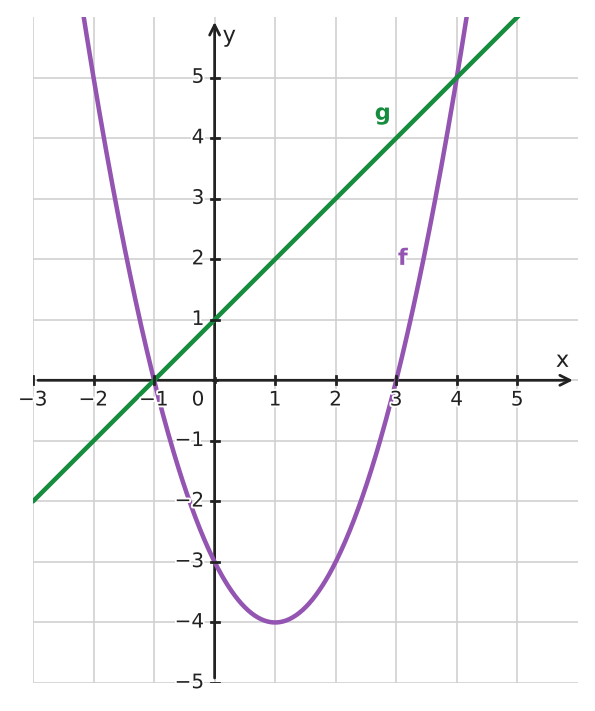
Figure for problem 532255

Hints

- Read the intersection coordinates from the axes. - Use point-slope information for the line and vertex form for the parabola. - Set the equations equal and factor.

Solution

1. From the graph, the intersection points are \((-1, 0)\) and \((4, 5)\). 2. Write \(g(x) = x + b\). Substituting \((-1, 0)\) gives \(b = 1\), so \(g(x) = x + 1\). 3. Write \(f(x) = a(x - 1)^2 - 4\). Substituting \((3, 0)\) gives \(0 = 4a - 4\), so \(a = 1\). 4. Therefore, \(f(x) = (x - 1)^2 - 4 = x^2 - 2x - 3\). 5. Set the functions equal: \(x^2 - 2x - 3 = x + 1\), so \(x^2 - 3x - 4 = 0\). 6. Factor: \((x - 4)(x + 1) = 0\), giving \(x = -1\) or \(x = 4\). 7. Substitution into \(g\) gives the points \((-1, 0)\) and \((4, 5)\), matching the graph.

Answer

1. \((-1, 0)\) and \((4, 5)\) 2. \(g(x) = x + 1\), \(f(x) = x^2 - 2x - 3\) 3. The calculated intersections are \((-1, 0)\) and \((4, 5)\).

5322589
The graph shows the parabola \(p(x) = x^2 - 2x - 4\) and two lines, \(g\) and \(h\). a) For each group of points, write the equation whose solutions are the x-coordinates of those points: - \(A\) and \(D\) - \(B\) and \(E\) - \(C\) b) Solve the equations to find the x-coordinates.
Figure for problem 532258

Hints

- Identify which two graphs meet at each labeled point. - Set the corresponding function expressions equal. - Factor the quadratic equations.

Solution

1. From the graph, \(g(x) = -x + 2\) and \(h(x) = x\). 2. Points \(A\) and \(D\) are intersections of \(p\) and \(g\), so solve \(x^2 - 2x - 4 = -x + 2\). 3. This becomes \(x^2 - x - 6 = (x - 3)(x + 2) = 0\), so the x-coordinates are \(-2\) and \(3\). 4. Points \(B\) and \(E\) are intersections of \(p\) and \(h\), so solve \(x^2 - 2x - 4 = x\). 5. This becomes \(x^2 - 3x - 4 = (x - 4)(x + 1) = 0\), so the x-coordinates are \(-1\) and \(4\). 6. Point \(C\) is the intersection of \(g\) and \(h\), so solve \(-x + 2 = x\), giving \(x = 1\).

Answer

a) \(A,D\): \(x^2 - 2x - 4 = -x + 2\); \(B,E\): \(x^2 - 2x - 4 = x\); \(C\): \(-x + 2 = x\) b) \(A,D\): \(x = -2, 3\); \(B,E\): \(x = -1, 4\); \(C\): \(x = 1\)
5333649
The graph shows a parabola \(p\) and a line \(g\). a) Read the intersection points from the graph. b) Given \(p(x) = -x^2 + 4x\) and \(g(x) = x\), calculate the intersections and compare them with the graph.
Figure for problem 533364

Hints

- Read both coordinates at each crossing. - Set the function expressions equal. - Factor out \(x\).

Solution

1. From the graph, the intersections are \((0, 0)\) and \((3, 3)\). 2. Set the functions equal: \(-x^2 + 4x = x\). 3. Rearrange and factor: \(x^2 - 3x = x(x - 3) = 0\). 4. Thus, \(x = 0\) or \(x = 3\). 5. Since \(g(x) = x\), the corresponding y-values are \(0\) and \(3\), confirming the graph.

Answer

a) \((0, 0)\) and \((3, 3)\) b) The calculation gives the same points.
5333869
The quadratic function \(f(x)=0.5x^2-2x+3\) and the linear function \(g(x)=x-1\) are shown in the graph. a) Use the graph to determine the x-coordinates of the intersections of \(f\) and \(g\). b) Define \(h(x)=f(x)-g(x)\). What is special about the values \(x_1\) and \(x_2\) from part a) on the graph of \(h\)? c) Explain the relationship between the intersections in part a) and your observation in part b).
Figure for problem 533386

Hints

- Look for the x-values where the parabola and line meet. - Consider what happens when two equal values are subtracted. - Recall the name for an x-value where a function's output is \(0\).

Solution

1. From the graph, the functions intersect at \(x_1=2\) and \(x_2=4\). 2. Compute the difference: \(h(x)=f(x)-g(x)=0.5x^2-3x+4\). 3. At each intersection, \(f(x)=g(x)\). Therefore, \(h(2)=f(2)-g(2)=0\) and \(h(4)=f(4)-g(4)=0\). Thus, \(2\) and \(4\) are the zeros of \(h\). 4. In general, \(f(x)=g(x)\) is equivalent to \(f(x)-g(x)=0\), so the x-coordinates of the intersections of two graphs are the zeros of their difference function.

Answer

a) \(x_1=2\) and \(x_2=4\) b) The values \(2\) and \(4\) are the zeros of \(h\). c) At an intersection, \(f(x)=g(x)\), which is equivalent to \(f(x)-g(x)=0\).
5333919
The graph shows a quadratic function \(f\) and a linear function \(g\). a) Determine the equations of \(f\) and \(g\) from the graph. b) Write an equation that can be used to find the intersections of the two graphs. c) Solve the equation, give the coordinates of the intersections, and compare your results with the graph.
Figure for problem 533391

Hints

- Use the vertex and another visible point to determine the parabola. - Use two points to find the line's slope and y-intercept. - At an intersection, the function outputs are equal. - Rearrange the quadratic equation and look for a factorization.

Solution

1. The parabola has vertex \((0,4)\), opens downward, and passes through \((2,0)\). Therefore, \(f(x)=-x^2+4\). 2. The line has y-intercept \(2\) and slope \(-1\), so \(g(x)=-x+2\). 3. Set the functions equal: \(-x^2+4=-x+2\). 4. Rearrange to obtain \(x^2-x-2=0\), and factor: \((x-2)(x+1)=0\). Thus, \(x=2\) or \(x=-1\). 5. Substitute into \(g\). The corresponding points are \((2,0)\) and \((-1,3)\), which agree with the graph.

Answer

a) \(f(x)=-x^2+4\); \(g(x)=-x+2\) b) \(-x^2+4=-x+2\) c) \((-1,3)\) and \((2,0)\)
5333969
Find the intersections of the translated parent quadratic \(f(x)=x^2-4\) and the line \(g(x)=x-2\). a) Write the equation that represents the intersection condition. b) Solve the equation without a calculator and determine the intersection coordinates. c) Compare your calculated points with the graph.
Figure for problem 533396

Hints

- At an intersection, the two functions have equal outputs. - Move all terms to one side and factor the quadratic expression. - An intersection point includes both an x-coordinate and a y-coordinate.

Solution

1. At an intersection, \(f(x)=g(x)\), so \(x^2-4=x-2\). 2. Move all terms to one side: \(x^2-x-2=0\). 3. Factor: \((x-2)(x+1)=0\). Therefore, \(x=2\) or \(x=-1\). 4. Substitute into \(g(x)=x-2\). When \(x=2\), \(y=0\). When \(x=-1\), \(y=-3\). 5. The intersections are \((2,0)\) and \((-1,-3)\), which match the graph.

Answer

a) \(x^2-4=x-2\) b) \((-1,-3)\) and \((2,0)\) c) The calculated points agree with the graph.
5334559
Camila wants to solve \(x^2+x-2=0\) graphically and sketches two approaches. a) For each approach, describe how the solutions are located on the graph. b) Read the solutions from the graphs. c) Verify the solutions algebraically by factoring.
Figure for problem 533455

Hints

- Connect the zeros of a function to an equation of the form \(f(x)=0\). - In the second graph, interpret what it means when the two function outputs are equal. - Decide whether x-coordinates or y-coordinates represent the equation solutions. - Find two integers whose product is \(-2\) and whose sum is \(1\).

Solution

1. In graph a), the function \(f(x)=x^2+x-2\) is shown. The solutions are the x-intercepts of the parabola because they satisfy \(f(x)=0\). 2. In graph b), the equation is rewritten as \(x^2=-x+2\). The solutions are the x-coordinates of the intersections of \(y=x^2\) and \(y=-x+2\). 3. Both graphs show the solutions \(x=-2\) and \(x=1\). 4. To verify, factor the original equation: \(x^2+x-2=(x+2)(x-1)=0\). Therefore, \(x=-2\) or \(x=1\), confirming the graphical results.

Answer

a) In graph a), use the x-intercepts of \(f\). In graph b), use the x-coordinates of the intersections of the parabola and line. b) \(x=-2\) and \(x=1\) c) \((x+2)(x-1)=0\), so \(x=-2\) or \(x=1\).
5336579
Calculate the coordinates of the intersections of the parabola \(p(x)=x^2-2x-1\) and the line \(g(x)=x-3\). Check your results against the graph.
Figure for problem 533657

Hints

- At an intersection, the two functions have equal outputs. - Move all terms to one side so the other side is \(0\). - Look for two factors of the quadratic expression. - Find the y-coordinate for each solution.

Solution

1. Set the functions equal: \(x^2-2x-1=x-3\). 2. Rearrange: \(x^2-3x+2=0\). 3. Factor: \((x-1)(x-2)=0\), so \(x=1\) or \(x=2\). 4. Substitute into \(g\): \(g(1)=-2\) and \(g(2)=-1\). 5. Therefore, the intersections are \((1,-2)\) and \((2,-1)\), which agree with the graph.

Answer

\((1,-2)\) and \((2,-1)\)
5549379
Maya factors \(6x^2+7x+2\) as \((3x+2)(2x+2)\). Explain how you can tell her factorization is incorrect, then give the correct factorization.

Hints

- Check a proposed factorization by multiplying it back out. - Compare all three coefficients of the product with the original trinomial. - Refactor the original expression rather than changing only one guessed factor.

Solution

1. Expanding Maya's factors gives \(6x^2+10x+4\), which does not match the original trinomial. 2. Split the middle term in the original expression: \(6x^2+4x+3x+2\). 3. Factor by grouping: \(2x(3x+2)+1(3x+2)=(3x+2)(2x+1)\).

Answer

Maya's factors expand to \(6x^2+10x+4\), not \(6x^2+7x+2\). The correct factorization is \((3x+2)(2x+1)\).
5256019
Find the solution set of the system in terms of the real parameters \(a\) and \(b\): \(\begin{cases}x + y = 2a + b \\ xy = a^2 + ab\end{cases}\).

Hints

- Solve the sum equation for one variable. - Substitute into the product equation and factor the resulting quadratic. - Determine when the two ordered-pair expressions are identical.

Solution

1. Solve the first equation for \(y\): \(y = 2a + b - x\). 2. Substitute into the product equation: \(x(2a + b - x) = a^2 + ab\). 3. Rewrite in standard form: \(x^2 - (2a + b)x + a^2 + ab = 0\). 4. Factor: \((x - a)(x - a - b) = 0\). Thus, \(x = a\) or \(x = a + b\). 5. The corresponding values of \(y\) are \(a + b\) and \(a\). When \(b = 0\), the two ordered-pair expressions coincide.

Answer

For \(b \ne 0\), \(\{(a, a + b), (a + b, a)\}\). For \(b = 0\), \(\{(a, a)\}\).
5371759
A square with side length \(c=\sqrt{53}\,\text{cm}\) is inscribed in a larger square so that four congruent right triangles are formed at the corners. The legs of each triangle have lengths \(a\) and \(b\). The area of the larger square is \(81\,\text{cm}^2\). Let \(x\) represent one triangle leg. Derive a quadratic equation in \(x\), factor it, and use the factorization to find \(a\) and \(b\).
Figure for problem 537175

Hints

- Use the larger square's area to determine \(a+b\). - The inner-square side is the hypotenuse of each corner triangle, giving a second relation between \(a\) and \(b\). - Substitute one leg as the larger-square side minus the other, then factor the resulting quadratic.

Solution

1. The larger square has side length \(\sqrt{81}=9\,\text{cm}\), so \(a+b=9\). 2. Each corner triangle has hypotenuse \(\sqrt{53}\,\text{cm}\), so \(a^2+b^2=53\). 3. Set \(b=9-a\): \(a^2+(9-a)^2=53\). 4. Simplify: \(2a^2-18a+28=0\), so \(a^2-9a+14=0\). 5. Factor: \((a-2)(a-7)=0\). Thus the two leg lengths are \(2\,\text{cm}\) and \(7\,\text{cm}\), in either order.

Answer

Quadratic: \(x^2-9x+14=0\) Factorization: \((x-2)(x-7)=0\) \(\{a,b\}=\{2\,\text{cm},7\,\text{cm}\}\)

All problems may be used, copied and printed free of charge for school and tutoring, including paid tutoring. Commercial adaptations as well as publication or redistribution on the internet are not permitted.