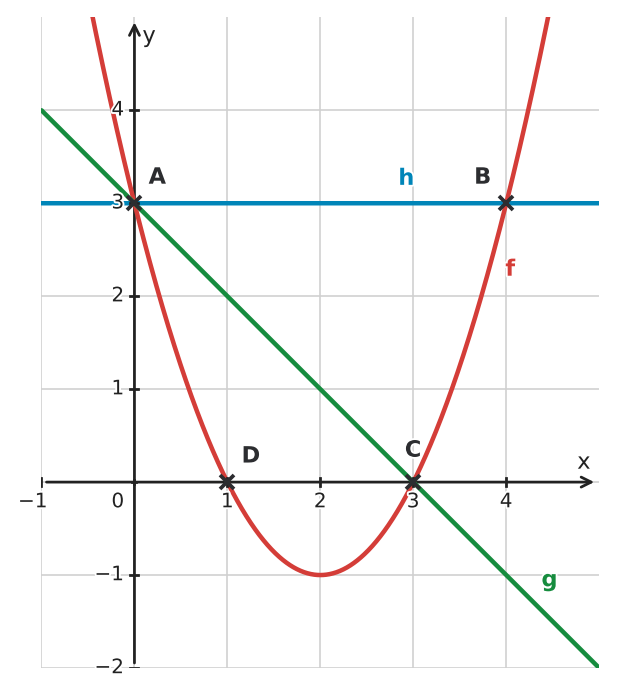
The graph shows a quadratic function \(f\) and two linear functions \(g\) and \(h\).
For each point \(A\), \(B\), \(C\), and \(D\), write an equation involving \(f\), \(g\), or \(h\) that is satisfied by the point's x-coordinate.
Then determine the equations of the three functions from the graph.
Hints
- Identify which graphs meet at each labeled point.
- A point on the x-axis has a function value of \(0\).
- Use the vertex and intercepts to determine the function equations.
- Set the appropriate function expressions equal to find an intersection's x-coordinate.
Solution
1. Point \(A\) lies on all three graphs, so its x-coordinate satisfies \(f(x)=g(x)\), \(f(x)=h(x)\), or \(g(x)=h(x)\). Point \(B\) satisfies \(f(x)=h(x)\). Point \(C\) satisfies \(f(x)=g(x)\), and because it lies on the x-axis, it also satisfies \(f(x)=0\). Point \(D\) satisfies \(f(x)=0\).
2. The horizontal line is \(h(x)=3\). The line \(g\) passes through \((0,3)\) and \((3,0)\), so its slope is \(-1\) and \(g(x)=-x+3\).
3. The parabola has vertex \((2,-1)\), so write \(f(x)=a(x-2)^2-1\). Since it passes through \((0,3)\), \(3=4a-1\), which gives \(a=1\). Thus, \(f(x)=(x-2)^2-1=x^2-4x+3\).
Answer
\(A\): \(f(x)=g(x)\), \(f(x)=h(x)\), or \(g(x)=h(x)\)
\(B\): \(f(x)=h(x)\)
\(C\): \(f(x)=g(x)\) or \(f(x)=0\)
\(D\): \(f(x)=0\)
The functions are \(f(x)=x^2-4x+3\), \(g(x)=-x+3\), and \(h(x)=3\).