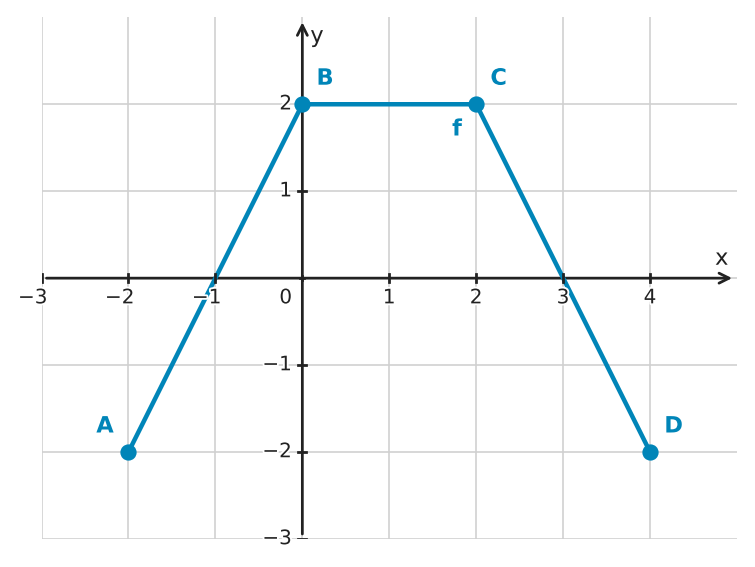
The graph of \(f\) is shown with marked points \(A\), \(B\), \(C\), and \(D\).
a) Read the domain and the coordinates of the four marked points from the graph. Then, for \(g(x)=-0.5f(x)+1\), find the domain and the transformed coordinates of \(A\), \(B\), \(C\), and \(D\).
b) For \(h(x)=f(0.5x)-1\), find the domain and the transformed coordinates of the four points.
Hints
- Read the endpoints and marked coordinates directly from the graph before transforming anything.
- Outside operations change y-coordinates.
- Inside operations change x-coordinates and the domain.
- Transform each point separately and use the same horizontal rule on the domain endpoints.
Solution
1. From the graph, the domain of \(f\) is \([-2, 4]\), with \(A(-2, -2)\), \(B(0, 2)\), \(C(2, 2)\), and \(D(4, -2)\).
2. For \(g\), the input is unchanged, so the domain remains \([-2, 4]\). Transform each output by \(y\mapsto-0.5y+1\).
3. This gives \(A_g(-2, 2)\), \(B_g(0, 0)\), \(C_g(2, 0)\), and \(D_g(4, 2)\).
4. For \(h\), the input factor \(0.5\) creates a horizontal stretch by a factor of \(2\), so the domain becomes \([-4, 8]\). Then shift outputs down \(1\) unit.
5. Each point \((x, y)\) maps to \((2x, y-1)\), giving \(A_h(-4, -3)\), \(B_h(0, 1)\), \(C_h(4, 1)\), and \(D_h(8, -3)\).
Answer
a) Original domain: \([-2, 4]\); original points: \(A(-2, -2)\), \(B(0, 2)\), \(C(2, 2)\), \(D(4, -2)\). For \(g\), domain: \([-2, 4]\); points: \(A_g(-2, 2)\), \(B_g(0, 0)\), \(C_g(2, 0)\), \(D_g(4, 2)\).
b) Domain: \([-4, 8]\); points: \(A_h(-4, -3)\), \(B_h(0, 1)\), \(C_h(4, 1)\), \(D_h(8, -3)\).