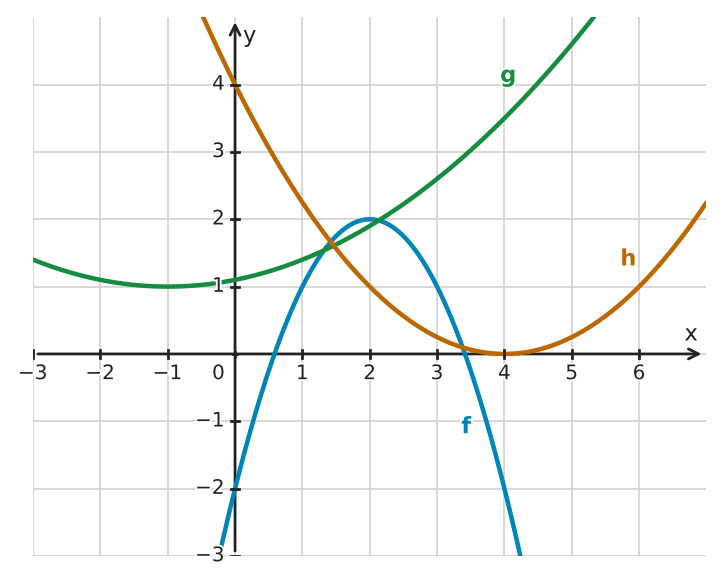
The graph shows three quadratic functions, \(f\), \(g\), and \(h\).
a) From the graph, determine the number of real solutions of \(f(x) = 0\), \(g(x) = 0\), and \(h(x) = 0\). For each equation, state whether its discriminant is positive, negative, or zero. Explain your reasoning.
b) The function \(f\) is given by \(f(x) = -x^2 + 4x - 2\). Calculate the discriminant of \(f(x) = 0\) and compare it with your answer from part a).
Hints
- Count each graph’s x-intercepts.
- Connect two, one, or zero x-intercepts with the sign of the discriminant.
- For part b), identify \(a\), \(b\), and \(c\) from the equation.
Solution
a) The graph of \(f\) crosses the x-axis twice, so \(f(x)=0\) has two real solutions and \(D>0\). The graph of \(g\) stays above the x-axis, so \(g(x)=0\) has no real solutions and \(D<0\). The graph of \(h\) touches the x-axis once, so \(h(x)=0\) has one real solution and \(D=0\).
b) For \(f(x)=-x^2+4x-2\), \(D=4^2-4\cdot(-1)\cdot(-2)=16-8=8\). Since \(8>0\), the calculation agrees with the two x-intercepts shown in the graph.
Answer
a) \(f\): two real solutions and \(D > 0\)
\(g\): no real solutions and \(D < 0\)
\(h\): one real solution and \(D = 0\)
b) \(D = 8\), which agrees with the graph.