Aimathic
Login | English | Deutsch

Free math worksheets

Build your own math worksheets from 30,000+ problems for grades 3 to 12, from fractions to AP Calculus. Every problem comes with step-by-step solutions.

Translations and reflections

Click problems to add them to your worksheet.

55103310
The coordinate grid shows triangle \(ABC\). Translate the triangle by the vector \(\langle 3,-2\rangle\), which moves every point \(3\) units right and \(2\) units down. Give the coordinates of \(A'\), \(B'\), and \(C'\).
Figure for problem 551033

Hints

- Read the coordinates of each original vertex carefully from the grid. - A translation changes every point by the same horizontal and vertical amounts. - Keep each image label matched with its original vertex.

Solution

1. Read the vertices from the graph: \(A=(-4,3)\), \(B=(-1,3)\), and \(C=(-2,1)\). 2. A translation by \(\langle 3,-2\rangle\) sends \((x,y)\) to \((x+3,y-2)\). 3. Therefore, \(A'=(-1,1)\), \(B'=(2,1)\), and \(C'=(1,-1)\).

Answer

\(A'=(-1,1)\), \(B'=(2,1)\), \(C'=(1,-1)\)
55500810
The coordinate grid shows a point \(P\) and its image \(P'\) under a translation. What translation vector maps \(P\) to \(P'\)?
Figure for problem 555008

Hints

- Compare the x-coordinates of the point and its image. - Compare the y-coordinates in the same direction, from preimage to image.

Solution

1. From the graph, \(P=(-4,1)\) and \(P'=(1,4)\). 2. The horizontal change is \(1-(-4)=5\), and the vertical change is \(4-1=3\). 3. Therefore, the translation vector is \(\langle 5,3\rangle\).

Answer

\(\langle 5,3\rangle\)
51304610
Consider the linear function \(h(x) = -1.5x + 6\). a) Reflect the graph of \(h\) across the y-axis. Find an equation for the image function \(h_1\). b) Reflect the graph of \(h\) across the x-axis. Find an equation for the image function \(h_2\). c) Are the graphs of \(h_1\) and \(h_2\) parallel? Justify your answer using their slopes.

Hints

- How do the coordinates of a point change under reflection across the y-axis or x-axis? - Translate those coordinate changes into changes in the function rule. - What must be true about the slopes of two parallel lines?

Solution

1. Reflecting across the y-axis replaces \(x\) with \(-x\): \(h_1(x) = -1.5(-x) + 6 = 1.5x + 6\). 2. Reflecting across the x-axis multiplies each output by \(-1\): \(h_2(x) = -(-1.5x + 6) = 1.5x - 6\). 3. Both image lines have slope \(1.5\). Since their y-intercepts are different, they are distinct parallel lines.

Answer

a) \(h_1(x) = 1.5x + 6\) b) \(h_2(x) = 1.5x - 6\) c) Yes. Both lines have slope \(1.5\).
54222410
Distinct points \(A\) and \(B\) lie on line \(\ell\). A geometry app translates both points by the same directed segment, producing \(A'\) and \(B'\). The translation direction is not parallel to \(\ell\). Thus \(\overline{AA'}\parallel\overline{BB'}\), \(AA'=BB'\), and the two directed segments point the same way. Explain why line \(A'B'\) is parallel to \(\ell\).
Figure for problem 542224

Hints

- Place the original and image points in one quadrilateral. - Use the information about the two translation segments as an opposite-side condition. - After classifying the quadrilateral, examine its other pair of opposite sides.

Solution

1. In quadrilateral \(ABB'A'\), opposite sides \(\overline{AA'}\) and \(\overline{BB'}\) are parallel and congruent. 2. A quadrilateral with one pair of opposite sides both parallel and congruent is a parallelogram. 3. Therefore, \(ABB'A'\) is a parallelogram. 4. Its other pair of opposite sides is parallel, so \(A'B'\parallel AB\). 5. Since \(\overline{AB}\) lies on \(\ell\), line \(A'B'\) is parallel to \(\ell\).

Answer

The equal, parallel translation segments make \(ABB'A'\) a parallelogram. Therefore, \(A'B'\parallel AB\), and hence \(A'B'\parallel\ell\).
55103410
The coordinate grid shows triangle \(PQR\). Reflect the triangle across the \(y\)-axis. Give the coordinates of \(P'\), \(Q'\), and \(R'\). Then state whether the orientation of the vertex order \(P\to Q\to R\) is preserved or reversed.
Figure for problem 551034

Hints

- Compare how a point and its reflection are positioned relative to the \(y\)-axis. - Track what changes and what stays the same in each ordered pair. - After locating the image vertices, follow the labeled vertices in order around each triangle.

Solution

1. Read the vertices from the graph: \(P=(-3,1)\), \(Q=(-1,4)\), and \(R=(1,1)\). 2. Reflection across the \(y\)-axis sends \((x,y)\) to \((-x,y)\). 3. Thus, \(P'=(3,1)\), \(Q'=(1,4)\), and \(R'=(-1,1)\). 4. A reflection reverses orientation, so the order \(P\to Q\to R\) and the corresponding order \(P'\to Q'\to R'\) have opposite orientations.

Answer

\(P'=(3,1)\), \(Q'=(1,4)\), \(R'=(-1,1)\); the orientation is reversed.
55103610
The diagram shows congruent quadrilaterals \(ABCD\) and \(A'B'C'D'\). A student says, “Since all corresponding lengths and angles are preserved, a translation could map \(ABCD\) to \(A'B'C'D'\).” Decide whether the student's claim is possible. Explain which property of the labeled vertex order distinguishes a translation from a reflection in this diagram, and name two geometric properties that both transformations preserve.
Figure for problem 551036

Hints

- Trace the labeled vertices in order around each quadrilateral rather than comparing only side lengths. - Which rigid transformations preserve clockwise versus counterclockwise orientation? - Separate properties shared by all rigid motions from the property that distinguishes these two transformations.

Solution

1. Following \(A\to B\to C\to D\) around the first quadrilateral gives the opposite orientation from following \(A'\to B'\to C'\to D'\) around the image. 2. A translation preserves orientation, so no translation can produce this labeled image. 3. A reflection reverses orientation, so a reflection is consistent with the diagram. 4. Both translations and reflections preserve distances and angle measures.

Answer

The student's claim is not possible. The labeled vertex order has reversed orientation, which a translation cannot do but a reflection can. Both transformations preserve distances and angle measures.
55500910
The grid shows triangle \(ABC\) and the vertical reflection line \(x=2\). Reflect the triangle across \(x=2\). Give the coordinates of \(A'\), \(B'\), and \(C'\).
Figure for problem 555009

Hints

- Measure each vertex's horizontal distance from the line \(x=2\). - A reflection keeps the y-coordinate unchanged for a vertical mirror line. - Place each image the same horizontal distance on the opposite side of the mirror.

Solution

1. From the graph, \(A=(-2,3)\), \(B=(0,1)\), and \(C=(-3,-1)\). 2. Reflection across \(x=2\) keeps each y-coordinate and places the x-coordinates equally far from \(2\) on the other side. Equivalently, \(x'=4-x\). 3. Therefore, \(A'=(6,3)\), \(B'=(4,1)\), and \(C'=(7,-1)\).

Answer

\(A'=(6,3)\), \(B'=(4,1)\), \(C'=(7,-1)\)
55501010
The coordinate grid shows segment \(\overline{MN}\) and the horizontal reflection line \(y=-1\). Reflect the segment across \(y=-1\). Give \(M'\) and \(N'\), and state the y-coordinate of the midpoint of each point-image pair.
Figure for problem 555010

Hints

- Compare each endpoint's vertical distance from \(y=-1\). - A horizontal reflection leaves the x-coordinate unchanged. - The mirror line must bisect the vertical segment joining a point and its image.

Solution

1. From the graph, \(M=(-3,3)\) and \(N=(2,1)\). 2. Reflection across \(y=-1\) keeps each x-coordinate and sends \(y\) to \(-2-y\). 3. Thus, \(M'=(-3,-5)\) and \(N'=(2,-3)\). 4. The midpoint of each point-image pair lies on the reflection line, so its y-coordinate is \(-1\).

Answer

\(M'=(-3,-5)\), \(N'=(2,-3)\); each point-image midpoint has y-coordinate \(-1\).
51304710
Line \(k\) passes through the origin \(O(0, 0)\) and \(B(4, 2)\). a) Find an equation for \(k\). b) Reflect \(k\) across the horizontal line \(y = 2\). Find an equation for the image line \(k'\). c) Explain why this reflection reverses the sign of the slope.

Hints

- Find the slope from the two given points. - Which points stay fixed under a reflection across \(y = 2\)? - Reflect the origin by using its distance from \(y = 2\). - Compare the horizontal and vertical changes before and after the reflection.

Solution

1. The slope through \((0, 0)\) and \((4, 2)\) is \(\frac{2}{4} = 0.5\), so \(k(x) = 0.5x\). 2. Point \(B(4, 2)\) lies on the line of reflection, so it stays fixed. The origin is 2 units below \(y = 2\), so it reflects to \((0, 4)\). 3. The image line through \((0, 4)\) and \((4, 2)\) has slope \(\frac{2 - 4}{4 - 0} = -0.5\), so \(k'(x) = -0.5x + 4\). 4. A horizontal reflection keeps horizontal changes the same but reverses vertical changes. Therefore, \(\frac{\Delta y}{\Delta x}\) changes sign.

Answer

a) \(k(x) = 0.5x\) b) \(k'(x) = -0.5x + 4\) c) The reflection reverses \(\Delta y\) while keeping \(\Delta x\) unchanged, so the slope changes sign.
52185810
The graphs of \(f(x)=x^3+2\) and \(h(x)=(6-x)^3+2\) are reflections of each other across a vertical line \(x=a\). Find \(a\). Then explain why the transformation \(x\mapsto 2a-x\) represents a reflection across \(x=a\) by considering the midpoint of an input \(x\) and its reflected input \(x'\).

Hints

- Compare the input \(6-x\) with the general reflected input \(2a-x\). - A reflection line bisects the segment joining a point and its image. - Use the midpoint formula on the number line. - Determine the constant midpoint required for reflection across \(x=a\).

Solution

1. Since \(h(x)=f(6-x)\), compare \(6-x\) with \(2a-x\). This gives \(2a=6\), so \(a=3\). 2. For any input \(x\), let its reflected input be \(x'=2a-x\). 3. Their midpoint is \(\frac{x+x'}{2}=\frac{x+(2a-x)}{2}=a\). 4. Also, \(|x-a|=|x'-a|\). Thus, \(x\) and \(x'\) lie the same distance from \(x=a\) on opposite sides, so the transformation is a reflection across that line.

Answer

The reflection line is \(x=3\). For \(x'=2a-x\), the midpoint is \(\frac{x+x'}{2}=a\), and the two inputs are equidistant from \(x=a\).
53674810
In isosceles \(\triangle ADC\), \(AD=CD\). Point \(E\) lies on \(\overline{AD}\), point \(F\) lies on \(\overline{CD}\), and \(AE=CF\). Segments \(\overline{AF}\) and \(\overline{CE}\) intersect at \(B\). Use the reflection symmetry of \(\triangle ADC\) to prove that \(\triangle ABC\) is isosceles. Identify the mirror line, explain why the reflection maps \(E\) to \(F\), and explain why the intersection point \(B\) is fixed.
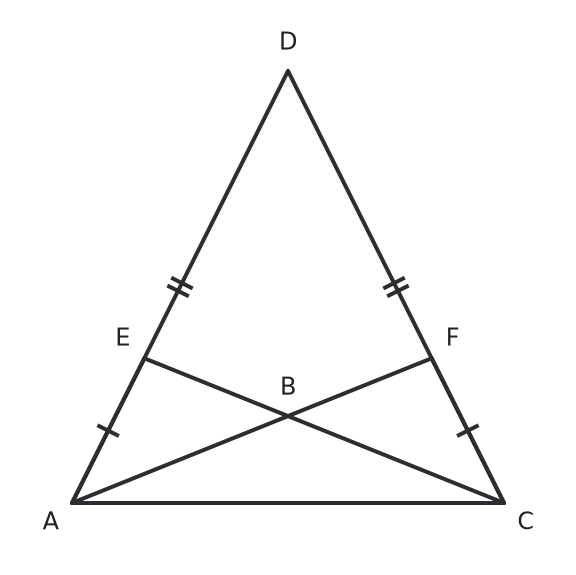
Figure for problem 536748

Hints

- Identify the reflection symmetry of the outer isosceles triangle. - Track a point on one congruent side by its distance from the corresponding base vertex. - What happens to the intersection of two lines when the reflection swaps those two lines?

Solution

1. The reflection across the symmetry axis of isosceles \(\triangle ADC\)—the line through \(D\) and the midpoint of \(AC\)—maps \(A\leftrightarrow C\) and side \(AD\) onto side \(CD\). 2. Reflection preserves distance. The image of \(E\) must lie on \(CD\) at the same distance from \(C\) that \(E\) lies from \(A\). Since \(AE=CF\), the image of \(E\) is \(F\). 3. Therefore, line \(CE\) reflects to line \(AF\), and line \(AF\) reflects to line \(CE\). 4. Their intersection \(B\) must map to itself, so \(B\) lies on the mirror line. 5. Since the reflection maps \(A\) to \(C\) and fixes \(B\), it maps \(\overline{BA}\) to \(\overline{BC}\). Reflections preserve distance, so \(BA=BC\). 6. Therefore, \(\triangle ABC\) is isosceles.

Answer

Reflect across the symmetry axis through \(D\) and the midpoint of \(AC\). The reflection maps \(A\leftrightarrow C\) and, because \(AE=CF\), maps \(E\leftrightarrow F\). Thus, lines \(AF\) and \(CE\) are images of each other, so their intersection \(B\) is fixed. Hence, \(BA=BC\), and \(\triangle ABC\) is isosceles.

53715110
Two farms, \(A\) and \(B\), are on the same side of a straight creek bank \(g\). The farmers will build a shared water station \(T\) on the bank. Where should \(T\) be placed to minimize the total pipe length \(AT + TB\)? Justify your answer by reflecting \(B\) across \(g\) to point \(B'\) and using the triangle inequality.
Figure for problem 537151

Hints

- Reflection preserves distance to points on the mirror line. - Replace the broken path to \(B\) with a path to its reflected point. - The shortest distance between two points is a straight segment. - Use the triangle inequality to compare any other point on the bank.

Solution

1. Reflect \(B\) across line \(g\) to point \(B'\). 2. For every point \(X\) on \(g\), reflection preserves distance and fixes \(X\), so \(XB = XB'\). 3. Therefore, \(AX + XB = AX + XB'\). 4. Draw \(\overline{AB'}\). Let its intersection with \(g\) be \(T\). Since \(A\), \(T\), and \(B'\) are collinear, \(AT + TB = AT + TB' = AB'\). 5. For any other point \(Q\) on \(g\), the triangle inequality gives \(AQ + QB' > AB'\). 6. Since \(QB' = QB\), \(AQ + QB > AT + TB\). Thus, \(T\) is the unique minimizing location.

Answer

Reflect \(B\) across \(g\) to \(B'\). Place the water station at \(T = \overline{AB'} \cap g\). This location minimizes \(AT + TB\).
55103510
The diagram shows two pairs of corresponding points under the same reflection: \(A\) maps to \(A'\), and \(B\) maps to \(B'\). The reflection line is not drawn. Describe a straightedge-and-compass construction that determines the reflection line. Justify why the two point-image pairs must determine the same line.
Figure for problem 551035

Hints

- Think about how far any point on a reflection line is from a point and from its image. - Which standard construction identifies all points equidistant from the endpoints of a segment? - Use the fact that both point-image pairs come from one and the same reflection.

Solution

1. Construct the perpendicular bisector of \(\overline{AA'}\). 2. Construct the perpendicular bisector of \(\overline{BB'}\). 3. For any reflection, the reflection line is the perpendicular bisector of the segment joining a point to its image. 4. Because both pairs come from the same reflection, the two perpendicular bisectors coincide. Their common line is the reflection line.

Answer

Construct the perpendicular bisectors of \(\overline{AA'}\) and \(\overline{BB'}\). They coincide, and that common perpendicular bisector is the reflection line.

All problems may be used, copied and printed free of charge for school and tutoring, including paid tutoring. Commercial adaptations as well as publication or redistribution on the internet are not permitted.