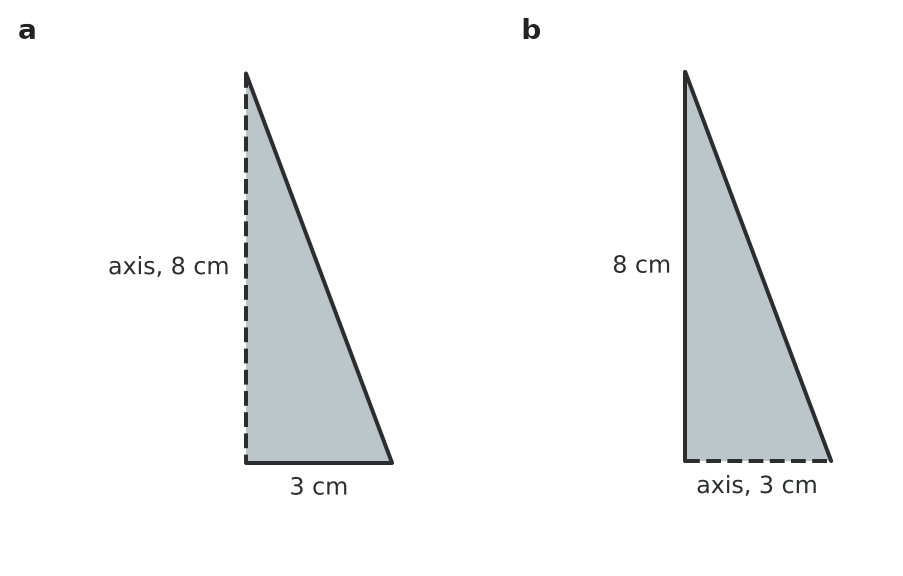
The same right triangular region is shown twice.
a) In panel a, the region rotates about the dashed axis. Identify the resulting solid and give its radius and height.
b) In panel b, the region rotates about the dashed axis. Identify the resulting solid and give its radius and height.
c) Find the exact volume in each case and determine which rotation produces the greater volume.
Hints
- In each panel, decide which leg lies on the rotation axis.
- The other perpendicular leg sweeps out the circular base and therefore determines the radius.
- Use the same cone-volume formula for both rotations before comparing the exact results.
Solution
1. In panel a, the leg on the axis becomes the cone's height, \(8\,\text{cm}\), and the perpendicular leg becomes its radius, \(3\,\text{cm}\).
2. In panel b, the leg on the axis becomes the cone's height, \(3\,\text{cm}\), and the perpendicular leg becomes its radius, \(8\,\text{cm}\).
3. The first volume is \(\frac{1}{3}\pi(3^2)(8)=24\pi\,\text{cm}^3\). The second is \(\frac{1}{3}\pi(8^2)(3)=64\pi\,\text{cm}^3\), so panel b produces the greater volume.
Answer
a) Cone: radius \(3\,\text{cm}\), height \(8\,\text{cm}\).
b) Cone: radius \(8\,\text{cm}\), height \(3\,\text{cm}\).
c) The volumes are \(24\pi\,\text{cm}^3\) and \(64\pi\,\text{cm}^3\), respectively; panel b produces the greater volume.