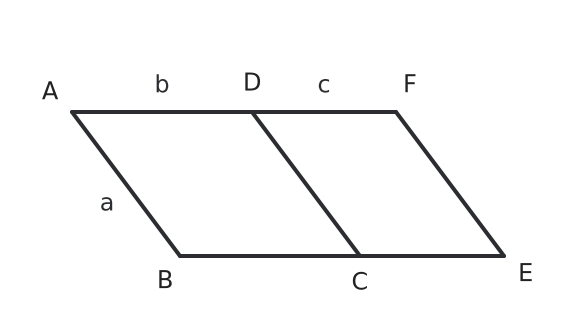
Parallelograms \(ABCD\) and \(DCEF\) share side \(\overline{CD}\). The diagram shows \(a = 5\,\text{cm}\), \(b = 5\,\text{cm}\), and \(c = 4\,\text{cm}\). Points \(A\), \(D\), and \(F\) are collinear.
a) Explain why quadrilateral \(ABEF\) is a parallelogram.
b) Find the perimeter of \(ABEF\).
Hints
- Use the opposite-side properties of each given parallelogram.
- Compare \(\overline{AB}\) and \(\overline{EF}\) through their relationships with \(\overline{CD}\).
- Use the collinearity of \(A\), \(D\), and \(F\) to determine the long side of \(ABEF\).
- After the proof in part a), use the side lengths of the resulting parallelogram for its perimeter.
Solution
1. In parallelogram \(ABCD\), \(\overline{AB} \parallel \overline{CD}\) and \(AB = CD = 5\,\text{cm}\).
2. In parallelogram \(DCEF\), \(\overline{CD} \parallel \overline{EF}\) and \(CD = EF = 5\,\text{cm}\).
3. Therefore, \(\overline{AB}\) and \(\overline{EF}\) are parallel and congruent. A quadrilateral with one pair of opposite sides both parallel and congruent is a parallelogram, so \(ABEF\) is a parallelogram.
4. Since \(A\), \(D\), and \(F\) are collinear, \(AF = AD + DF = 5\,\text{cm} + 4\,\text{cm} = 9\,\text{cm}\).
5. The perimeter is \(2 \cdot (AB + AF) = 2 \cdot (5\,\text{cm} + 9\,\text{cm}) = 28\,\text{cm}\).
Answer
a) \(\overline{AB}\) and \(\overline{EF}\) are parallel and congruent, so \(ABEF\) is a parallelogram.
b) \(28\,\text{cm}\)