Aimathic
Login | English | Deutsch

Free math worksheets

Build your own math worksheets from 30,000+ problems for grades 3 to 12, from fractions to AP Calculus. Every problem comes with step-by-step solutions.

Construct inscribed and circumscribed figures

Click problems to add them to your worksheet.

51219410
Construct a regular octagon inscribed in a circle. a) Find the octagon’s central angle. b) Describe how to locate all eight vertices by first drawing two perpendicular diameters and then constructing angle bisectors. c) Find the measure of one interior angle of the octagon.

Hints

- What angle is formed by two perpendicular lines? - What happens when each right angle at the center is bisected? - How are an interior angle and its adjacent exterior angle related?

Solution

1. The central angle is \(360^\circ \div 8 = 45^\circ\). 2. Draw two perpendicular diameters. Their endpoints give four points on the circle separated by \(90^\circ\) central angles. Bisect each of the four right angles at the center. The bisectors meet the circle at four additional points, producing eight equally spaced vertices separated by \(45^\circ\). 3. A regular octagon’s exterior angle equals its central angle, \(45^\circ\). Therefore, one interior angle is \(180^\circ - 45^\circ = 135^\circ\).

Answer

a) \(45^\circ\) b) Draw two perpendicular diameters, then bisect each \(90^\circ\) central angle to create eight equally spaced points. c) \(135^\circ\)
51280910
Use a circle with a diameter to construct right triangle \(ABC\) with hypotenuse \(AB = c = 7\,\text{cm}\) and leg \(BC = a = 4\,\text{cm}\).

Hints

- The right-angle vertex must lie on the circle whose diameter is the hypotenuse. - Use the given leg length to draw a second circle. - The intersections locate the possible positions of \(C\).

Solution

1. Draw \(\overline{AB}\) with \(AB = 7\,\text{cm}\). 2. Construct the midpoint \(M\) of \(\overline{AB}\). 3. Draw the circle centered at \(M\) with radius \(3.5\,\text{cm}\), so \(\overline{AB}\) is a diameter. 4. Draw a circle centered at \(B\) with radius \(4\,\text{cm}\). 5. Label either intersection of the two circles as \(C\), then draw \(\overline{AC}\) and \(\overline{BC}\). 6. The two intersections give reflected, congruent triangles. In either triangle, \(\angle C = 90^\circ\) because it subtends diameter \(\overline{AB}\).

Answer

Point \(C\) is either intersection of the circle with diameter \(\overline{AB}\) and the circle centered at \(B\) with radius \(4\,\text{cm}\). The two constructions are reflected, congruent solutions.
54215810
A geometry program identifies two points associated with triangle \(ABC\): - Point \(X\) satisfies \(XA=XB=XC=6.4\,\text{cm}\). - The perpendicular distances from point \(Y\) to the three side lines of the triangle are all \(2.7\,\text{cm}\), and \(Y\) lies inside the triangle. a) Which point is the center of the circle circumscribed about \(\triangle ABC\), and what radius should that circle have? b) Which point is the center of the circle inscribed in \(\triangle ABC\), and what radius should that circle have? c) Explain why choosing \(X\) as the center of the inscribed circle is not justified by the given information.
Figure for problem 542158

Hints

- Decide whether each circle must meet vertices or side lines. - Match each type of equal distance to the geometric objects it references. - Check whether the evidence for one center also proves tangency to every side.

Solution

1. A circumscribed circle must pass through all three vertices. Since \(XA=XB=XC=6.4\,\text{cm}\), point \(X\) is the circumcenter and the circumradius is \(6.4\,\text{cm}\). 2. An inscribed circle must be tangent to all three sides. Since the perpendicular distances from \(Y\) to the three side lines are all \(2.7\,\text{cm}\), point \(Y\) is the incenter and the inradius is \(2.7\,\text{cm}\). 3. Equal distances from \(X\) to the vertices do not imply equal perpendicular distances from \(X\) to the sides. Therefore, the data about \(X\) do not show that a circle centered at \(X\) would be tangent to all three sides.

Answer

a) \(X\) is the circumcenter, and the radius is \(6.4\,\text{cm}\). b) \(Y\) is the incenter, and the radius is \(2.7\,\text{cm}\). c) The information about \(X\) concerns distances to vertices, not perpendicular distances to sides, so it does not establish an inscribed circle.
54216310
A circle has radius \(5\,\text{cm}\). A geometry app will place consecutive vertices of a regular hexagon by keeping one chord length fixed and stepping it around the circle. Student A chooses a chord length of \(5\,\text{cm}\). Student B chooses a chord length of \(10\,\text{cm}\). a) Which choice produces six equally spaced vertices? b) Explain why that chord length works. c) Explain what happens with the other chord length.
Figure for problem 542163

Hints

- Relate the number of equal sides to the angle around the center. - Compare the triangle formed by two radii and one candidate chord. - Consider how many distinct endpoints a diameter can reach from a point on the circle.

Solution

1. A regular hexagon has central angle \(360^\circ\div6=60^\circ\). 2. Two radii and a chord subtending \(60^\circ\) form an equilateral triangle, so the chord length equals the circle's radius. 3. Therefore, the \(5\,\text{cm}\) chord chosen by Student A steps off six equal arcs and produces the regular hexagon. 4. A \(10\,\text{cm}\) chord is a diameter. Its endpoints are opposite each other, so repeatedly using that length alternates between only two points instead of producing six vertices.

Answer

a) Student A's \(5\,\text{cm}\) chord. b) Each side subtends a \(60^\circ\) central angle, making the triangle formed by two radii and one side equilateral. c) The \(10\,\text{cm}\) chord is a diameter, so it reaches only the antipodal point and cannot generate six distinct vertices.
54217010
Right triangle \(ABC\) has legs \(AC=9\,\text{cm}\) and \(BC=12\,\text{cm}\), with hypotenuse \(AB=15\,\text{cm}\). Two geometry-app plans are proposed for the center of its circumscribed circle: - Plan 1 uses the intersection of two side perpendicular bisectors. - Plan 2 uses the midpoint \(M\) of \(\overline{AB}\). Explain why both plans locate the same point, and determine the circumradius.
Figure for problem 542170

Hints

- Recall what equal-distance condition defines the center of a circumscribed circle. - Use the special relationship between a right triangle and its hypotenuse. - Once the center is identified, relate the radius to the hypotenuse length.

Solution

1. The center of a triangle's circumscribed circle is the intersection of its side perpendicular bisectors, so Plan 1 locates the circumcenter. 2. In a right triangle, the midpoint of the hypotenuse is equidistant from all three vertices. Thus \(MA=MB=MC\), so \(M\) is the circumcenter. 3. Since \(M\) is the midpoint of the \(15\,\text{cm}\) hypotenuse, \(MA=MB=\frac{15}{2}=7.5\,\text{cm}\). 4. Therefore, both plans locate \(M\), and the circumradius is \(7.5\,\text{cm}\).

Answer

Both plans locate the midpoint \(M\) of the hypotenuse, because that point is equidistant from all three vertices of a right triangle. The circumradius is \(7.5\,\text{cm}\).
54217610
A square has side length \(10\,\text{cm}\). Let \(O\) be the intersection of its diagonals. a) Explain why \(O\) can serve as the center of both the circle inscribed in the square and the circle circumscribed about the square. b) Find the radius of the inscribed circle. c) Find the radius of the circumscribed circle.
Figure for problem 542176

Hints

- Use the symmetries and diagonal properties of a square to compare distances from its center. - Relate the smaller radius to the distance between opposite sides. - Relate the larger radius to a segment joining opposite vertices.

Solution

1. The diagonals of a square are congruent and bisect each other, so \(O\) is equidistant from all four vertices. The square's symmetry also makes \(O\) equidistant from all four sides. 2. Therefore, a circle centered at \(O\) can pass through all four vertices, and another circle centered at \(O\) can be tangent to all four sides. 3. The perpendicular distance from \(O\) to a side is half the side length, so the inradius is \(\frac{10}{2}=5\,\text{cm}\). 4. A diagonal has length \(\sqrt{10^2+10^2}=10\sqrt{2}\,\text{cm}\). 5. The circumradius is half the diagonal, so it is \(5\sqrt{2}\,\text{cm}\).

Answer

a) \(O\) is equidistant from the four sides and also from the four vertices, so it is the center of both circles. b) \(5\,\text{cm}\). c) \(5\sqrt{2}\,\text{cm}\).
54218110
In triangle \(ABC\), the perpendicular bisectors of \(\overline{AB}\) and \(\overline{BC}\) intersect at \(O\). a) Prove that \(OA=OC\). b) Explain why the perpendicular bisector of \(\overline{AC}\) must also pass through \(O\). c) Explain how these facts verify the circle circumscribed about \(\triangle ABC\).
Figure for problem 542181

Hints

- Translate membership on each perpendicular bisector into an equal-distance statement. - Link the two equalities through their common distance. - Use the final set of equal distances to identify one circle through all three vertices.

Solution

1. Since \(O\) lies on the perpendicular bisector of \(\overline{AB}\), \(OA=OB\). 2. Since \(O\) lies on the perpendicular bisector of \(\overline{BC}\), \(OB=OC\). 3. By the transitive property, \(OA=OC\). 4. A point equidistant from \(A\) and \(C\) lies on the perpendicular bisector of \(\overline{AC}\), so that third perpendicular bisector also passes through \(O\). 5. A circle centered at \(O\) with radius \(OA\) passes through \(A\), \(B\), and \(C\) because \(OA=OB=OC\). Therefore, it is the circumscribed circle of \(\triangle ABC\).

Answer

a) \(OA=OB\) and \(OB=OC\), so \(OA=OC\). b) Because \(OA=OC\), point \(O\) lies on the perpendicular bisector of \(\overline{AC}\). c) The circle centered at \(O\) with radius \(OA\) passes through all three vertices, so it is the circumscribed circle.
54224610
A regular hexagon \(ABCDEF\) has center \(O\). A geometry app creates the perpendicular from \(O\) to side \(\overline{AB}\), meeting it at \(M\), and draws a circle with center \(O\) and radius \(OM\). Prove that this circle is tangent to all six sides of the hexagon.
Figure for problem 542246

Hints

- First justify tangency to the side used in the app construction. - Identify a symmetry that maps one side of a regular hexagon to every other side. - Track what that symmetry does to the perpendicular distance from the center.

Solution

1. Since \(OM\perp AB\), the circle centered at \(O\) with radius \(OM\) is tangent to \(\overline{AB}\) at \(M\). 2. A regular hexagon has rotational symmetry of \(60^\circ\) about \(O\). 3. Each rotation maps \(\overline{AB}\) to another side and maps \(\overline{OM}\) to a perpendicular segment of the same length from \(O\) to that side. 4. Therefore, every side is at distance \(OM\) from \(O\), so the circle is tangent to all six sides.

Answer

The perpendicular distance from \(O\) to every side is \(OM\) by the hexagon’s rotational symmetry. Therefore, the circle centered at \(O\) with radius \(OM\) is tangent to all six sides.
54225310
Rectangle \(ABCD\) has diagonals that intersect at \(O\). Describe how a geometry app can create its circumscribed circle using \(O\), and prove that all four vertices lie on the circle.
Figure for problem 542253

Hints

- Use two standard properties of the diagonals of a rectangle. - Compare the four half-diagonal lengths from their intersection. - Choose the center and radius once those distances are shown equal.

Solution

1. The app draws diagonals \(\overline{AC}\) and \(\overline{BD}\) to locate their intersection \(O\). 2. The diagonals of a rectangle bisect each other, so \(OA=OC\) and \(OB=OD\). 3. The diagonals of a rectangle are congruent, so \(AC=BD\). Their halves are therefore congruent, giving \(OA=OB\). 4. Thus \(OA=OB=OC=OD\). 5. The app draws the circle centered at \(O\) with radius \(OA\). It passes through all four vertices.

Answer

The app intersects the diagonals at \(O\), then draws the circle centered at \(O\) through \(A\). Because the rectangle’s congruent diagonals bisect each other, \(OA=OB=OC=OD\), so the circle passes through every vertex.
54226710
Two distinct diameters \(\overline{AC}\) and \(\overline{BD}\) are drawn in a circle. Connect the endpoints in their order around the circle to form quadrilateral \(ABCD\). Prove that this construction always produces a rectangle, even when the diameters are not perpendicular.
Figure for problem 542267

Hints

- Identify the arc intercepted by each angle of the quadrilateral. - Recall the angle measure subtended by a diameter. - Distinguish the conditions for a rectangle from the stronger conditions for a square.

Solution

1. Angle \(\angle ABC\) intercepts diameter \(\overline{AC}\), so it is a right angle. 2. Angle \(\angle BCD\) intercepts diameter \(\overline{BD}\), so it is a right angle. 3. Similarly, \(\angle CDA\) intercepts diameter \(\overline{AC}\), and \(\angle DAB\) intercepts diameter \(\overline{BD}\). Both are right angles. 4. Therefore, \(ABCD\) has four right angles and is a rectangle. 5. Perpendicular diameters are not required; they would only make the rectangle a square.

Answer

Each vertex angle intercepts one of the two diameters and is therefore \(90^\circ\). Thus \(ABCD\) is always a rectangle. It is a square only when the diameters are perpendicular.
54228110
Triangle \(ABC\) has \(m\angle A=40^\circ\), \(m\angle B=30^\circ\), and \(m\angle C=110^\circ\). A student constructs the perpendicular bisectors of two sides and finds that they intersect at point \(O\) outside the triangle. The student concludes that the construction failed. Explain why the construction is correct and how to complete the circumscribed circle.
Figure for problem 542281

Hints

- Classify the triangle from its angle measures. - Recall how the circumcenter’s location depends on the triangle type. - Use the perpendicular-bisector locus to compare distances from \(O\) to the vertices.

Solution

1. Triangle \(ABC\) is obtuse because \(m\angle C=110^\circ\). 2. The circumcenter of an obtuse triangle lies outside the triangle, so the location of \(O\) is expected. 3. Since \(O\) lies on the perpendicular bisector of two sides, it is equidistant from the endpoints of those sides. Thus \(OA=OB=OC\). 4. Draw the circle centered at \(O\) with radius \(OA\). It passes through \(A\), \(B\), and \(C\).

Answer

The construction is correct. An obtuse triangle’s circumcenter lies outside the triangle. Draw the circle centered at \(O\) with radius \(OA\); because \(OA=OB=OC\), it passes through all three vertices.
54230010
Rays \(\overrightarrow{OX}\) and \(\overrightarrow{OY}\) form a right angle. A geometry app marks point \(A\) on \(\overrightarrow{OX}\) so that \(OA=4\,\text{cm}\), creates the perpendicular to \(\overrightarrow{OX}\) through \(A\), and lets it meet the internal angle bisector at \(C\). The app then draws the circle centered at \(C\) with radius \(4\,\text{cm}\). Prove that the circle lies inside the angle and is tangent to both rays.
Figure for problem 542300

Hints

- The center must be equidistant from the two sides of the angle. - Use the perpendicular through \(A\) to identify one center-to-side distance. - Recognize the special right triangle formed with the angle bisector.

Solution

1. The angle bisector makes \(45^\circ\) with each ray. Triangle \(OAC\) is a \(45^\circ\)-\(45^\circ\)-\(90^\circ\) triangle because \(AC\perp OX\). 2. Since \(OA=4\,\text{cm}\), the equal legs give \(AC=4\,\text{cm}\). 3. Point \(C\) lies on the angle bisector, so its perpendicular distances to the two rays are equal. 4. One of those distances is \(AC=4\,\text{cm}\), so both distances are \(4\,\text{cm}\). 5. Therefore, the circle centered at \(C\) with radius \(4\,\text{cm}\) is tangent to both rays and lies inside the angle.

Answer

Triangle \(OAC\) is a \(45^\circ\)-\(45^\circ\)-\(90^\circ\) triangle, so \(AC=OA=4\,\text{cm}\). Since \(C\) lies on the angle bisector, it is \(4\,\text{cm}\) from both rays. Thus the circle is tangent to both rays inside the angle.
54230910
A parallelogram has one interior angle measuring \(70^\circ\). A student plans to construct a circle through all four vertices. Determine whether such a circumscribed circle exists, and justify your answer.
Figure for problem 542309

Hints

- Determine the angle opposite the given angle in a parallelogram. - Recall a necessary angle condition for four points to lie on one circle. - Compare the required and actual sums.

Solution

1. Opposite angles of a parallelogram are congruent, so the angle opposite the \(70^\circ\) angle also measures \(70^\circ\). 2. Opposite angles of a cyclic quadrilateral must be supplementary. 3. The two opposite angles have sum \(70^\circ+70^\circ=140^\circ\), not \(180^\circ\). 4. Therefore, the parallelogram is not cyclic, and no circle passes through all four vertices.

Answer

No circumscribed circle exists. The opposite \(70^\circ\) angles sum to \(140^\circ\), but opposite angles of a cyclic quadrilateral must sum to \(180^\circ\).
54231610
A rectangle measures \(12\,\text{cm}\) by \(8\,\text{cm}\). A student wants to construct one circle tangent to all four sides. Determine whether this is possible, and explain why.
Figure for problem 542316

Hints

- Relate a circle’s diameter to the distance between two parallel tangent lines. - Apply that idea to each pair of opposite sides. - Compare the two required diameters.

Solution

1. A circle tangent to both horizontal sides would have diameter equal to the rectangle’s height, \(8\,\text{cm}\). 2. A circle tangent to both vertical sides would have diameter equal to the rectangle’s width, \(12\,\text{cm}\). 3. One circle cannot have both diameters. 4. Therefore, no circle is tangent to all four sides of this rectangle. A rectangle has an incircle only when its side lengths are equal, making it a square.

Answer

The construction is impossible. Tangency to one pair of opposite sides requires diameter \(8\,\text{cm}\), while tangency to the other pair requires diameter \(12\,\text{cm}\).
54233710
Three distinct points \(A\), \(B\), and \(C\) lie on one line. A student tries to construct a circle through all three points by intersecting perpendicular bisectors. Explain why the construction cannot succeed and why no such circle exists.
Figure for problem 542337

Hints

- Compare the directions of the perpendicular bisectors of two collinear segments. - Determine whether those bisectors can intersect. - Relate their intersection to the center of a proposed circle.

Solution

1. The perpendicular bisector of \(\overline{AB}\) is perpendicular to the line containing \(A\), \(B\), and \(C\). 2. The perpendicular bisector of \(\overline{BC}\) is also perpendicular to that same line. 3. Because the segment midpoints are different, the two perpendicular bisectors are distinct parallel lines and do not intersect. 4. A circle center through \(A\), \(B\), and \(C\) would have to lie on both perpendicular bisectors. 5. Since no such point exists, no circle passes through the three distinct collinear points.

Answer

The perpendicular bisectors of \(\overline{AB}\) and \(\overline{BC}\) are distinct parallel lines, so there is no possible center. Therefore, no circle passes through all three collinear points.
54234410
A student wants to construct the circle through the three vertices of a scalene triangle. The student intersects two internal angle bisectors and uses that intersection as the circle’s center. Explain why this construction is generally incorrect, and state the correct construction.
Figure for problem 542344

Hints

- Identify the triangle center produced by internal angle bisectors. - Compare its defining distances with the distances required for a circumcircle. - Recall which loci contain points equidistant from two vertices.

Solution

1. The intersection of the internal angle bisectors is the incenter. 2. The incenter is equidistant from the three sides, not generally from the three vertices. 3. Therefore, a circle centered at the incenter and passing through one vertex will usually not pass through the other two vertices of a scalene triangle. 4. To construct the circumscribed circle, construct the perpendicular bisectors of two sides. 5. Their intersection is equidistant from all three vertices and is the circumcenter. Draw the circle centered there through any vertex.

Answer

The angle-bisector intersection is the incenter, which controls distances to sides rather than vertices. The correct center is the intersection of two side perpendicular bisectors; a circle centered there passes through all three vertices.
54237910
A circle has center \(O\), radius \(R\), and diameter \(\overline{AB}\). Describe how a geometry app can create two congruent circles inside it so that they are tangent to each other at \(O\), one is internally tangent to the large circle at \(A\), and the other is internally tangent to the large circle at \(B\). Justify the method.
Figure for problem 542379

Hints

- The tangency point \(O\) fixes the distance from each small center to \(O\). - Internal tangency at \(A\) or \(B\) requires collinear centers and tangency point. - Compare the distance between the two small centers with the sum of their radii.

Solution

1. The app finds the midpoint \(C\) of \(\overline{AO}\) and the midpoint \(D\) of \(\overline{OB}\). 2. Since \(AO=OB=R\), \(CO=DO=\frac{R}{2}\), and \(CA=DB=\frac{R}{2}\). 3. The app draws a circle centered at \(C\) with radius \(\frac{R}{2}\), and a circle centered at \(D\) with the same radius. 4. The first small circle passes through \(A\) and \(O\); because \(A\), \(C\), and \(O\) are collinear, it is internally tangent to the large circle at \(A\). 5. Similarly, the second small circle is internally tangent to the large circle at \(B\). 6. The center distance \(CD=CO+OD=R\), which equals the sum of the two small radii. Therefore, the small circles are externally tangent at \(O\).

Answer

The app uses the midpoints of \(AO\) and \(OB\) as centers and radius \(\frac{R}{2}\) for both small circles. They are tangent to each other at \(O\) and internally tangent to the large circle at \(A\) and \(B\).
51271210
In isosceles triangle \(ABC\) with base \(\overline{AB}\), the vertex angle is \(\gamma=50^\circ\). The angle bisectors of the base angles \(\alpha\) and \(\beta\) intersect at \(W\). a) Find \(\alpha\) and \(\beta\). b) Find \(\angle AWB\). c) What special property does point \(W\) have in relation to the three sides of the triangle?

Hints

- Use the triangle angle sum. - In an isosceles triangle, the base angles are congruent. - An angle bisector divides an angle into two congruent angles. - What distance property does a point on an angle bisector have?

Solution

1. Since the triangle is isosceles, \(\alpha=\beta\). Using the triangle angle sum, \(\alpha=\beta=\frac{180^\circ-50^\circ}{2}=65^\circ\). 2. In triangle \(ABW\), the angles at \(A\) and \(B\) are half of the base angles, so each measures \(32.5^\circ\). 3. Therefore, \(\angle AWB=180^\circ-32.5^\circ-32.5^\circ=115^\circ\). 4. Since \(W\) is the intersection of the triangle's angle bisectors, it is the incenter. It is equidistant from all three sides.

Answer

a) \(\alpha=\beta=65^\circ\). b) \(\angle AWB=115^\circ\). c) \(W\) is the incenter and is the same perpendicular distance from all three sides.
51271310
A rectangular park \(ABCD\) has side lengths \(AB=12\,\text{m}\) and \(BC=5\,\text{m}\). Diagonal \(AC=13\,\text{m}\) divides the park into triangles \(ABC\) and \(ADC\). A fountain will be placed at the incenter of each triangle. a) Explain how angle bisectors determine the location \(W_1\) of the fountain in triangle \(ABC\). b) For a right triangle with legs \(a\) and \(b\) and hypotenuse \(c\), the inradius is \(r=\frac{a+b-c}{2}\). Find the distance from \(W_1\) to side \(\overline{AB}\). c) How far is each fountain, \(W_1\) and \(W_2\), from diagonal \(\overline{AC}\)? Justify your answer.

Hints

- How do you locate the center of a circle tangent to all three sides of a triangle? - What does the inradius measure? - Compare the two triangles formed by the diagonal of the rectangle.

Solution

1. Construct at least two angle bisectors of triangle \(ABC\). Their intersection is the incenter \(W_1\). 2. The perpendicular distance from an incenter to any side equals the inradius. Here, \(r=\frac{12+5-13}{2}=\frac{4}{2}=2\,\text{m}\). 3. Triangles \(ABC\) and \(ADC\) are congruent \(5\)-\(12\)-\(13\) right triangles, so their incircles have the same radius. 4. Since \(\overline{AC}\) is a side of each triangle, each incenter is \(2\,\text{m}\) from \(\overline{AC}\).

Answer

a) \(W_1\) is the intersection of the angle bisectors of triangle \(ABC\). b) \(2\,\text{m}\). c) Each fountain is \(2\,\text{m}\) from \(\overline{AC}\).
54218810
An equilateral triangle has side length \(12\,\text{cm}\). A geometry app identifies point \(O\), the common intersection of the triangle's medians, angle bisectors, and perpendicular bisectors. a) Explain why \(O\) is the center of both the inscribed circle and the circumscribed circle. b) Find the inradius. c) Find the circumradius.
Figure for problem 542188

Hints

- Match each family of bisectors with the distances it equalizes. - Use an altitude to form a right triangle with half of one side. - Recall how the common center divides a median in an equilateral triangle.

Solution

1. Because \(O\) lies on all three angle bisectors, it is equidistant from the three sides, so it is the incenter. 2. Because \(O\) lies on all three perpendicular bisectors, it is equidistant from the three vertices, so it is the circumcenter. 3. An altitude splits the equilateral triangle into a right triangle with hypotenuse \(12\,\text{cm}\) and one leg \(6\,\text{cm}\). Its length is \(\sqrt{12^2-6^2}=6\sqrt{3}\,\text{cm}\). 4. The common center divides a median in a \(2:1\) ratio measured from the vertex. Therefore, the distance from \(O\) to a side is one third of the altitude: \(r=2\sqrt{3}\,\text{cm}\). 5. The distance from \(O\) to a vertex is two thirds of the altitude: \(R=4\sqrt{3}\,\text{cm}\).

Answer

a) \(O\) is equidistant from the sides and from the vertices, so it is both the incenter and circumcenter. b) \(2\sqrt{3}\,\text{cm}\). c) \(4\sqrt{3}\,\text{cm}\).
54219510
A circle has center \(O\) and radius \(4.5\,\text{cm}\). Two perpendicular diameters have endpoints \(A,C\) and \(B,D\). A geometry app creates the tangent line at each of the four endpoints. a) Explain why the four tangent lines form a square circumscribed about the circle. b) Find the side length and perimeter of the square.
Figure for problem 542195

Hints

- Relate each tangent to the radius at its point of contact. - Compare tangents at opposite endpoints and at adjacent endpoints. - Connect the spacing between opposite tangents to a measurement through the center.

Solution

1. Tangents at opposite endpoints of a diameter are perpendicular to the same diameter line, so each pair of opposite tangents is parallel. 2. Adjacent radii lie on perpendicular diameters. Their tangent lines are also perpendicular, so each corner of the tangent quadrilateral is a right angle. 3. The distance between either pair of opposite tangents equals the circle's diameter, \(2\cdot4.5=9\,\text{cm}\). 4. Thus the tangent quadrilateral has four right angles and equal side lengths of \(9\,\text{cm}\), so it is a square. 5. Its perimeter is \(4\cdot9=36\,\text{cm}\).

Answer

a) Opposite tangents are parallel, adjacent tangents are perpendicular, and the distance between each pair of opposite tangents is the same diameter. Therefore, they form a square. b) Side length: \(9\,\text{cm}\). Perimeter: \(36\,\text{cm}\).
54220410
A circle has radius \(6\,\text{cm}\). A geometry app marks consecutive vertices \(A,B,C,D,E,F\) of an inscribed regular hexagon, then connects \(A\), \(C\), and \(E\). a) Explain why \(\triangle ACE\) is equilateral. b) Find its side length.
Figure for problem 542204

Hints

- Count how many hexagon central angles separate each selected pair of vertices. - Relate equal central angles to their chords. - Split one central triangle into two right triangles to find the chord length.

Solution

1. Consecutive vertices of a regular hexagon are separated by \(60^\circ\) central angles. 2. Each side of \(\triangle ACE\) skips one hexagon vertex, so each subtends a \(120^\circ\) central angle. 3. Equal central angles intercept congruent chords, so \(AC=CE=EA\). Therefore, \(\triangle ACE\) is equilateral. 4. For chord \(\overline{AC}\), the two radii and the chord form an isosceles triangle with sides \(6\), \(6\), and included angle \(120^\circ\). 5. Bisecting that central triangle gives a right triangle with hypotenuse \(6\) and acute angle \(60^\circ\), so half the chord is \(3\sqrt{3}\,\text{cm}\). 6. Therefore, each side of \(\triangle ACE\) is \(6\sqrt{3}\,\text{cm}\).

Answer

a) The three sides subtend equal \(120^\circ\) central angles, so the three chords are congruent and \(\triangle ACE\) is equilateral. b) \(6\sqrt{3}\,\text{cm}\).
54221110
Triangle \(ABC\) is isosceles with \(CA=CB\) and base \(\overline{AB}\). Point \(M\) is the midpoint of \(\overline{AB}\). A geometry app uses line \(CM\) and the perpendicular bisector of \(\overline{AC}\); they intersect at \(O\). Explain why these two lines are sufficient to locate the center of the circle circumscribed about \(\triangle ABC\).
Figure for problem 542211

Hints

- Use the special base-median property of an isosceles triangle. - Translate membership on each selected line into equal distances from vertices. - Combine the equalities to account for the third vertex and the unused side.

Solution

1. In an isosceles triangle, the segment from the vertex to the midpoint of the base is perpendicular to the base. Thus line \(CM\) is the perpendicular bisector of \(\overline{AB}\). 2. Since \(O\) lies on \(CM\), \(OA=OB\). 3. Since \(O\) lies on the perpendicular bisector of \(\overline{AC}\), \(OA=OC\). 4. Therefore, \(OA=OB=OC\). 5. The equality \(OB=OC\) also places \(O\) on the perpendicular bisector of \(\overline{BC}\). 6. A circle centered at \(O\) with radius \(OA\) passes through all three vertices, so \(O\) is the circumcenter.

Answer

Line \(CM\) is the perpendicular bisector of the base. Its intersection with the perpendicular bisector of \(\overline{AC}\) gives \(OA=OB\) and \(OA=OC\). Hence \(OA=OB=OC\), so \(O\) is the circumcenter and the third perpendicular bisector also passes through \(O\).
54221810
In triangle \(ABC\), the angle bisectors of \(\angle A\) and \(\angle B\) intersect at \(I\). Perpendiculars from \(I\) meet \(\overline{BC}\), \(\overline{CA}\), and \(\overline{AB}\) at \(X\), \(Y\), and \(Z\), respectively. The app reports \(IX=3.4\,\text{cm}\). a) Find \(IY\) and \(IZ\). b) Explain why a circle centered at \(I\) with radius \(3.4\,\text{cm}\) is inscribed in \(\triangle ABC\).
Figure for problem 542218

Hints

- Use each angle bisector to compare distances to its two side lines. - Link the two comparisons through the side shared by the angles. - Interpret equal perpendicular distances as tangency radii.

Solution

1. Since \(I\) lies on the bisector of \(\angle B\), its perpendicular distances to lines \(BA\) and \(BC\) are equal. Thus \(IZ=IX=3.4\,\text{cm}\). 2. Since \(I\) lies on the bisector of \(\angle A\), its perpendicular distances to lines \(AB\) and \(AC\) are equal. Thus \(IZ=IY\). 3. Therefore, \(IY=IZ=IX=3.4\,\text{cm}\). 4. A circle centered at \(I\) with this radius reaches each side along a perpendicular segment, so it is tangent to all three sides at \(X\), \(Y\), and \(Z\). 5. Hence the circle is inscribed in \(\triangle ABC\).

Answer

a) \(IY=IZ=3.4\,\text{cm}\). b) The center \(I\) is the same perpendicular distance from all three sides, so the circle of radius \(3.4\,\text{cm}\) is tangent to each side and is the triangle's incircle.
54222710
A rhombus \(ABCD\) has diagonals intersecting at \(O\). A geometry app proposes a circle centered at \(O\) and tangent to side \(\overline{AB}\). Prove that the same circle is tangent to all four sides of the rhombus.
Figure for problem 542227

Hints

- Use the angle-bisecting property of a rhombus's diagonals. - Translate membership on an angle bisector into equal side distances. - Chain the equal-distance relationships around the quadrilateral.

Solution

1. In a rhombus, diagonal \(\overline{AC}\) bisects \(\angle A\) and \(\angle C\), while diagonal \(\overline{BD}\) bisects \(\angle B\) and \(\angle D\). 2. Point \(O\) therefore lies on the angle bisector at every vertex. 3. A point on an angle bisector is equidistant from the two sides of that angle. 4. From the bisector at \(A\), the distances from \(O\) to \(\overline{AB}\) and \(\overline{AD}\) are equal. From the bisector at \(B\), the distances from \(O\) to \(\overline{AB}\) and \(\overline{BC}\) are equal. The remaining side has the same distance by the bisector at \(C\) or \(D\). 5. Thus \(O\) is the same perpendicular distance from all four sides. 6. A circle centered at \(O\) with radius equal to the distance to \(\overline{AB}\) is tangent to every side, so it is inscribed in the rhombus.

Answer

The diagonals place \(O\) on all four angle bisectors. Therefore, \(O\) is equidistant from all four sides, and the circle tangent to \(\overline{AB}\) is also tangent to \(\overline{BC}\), \(\overline{CD}\), and \(\overline{DA}\).
54223210
Rhombus \(ABCD\) has diagonals that intersect at \(O\). A student draws a circle centered at \(O\) with radius \(OA\) and claims that it circumscribes the rhombus. a) Which vertices are guaranteed to lie on this circle? b) What additional condition makes the circle pass through all four vertices? c) Identify the special type of rhombus for which the construction works.
Figure for problem 542232

Hints

- Use the fact that the diagonals of a rhombus bisect each other. - Compare the four distances from \(O\) to the vertices. - Recall what a rhombus with congruent diagonals must be.

Solution

1. The diagonals of a rhombus bisect each other, so \(OA=OC\) and \(OB=OD\). 2. A circle centered at \(O\) with radius \(OA\) is therefore guaranteed to pass through \(A\) and \(C\). 3. It also passes through \(B\) and \(D\) exactly when \(OA=OB\), which is equivalent to the diagonals being congruent. 4. A rhombus with congruent diagonals is a square. 5. Thus the proposed construction circumscribes the rhombus exactly when the rhombus is a square.

Answer

a) \(A\) and \(C\). b) The diagonals must be congruent, so \(OA=OB\). c) The construction works when the rhombus is a square.
54223910
Quadrilateral \(ABCD\) is an isosceles trapezoid with \(\overline{AB}\parallel\overline{CD}\) and \(AD=BC\). Describe how a geometry app can create the circle through all four vertices using perpendicular bisectors. Justify why the fourth vertex lies on the circle.
Figure for problem 542239

Hints

- Use the symmetry of an isosceles trapezoid to relate the two bases. - Choose perpendicular bisectors whose intersection is forced to be equidistant from three vertices. - Use the symmetry axis to account for the remaining vertex.

Solution

1. The app creates the perpendicular bisector of base \(\overline{AB}\). In an isosceles trapezoid, this line is the axis of symmetry and also perpendicularly bisects \(\overline{CD}\). 2. The app creates the perpendicular bisector of leg \(\overline{AD}\). Let its intersection with the symmetry axis be \(O\). 3. Since \(O\) lies on the perpendicular bisector of \(\overline{AB}\), \(OA=OB\). 4. Since \(O\) lies on the perpendicular bisector of \(\overline{AD}\), \(OA=OD\). 5. Because the symmetry axis exchanges \(C\) and \(D\), \(OC=OD\). Thus \(OA=OB=OC=OD\). 6. A circle centered at \(O\) with radius \(OA\) passes through all four vertices.

Answer

The app intersects the perpendicular bisector of \(\overline{AB}\), which is the trapezoid’s symmetry axis, with the perpendicular bisector of \(\overline{AD}\). The intersection \(O\) is equidistant from \(A\), \(B\), \(C\), and \(D\), so the circle centered at \(O\) through \(A\) is the circumcircle of \(ABCD\).
54226010
A circle with center \(O\) is given. Describe how a geometry app can create an equilateral triangle circumscribed about the circle by first locating three points on the circle whose central angles are \(120^\circ\), then creating tangents at those points. Justify why the resulting triangle is equilateral.
Figure for problem 542260

Hints

- Use a familiar regular polygon to locate three equally spaced points on the circle. - Create each tangent from its relationship to a radius. - Relate the angle between two tangents to the central angle between their tangency points.

Solution

1. In the app, inscribe a regular hexagon in the circle and select every other vertex. The three selected points divide the circle into three equal arcs, so each central angle between consecutive selected points is \(120^\circ\). 2. At each selected point, the app creates the tangent perpendicular to the radius through that point. 3. Consecutive tangents meet to form the vertices of a triangle surrounding the circle. 4. The angle formed by two tangents equals \(180^\circ\) minus the central angle between their tangency points, so each triangle angle is \(180^\circ-120^\circ=60^\circ\). 5. A triangle with three \(60^\circ\) angles is equilateral.

Answer

The app selects three equally spaced points on the circle, creates the tangent at each point, and uses the three tangent intersections as the triangle’s vertices. Each angle is \(60^\circ\), so the triangle is equilateral and the given circle is its incircle.
54227410
A designer wants to inscribe a circle in quadrilateral \(ABCD\) so that the circle is tangent to all four sides. The side lengths are \(AB=6\,\text{cm}\), \(BC=8\,\text{cm}\), \(CD=7\,\text{cm}\), and \(DA=4\,\text{cm}\). Determine whether the construction is possible, and justify your conclusion.
Figure for problem 542274

Hints

- Think about the two tangent segments from each vertex to a proposed circle. - Express each side as a sum of two tangent-segment lengths. - Compare the sums of opposite sides before attempting a construction.

Solution

1. If a circle is tangent to all four sides, the two tangent segments drawn from each vertex to the circle are congruent. 2. Adding the tangent-segment parts along opposite sides shows that a tangential quadrilateral must satisfy \(AB+CD=BC+DA\). 3. Here, \(AB+CD=6\,\text{cm}+7\,\text{cm}=13\,\text{cm}\). 4. Also, \(BC+DA=8\,\text{cm}+4\,\text{cm}=12\,\text{cm}\). 5. Since the two sums are unequal, no circle can be tangent to all four sides.

Answer

The construction is impossible because \(AB+CD=13\,\text{cm}\) but \(BC+DA=12\,\text{cm}\). A quadrilateral with an inscribed circle must have equal sums of opposite side lengths.
54228810
Circle \(\Gamma\) has center \(O\), and \(T\) is a point on \(\Gamma\). Point \(P\) lies neither on \(\Gamma\) nor on the tangent to \(\Gamma\) at \(T\). Describe how a geometry app can create the unique circle that passes through \(P\) and is tangent to \(\Gamma\) at \(T\). Justify both the tangency and the uniqueness.
Figure for problem 542288

Hints

- Think about the equal distances from a circle’s center to two points on that circle. - Use the alignment forced by tangency at a specified point. - Connect the excluded tangent-line case to the uniqueness of the two-locus intersection.

Solution

1. If the required circle has center \(C\), then \(C\), \(T\), and \(O\) must be collinear because the centers of two tangent circles and their tangency point lie on one line. 2. Since the required circle passes through both \(P\) and \(T\), its center satisfies \(CP=CT\). Therefore, \(C\) lies on the perpendicular bisector of \(\overline{PT}\). 3. The app creates the perpendicular bisector of \(\overline{PT}\) and lets its intersection with line \(OT\) be \(C\). 4. The app draws the circle centered at \(C\) with radius \(CT\). Because \(CP=CT\), this circle passes through \(P\) and \(T\). 5. The centers \(O\) and \(C\) are collinear with \(T\), so the two circles are tangent at \(T\). 6. Any circle satisfying the conditions must have its center on both line \(OT\) and the perpendicular bisector of \(\overline{PT}\). These lines are not parallel because \(P\) is not on the tangent at \(T\), so they meet at exactly one point. Thus the circle is unique.

Answer

The app intersects the perpendicular bisector of \(\overline{PT}\) with line \(OT\) at \(C\). The circle centered at \(C\) with radius \(CT\) passes through \(P\) and is tangent to \(\Gamma\) at \(T\). It is unique because every possible center must lie on those same two nonparallel lines.
54229510
A circle has center \(O\), radius \(5\,\text{cm}\), and a fixed point \(A\) on the circle. Describe how a geometry app can create every rectangle \(ABCD\) inscribed in the circle with \(AB=6\,\text{cm}\). How many such rectangles are possible for the fixed point \(A\), and what is the length of \(BC\)?
Figure for problem 542295

Hints

- Locate all possible adjacent vertices at the required chord distance from \(A\). - Complete each quadrilateral using diametrically opposite points. - Use the right triangle formed by one diameter and one rectangle side.

Solution

1. The app draws a circle centered at \(A\) with radius \(6\,\text{cm}\). It intersects the given circle at two points, \(B_1\) and \(B_2\), because \(0<6<10\), the diameter of the given circle. 2. For either choice \(B_i\), the app creates \(C\) diametrically opposite \(A\) and \(D_i\) diametrically opposite \(B_i\). 3. In quadrilateral \(AB_iCD_i\), diagonals \(\overline{AC}\) and \(\overline{B_iD_i}\) are diameters of the same circle. They are congruent and bisect each other at \(O\), so the quadrilateral is a rectangle. 4. Triangle \(AB_iC\) is right at \(B_i\) because \(\overline{AC}\) is a diameter. Its hypotenuse is \(AC=10\,\text{cm}\), and \(AB_i=6\,\text{cm}\). 5. Therefore, \(B_iC=\sqrt{10^2-6^2}=8\,\text{cm}\). 6. The two intersections \(B_1\) and \(B_2\) give exactly two rectangles for the fixed point \(A\), reflected across diameter \(\overline{AO}\).

Answer

There are exactly two rectangles for the fixed point \(A\). In each one, \(AB=6\,\text{cm}\) and \(BC=8\,\text{cm}\).
54230210
Convex kite \(ABCD\) has \(AB=AD\) and \(CB=CD\), with \(\overline{AC}\) as its symmetry diagonal. Describe how a geometry app can create a circle tangent to all four sides, and justify why the method works.
Figure for problem 542302

Hints

- Use the kite’s symmetry diagonal as one angle bisector. - Add one adjacent vertex-angle bisector to equalize distances to three sides. - Use reflection symmetry to account for the fourth side.

Solution

1. The symmetry diagonal \(\overline{AC}\) is the internal angle bisector of \(\angle A\). 2. The app creates the internal angle bisector of \(\angle B\), and lets it meet \(\overline{AC}\) at \(O\). 3. Since \(O\) lies on the bisector of \(\angle A\), its distances to \(\overline{AB}\) and \(\overline{AD}\) are equal. 4. Since \(O\) lies on the bisector of \(\angle B\), its distances to \(\overline{AB}\) and \(\overline{BC}\) are equal. 5. Reflection across \(\overline{AC}\) fixes \(O\) and maps \(\overline{BC}\) to \(\overline{DC}\), so the distances from \(O\) to those sides are equal. 6. Therefore, \(O\) is equidistant from all four sides. The app uses the perpendicular distance from \(O\) to any side as the radius of the circle centered at \(O\).

Answer

The app intersects the angle bisector of \(\angle B\) with symmetry diagonal \(\overline{AC}\). The intersection \(O\) is equidistant from all four sides. A circle centered at \(O\) with radius equal to the perpendicular distance to any side is tangent to every side.
54230710
In triangle \(ABC\), a geometry app creates the external angle bisectors at \(A\) and \(B\), which intersect at \(I\). Prove that \(I\) is equidistant from the three lines containing the sides of the triangle, and explain how this point can be used to create an excircle.
Figure for problem 542307

Hints

- Use the distance property of an external angle bisector at each vertex. - Link the two pairs of equal distances through their common side line. - Choose the circle’s radius as a perpendicular distance to a side line.

Solution

1. Since \(I\) lies on the external angle bisector at \(A\), its perpendicular distances to lines \(AB\) and \(AC\) are equal. 2. Since \(I\) lies on the external angle bisector at \(B\), its perpendicular distances to lines \(BA\) and \(BC\) are equal. 3. Therefore, the distances from \(I\) to lines \(AB\), \(AC\), and \(BC\) are all equal. 4. The app uses the perpendicular distance from \(I\) to any one of the three side lines as the radius of a circle centered at \(I\). 5. The circle is tangent to all three side lines and is an excircle of triangle \(ABC\).

Answer

The two external angle bisectors meet at a point \(I\) that is equidistant from all three side lines. A circle centered at \(I\) with radius equal to the perpendicular distance to any side line is an excircle.
54232310
Right triangle \(ABC\) has \(\angle A=90^\circ\), \(AB=6\,\text{cm}\), and \(AC=8\,\text{cm}\). Let \(D\), \(E\), and \(F\) be the midpoints of \(\overline{BC}\), \(\overline{CA}\), and \(\overline{AB}\), respectively. Describe how a geometry app can create the circle through \(D\), \(E\), and \(F\), and find its radius.
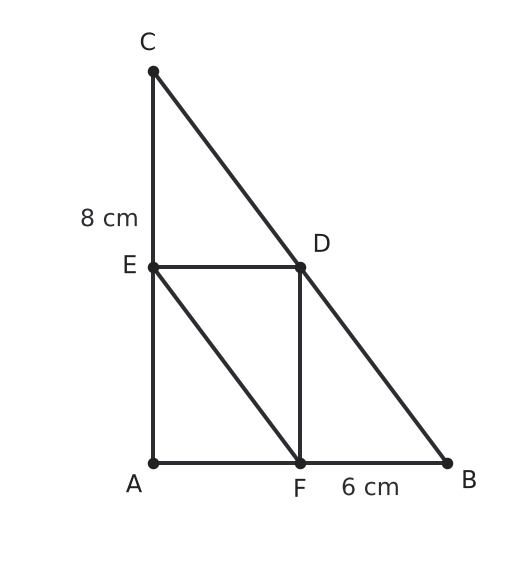
Figure for problem 542323

Hints

- Use the Triangle Midsegment Theorem to determine the side lengths and parallel directions in \(\triangle DEF\). - Identify which angle of the midpoint triangle is a right angle. - Recall where the circumcenter of a right triangle lies.

Solution

1. The app identifies \(D\), \(E\), and \(F\) as the three side midpoints. 2. The hypotenuse is \(BC=\sqrt{6^2+8^2}=10\,\text{cm}\). 3. By the Triangle Midsegment Theorem, \(DE=3\,\text{cm}\), \(DF=4\,\text{cm}\), and \(EF=5\,\text{cm}\). Also, \(DE\parallel AB\) and \(DF\parallel AC\), so \(\angle EDF=90^\circ\). 4. Thus, \(\triangle DEF\) is a right triangle with hypotenuse \(\overline{EF}\). 5. The app finds the midpoint \(N\) of \(\overline{EF}\). The midpoint of a right triangle’s hypotenuse is equidistant from all three vertices, so \(ND=NE=NF\). 6. The app draws the circle centered at \(N\) with radius \(NE\). Its radius is \(\frac{EF}{2}=\frac{5}{2}=2.5\,\text{cm}\).

Answer

The app finds the midpoint \(N\) of \(\overline{EF}\), then draws the circle centered at \(N\) through \(E\). It also passes through \(D\) and \(F\), and its radius is \(2.5\,\text{cm}\).

54233010
A circle has center \(O\) and radius \(5\,\text{cm}\). Describe how a geometry app can create an isosceles trapezoid \(ABCD\) inscribed in the circle whose parallel bases lie on opposite sides of \(O\), with \(AB=8\,\text{cm}\) and \(CD=6\,\text{cm}\). Find the trapezoid’s height and the length of each leg.
Figure for problem 542330

Hints

- Relate half of each chord to its distance from the center. - Place the chord midpoints on opposite sides of the center along one diameter. - Use the symmetry axis and a right triangle to find a leg length.

Solution

1. For an \(8\,\text{cm}\) chord, half the chord is \(4\,\text{cm}\). If its midpoint is \(M\), then \(OM=\sqrt{5^2-4^2}=3\,\text{cm}\). 2. For a \(6\,\text{cm}\) chord, half the chord is \(3\,\text{cm}\). If its midpoint is \(N\), then \(ON=\sqrt{5^2-3^2}=4\,\text{cm}\). 3. The app chooses a diameter line through \(O\) and marks \(M\) and \(N\) on opposite rays so that \(OM=3\,\text{cm}\) and \(ON=4\,\text{cm}\). 4. Through \(M\) and \(N\), the app creates lines perpendicular to the diameter. Their intersections with the circle form chords \(\overline{AB}\) and \(\overline{CD}\) of the required lengths. 5. The common perpendicular through \(O\) is an axis of symmetry, so the legs are congruent and the trapezoid is isosceles. Its height is \(MN=3+4=7\,\text{cm}\). 6. The horizontal offset between corresponding endpoints is \(4-3=1\,\text{cm}\). Therefore, each leg has length \(\sqrt{7^2+1^2}=\sqrt{50}=5\sqrt{2}\,\text{cm}\).

Answer

The app creates an isosceles trapezoid with height \(7\,\text{cm}\) and congruent legs of length \(5\sqrt{2}\,\text{cm}\).
54235110
A triangle has side lengths \(13\,\text{cm}\), \(14\,\text{cm}\), and \(15\,\text{cm}\). Describe how a geometry app can create its inscribed circle, and determine the circle's radius.
Figure for problem 542351

Hints

- Which two app-created lines locate the center of an inscribed circle? - The radius is a perpendicular distance from that center to a side. - Relate the triangle's area, semiperimeter, and inradius.

Solution

1. The app creates two internal angle bisectors of the triangle. Their intersection \(I\) is the incenter. 2. The app creates the perpendicular from \(I\) to any side. Let its foot be \(T\). The length \(IT\) is the radius of the inscribed circle. 3. The semiperimeter is \(s=\frac{13+14+15}{2}=21\,\text{cm}\). 4. Heron's formula gives \([ABC]=\sqrt{21(21-13)(21-14)(21-15)}=\sqrt{21\cdot8\cdot7\cdot6}=84\,\text{cm}^2\). 5. Since \([ABC]=rs\), the inradius is \(r=\frac{84}{21}=4\,\text{cm}\). 6. The app draws the circle centered at \(I\) with radius \(IT=4\,\text{cm}\). It is tangent to all three sides.

Answer

The app intersects two internal angle bisectors to locate the incenter, then uses its perpendicular distance to a side as the radius. The inscribed circle has radius \(4\,\text{cm}\).
54235810
A circle has center \(O\), radius \(R\), and a marked point \(A\) on the circle. Describe how a geometry app can create a regular dodecagon inscribed in the circle. Then express its side length in terms of \(R\).
Figure for problem 542358

Hints

- Begin with a regular polygon whose vertices are easy to mark using the radius. - Double the number of equal arcs by bisecting central angles. - Treat one side as the base of an isosceles triangle with vertex at the center.

Solution

1. The app uses the radius \(R\) as a chord length and steps it around the circle from \(A\). The six marked points form a regular hexagon, so the six central angles are each \(60^\circ\). 2. The app creates the bisector of each \(60^\circ\) central angle. Each bisector meets the circle at one new point between consecutive hexagon vertices. 3. The original six points and the six new points divide the circle into twelve equal central angles of \(30^\circ\). Connecting consecutive points produces a regular dodecagon. 4. A side \(s\) of the dodecagon is a chord subtending \(30^\circ\). By the Law of Cosines, \(s^2=R^2+R^2-2R^2\cos30^\circ=R^2(2-\sqrt{3})\). 5. Therefore, \(s=R\sqrt{2-\sqrt{3}}\).

Answer

The app first creates a regular hexagon by stepping the radius around the circle, then bisects each \(60^\circ\) central angle to create six additional vertices. The dodecagon's side length is \(R\sqrt{2-\sqrt{3}}\).
54236510
Two parallel lines are \(8\,\text{cm}\) apart. Point \(P\) lies on the line halfway between them. Describe how a geometry app can create every circle that is tangent to both parallel lines and passes through \(P\). Explain why there are exactly two solutions.
Figure for problem 542365

Hints

- Relate a circle's diameter to the distance between the parallel tangent lines. - Identify the locus of points equidistant from two parallel lines. - Add the condition that the circle must pass through \(P\).

Solution

1. Any circle tangent to both parallel lines must have radius \(4\,\text{cm}\), half the distance between the lines. 2. Its center must be equidistant from the two lines, so the center lies on the line halfway between the two parallel lines. 3. On that halfway line, the app marks points \(C_1\) and \(C_2\) on opposite sides of \(P\) such that \(PC_1=PC_2=4\,\text{cm}\). 4. The app draws circles centered at \(C_1\) and \(C_2\), each with radius \(4\,\text{cm}\). Both circles pass through \(P\) and are tangent to each parallel line. 5. A valid center must lie both on the line halfway between the parallel lines and on the circle centered at \(P\) with radius \(4\,\text{cm}\). That circle intersects the halfway line at exactly \(C_1\) and \(C_2\), so there are exactly two solutions.

Answer

The app marks the two points on the halfway line that are \(4\,\text{cm}\) from \(P\). The circles centered at those points with radius \(4\,\text{cm}\) are the two solutions.
54238610
Two concentric circles have center \(O\). The outer circle has radius \(10\,\text{cm}\), and the inner circle has radius \(5\sqrt{2}\,\text{cm}\). Describe how a geometry app can create a square that is inscribed in the outer circle and circumscribed about the inner circle. Prove that the same square satisfies both conditions.
Figure for problem 542386

Hints

- Use perpendicular diameters to create four equally spaced outer-circle vertices. - Find the perpendicular distance from the center to one side of the square. - Compare that distance with the inner radius.

Solution

1. The app creates two perpendicular diameters of the outer circle and connects their four endpoints in order to form square \(ABCD\). 2. Each vertex lies on the outer circle, so the square is inscribed in that circle. 3. The central angle subtended by each side is \(90^\circ\). The perpendicular from \(O\) to a side bisects that side and forms a right triangle with hypotenuse \(10\,\text{cm}\) and acute angle \(45^\circ\). 4. Therefore, the distance from \(O\) to each side is \(10\cos45^\circ=10\cdot\frac{\sqrt{2}}{2}=5\sqrt{2}\,\text{cm}\). 5. This distance equals the inner circle's radius, so every side of the square is tangent to the inner circle. Thus the square is circumscribed about the inner circle.

Answer

The app connects the endpoints of two perpendicular diameters of the outer circle. The resulting square is inscribed in the outer circle, and each side is \(5\sqrt{2}\,\text{cm}\) from \(O\), so each side is tangent to the inner circle.
54239310
A circle has center \(O\) and radius \(r\). Describe how a geometry app can create a regular hexagon circumscribed about the circle, and express the hexagon's side length in terms of \(r\).
Figure for problem 542393

Hints

- First create six equally spaced radii. - A side of the circumscribed polygon lies on a tangent line. - Use half of one side and the apothem in a \(30^\circ\)-\(60^\circ\)-\(90^\circ\) triangle.

Solution

1. The app steps the radius around the circle to mark six equally spaced points. Consecutive radii form central angles of \(60^\circ\). 2. At each marked point, the app creates the line perpendicular to the radius. These six lines are tangents to the circle. 3. The intersections of consecutive tangents are the vertices of a regular hexagon circumscribed about the circle. 4. The radius to the midpoint of one hexagon side is perpendicular to that side and has length \(r\). The segment from the midpoint to a vertex forms a right triangle with angle \(30^\circ\) at \(O\). 5. If the side length is \(s\), then \(\tan30^\circ=\frac{s/2}{r}\). Therefore, \(s=2r\tan30^\circ=\frac{2r}{\sqrt{3}}=\frac{2\sqrt{3}}{3}r\).

Answer

The app marks six equally spaced tangency points, creates the tangent at each point, and uses consecutive tangent intersections as the vertices. The circumscribed regular hexagon has side length \(\frac{2r}{\sqrt{3}}\).
54240010
Convex kite \(ABCD\) has \(AB=AD\) and \(CB=CD\), with \(A\) and \(C\) as the endpoints of its symmetry diagonal. Determine the necessary and sufficient condition for a circle to pass through all four vertices. When the condition holds, describe how to construct the circle.
Figure for problem 542400

Hints

- Use the kite's congruent triangles to compare the opposite angles. - Apply the opposite-angle condition for a cyclic quadrilateral. - Interpret two right angles that subtend the same segment.

Solution

1. Triangles \(ABC\) and \(ADC\) are congruent by SSS, so opposite angles \(\angle B\) and \(\angle D\) are congruent. 2. A convex quadrilateral is cyclic exactly when a pair of opposite angles is supplementary. 3. Since \(\angle B=\angle D\), they are supplementary exactly when \(\angle B=\angle D=90^\circ\). 4. Thus the kite is cyclic if and only if the angles at \(B\) and \(D\) are right angles. 5. When this condition holds, both \(B\) and \(D\) subtend segment \(\overline{AC}\) as a right angle. Therefore, \(AC\) is a diameter of the circumcircle. 6. Construct the midpoint of \(\overline{AC}\) and draw the circle centered there through \(A\). It also passes through \(B\), \(C\), and \(D\).

Answer

The kite has a circumscribed circle if and only if \(\angle B=\angle D=90^\circ\). In that case, construct the circle with diameter \(\overline{AC}\).
54240710
A square has side length \(10\,\text{cm}\). Describe how a geometry app can create two congruent circles inside the square so that both are tangent to the bottom side, the left circle is tangent to the left side, the right circle is tangent to the right side, and the two circles are tangent to each other. Find the common radius and justify the method.
Figure for problem 542407

Hints

- Express each center's position using its distance from two sides of the square. - Compare the horizontal center distance with the distance required for two congruent tangent circles. - Use a parallel offset line to locate both centers exactly.

Solution

1. Let the common radius be \(r\). The left center is \(r\) from the left and bottom sides, and the right center is \(r\) from the right and bottom sides. 2. Therefore, the horizontal distance between the centers is \(10-2r\). 3. External tangency requires the center distance to equal \(2r\), so \(10-2r=2r\). 4. Solving gives \(r=2.5\,\text{cm}\). 5. The app creates the line parallel to the bottom side at distance \(2.5\,\text{cm}\). On this line, it locates one center \(2.5\,\text{cm}\) from the left side and the other \(2.5\,\text{cm}\) from the right side. 6. Circles of radius \(2.5\,\text{cm}\) centered at those points have all four required side tangencies, and their centers are \(5\,\text{cm}\) apart, so the circles are tangent.

Answer

Each circle has radius \(2.5\,\text{cm}\). The app places both centers on the line \(2.5\,\text{cm}\) above the bottom side, one \(2.5\,\text{cm}\) from the left side and the other \(2.5\,\text{cm}\) from the right side.
54242110
The app shows two concentric circles with center \(O\) and radii \(10\,\text{cm}\) and \(4\,\text{cm}\). Determine every circle that is internally tangent to the larger circle and externally tangent to the smaller circle. Find the radius of each such circle and describe the locus of its center.
Figure for problem 542421

Hints

- Write one center-distance equation for each type of tangency. - Both equations involve the same distance from the unknown center to \(O\). - After finding the radius, identify all points that can have the required center distance.

Solution

1. Let a required circle have center \(C\) and radius \(r\). 2. Internal tangency to the larger circle gives \(OC+r=10\). 3. External tangency to the smaller circle gives \(OC=4+r\). 4. Therefore, \(10-r=4+r\), so \(r=3\). 5. Substituting gives \(OC=7\). Thus, every possible center lies on the circle centered at \(O\) with radius \(7\,\text{cm}\). 6. Conversely, a circle of radius \(3\,\text{cm}\) centered at any point of this locus has center distances \(7=10-3\) and \(7=4+3\), so both required tangencies hold.

Answer

Each required circle has radius \(3\,\text{cm}\). Its center can be any point on the circle centered at \(O\) with radius \(7\,\text{cm}\).
54243410
A semicircle has center \(O\), radius \(10\,\text{cm}\), and diameter line \(\ell\). Point \(T\) lies on the diameter with \(OT=6\,\text{cm}\). The app is to place a circle inside the semicircle that is tangent to \(\ell\) at \(T\) and internally tangent to the semicircle. Determine the radius and the exact location of the small circle's center.

Hints

- Tangency at \(T\) determines the line containing the small circle's center. - Use the line joining the two circle centers for the internal-tangency condition. - Apply the Pythagorean Theorem to triangle \(OTC\).

Solution

1. The center \(C\) lies on the perpendicular to \(\ell\) through \(T\), in the half-plane containing the semicircle. Let the radius be \(r\), so \(CT=r\). 2. Internal tangency to the semicircle gives \(OC=10-r\). 3. Right triangle \(OTC\) has legs \(OT=6\) and \(CT=r\), so \(OC^2=36+r^2\). 4. Therefore, \(36+r^2=(10-r)^2\). 5. Simplifying gives \(36=100-20r\), so \(r=\frac{16}{5}\,\text{cm}\). 6. The app marks \(C\) on the inward perpendicular through \(T\) so that \(CT=\frac{16}{5}\,\text{cm}\), then draws the circle centered at \(C\) through \(T\). This gives \(OC=\frac{34}{5}\,\text{cm}=10-r\), confirming internal tangency.

Answer

The radius is \(\frac{16}{5}\,\text{cm}\). The center is the point \(C\) on the inward perpendicular to \(\ell\) through \(T\) with \(CT=\frac{16}{5}\,\text{cm}\).
54237210
A quarter-circle sector has center \(O\), radius \(R\), and central angle \(90^\circ\). Describe how a geometry app can create the circle inside the sector that is tangent to both radii and internally tangent to the quarter-circle arc. Express the smaller circle's radius \(\rho\) in terms of \(R\).
Figure for problem 542372

Hints

- Locate the center using equal distances from the two sides of the sector. - Relate the center distance \(OC\) to \(\rho\) with a right isosceles triangle. - Use internal tangency to connect \(OC\), \(\rho\), and \(R\).

Solution

1. The center \(C\) of the smaller circle must be equidistant from the two radii, so the app creates the \(45^\circ\) angle bisector of the sector. 2. If the smaller radius is \(\rho\), then the perpendicular distances from \(C\) to both radii are \(\rho\). The resulting right isosceles triangle gives \(OC=\rho\sqrt{2}\). 3. Internal tangency to the outer arc requires \(OC+\rho=R\). Thus \(\rho\sqrt{2}+\rho=R\), so \(\rho=\frac{R}{1+\sqrt{2}}=R(\sqrt{2}-1)\). 4. In the app, create \(R\sqrt{2}\) as the diagonal of a square with side \(R\), then create \(\rho=R\sqrt{2}-R\). 5. Mark a point at perpendicular distance \(\rho\) from one radius and create through it a line parallel to that radius. Its intersection with the angle bisector is \(C\). 6. The app draws the circle centered at \(C\) with radius \(\rho\). It is tangent to both radii and to the quarter-circle arc.

Answer

The smaller circle has radius \(\rho=R(\sqrt{2}-1)\). Its center lies on the sector's angle bisector at equal perpendicular distance \(\rho\) from both radii.
54244110
The app constructs an isosceles trapezoid circumscribed about a circle with center \(O\) and radius \(3\,\text{cm}\). The legs make \(60^\circ\) angles with the bases. Find the lengths of the two bases and the two legs.
Figure for problem 542441

Hints

- The two parallel bases are tangent at opposite endpoints of a diameter. - The center of a circle tangent to two intersecting lines lies on an angle bisector of those lines. - Use right triangles with perpendicular leg \(3\,\text{cm}\) and angles \(30^\circ\) or \(60^\circ\).

Solution

1. The two bases are tangent at opposite endpoints of a diameter, so they are parallel and \(6\,\text{cm}\) apart. 2. Because \(O\) is equidistant from each pair of adjacent sides, \(O\) lies on the angle bisector at every vertex. 3. At an endpoint of the shorter base, the interior angle is \(120^\circ\). The angle between the base and the segment from that vertex to \(O\) is therefore \(60^\circ\). In the resulting right triangle, the half-length of the shorter base is \(\frac{3}{\tan 60^\circ}=\sqrt{3}\,\text{cm}\). 4. At an endpoint of the longer base, the interior angle is \(60^\circ\). The angle between the base and the segment from that vertex to \(O\) is \(30^\circ\). Thus, the half-length of the longer base is \(\frac{3}{\tan 30^\circ}=3\sqrt{3}\,\text{cm}\). 5. Therefore, the bases have lengths \(2\sqrt{3}\,\text{cm}\) and \(6\sqrt{3}\,\text{cm}\). 6. Each leg spans a perpendicular distance of \(6\,\text{cm}\), so its length is \(\frac{6}{\sin 60^\circ}=4\sqrt{3}\,\text{cm}\).

Answer

The bases have lengths \(2\sqrt{3}\,\text{cm}\) and \(6\sqrt{3}\,\text{cm}\). Each leg has length \(4\sqrt{3}\,\text{cm}\).
54244810
The app combines the central-angle constructions for an inscribed equilateral triangle and an inscribed regular pentagon in the same circle. Explain how the app obtains a \(24^\circ\) central angle and why its chord is the side of an inscribed regular \(15\)-gon.
Figure for problem 542448

Hints

- Find the central angles for regular polygons with \(3\) and \(5\) sides. - Place those two angles from the same initial radius and compare their terminal rays. - Relate the bisected difference to the number of equal angles in a full turn.

Solution

1. An inscribed equilateral triangle has central angle \(\frac{360^\circ}{3}=120^\circ\). 2. An inscribed regular pentagon has central angle \(\frac{360^\circ}{5}=72^\circ\). 3. The app places the \(120^\circ\) and \(72^\circ\) rays on the same side of the initial radius. The angle between them is \(120^\circ-72^\circ=48^\circ\). 4. The app bisects this \(48^\circ\) angle, producing a \(24^\circ\) central angle. 5. The chord subtending that angle can be repeated around the circle. Since \(15\cdot24^\circ=360^\circ\), fifteen consecutive copies close exactly and form a regular \(15\)-gon.

Answer

The app subtracts the pentagon central angle from the equilateral-triangle central angle and then bisects: \(\frac{120^\circ-72^\circ}{2}=24^\circ\). Fifteen such central angles complete \(360^\circ\), so the corresponding chord is the side of an inscribed regular \(15\)-gon.
54241410
The app carries out the following construction in a circle with center \(O\) and radius \(R\): 1. It draws perpendicular radii \(\overline{OA}\) and \(\overline{OB}\). 2. It marks the midpoint \(M\) of \(\overline{OB}\). 3. It draws the circle centered at \(M\) through \(A\). This circle meets the diameter line \(OB\) on the side opposite \(B\) at \(P\). 4. It uses \(AP\) as a chord length on the original circle. Prove that \(AP\) is the side length of an inscribed regular pentagon.
Figure for problem 542414

Hints

- Use the right triangle formed by the perpendicular radii and the midpoint of \(\overline{OB}\). - Express \(OP\) using the radius of the auxiliary circle, then find \(AP^2\). - Compare \(AP\) with the chord subtending one-fifth of a full turn.

Solution

1. Since \(OA\perp OB\), triangle \(AOM\) is right with \(OA=R\) and \(OM=\frac{R}{2}\). 2. Therefore, \(AM=\frac{R\sqrt{5}}{2}\). 3. Because \(MP=MA\) and \(P\) lies on the side of \(O\) opposite \(B\), \(OP=MP-OM=\frac{R(\sqrt{5}-1)}{2}\). 4. Triangle \(AOP\) is right, so \(AP^2=R^2+\left(\frac{R(\sqrt{5}-1)}{2}\right)^2=\frac{R^2(5-\sqrt{5})}{2}\). 5. A chord subtending \(72^\circ\) has squared length \(2R^2(1-\cos 72^\circ)\). Since \(\cos 72^\circ=\frac{\sqrt{5}-1}{4}\), this squared length is also \(\frac{R^2(5-\sqrt{5})}{2}\). 6. Thus, \(AP\) subtends a \(72^\circ\) central angle. Five consecutive chords of this length subtend \(5\cdot72^\circ=360^\circ\), so their endpoints form a regular pentagon.

Answer

The chord length is \(AP=R\sqrt{\frac{5-\sqrt{5}}{2}}\). It subtends a \(72^\circ\) central angle, so five consecutive chords of this length form an inscribed regular pentagon.
54242810
The app shows an equilateral triangle with side length \(12\,\text{cm}\). Three congruent circles are to lie inside the triangle so that each circle is tangent to the two sides meeting at one vertex and tangent to the other two circles. Determine the radius of each circle and explain how the app can locate the three centers.
Figure for problem 542428

Hints

- Use the symmetry of the equilateral triangle to place each center on a vertex angle bisector. - Relate a center's distance from a vertex to its perpendicular distance from either adjacent side. - Express the distance between two centers next to the same side and set it equal to twice the radius.

Solution

1. Each center lies on a vertex angle bisector. Since each vertex angle is \(60^\circ\), a center at distance \(2r\) from its vertex is perpendicular distance \(r\) from both adjacent sides. 2. Consider the two circles adjacent to \(\overline{AB}\). Their centers are horizontally \(\sqrt{3}r\) from the corresponding endpoints of \(\overline{AB}\). 3. Therefore, the distance between these two centers is \(12-2\sqrt{3}r\). 4. Tangency requires this distance to equal \(2r\), so \(12-2\sqrt{3}r=2r\). 5. Solving gives \(r=\frac{6}{1+\sqrt{3}}=3(\sqrt{3}-1)\). 6. The app places each center on a vertex angle bisector at distance \(2r=6(\sqrt{3}-1)\,\text{cm}\) from the vertex. Symmetry makes every pair of centers \(2r\) apart, so the three circles are pairwise tangent.

Answer

Each circle has radius \(3(\sqrt{3}-1)\,\text{cm}\). The app places each center on a vertex angle bisector at distance \(6(\sqrt{3}-1)\,\text{cm}\) from the corresponding vertex.

All problems may be used, copied and printed free of charge for school and tutoring, including paid tutoring. Commercial adaptations as well as publication or redistribution on the internet are not permitted.