Aimathic
Login | English | Deutsch

Free math worksheets

Build your own math worksheets from 30,000+ problems for grades 3 to 12, from fractions to AP Calculus. Every problem comes with step-by-step solutions.

Converse and contrapositive statements

Click problems to add them to your worksheet.

51554510
Consider the statement: “If \(\triangle ABC\) is isosceles with base \(\overline{AB}\), then the base angles \(\alpha\) and \(\beta\) are congruent.” a) Identify the hypothesis and conclusion. b) Write the converse. c) Determine whether the converse is true or false.

Hints

- The hypothesis follows “if,” and the conclusion follows “then.” - Form the converse by switching the hypothesis and conclusion. - Relate congruent angles in a triangle to their opposite sides.

Solution

1. The hypothesis is that \(\triangle ABC\) is isosceles with base \(\overline{AB}\). The conclusion is that \(\alpha = \beta\). 2. The converse is: “If \(\alpha = \beta\) in \(\triangle ABC\), then \(\triangle ABC\) is isosceles with base \(\overline{AB}\).” 3. The converse is true. In a triangle, congruent angles have congruent opposite sides. Therefore, \(AC = BC\), so \(\triangle ABC\) is isosceles with base \(\overline{AB}\).

Answer

a) Hypothesis: \(\triangle ABC\) is isosceles with base \(\overline{AB}\). Conclusion: \(\alpha = \beta\). b) If \(\alpha = \beta\), then \(\triangle ABC\) is isosceles with base \(\overline{AB}\). c) The converse is true.
51554610
Consider the statement: “If a quadrilateral is a square, then its diagonals are perpendicular.” a) Write the converse. b) Determine whether the converse is true. Justify your answer with an explanation or a counterexample.

Hints

- Switch the hypothesis and conclusion. - Look for another quadrilateral with perpendicular diagonals. - A counterexample must satisfy the new hypothesis but not its conclusion.

Solution

1. The converse is: “If a quadrilateral has perpendicular diagonals, then it is a square.” 2. The converse is false. 3. A rhombus that is not a square has perpendicular diagonals but does not have four right angles. Therefore, perpendicular diagonals alone do not guarantee that a quadrilateral is a square.

Answer

a) If a quadrilateral has perpendicular diagonals, then it is a square. b) The converse is false. A nonsquare rhombus is a counterexample.
54215610
Points \(A\) and \(B\) are distinct. Consider these statements about a point \(P\): I. If \(P\) lies on the perpendicular bisector of \(\overline{AB}\), then \(PA=PB\). II. If \(PA=PB\), then \(P\) lies on the perpendicular bisector of \(\overline{AB}\). III. If \(PA\ne PB\), then \(P\) does not lie on the perpendicular bisector of \(\overline{AB}\). a) Which statement is the converse of statement I? b) Which statement is the contrapositive of statement I? c) Which pair is logically equivalent, and which of the three statements are true in Euclidean geometry?
Figure for problem 542156

Hints

- Track what happens to the hypothesis and conclusion in each statement. - One logical form reverses the two parts; another also negates both parts. - Separate logical equivalence from whether a geometric converse happens to be true.

Solution

1. Statement II switches the hypothesis and conclusion of statement I, so II is the converse. 2. Statement III negates both parts of statement I and reverses their order, so III is the contrapositive. 3. A conditional statement and its contrapositive are logically equivalent, so statements I and III are equivalent. 4. The perpendicular-bisector theorem and its converse are both true: points on the perpendicular bisector are equidistant from the endpoints, and points equidistant from the endpoints lie on the perpendicular bisector. 5. Therefore, statements I, II, and III are all true.

Answer

a) Statement II. b) Statement III. c) Statements I and III are logically equivalent. All three statements are true.
54216410
Consider the statement: “If the diagonals of a quadrilateral bisect each other, then the quadrilateral is a parallelogram.” a) Write the converse. b) Write the contrapositive. c) State whether the original statement, its converse, and its contrapositive are true or false in Euclidean geometry.
Figure for problem 542164

Hints

- Label the hypothesis and conclusion before changing the statement. - One requested form reverses the parts; the other reverses and negates them. - Use known diagonal properties and tests for parallelograms to judge truth.

Solution

1. The converse switches the hypothesis and conclusion: If a quadrilateral is a parallelogram, then its diagonals bisect each other. 2. The contrapositive reverses and negates both parts: If a quadrilateral is not a parallelogram, then its diagonals do not bisect each other. 3. The original statement is true by the parallelogram test involving diagonals. 4. The converse is true because the diagonals of every parallelogram bisect each other. 5. The contrapositive is true because it is logically equivalent to the true original statement.

Answer

a) If a quadrilateral is a parallelogram, then its diagonals bisect each other. b) If a quadrilateral is not a parallelogram, then its diagonals do not bisect each other. c) The original statement, the converse, and the contrapositive are all true.
54217110
Consider the statement: “If two coplanar lines cut by a transversal are parallel, then a pair of corresponding angles is congruent.” A student writes, “If a pair of corresponding angles is congruent, then the two lines are parallel,” and labels it the contrapositive. a) Correct the student's label. b) Write the actual contrapositive of the original statement. c) State whether the student's statement and the actual contrapositive are true or false.
Figure for problem 542171

Hints

- Compare exactly how the student changed the hypothesis and conclusion. - Check whether either part was negated. - Use the relevant parallel-line theorem and its converse to judge truth.

Solution

1. The student's statement switches the hypothesis and conclusion without negating them, so it is the converse. 2. The contrapositive reverses and negates both parts: If a pair of corresponding angles is not congruent, then the two lines are not parallel. 3. The student's converse is true by the converse of the corresponding angles theorem. 4. The actual contrapositive is true because it is logically equivalent to the true original statement.

Answer

a) The student's statement is the converse. b) If a pair of corresponding angles is not congruent, then the two lines are not parallel. c) Both the converse and the contrapositive are true.
54218210
Consider the statement: “If a triangle is a right triangle with legs \(a\) and \(b\) and hypotenuse \(c\), then \(a^2+b^2=c^2\).” A triangle has side lengths \(8\), \(15\), and \(17\). a) Which logical form of the statement allows you to conclude that the triangle is right? b) Verify that the logical form applies. c) Write the contrapositive of the original statement.

Hints

- Compare the direction of the given theorem with the conclusion you need. - Test the side lengths using the relationship stated in the theorem. - For the contrapositive, reverse and negate both parts.

Solution

1. Concluding that a triangle is right from the equation \(a^2+b^2=c^2\) uses the converse of the original statement. 2. For the given lengths, \(8^2+15^2=64+225=289\), and \(17^2=289\). 3. Since \(8^2+15^2=17^2\), the converse of the Pythagorean theorem shows that the triangle is right. 4. The contrapositive is: If \(a^2+b^2\ne c^2\), then the triangle is not a right triangle with legs \(a\) and \(b\) and hypotenuse \(c\).

Answer

a) The converse. b) \(8^2+15^2=289=17^2\), so the triangle is right. c) If \(a^2+b^2\ne c^2\), then the triangle is not a right triangle with legs \(a\) and \(b\) and hypotenuse \(c\).
54221210
Consider the statement: “If a point lies inside an angle and lies on the angle bisector, then its perpendicular distances to the two sides of the angle are equal.” Point \(P\) lies inside an angle. Its perpendicular distances to the two sides are \(4.2\,\text{cm}\) and \(5.1\,\text{cm}\). a) Use the contrapositive to determine whether \(P\) lies on the angle bisector. b) Write the converse of the original statement and state whether it is true.
Figure for problem 542212

Hints

- Negate the equal-distance conclusion before reversing the conditional. - Compare the two given perpendicular distances directly. - For the converse, connect equal side distances to a familiar angle locus.

Solution

1. The contrapositive is: If a point inside an angle does not have equal perpendicular distances to the two sides, then it does not lie on the angle bisector. 2. Since \(4.2\,\text{cm}\ne5.1\,\text{cm}\), point \(P\) is not equidistant from the sides. 3. Therefore, the contrapositive shows that \(P\) does not lie on the angle bisector. 4. The converse is: If a point inside an angle has equal perpendicular distances to the two sides, then it lies on the angle bisector. 5. The converse is true by the angle-bisector locus theorem.

Answer

a) \(P\) does not lie on the angle bisector because its perpendicular distances to the sides are unequal. b) If a point inside an angle is equidistant from the two sides, then it lies on the angle bisector. This converse is true.
54222510
Consider the statement: “In the same circle, if two chords are congruent, then their minor arcs are congruent.” Two minor arcs in one circle measure \(84^\circ\) and \(96^\circ\). a) Write the contrapositive and use it to compare the corresponding chord lengths. b) Write the converse and state whether it is true.
Figure for problem 542225

Hints

- Reverse and negate both parts of the original statement. - Compare the arc measures before making a chord conclusion. - Recall how chord size changes with minor-arc size in one circle.

Solution

1. The contrapositive is: If two minor arcs in the same circle are not congruent, then their chords are not congruent. 2. The arc measures \(84^\circ\) and \(96^\circ\) are different, so the arcs are not congruent. 3. Therefore, their corresponding chords are not congruent. 4. The \(96^\circ\) arc is larger, so its chord is longer than the chord of the \(84^\circ\) arc. 5. The converse is: If two minor arcs in the same circle are congruent, then their chords are congruent. 6. The converse is true.

Answer

a) If two minor arcs in the same circle are not congruent, then their chords are not congruent. Therefore, the chords are unequal, and the chord intercepting the \(96^\circ\) arc is longer. b) If two minor arcs in the same circle are congruent, then their chords are congruent. This converse is true.
54223310
Consider the statement: “If two chords of the same circle are congruent, then they are equidistant from the center.” a) Write the converse. b) Write the contrapositive. c) In one circle, chord \(\overline{AB}\) is \(6\,\text{cm}\) from the center and chord \(\overline{CD}\) is \(9\,\text{cm}\) from the center. What does the contrapositive allow you to conclude?
Figure for problem 542233

Hints

- Identify the hypothesis and conclusion of the original statement. - For the converse, exchange those two parts without negating them. - For the contrapositive, reverse and negate both parts before applying the given distances.

Solution

1. The converse exchanges the hypothesis and conclusion: if two chords of the same circle are equidistant from the center, then they are congruent. 2. The contrapositive negates and reverses the original statement: if two chords of the same circle are not equidistant from the center, then they are not congruent. 3. The distances \(6\,\text{cm}\) and \(9\,\text{cm}\) are unequal, so the chords are not equidistant from the center. Therefore, \(\overline{AB}\not\cong\overline{CD}\).

Answer

a) If two chords of the same circle are equidistant from the center, then they are congruent. b) If two chords of the same circle are not equidistant from the center, then they are not congruent. c) \(\overline{AB}\not\cong\overline{CD}\).
54224010
Consider the statement: “If a parallelogram is a rhombus, then its diagonals are perpendicular.” a) Write the converse. b) Write the contrapositive. c) A parallelogram has diagonals with slopes \(2\) and \(-\frac{1}{3}\). What can you conclude by using the contrapositive?
Figure for problem 542240

Hints

- Keep the condition that the figure is a parallelogram in each logical statement. - Reverse the hypothesis and conclusion for the converse. - Test whether the two diagonal slopes represent perpendicular lines before using the contrapositive.

Solution

1. The converse is: if the diagonals of a parallelogram are perpendicular, then the parallelogram is a rhombus. 2. The contrapositive is: if the diagonals of a parallelogram are not perpendicular, then the parallelogram is not a rhombus. 3. The product of the diagonal slopes is \(2\left(-\frac{1}{3}\right)=-\frac{2}{3}\), not \(-1\), so the diagonals are not perpendicular. 4. By the contrapositive, the parallelogram is not a rhombus.

Answer

a) If the diagonals of a parallelogram are perpendicular, then the parallelogram is a rhombus. b) If the diagonals of a parallelogram are not perpendicular, then the parallelogram is not a rhombus. c) The parallelogram is not a rhombus.
54225410
Consider the statement: “If a quadrilateral is a parallelogram, then both pairs of opposite sides are congruent.” a) Write the converse and state whether it is true. b) Write the contrapositive. c) Quadrilateral \(WXYZ\) has \(WX=YZ=7\,\text{cm}\), \(XY=5\,\text{cm}\), and \(WZ=6\,\text{cm}\). What can you conclude from the contrapositive?
Figure for problem 542254

Hints

- Preserve the phrase “both pairs” when reversing the statement. - Negating “both pairs are congruent” means that at least one pair is not congruent. - Compare the lengths in each pair of opposite sides.

Solution

1. The converse is: if both pairs of opposite sides of a quadrilateral are congruent, then the quadrilateral is a parallelogram. This converse is true. 2. The contrapositive is: if at least one pair of opposite sides of a quadrilateral is not congruent, then the quadrilateral is not a parallelogram. 3. In \(WXYZ\), \(XY\ne WZ\) because \(5\ne6\). 4. Therefore, at least one pair of opposite sides is not congruent, so \(WXYZ\) is not a parallelogram.

Answer

a) If both pairs of opposite sides of a quadrilateral are congruent, then it is a parallelogram. The converse is true. b) If at least one pair of opposite sides of a quadrilateral is not congruent, then it is not a parallelogram. c) \(WXYZ\) is not a parallelogram.
54226110
In triangle \(ABC\), point \(M\) is the midpoint of side \(\overline{AB}\). Consider the statement: “If triangle \(ABC\) is right at \(C\), then \(MA=MB=MC\).” a) Write the converse. b) Write the contrapositive of the original statement. c) Suppose \(MA=5\,\text{cm}\) and \(MC=4.7\,\text{cm}\). What does the contrapositive show about \(\angle C\)?
Figure for problem 542261

Hints

- Treat the midpoint condition as fixed context while changing the conditional. - Negate the equality of all three distances carefully. - Compare the given distance from \(M\) to \(C\) with the half-hypotenuse distances.

Solution

1. The converse is: if \(MA=MB=MC\), then triangle \(ABC\) is right at \(C\). 2. The contrapositive is: if \(MA\), \(MB\), and \(MC\) are not all equal, then triangle \(ABC\) is not right at \(C\). 3. Since \(M\) is the midpoint of \(\overline{AB}\), \(MA=MB=5\,\text{cm}\), but \(MC=4.7\,\text{cm}\). The three distances are not all equal. 4. Therefore, \(\angle C\ne90^\circ\).

Answer

a) If the midpoint \(M\) of \(\overline{AB}\) is equidistant from \(A\), \(B\), and \(C\), then triangle \(ABC\) is right at \(C\). b) If those three distances from \(M\) are not all equal, then triangle \(ABC\) is not right at \(C\). c) \(\angle C\ne90^\circ\).
54226810
Points \(A\) and \(B\) lie on a circle, and point \(P\) lies outside the circle. Consider the statement: “If \(\overline{PA}\) and \(\overline{PB}\) are tangent segments, then \(PA=PB\).” a) Write the converse. b) Is the converse true? Give a counterexample. c) Write the contrapositive of the original statement.
Figure for problem 542268

Hints

- Reverse the hypothesis and conclusion while keeping the stated circle context fixed. - Look for two equal segments from an external point to points on a circle that are not tangent. - Reverse and negate both parts to form the contrapositive.

Solution

1. The converse is: if \(PA=PB\), then \(\overline{PA}\) and \(\overline{PB}\) are tangent segments. 2. The converse is false. For example, use the unit circle centered at \(O(0, 0)\), let \(P(2, 0)\), \(A(0, 1)\), and \(B(0, -1)\). Then \(P\) is outside the circle and \(PA=PB=\sqrt{5}\). 3. However, neither \(\overline{PA}\) nor \(\overline{PB}\) is perpendicular to the radius at its endpoint, so neither segment is tangent. 4. The contrapositive is: if \(PA\ne PB\), then \(\overline{PA}\) and \(\overline{PB}\) are not both tangent segments.

Answer

a) If \(PA=PB\), then \(\overline{PA}\) and \(\overline{PB}\) are tangent segments. b) False. On the unit circle, take \(P(2, 0)\), \(A(0, 1)\), and \(B(0, -1)\). Then \(PA=PB=\sqrt{5}\), but the segments are not tangent. c) If \(PA\ne PB\), then the two segments are not both tangent segments.
54227510
Consider the statement: “If a parallelogram has one right angle, then it is a rectangle.” a) Write the converse. b) Write the contrapositive. c) A parallelogram has an interior angle measuring \(110^\circ\). Use the contrapositive to determine whether it can have any right angle.
Figure for problem 542275

Hints

- Keep the condition that the figure is a parallelogram. - Reverse the original parts for the converse, and reverse-negate them for the contrapositive. - Use the angle relationships in a parallelogram to interpret the \(110^\circ\) angle.

Solution

1. The converse is: if a parallelogram is a rectangle, then it has at least one right angle. 2. The contrapositive is: if a parallelogram is not a rectangle, then it has no right angles. 3. A parallelogram with a \(110^\circ\) angle has adjacent angles of \(70^\circ\), so none of its angles is right. Equivalently, it is not a rectangle. 4. By the contrapositive, it cannot have any right angle.

Answer

a) If a parallelogram is a rectangle, then it has at least one right angle. b) If a parallelogram is not a rectangle, then it has no right angles. c) It cannot have any right angle.
54228210
Consider the statement: “If point \(P\) is the circumcenter of triangle \(ABC\), then \(PA=PB=PC\).” a) Write the converse and state whether it is true. b) Write the contrapositive. c) A point \(Q\) satisfies \(QA=7.2\,\text{cm}\), \(QB=7.2\,\text{cm}\), and \(QC=6.9\,\text{cm}\). What can you conclude?
Figure for problem 542282

Hints

- Reverse the defining condition for the converse. - Negate equality of all three distances carefully. - Compare the three given distances before applying the logical statement.

Solution

1. The converse is: if \(PA=PB=PC\), then \(P\) is the circumcenter of triangle \(ABC\). It is true because a point equidistant from all three vertices is the center of the circle through them. 2. The contrapositive is: if \(PA\), \(PB\), and \(PC\) are not all equal, then \(P\) is not the circumcenter of triangle \(ABC\). 3. For point \(Q\), the three distances are not all equal because \(6.9\ne7.2\). 4. Therefore, \(Q\) is not the circumcenter of triangle \(ABC\).

Answer

a) If \(PA=PB=PC\), then \(P\) is the circumcenter of triangle \(ABC\). The converse is true. b) If the three distances are not all equal, then \(P\) is not the circumcenter. c) \(Q\) is not the circumcenter of triangle \(ABC\).
54228910
Consider the statement: “If two nonvertical lines are perpendicular, then the product of their slopes is \(-1\).” a) Write the converse and state whether it is true. b) Write the contrapositive. c) Two nonvertical lines have slopes \(\frac{3}{4}\) and \(-\frac{4}{5}\). What can you conclude?
Figure for problem 542289

Hints

- Reverse the slope condition and geometric conclusion for the converse. - Reverse and negate both parts for the contrapositive. - Multiply the two given slopes exactly.

Solution

1. The converse is: if the product of the slopes of two nonvertical lines is \(-1\), then the lines are perpendicular. This converse is true. 2. The contrapositive is: if the product of the slopes of two nonvertical lines is not \(-1\), then the lines are not perpendicular. 3. The product of the given slopes is \(\frac{3}{4}\cdot\left(-\frac{4}{5}\right)=-\frac{3}{5}\). 4. Since \(-\frac{3}{5}\ne-1\), the lines are not perpendicular.

Answer

a) If the product of the slopes of two nonvertical lines is \(-1\), then the lines are perpendicular. The converse is true. b) If the product is not \(-1\), then the lines are not perpendicular. c) The lines are not perpendicular.
54229610
Consider the statement: “If parallelogram \(ABCD\) is a rhombus, then diagonal \(\overline{AC}\) bisects \(\angle A\) and \(\angle C\).” a) Write the converse and state whether it is true. b) Write the contrapositive. c) In a parallelogram, \(m\angle BAC=28^\circ\) and \(m\angle CAD=31^\circ\). What can you conclude?
Figure for problem 542296

Hints

- Keep the parallelogram condition in the converse. - Negate the statement that one diagonal bisects both named angles. - Compare the two parts of \(\angle A\).

Solution

1. The converse is: if diagonal \(\overline{AC}\) bisects \(\angle A\) and \(\angle C\) of a parallelogram, then the parallelogram is a rhombus. This converse is true. 2. The contrapositive is: if \(\overline{AC}\) fails to bisect at least one of \(\angle A\) and \(\angle C\), then the parallelogram is not a rhombus. 3. Since \(28^\circ\ne31^\circ\), diagonal \(\overline{AC}\) does not bisect \(\angle A\). 4. Therefore, the parallelogram is not a rhombus.

Answer

a) If \(\overline{AC}\) bisects \(\angle A\) and \(\angle C\) of a parallelogram, then it is a rhombus. The converse is true. b) If \(\overline{AC}\) does not bisect at least one of those angles, then the parallelogram is not a rhombus. c) The parallelogram is not a rhombus.
54231010
Consider the statement: “If three positive lengths form a triangle, then the sum of any two lengths is greater than the third length.” a) Write the converse and state whether it is true. b) Write a contrapositive form that is useful for testing three lengths. c) Can lengths \(3\,\text{cm}\), \(4\,\text{cm}\), and \(8\,\text{cm}\) form a triangle?
Figure for problem 542310

Hints

- Reverse the necessary condition to form the converse. - Negate “every pair has a sum greater than the third.” - Test the two smaller lengths against the largest length.

Solution

1. The converse is: if each pair of three positive lengths has a sum greater than the remaining length, then the three lengths form a triangle. This converse is true. 2. A useful contrapositive is: if the sum of some two lengths is less than or equal to the third length, then the three lengths do not form a triangle. 3. Here, \(3\,\text{cm}+4\,\text{cm}=7\,\text{cm}\le8\,\text{cm}\). 4. Therefore, the three lengths cannot form a triangle.

Answer

a) If all three triangle inequalities hold, then the lengths form a triangle. The converse is true. b) If one pair sums to no more than the third length, the lengths do not form a triangle. c) No, because \(3+4\le8\).
54231710
Consider the statement: “If two distinct circles are tangent at point \(T\), then their centers and \(T\) are collinear.” a) Write the converse and state whether it is true when the circles share point \(T\). b) Write the contrapositive. c) Two circles share point \(T(2, 1)\) and have centers \(O_1(0, 0)\) and \(O_2(5, 0)\). Can they be tangent at \(T\)?
Figure for problem 542317

Hints

- Relate each circle’s tangent at \(T\) to its radius through \(T\). - Reverse and negate the collinearity conclusion for the contrapositive. - Check whether the given point lies on the line through the centers.

Solution

1. The converse is: if two distinct circles share point \(T\) and their centers and \(T\) are collinear, then the circles are tangent at \(T\). This is true because both radii at \(T\) lie on the same line, so the circles have the same tangent line perpendicular to that line. 2. The contrapositive is: if the two centers and \(T\) are not collinear, then the circles are not tangent at \(T\). 3. Centers \(O_1\) and \(O_2\) lie on the x-axis, but \(T(2, 1)\) does not lie on the x-axis. 4. Therefore, the three points are not collinear, so the circles cannot be tangent at \(T\).

Answer

a) If two distinct circles share \(T\) and both centers are collinear with \(T\), then they are tangent at \(T\). The converse is true. b) If the centers and \(T\) are not collinear, the circles are not tangent at \(T\). c) No, the circles cannot be tangent at \(T\).
54232410
Consider the statement: “If quadrilateral \(ABCD\) is a kite with \(AB=AD\) and \(CB=CD\), then \(\angle B\cong\angle D\).” a) Write the converse. b) Is the converse true? Give a counterexample. c) Write the contrapositive of the original statement.
Figure for problem 542324

Hints

- Reverse the side-based hypothesis and angle conclusion for the converse. - Look for a familiar quadrilateral with congruent opposite angles but unequal adjacent sides. - Reverse and negate both parts for the contrapositive.

Solution

1. The converse is: if \(\angle B\cong\angle D\), then \(ABCD\) is a kite with \(AB=AD\) and \(CB=CD\). 2. The converse is false. A nonsquare rectangle has \(\angle B\cong\angle D\), but it does not have two pairs of congruent consecutive sides and is not a kite under the stated side condition. 3. The contrapositive is: if \(\angle B\not\cong\angle D\), then \(ABCD\) is not a kite with \(AB=AD\) and \(CB=CD\).

Answer

a) If \(\angle B\cong\angle D\), then \(ABCD\) is a kite with the stated side pairs. b) False; a nonsquare rectangle is a counterexample. c) If \(\angle B\not\cong\angle D\), then \(ABCD\) is not such a kite.
54233110
Consider the statement: “If two triangles are congruent, then all pairs of corresponding angles are congruent.” a) Write the converse. b) Is the converse true? Give a counterexample. c) Write the contrapositive of the original statement.
Figure for problem 542331

Hints

- Reverse the hypothesis and conclusion for the converse. - Look for triangles with the same shape but different sizes. - Negate the claim that every corresponding angle pair is congruent.

Solution

1. The converse is: if all pairs of corresponding angles of two triangles are congruent, then the triangles are congruent. 2. The converse is false. A \(3\)-\(4\)-\(5\) triangle and a \(6\)-\(8\)-\(10\) triangle have congruent corresponding angles because they are similar, but their corresponding side lengths differ, so they are not congruent. 3. The contrapositive is: if at least one pair of corresponding angles is not congruent, then the triangles are not congruent.

Answer

a) If all corresponding angles are congruent, then the triangles are congruent. b) False; \(3\)-\(4\)-\(5\) and \(6\)-\(8\)-\(10\) triangles are a counterexample. c) If at least one pair of corresponding angles is not congruent, then the triangles are not congruent.
54233810
In this problem, a trapezoid has exactly one pair of parallel sides. A theorem says: “If a trapezoid is isosceles, then its diagonals are congruent.” Its converse is also true. a) Combine the theorem and its converse into one biconditional statement. b) Write an equivalent biconditional using “not isosceles” and “not congruent.” c) A trapezoid has diagonals of lengths \(11\,\text{cm}\) and \(12\,\text{cm}\). What can you conclude?
Figure for problem 542338

Hints

- A biconditional is valid only when both a conditional and its converse are true. - For an equivalent negative form, negate both conditions in the biconditional. - Compare the two given diagonal lengths before applying the negative form.

Solution

1. Let \(P\) be “the trapezoid is isosceles” and let \(Q\) be “its diagonals are congruent.” The theorem is \(P\Rightarrow Q\), and its true converse is \(Q\Rightarrow P\). 2. Therefore, the two directions combine to give: a trapezoid is isosceles if and only if its diagonals are congruent. 3. Negating both equivalent conditions gives another biconditional: a trapezoid is not isosceles if and only if its diagonals are not congruent. 4. Since \(11\ne12\), the diagonals are not congruent. 5. Therefore, the trapezoid is not isosceles.

Answer

a) A trapezoid is isosceles if and only if its diagonals are congruent. b) A trapezoid is not isosceles if and only if its diagonals are not congruent. c) The trapezoid is not isosceles.
54235210
Consider the statement: “If point \(P\) lies outside a circle with center \(O\) and radius \(r\), then \(OP>r\).” a) Write the converse and state whether it is true. b) Write the contrapositive. c) A circle has radius \(8\,\text{cm}\), and \(OP=8.2\,\text{cm}\). Use one of the statements to classify \(P\).
Figure for problem 542352

Hints

- Reverse the condition and conclusion to form the converse. - Negate “outside” and the strict inequality carefully. - Compare the given center-to-point distance with the radius.

Solution

1. The converse is: if \(OP>r\), then \(P\) lies outside the circle. This is true by the distance definition of the exterior of a circle. 2. The contrapositive is: if \(OP\le r\), then \(P\) does not lie outside the circle. 3. Since \(8.2>8\), the converse applies, so \(P\) lies outside the circle.

Answer

a) If \(OP>r\), then \(P\) lies outside the circle. This is true. b) If \(OP\le r\), then \(P\) is not outside the circle. c) Point \(P\) lies outside the circle.
54235910
In a circle, consider the statement: “If a diameter is perpendicular to a chord, then it bisects the chord.” Assume the chord is not itself a diameter. a) Write the converse and state whether it is true. b) Write the contrapositive. c) Diameter \(\overline{CD}\) intersects chord \(\overline{AB}\) at \(M\), and \(AM=MB\). What can you conclude?
Figure for problem 542359

Hints

- Reverse the condition and conclusion without changing their meanings. - Negate “bisects” and “is perpendicular” carefully. - Interpret \(AM=MB\) as a statement about point \(M\).

Solution

1. The converse is: if a diameter bisects a chord that is not a diameter, then it is perpendicular to the chord. This is true. 2. The contrapositive is: if a diameter does not bisect a chord, then it is not perpendicular to the chord. 3. Since \(AM=MB\), diameter \(\overline{CD}\) bisects chord \(\overline{AB}\). By the converse, \(CD\perp AB\).

Answer

a) If a diameter bisects a chord that is not a diameter, then it is perpendicular to the chord. This is true. b) If a diameter does not bisect a chord, then it is not perpendicular to the chord. c) \(CD\perp AB\).
54237310
Consider the statement: “If quadrilateral \(ABCD\) is a parallelogram, then \(\angle A+\angle B=180^\circ\) and \(\angle B+\angle C=180^\circ\).” a) Write the converse and state whether it is true for a convex quadrilateral. b) Write the contrapositive. c) A convex quadrilateral has angle measures \(72^\circ\), \(108^\circ\), \(72^\circ\), and \(108^\circ\) in order. What can you conclude?
Figure for problem 542373

Hints

- Reverse the complete two-part conclusion, not just one angle condition. - Match each supplementary pair with a pair of opposite sides. - Check both required sums in the numerical case.

Solution

1. The converse is: if \(\angle A+\angle B=180^\circ\) and \(\angle B+\angle C=180^\circ\), then \(ABCD\) is a parallelogram. 2. The first supplementary pair implies \(AD\parallel BC\), and the second implies \(AB\parallel CD\). Thus the converse is true for a convex quadrilateral. 3. The contrapositive is: if \(ABCD\) is not a parallelogram, then \(\angle A+\angle B\ne180^\circ\) or \(\angle B+\angle C\ne180^\circ\). 4. For the given quadrilateral, \(72^\circ+108^\circ=180^\circ\) for both required consecutive pairs. By the converse, the quadrilateral is a parallelogram.

Answer

a) If both specified consecutive-angle pairs are supplementary, then the convex quadrilateral is a parallelogram. This is true. b) If the quadrilateral is not a parallelogram, then at least one specified pair is not supplementary. c) The quadrilateral is a parallelogram.
54238710
In this problem, a trapezoid has exactly one pair of parallel sides. Consider the statement: “If trapezoid \(ABCD\) with \(AB\parallel CD\) is isosceles, then \(\angle A\cong\angle B\).” a) Write the converse and state whether it is true. b) Write the contrapositive. c) In trapezoid \(ABCD\), \(\angle A=\angle B=68^\circ\). What can you conclude about the legs?
Figure for problem 542387

Hints

- Reverse the stated base-angle condition and isosceles conclusion. - Reverse and negate both parts for the contrapositive. - Apply the converse to the given base-angle equality.

Solution

1. The converse is: if \(\angle A\cong\angle B\) in trapezoid \(ABCD\) with \(AB\parallel CD\), then the trapezoid is isosceles. This is true. 2. The contrapositive is: if trapezoid \(ABCD\) is not isosceles, then \(\angle A\not\cong\angle B\). 3. Since \(\angle A=\angle B\), the converse applies. Therefore, \(ABCD\) is an isosceles trapezoid. 4. Its legs are congruent, so \(AD=BC\).

Answer

a) If \(\angle A\cong\angle B\) in trapezoid \(ABCD\) with \(AB\parallel CD\), then the trapezoid is isosceles. This is true. b) If the trapezoid is not isosceles, then \(\angle A\not\cong\angle B\). c) \(AD=BC\).
54239410
Consider the statement: “If a triangle is equilateral, then all three of its angles measure \(60^\circ\).” a) Write the converse and state whether it is true. b) Write the contrapositive. c) A triangle has angle measures \(59^\circ\), \(60^\circ\), and \(61^\circ\). What can you conclude about its side lengths?
Figure for problem 542394

Hints

- Reverse the side condition and the angle condition for the converse. - Negate “all three angles are \(60^\circ\)” carefully. - Compare unequal angles with their opposite sides.

Solution

1. The converse is: if all three angles of a triangle measure \(60^\circ\), then the triangle is equilateral. This is true because congruent angles have congruent opposite sides. 2. The contrapositive is: if at least one angle of a triangle does not measure \(60^\circ\), then the triangle is not equilateral. 3. The given triangle has angles that are not all \(60^\circ\), so the contrapositive shows it is not equilateral. 4. Since all three angle measures are different, the opposite side lengths are also all different. Thus the triangle is scalene.

Answer

a) If all three angles are \(60^\circ\), then the triangle is equilateral. This is true. b) If at least one angle is not \(60^\circ\), then the triangle is not equilateral. c) The triangle is scalene.
54240110
Consider the statement: “If triangle \(ABC\) is right at \(A\), then its orthocenter is \(A\).” a) Write the converse and state whether it is true. b) Write the contrapositive. c) The orthocenter of a triangle is vertex \(B\). What can you conclude?
Figure for problem 542401

Hints

- Reverse the right-angle condition and the orthocenter location. - Recall what it means for an altitude from another vertex to pass through \(A\). - Apply the same reasoning after relabeling the right-angle vertex.

Solution

1. The converse is: if the orthocenter of triangle \(ABC\) is \(A\), then the triangle is right at \(A\). 2. If the orthocenter is \(A\), the altitude from \(B\) passes through \(A\), so \(AB\perp AC\). Therefore, the converse is true. 3. The contrapositive is: if the orthocenter is not \(A\), then triangle \(ABC\) is not right at \(A\). 4. If the orthocenter is \(B\), applying the same converse with vertex \(B\) shows that \(BA\perp BC\). Thus the triangle is right at \(B\).

Answer

a) If the orthocenter is \(A\), then the triangle is right at \(A\). This is true. b) If the orthocenter is not \(A\), then the triangle is not right at \(A\). c) The triangle is right at \(B\).
54240810
In this problem, a trapezoid has exactly one pair of parallel sides. Trapezoid \(ABCD\) has \(\overline{AB}\parallel\overline{CD}\). Consider the statement: “If \(ABCD\) is cyclic, then \(AD=BC\).” a) Write the converse and state whether it is true. b) Write the contrapositive of the original statement. c) A trapezoid has leg lengths \(7\,\text{cm}\) and \(9\,\text{cm}\). What can you conclude about whether it is cyclic?
Figure for problem 542408

Hints

- Connect congruent legs in a trapezoid to its base angles. - For the contrapositive, reverse the statement and negate both parts. - Compare the two given leg lengths before choosing the useful logical form.

Solution

1. The converse is: If \(AD=BC\), then trapezoid \(ABCD\) is cyclic. This is true because congruent legs make the trapezoid isosceles, so its base angles are congruent and its opposite angles are supplementary. 2. The contrapositive is: If \(AD\ne BC\), then \(ABCD\) is not cyclic. 3. The given legs have different lengths, so the contrapositive applies.

Answer

a) If \(AD=BC\), then \(ABCD\) is cyclic. The converse is true. b) If \(AD\ne BC\), then \(ABCD\) is not cyclic. c) The trapezoid is not cyclic.
54241510
In triangle \(ABC\), point \(D\) lies on \(\overline{BC}\). Consider the statement: “If \(\overline{AD}\) bisects \(\angle A\), then \(\frac{BD}{DC}=\frac{AB}{AC}\).” a) Write the converse and state whether it is true. b) Write the contrapositive of the original statement. c) Suppose \(AB=8\,\text{cm}\), \(AC=12\,\text{cm}\), \(BD=6\,\text{cm}\), and \(DC=9\,\text{cm}\). What can you conclude about \(\overline{AD}\)?
Figure for problem 542415

Hints

- Reverse the hypothesis and conclusion without changing their mathematical meaning. - Negate an equality by writing an inequality. - Reduce both given ratios before applying a logical form.

Solution

1. The converse is: If \(\frac{BD}{DC}=\frac{AB}{AC}\), then \(\overline{AD}\) bisects \(\angle A\). This is the converse of the angle bisector theorem and is true. 2. The contrapositive is: If \(\frac{BD}{DC}\ne\frac{AB}{AC}\), then \(\overline{AD}\) does not bisect \(\angle A\). 3. The given ratios are \(\frac{BD}{DC}=\frac{6}{9}=\frac{2}{3}\) and \(\frac{AB}{AC}=\frac{8}{12}=\frac{2}{3}\). 4. Since the ratios are equal, the converse shows that \(\overline{AD}\) bisects \(\angle A\).

Answer

a) If \(\frac{BD}{DC}=\frac{AB}{AC}\), then \(\overline{AD}\) bisects \(\angle A\). The converse is true. b) If the two ratios are unequal, then \(\overline{AD}\) is not an angle bisector. c) Segment \(\overline{AD}\) bisects \(\angle A\).
54242210
Let \(A\) and \(B\) be endpoints of a diameter of a circle, and let \(P\) be distinct from \(A\) and \(B\). Consider the statement: “If \(P\) lies on the circle, then \(\angle APB=90^\circ\).” a) Write the converse and state whether it is true. b) Write the contrapositive. c) If \(m\angle APB=87^\circ\), what can you conclude about \(P\)?
Figure for problem 542422

Hints

- Reverse the original hypothesis and conclusion for the converse. - Negate “is a right angle” carefully. - Compare the measured angle with \(90^\circ\).

Solution

1. The converse is: If \(\angle APB=90^\circ\), then \(P\) lies on the circle with diameter \(\overline{AB}\). This is true by the converse of Thales' theorem. 2. The contrapositive is: If \(\angle APB\ne90^\circ\), then \(P\) does not lie on the circle. 3. Since \(87^\circ\ne90^\circ\), the contrapositive applies.

Answer

a) If \(\angle APB=90^\circ\), then \(P\) lies on the circle with diameter \(\overline{AB}\). The converse is true. b) If \(\angle APB\ne90^\circ\), then \(P\) is not on the circle. c) Point \(P\) is not on the circle.
54243510
Let \(c\) be the longest side of triangle \(ABC\), and let \(a\) and \(b\) be the other two sides. Consider the statement: “If triangle \(ABC\) is acute, then \(c^2<a^2+b^2\).” a) Write the converse and state whether it is true. b) Write the contrapositive. c) A triangle has side lengths \(5\), \(6\), and \(8\). What can you conclude?
Figure for problem 542435

Hints

- Identify the longest side before applying the inequality. - Negating a strict inequality changes its direction and includes equality. - Compare the square of the longest side with the sum of the other two squares.

Solution

1. The converse is: If \(c^2<a^2+b^2\), then triangle \(ABC\) is acute. This is true when \(c\) is the longest side. 2. The contrapositive is: If \(c^2\ge a^2+b^2\), then the triangle is not acute. 3. For the given triangle, the longest side is \(8\), and \(8^2=64\) while \(5^2+6^2=61\). 4. Since \(64>61\), the contrapositive shows that the triangle is not acute. The strict inequality rules out a right triangle, so the triangle is obtuse.

Answer

a) If \(c^2<a^2+b^2\), then the triangle is acute. The converse is true. b) If \(c^2\ge a^2+b^2\), then the triangle is not acute. c) The \(5\)-\(6\)-\(8\) triangle is obtuse.
54244910
A reflection across line \(m\) maps point \(P\) to point \(P'\). Consider the statement: “If \(P'=P\), then \(P\) lies on \(m\).” a) Write the converse and state whether it is true. b) Write the contrapositive of the original statement. c) Point \(Q\) is \(3\,\text{cm}\) from line \(m\). What can you conclude about its reflected image \(Q'\)?
Figure for problem 542449

Hints

- Identify the fixed points of a reflection. - Reverse the statement for the converse and negate both parts for the contrapositive. - Relate a point's distance from the reflection line to the distance from the point to its image.

Solution

1. The converse is: If \(P\) lies on \(m\), then reflection across \(m\) maps \(P\) to itself. This is true because every point on a reflection line is fixed. 2. The contrapositive is: If \(P\) does not lie on \(m\), then \(P'\ne P\). 3. Since \(Q\) is \(3\,\text{cm}\) from \(m\), it does not lie on \(m\), so \(Q'\ne Q\). 4. The reflection line is the perpendicular bisector of \(\overline{QQ'}\), so \(QQ'=2\cdot3=6\,\text{cm}\).

Answer

a) If \(P\) lies on \(m\), then \(P'=P\). The converse is true. b) If \(P\) is not on \(m\), then \(P'\ne P\). c) Point \(Q'\) is distinct from \(Q\), and \(QQ'=6\,\text{cm}\).
54217810
Consider the statement: “If a convex quadrilateral is cyclic, then each pair of opposite angles is supplementary.” a) Write the contrapositive. b) A convex quadrilateral has one pair of opposite angles measuring \(103^\circ\) and \(75^\circ\). Use the contrapositive to decide whether the quadrilateral can be cyclic. c) Write the converse of the original statement and state whether it is true.
Figure for problem 542178

Hints

- Reverse and negate both parts of the original conditional. - Compare the given angle sum with the defining sum for supplementary angles. - For the converse, switch the hypothesis and conclusion without negating them.

Solution

1. The contrapositive is: If a convex quadrilateral has at least one pair of opposite angles that is not supplementary, then the quadrilateral is not cyclic. 2. The given opposite angles have sum \(103^\circ+75^\circ=178^\circ\), not \(180^\circ\). 3. Therefore, the pair is not supplementary, and the contrapositive shows that the quadrilateral is not cyclic. 4. The converse is: If each pair of opposite angles in a convex quadrilateral is supplementary, then the quadrilateral is cyclic. 5. The converse is true in Euclidean geometry. Because the four interior angles sum to \(360^\circ\), requiring one pair of opposite angles to be supplementary is an equivalent condition.

Answer

a) If a convex quadrilateral has at least one pair of opposite angles that is not supplementary, then it is not cyclic. b) The angle sum is \(178^\circ\), so the quadrilateral is not cyclic. c) If each pair of opposite angles in a convex quadrilateral is supplementary, then it is cyclic. This converse is true.
54218910
A circle has center \(O\) and radius \(6\,\text{cm}\). Line \(m\) passes through point \(T\), and \(OT\perp m\). A student concludes that \(m\) is tangent to the circle at \(T\), even though the distance \(OT\) has not been given. a) Which logical form of the tangent-radius theorem is the student trying to use? b) Explain why the conclusion is not yet justified, and state the missing condition. c) Write the contrapositive of the statement: “If \(m\) is tangent to the circle at \(T\), then \(OT\perp m\).”
Figure for problem 542189

Hints

- Compare the direction of the known theorem with the student's conclusion. - Check every condition required for a segment from the center to be a radius. - Form the contrapositive by reversing and negating both parts.

Solution

1. The student is trying to use the converse: if a line is perpendicular to a radius at the radius's endpoint on the circle, then the line is tangent there. 2. The given information does not show that \(T\) lies on the circle. The missing condition is \(OT=6\,\text{cm}\), equal to the circle's radius. 3. With \(OT=6\,\text{cm}\), segment \(\overline{OT}\) is a radius ending at \(T\), and the perpendicular line \(m\) is tangent at \(T\). 4. The contrapositive is: If \(OT\) is not perpendicular to \(m\), then \(m\) is not tangent to the circle at \(T\).

Answer

a) The converse. b) It is not known that \(T\) lies on the circle. The missing condition is \(OT=6\,\text{cm}\). c) If \(OT\not\perp m\), then \(m\) is not tangent to the circle at \(T\).
54219610
Consider the statement: “If a quadrilateral is a rectangle, then its diagonals are congruent.” a) Write the converse and determine whether it is true. b) Write the contrapositive and determine whether it is true. c) Add one condition to the converse that makes it a valid test for a rectangle. Explain why the added condition works.
Figure for problem 542196

Hints

- Test whether one diagonal property alone determines a rectangle. - Separate a logically equivalent form from a reversed statement. - Look for a second diagonal condition that first establishes a parallelogram.

Solution

1. The converse is: If a quadrilateral has congruent diagonals, then it is a rectangle. 2. The converse is false. A nonrectangular isosceles trapezoid has congruent diagonals. 3. The contrapositive is: If a quadrilateral does not have congruent diagonals, then it is not a rectangle. 4. The contrapositive is true because it is logically equivalent to the true original statement. 5. A valid strengthened converse is: If a quadrilateral's diagonals are congruent and bisect each other, then the quadrilateral is a rectangle. 6. Diagonals that bisect each other make the quadrilateral a parallelogram, and a parallelogram with congruent diagonals is a rectangle.

Answer

a) Converse: If a quadrilateral has congruent diagonals, then it is a rectangle. This is false; a nonrectangular isosceles trapezoid is a counterexample. b) Contrapositive: If a quadrilateral's diagonals are not congruent, then it is not a rectangle. This is true. c) Add that the diagonals bisect each other. Then the quadrilateral is a parallelogram, and congruent diagonals make that parallelogram a rectangle.
54220510
Consider the statement: “If two angles are vertical angles, then they are congruent.” A student writes, “If two angles are not vertical angles, then they are not congruent,” and calls it the contrapositive. a) Correct the student's label and determine whether the student's statement is true. b) Write the actual contrapositive and state whether it is true. c) Write the converse and state whether it is true.
Figure for problem 542205

Hints

- Track whether the two parts were reversed, negated, or both. - Test false-looking statements with congruent angles from different locations. - Remember which logical form is always equivalent to the original conditional.

Solution

1. The student's statement negates both the hypothesis and conclusion without reversing them, so it is the inverse. 2. The inverse is false. Two nonvertical angles can still have the same measure. 3. The contrapositive is: If two angles are not congruent, then they are not vertical angles. 4. The contrapositive is true because it is logically equivalent to the original statement. 5. The converse is: If two angles are congruent, then they are vertical angles. 6. The converse is false because congruent angles can occur in many configurations other than a vertical pair.

Answer

a) It is the inverse, and it is false. b) If two angles are not congruent, then they are not vertical angles. This is true. c) If two angles are congruent, then they are vertical angles. This is false.
54221910
In triangle \(ABC\), point \(D\) is the midpoint of \(\overline{AB}\), and point \(E\) lies on \(\overline{AC}\). Consider the statement: “If \(DE\parallel BC\), then \(E\) is the midpoint of \(\overline{AC}\).” a) Write the converse and determine whether it is true. b) Write the contrapositive and determine whether it is true. c) Name the geometric ideas that justify the original statement and its converse.
Figure for problem 542219

Hints

- Keep the fixed condition about \(D\) in place while reversing the conditional. - Use proportional side divisions for the original statement and two side midpoints for its converse. - Remember that a contrapositive has the same truth value as its original statement.

Solution

1. The converse is: If \(E\) is the midpoint of \(\overline{AC}\), then \(DE\parallel BC\). 2. The converse is true by the Triangle Midsegment Theorem because \(D\) and \(E\) are then the midpoints of two sides. 3. The contrapositive is: If \(E\) is not the midpoint of \(\overline{AC}\), then \(DE\) is not parallel to \(BC\). 4. The contrapositive is true because it is logically equivalent to the true original statement. 5. For the original statement, the Triangle Proportionality Theorem gives \(\frac{AD}{DB}=\frac{AE}{EC}\) when \(DE\parallel BC\). Since \(D\) is the midpoint of \(\overline{AB}\), the first ratio is \(1\), so \(AE=EC\) and \(E\) is the midpoint of \(\overline{AC}\).

Answer

a) If \(E\) is the midpoint of \(\overline{AC}\), then \(DE\parallel BC\). This is true. b) If \(E\) is not the midpoint of \(\overline{AC}\), then \(DE\not\parallel BC\). This is true. c) The original statement uses the Triangle Proportionality Theorem; the converse uses the Triangle Midsegment Theorem.
54224710
Consider the statement: “If quadrilateral \(ABCD\) is a kite with \(\overline{AC}\) as its symmetry diagonal, then \(\overline{AC}\) is the perpendicular bisector of \(\overline{BD}\).” a) Write the converse. b) Explain why the converse is true. c) Write the contrapositive of the original statement.
Figure for problem 542247

Hints

- Reverse the hypothesis and conclusion to form the converse. - Use the locus property of a perpendicular bisector for points \(A\) and \(C\). - Reverse and negate both parts to form the contrapositive.

Solution

1. The converse is: if \(\overline{AC}\) is the perpendicular bisector of \(\overline{BD}\), then \(ABCD\) is a kite with \(\overline{AC}\) as its symmetry diagonal. 2. Every point on the perpendicular bisector of \(\overline{BD}\) is equidistant from \(B\) and \(D\). Since \(A\) and \(C\) lie on \(\overline{AC}\), \(AB=AD\) and \(CB=CD\). 3. Thus the quadrilateral has two pairs of congruent consecutive sides and is a kite; \(\overline{AC}\) is its symmetry diagonal. 4. The contrapositive is: if \(\overline{AC}\) is not the perpendicular bisector of \(\overline{BD}\), then \(ABCD\) is not a kite with \(\overline{AC}\) as its symmetry diagonal.

Answer

a) If \(\overline{AC}\) is the perpendicular bisector of \(\overline{BD}\), then \(ABCD\) is a kite with \(\overline{AC}\) as its symmetry diagonal. b) Points \(A\) and \(C\) are each equidistant from \(B\) and \(D\), so \(AB=AD\) and \(CB=CD\). c) If \(\overline{AC}\) is not the perpendicular bisector of \(\overline{BD}\), then \(ABCD\) is not a kite with \(\overline{AC}\) as its symmetry diagonal.
54230310
Consider the statement: “If a parallelogram is a square, then its diagonals are both congruent and perpendicular.” a) Write the converse and state whether it is true. b) Write the contrapositive of the original statement. c) A parallelogram has congruent diagonals, but their slopes are \(2\) and \(-1\). What can you conclude by using the contrapositive?
Figure for problem 542303

Hints

- Preserve both diagonal properties when reversing the statement. - Negate a conclusion joined by “and” by using “or.” - Test the given slopes for perpendicularity before applying the contrapositive.

Solution

1. The converse is: if a parallelogram has diagonals that are both congruent and perpendicular, then it is a square. This converse is true. 2. The contrapositive of the original statement is: if a parallelogram's diagonals are not congruent or are not perpendicular, then the parallelogram is not a square. 3. The product of the given diagonal slopes is \(2\cdot(-1)=-2\), not \(-1\), so the diagonals are not perpendicular. 4. Therefore, one of the required square properties fails. By the contrapositive, the parallelogram is not a square.

Answer

a) If a parallelogram has diagonals that are both congruent and perpendicular, then it is a square. The converse is true. b) If a parallelogram's diagonals are not congruent or are not perpendicular, then it is not a square. c) The slope product is \(-2\), so the diagonals are not perpendicular. Therefore, the parallelogram is not a square.
54234510
Use proof by contrapositive to prove this statement: “If a triangle’s circumcenter lies inside the triangle, then the triangle is acute.” Then classify a triangle whose circumcenter lies on one of its sides.

Hints

- For a contrapositive proof, negate the conclusion first and prove the negation of the hypothesis. - Split “not acute” into the right-triangle and obtuse-triangle cases. - Use the standard circumcenter location for each triangle type.

Solution

1. Let \(P\) be “the circumcenter lies inside the triangle” and let \(Q\) be “the triangle is acute.” The contrapositive of \(P\Rightarrow Q\) is: if the triangle is not acute, then its circumcenter does not lie inside the triangle. 2. A nonacute triangle is either right or obtuse. 3. In a right triangle, the circumcenter is the midpoint of the hypotenuse, so it lies on a side rather than inside the triangle. 4. In an obtuse triangle, the circumcenter lies outside the triangle. 5. Thus, whenever the triangle is not acute, its circumcenter is not inside. The contrapositive is true, so the original statement is true. 6. If the circumcenter lies on one of the triangle’s sides, the triangle is right.

Answer

The contrapositive is: if a triangle is not acute, then its circumcenter does not lie inside the triangle. A right triangle’s circumcenter lies on its hypotenuse, and an obtuse triangle’s circumcenter lies outside, so the contrapositive—and therefore the original statement—is true. A circumcenter on a side identifies a right triangle.
54236610
Use the hypothesis “two distinct circles are internally tangent” to write a true conditional whose conclusion describes the number of common points. a) Write the conditional. b) Write its converse and show that the converse is false with a geometric counterexample. c) Write the contrapositive. d) Two circles have radii \(9\,\text{cm}\) and \(4\,\text{cm}\), and their centers are \(13\,\text{cm}\) apart. Explain how this example relates to the converse.
Figure for problem 542366

Hints

- Recall how many common points tangent circles have. - Test the converse against both kinds of tangency, not only internal tangency. - For the numerical example, compare the center distance with the sum of the radii.

Solution

1. A true conditional is: if two distinct circles are internally tangent, then they have exactly one common point. 2. Its converse is: if two distinct circles have exactly one common point, then they are internally tangent. 3. The converse is false because externally tangent circles also have exactly one common point. 4. The contrapositive of the original conditional is: if two distinct circles do not have exactly one common point, then they are not internally tangent. 5. For the given circles, \(9+4=13\), which equals the center distance. Therefore, the circles are externally tangent. 6. They have exactly one common point but are not internally tangent, so they are a counterexample to the converse.

Answer

a) If two distinct circles are internally tangent, then they have exactly one common point. b) Converse: If two distinct circles have exactly one common point, then they are internally tangent. This is false; externally tangent circles are a counterexample. c) If two distinct circles do not have exactly one common point, then they are not internally tangent. d) Since \(13=9+4\), the circles are externally tangent. They have one common point but are not internally tangent, so they disprove the converse.
54238010
For a convex quadrilateral with diagonal lengths \(d_1\) and \(d_2\), consider the statement: “If the diagonals are perpendicular, then the area is \(\frac{1}{2}d_1d_2\).” a) Write the converse and state whether it is true. b) Write the contrapositive. c) A convex quadrilateral has diagonals of lengths \(12\,\text{cm}\) and \(9\,\text{cm}\) and area \(54\,\text{cm}^2\). What can you conclude?

Hints

- Reverse the perpendicularity and area statements for the converse. - Compare the special area formula with the formula involving the angle between diagonals. - Evaluate one-half the product of the given diagonal lengths.

Solution

1. The converse is: if the area of a convex quadrilateral is \(\frac{1}{2}d_1d_2\), then its diagonals are perpendicular. 2. In general, \(A=\frac{1}{2}d_1d_2\sin\theta\), where \(\theta\) is the angle between the diagonals. Equality with \(\frac{1}{2}d_1d_2\) requires \(\sin\theta=1\), so \(\theta=90^\circ\). Thus the converse is true. 3. The contrapositive is: if the area is not \(\frac{1}{2}d_1d_2\), then the diagonals are not perpendicular. 4. Here, \(\frac{1}{2}\cdot12\cdot9=54\,\text{cm}^2\), which equals the given area. By the converse, the diagonals are perpendicular.

Answer

a) If the area is \(\frac{1}{2}d_1d_2\), then the diagonals are perpendicular. This is true for a convex quadrilateral. b) If the area is not \(\frac{1}{2}d_1d_2\), then the diagonals are not perpendicular. c) The diagonals are perpendicular.
54242910
From point \(P\), one ray contains points \(A\) and \(B\), and another ray contains points \(C\) and \(D\), with the nearer point named first on each ray. Consider the statement: “If \(A\), \(B\), \(C\), and \(D\) lie on one circle, then \(PA\cdot PB=PC\cdot PD\).” a) Write the converse and state whether it is true. b) Write the contrapositive. c) Suppose \(PA=3\), \(PB=8\), \(PC=4\), and \(PD=6\). What can you conclude?
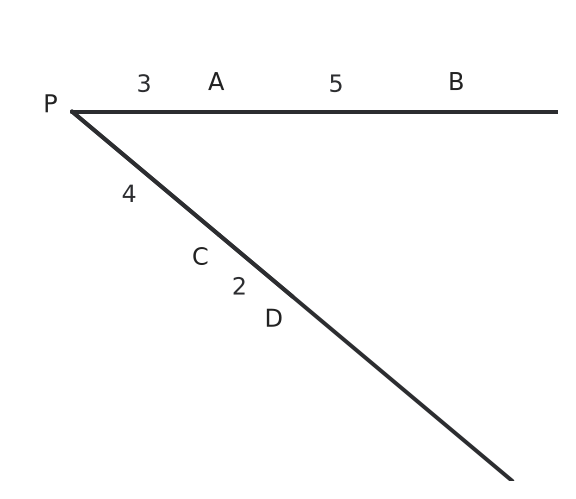
Figure for problem 542429

Hints

- Reverse the original theorem without changing the order of points on the rays. - For the contrapositive, negate the product equality first, then negate concyclicity. - Compute the two products before selecting the useful logical form.

Solution

1. The converse is: If \(PA\cdot PB=PC\cdot PD\), then \(A\), \(B\), \(C\), and \(D\) lie on one circle. With the stated ray order and distinct points, this converse of the secant-product theorem is true. 2. The contrapositive is: If \(PA\cdot PB\ne PC\cdot PD\), then the four points are not concyclic. 3. The products are \(3\cdot8=24\) and \(4\cdot6=24\). 4. Since the products are equal, the converse shows that the four points are concyclic.

Answer

a) Equal secant products imply that the four points are concyclic; the converse is true under the stated conditions. b) If the products are unequal, then the four points are not concyclic. c) The four points lie on one circle.

54244210
Consider a convex quadrilateral with four distinct vertices. Use the statement: “If the quadrilateral is a square, then a \(90^\circ\) rotation about the intersection of its diagonals maps the quadrilateral onto itself.” a) Write the converse and state whether it is true. b) Write the contrapositive. c) A quadrilateral is not mapped onto itself by a \(90^\circ\) rotation about any point. What can you conclude?
Figure for problem 542442

Hints

- Track where one vertex goes under repeated quarter-turns. - Compare all four distances from the rotation center and all four central angles. - Use the contrapositive for the final conclusion.

Solution

1. The converse is: If a \(90^\circ\) rotation about the intersection of a convex quadrilateral's diagonals maps the quadrilateral onto itself, then the quadrilateral is a square. 2. The converse is true. The rotation cycles the four vertices, so they are equally distant from the rotation center and consecutive central angles are \(90^\circ\). Thus, the vertices form a square. 3. The contrapositive is: If the quadrilateral is not mapped onto itself by that \(90^\circ\) rotation, then it is not a square. 4. The given quadrilateral fails the rotational condition about every point, so in particular it fails at any possible diagonal intersection. Therefore, it is not a square.

Answer

a) A convex quadrilateral invariant under a \(90^\circ\) rotation about its diagonal intersection is a square. The converse is true. b) If that rotation does not map the quadrilateral onto itself, then the quadrilateral is not a square. c) The quadrilateral is not a square.

All problems may be used, copied and printed free of charge for school and tutoring, including paid tutoring. Commercial adaptations as well as publication or redistribution on the internet are not permitted.