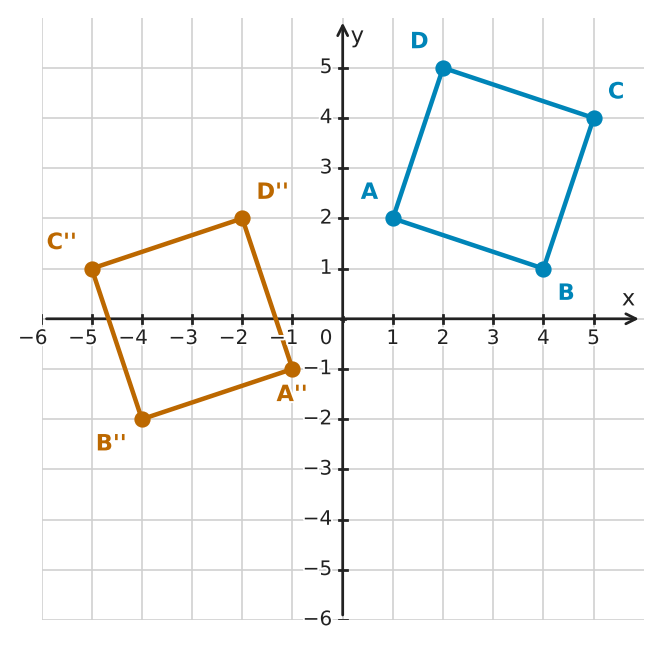
The graph shows quadrilateral \(ABCD\) and its image \(A''B''C''D''\) after a two-step rigid-motion sequence.
a) Read the coordinates of the vertices of both quadrilaterals from the graph.
b) Which rule maps the coordinates \((x, y)\) of a point on \(ABCD\) to the coordinates \((x'', y'')\) of the corresponding point on \(A''B''C''D''\)?
- **Rule I:** \((x, y)\to(x-5, y-3)\)
- **Rule II:** \((x, y)\to(-x, y-3)\)
- **Rule III:** \((x, y)\to(-x, -y)\)
- **Rule IV:** \((x, y)\to(x-3, -y)\)
c) Describe two basic transformations that can be performed in sequence to map \(ABCD\) onto \(A''B''C''D''\).
Hints
- Read each original vertex and its corresponding final image vertex carefully.
- Compare what happens to the \(x\)-coordinates and the \(y\)-coordinates separately.
- Interpret a sign change in one coordinate as a reflection.
- Interpret adding or subtracting a constant from one coordinate as a translation.
Solution
1. The vertices are \(A(1, 2)\), \(B(4, 1)\), \(C(5, 4)\), and \(D(2, 5)\). The final image vertices are \(A''(-1, -1)\), \(B''(-4, -2)\), \(C''(-5, 1)\), and \(D''(-2, 2)\).
2. For each corresponding pair, the \(x\)-coordinate changes sign and the \(y\)-coordinate decreases by \(3\). Therefore, Rule II is correct: \((x, y)\to(-x, y-3)\).
3. Reflect \(ABCD\) across the \(y\)-axis, then translate the result \(3\) units down.
Answer
a) \(A(1, 2)\), \(B(4, 1)\), \(C(5, 4)\), \(D(2, 5)\); \(A''(-1, -1)\), \(B''(-4, -2)\), \(C''(-5, 1)\), \(D''(-2, 2)\).
b) Rule II: \((x, y)\to(-x, y-3)\).
c) Reflect across the \(y\)-axis, then translate \(3\) units down.