Aimathic
Login | English | Deutsch

Free math worksheets

Build your own math worksheets from 30,000+ problems for grades 3 to 12, from fractions to AP Calculus. Every problem comes with step-by-step solutions.

Construct bisectors and perpendiculars

Click problems to add them to your worksheet.

51281410
Segment \(\overline{AB}\) has length \(7.6\,\text{cm}\). a) Describe a compass-and-straightedge procedure for locating its perpendicular bisector. b) Give the length of each of the two parts of \(\overline{AB}\). c) What special property does every point on the perpendicular bisector have in relation to \(A\) and \(B\)?

Hints

- How large must the compass radius be for the arcs to intersect twice? - Where does a perpendicular bisector cross the original segment? - Compare the distances from any point on the perpendicular bisector to the endpoints.

Solution

1. Draw \(\overline{AB}=7.6\,\text{cm}\). 2. Open the compass to a radius greater than \(3.8\,\text{cm}\). With center \(A\), draw arcs above and below the segment. Without changing the compass width, repeat with center \(B\). 3. Draw the line through the two arc intersection points. This line is the perpendicular bisector of \(\overline{AB}\). 4. The midpoint divides the segment into two parts of length \(7.6\div2=3.8\,\text{cm}\). 5. Every point on the perpendicular bisector is equidistant from \(A\) and \(B\).

Answer

a) Draw equal-radius arcs from \(A\) and \(B\) with radius greater than \(3.8\,\text{cm}\), then draw the line through their two intersections. b) Each part is \(3.8\,\text{cm}\). c) Every point on the perpendicular bisector is the same distance from \(A\) as from \(B\).
54216610
A geometry app produces the following points inside \(\angle AVB\): - An arc centered at \(V\) meets the two sides of the angle at \(A\) and \(B\). - Two arcs with the same radius, centered at \(A\) and \(B\), intersect at \(C\) inside the angle. Prove that ray \(\overrightarrow{VC}\) bisects \(\angle AVB\).
Figure for problem 542166

Hints

- Identify the two triangles on opposite sides of the proposed bisector. - Translate each equal-radius arc into an equal-length statement. - Determine what the two triangles share.

Solution

1. Since \(A\) and \(B\) lie on the same arc centered at \(V\), \(VA=VB\). 2. Since \(C\) lies on arcs of equal radius centered at \(A\) and \(B\), \(AC=BC\). 3. Segment \(\overline{VC}\) is common to \(\triangle AVC\) and \(\triangle BVC\). 4. Therefore, \(\triangle AVC\cong\triangle BVC\) by SSS. 5. Corresponding angles \(\angle AVC\) and \(\angle CVB\) are congruent, so \(\overrightarrow{VC}\) bisects \(\angle AVB\).

Answer

The equal-radius arcs give \(VA=VB\) and \(AC=BC\), while \(VC\) is shared. Thus \(\triangle AVC\cong\triangle BVC\) by SSS, so \(\angle AVC\cong\angle CVB\). Therefore, \(\overrightarrow{VC}\) is the angle bisector.
54218010
Point \(P\) lies outside line \(\ell\). A circle centered at \(P\) intersects \(\ell\) at points \(A\) and \(B\). A geometry app then creates the perpendicular bisector of \(\overline{AB}\). Explain why this perpendicular bisector passes through \(P\) and is the perpendicular to \(\ell\) through \(P\).
Figure for problem 542180

Hints

- Use the fact that \(A\) and \(B\) come from one circle with center \(P\). - Connect equal distances from two endpoints to a familiar locus. - Relate the segment being bisected to the original line.

Solution

1. Points \(A\) and \(B\) lie on the same circle centered at \(P\), so \(PA=PB\). 2. A point equidistant from the endpoints of a segment lies on that segment's perpendicular bisector. Therefore, \(P\) lies on the perpendicular bisector of \(\overline{AB}\). 3. Segment \(\overline{AB}\) lies on line \(\ell\). 4. The perpendicular bisector of \(\overline{AB}\) is perpendicular to \(\overline{AB}\), so it is perpendicular to \(\ell\). 5. Thus it is the line through \(P\) perpendicular to \(\ell\).

Answer

Since \(PA=PB\), point \(P\) lies on the perpendicular bisector of \(\overline{AB}\). Because \(\overline{AB}\) lies on \(\ell\), that bisector is perpendicular to \(\ell\). Therefore, it is the required perpendicular through \(P\).
54218610
Points \(A\), \(V\), and \(C\) are collinear, with \(\overrightarrow{VA}\) and \(\overrightarrow{VC}\) opposite rays. Ray \(\overrightarrow{VB}\) forms adjacent angles \(\angle AVB\) and \(\angle BVC\). A geometry app creates the internal bisector of each angle. Prove that the two angle bisectors are perpendicular.
Figure for problem 542186

Hints

- Represent one of the adjacent angle measures with a variable. - Use the relationship between angles in a linear pair. - Compare the two half-angle measures around their shared ray.

Solution

1. Let \(m\angle AVB=\alpha\). Since the two angles form a linear pair, \(m\angle BVC=180^\circ-\alpha\). 2. The first bisector creates an angle of measure \(\frac{\alpha}{2}\) next to \(\overrightarrow{VB}\). 3. The second bisector creates an angle of measure \(\frac{180^\circ-\alpha}{2}\) on the other side of \(\overrightarrow{VB}\). 4. The angle between the two bisectors is \(\frac{\alpha}{2}+\frac{180^\circ-\alpha}{2}=90^\circ\). 5. Therefore, the two angle bisectors are perpendicular.

Answer

The angles formed next to \(\overrightarrow{VB}\) have measures \(\frac{\alpha}{2}\) and \(\frac{180^\circ-\alpha}{2}\). Their sum is \(90^\circ\), so the two bisectors are perpendicular.
54219210
Equilateral triangles \(ACB\) and \(ADB\) lie on opposite sides of segment \(\overline{AB}\). A geometry app creates line \(CD\). Prove that line \(CD\) is the perpendicular bisector of \(\overline{AB}\).
Figure for problem 542192

Hints

- Translate each equilateral-triangle condition into equal distances from \(A\) and \(B\). - Identify the locus of points with those equal distances. - Use the fact that two distinct points determine one line.

Solution

1. Since \(\triangle ACB\) is equilateral, \(CA=CB\). Thus \(C\) is equidistant from \(A\) and \(B\). 2. Since \(\triangle ADB\) is equilateral, \(DA=DB\). Thus \(D\) is equidistant from \(A\) and \(B\). 3. Every point equidistant from \(A\) and \(B\) lies on the perpendicular bisector of \(\overline{AB}\). 4. Therefore, both \(C\) and \(D\) lie on that perpendicular bisector. 5. The unique line through \(C\) and \(D\) is the perpendicular bisector of \(\overline{AB}\), so \(CD\perp AB\) and it passes through the midpoint of \(\overline{AB}\).

Answer

Points \(C\) and \(D\) are each equidistant from \(A\) and \(B\), so both lie on the perpendicular bisector of \(\overline{AB}\). Hence line \(CD\) is that perpendicular bisector.
54219910
In a circle with center \(O\), chord \(\overline{AB}\) is not a diameter, and point \(M\) is its midpoint. A geometry app creates segment \(\overline{OM}\). Prove that \(\overline{OM}\perp\overline{AB}\).
Figure for problem 542199

Hints

- Compare the two triangles formed by the center, the midpoint, and the chord endpoints. - Identify equal lengths coming from the circle and from the midpoint. - Use the relationship between the two adjacent angles at \(M\).

Solution

1. Radii \(\overline{OA}\) and \(\overline{OB}\) are congruent, so \(OA=OB\). 2. Since \(M\) is the midpoint of \(\overline{AB}\), \(AM=MB\). 3. Segment \(\overline{OM}\) is common to \(\triangle OMA\) and \(\triangle OMB\). 4. Therefore, \(\triangle OMA\cong\triangle OMB\) by SSS. 5. Corresponding angles \(\angle OMA\) and \(\angle OMB\) are congruent and form a linear pair. 6. Congruent supplementary angles each measure \(90^\circ\), so \(OM\perp AB\).

Answer

The triangles on either side of \(\overline{OM}\) are congruent by SSS. Their angles at \(M\) are congruent and supplementary, so each is \(90^\circ\). Therefore, \(OM\perp AB\).
54220910
Two lines intersect at \(V\), forming two acute angles and two obtuse angles. Point \(X\) lies inside one of the obtuse angles. The perpendicular distances from \(X\) to the two intersecting lines are equal. Explain why ray \(\overrightarrow{VX}\) is the bisector of that obtuse angle rather than the bisector of an acute angle.
Figure for problem 542209

Hints

- Interpret equal distances to two intersecting lines as a locus condition. - Remember that the two full angle-bisector lines divide all four angle regions. - Use the stated location of \(X\) to select the correct ray.

Solution

1. A point equidistant from two intersecting lines lies on one of the two angle-bisector lines determined by those lines. 2. Each angle-bisector line contains two opposite rays: one bisects a pair of vertical angles, and the other bisector line bisects the other pair. 3. Point \(X\) lies inside an obtuse angle, so ray \(\overrightarrow{VX}\) lies in that obtuse region. 4. Therefore, \(\overrightarrow{VX}\) is the internal bisector of the obtuse angle containing \(X\), not of either acute angle.

Answer

Equal perpendicular distances place \(X\) on an angle-bisector line. Because \(X\) lies inside the obtuse region, ray \(\overrightarrow{VX}\) is the bisector of that obtuse angle.
54222310
Two circles with distinct centers \(O_1\) and \(O_2\) intersect at points \(A\) and \(B\). The geometry app creates line \(O_1O_2\). Prove that line \(O_1O_2\) is the perpendicular bisector of the common chord \(\overline{AB}\).
Figure for problem 542223

Hints

- Use the radius relationships in each circle separately. - Identify the locus of points equidistant from the chord endpoints. - Use the fact that the two centers are distinct.

Solution

1. Points \(A\) and \(B\) lie on the circle centered at \(O_1\), so \(O_1A=O_1B\). 2. Therefore, \(O_1\) lies on the perpendicular bisector of \(\overline{AB}\). 3. Points \(A\) and \(B\) also lie on the circle centered at \(O_2\), so \(O_2A=O_2B\). 4. Therefore, \(O_2\) lies on the same perpendicular bisector of \(\overline{AB}\). 5. The line through the two distinct points \(O_1\) and \(O_2\) is that perpendicular bisector.

Answer

Each center is equidistant from \(A\) and \(B\), so both centers lie on the perpendicular bisector of \(\overline{AB}\). Hence line \(O_1O_2\) is the perpendicular bisector of the common chord.
54224410
Lines \(\ell\) and \(m\) are parallel, and point \(A\) lies on \(\ell\). A geometry app creates the perpendicular from \(A\) to \(m\), meeting \(m\) at \(B\). Explain why \(\overline{AB}\) is shorter than every other segment from \(A\) to a different point on \(m\).
Figure for problem 542244

Hints

- Compare the perpendicular segment with a segment from \(A\) to an arbitrary different point on \(m\). - Identify the type of triangle formed by those two segments and part of line \(m\). - Recall which side of a right triangle must be longest.

Solution

1. The app creates line \(p\) through \(A\) perpendicular to \(m\), with \(B=p\cap m\). 2. Let \(C\ne B\) be any other point on \(m\). Since \(\overline{AB}\perp m\), triangle \(ABC\) is right at \(B\). 3. In a right triangle, the hypotenuse is longer than either leg. Thus \(AC>AB\). 4. Because this is true for every \(C\ne B\) on \(m\), \(\overline{AB}\) is the unique shortest segment from \(A\) to \(m\).

Answer

For any point \(C\ne B\) on \(m\), triangle \(ABC\) is right at \(B\), with \(\overline{AC}\) as its hypotenuse. Therefore, \(AC>AB\), so \(\overline{AB}\) is the unique shortest segment from \(A\) to \(m\).
54225110
Lines \(\ell\) and \(m\) are parallel. Distinct points \(A\) and \(C\) lie on \(\ell\). A geometry app creates perpendiculars to \(\ell\) through \(A\) and \(C\); they meet \(m\) at \(B\) and \(D\), respectively. Prove that \(AB=CD\).
Figure for problem 542251

Hints

- Determine the relationship between two lines perpendicular to the same line. - Use the original pair of parallel lines for the other pair of opposite sides. - Identify the resulting quadrilateral and use one of its side properties.

Solution

1. Since \(\overline{AB}\perp\ell\) and \(\overline{CD}\perp\ell\), \(\overline{AB}\parallel\overline{CD}\). 2. Segments \(\overline{AC}\) and \(\overline{BD}\) lie on the parallel lines \(\ell\) and \(m\), so \(\overline{AC}\parallel\overline{BD}\). 3. Quadrilateral \(ACDB\) has two pairs of parallel opposite sides and a right angle, so it is a rectangle. 4. Opposite sides of a rectangle are congruent. Therefore, \(AB=CD\).

Answer

The app-created perpendiculars are opposite sides of rectangle \(ACDB\). Therefore, \(AB=CD\).
54225810
A circle is drawn, but its center is not marked. Two nonparallel chords, \(\overline{AB}\) and \(\overline{CD}\), are visible. A geometry app creates the perpendicular bisector of each chord. Explain why the intersection of the two bisectors is the center of the circle.
Figure for problem 542258

Hints

- Consider the distances from the center to the endpoints of one chord. - Identify the locus of points equidistant from two endpoints. - Use both nonparallel chords to determine a unique intersection.

Solution

1. The center of a circle is equidistant from the endpoints of every chord. 2. Therefore, the center lies on the perpendicular bisector of \(\overline{AB}\) and on the perpendicular bisector of \(\overline{CD}\). 3. Because the chords are nonparallel, their perpendicular bisectors are distinct and nonparallel, so they intersect at exactly one point. 4. The circle's center lies on both bisectors, so their unique intersection is the center.

Answer

The center is equidistant from both endpoints of each chord, so it lies on both perpendicular bisectors. Because the chords are nonparallel, the bisectors intersect at exactly one point, which must be the circle's center.
54227210
Triangle \(ABC\) is isosceles with \(AB=AC\). A geometry app creates the perpendicular bisector of base \(\overline{BC}\). Prove that the line passes through \(A\), and state three roles it has in the triangle.
Figure for problem 542272

Hints

- Use the given equality to place \(A\) on a familiar locus. - Read the midpoint and perpendicular information from the app-created line. - Compare the two right triangles formed by the line.

Solution

1. Since \(AB=AC\), point \(A\) is equidistant from \(B\) and \(C\). 2. Every point equidistant from \(B\) and \(C\) lies on the perpendicular bisector of \(\overline{BC}\). Therefore, the app-created line passes through \(A\). 3. By construction, the line is perpendicular to \(\overline{BC}\) and passes through its midpoint, so it is both an altitude and a median from \(A\). 4. The two right triangles have congruent hypotenuses and the shared leg \(\overline{AM}\), so they are congruent by HL. Thus the line also bisects \(\angle A\).

Answer

The line passes through \(A\) because \(AB=AC\) places \(A\) on the perpendicular bisector of \(\overline{BC}\). It is the median, altitude, and angle bisector from \(A\).
54231410
From an external point \(P\), two tangents touch a circle at \(T\) and \(U\). A geometry app creates the angle bisector of \(\angle TPU\). Prove that the circle's center \(O\) lies on the angle bisector.
Figure for problem 542314

Hints

- Use the radii to the two points of tangency. - Compare the two right triangles that share segment \(\overline{PO}\). - Use the resulting angle congruence at \(P\).

Solution

1. Radii to points of tangency are perpendicular to the tangents, so \(OT\perp PT\) and \(OU\perp PU\). 2. Right triangles \(PTO\) and \(PUO\) share hypotenuse \(\overline{PO}\), and \(OT=OU\) because both are radii. 3. The triangles are congruent by HL. 4. Therefore, \(\angle TPO\cong\angle OPU\). 5. Thus ray \(\overrightarrow{PO}\) bisects \(\angle TPU\), so the app-created angle bisector passes through \(O\).

Answer

The two right triangles formed by the tangents, radii, and \(\overline{PO}\) are congruent by HL. Therefore, \(\angle TPO\cong\angle OPU\), so the angle bisector passes through the center \(O\).
54232110
Distinct points \(A\), \(B\), and \(C\) lie on a circle with center \(O\), and chords \(\overline{AB}\) and \(\overline{AC}\) are congruent. Prove that ray \(\overrightarrow{AO}\) bisects \(\angle BAC\).
Figure for problem 542321

Hints

- Compare the two triangles formed by the center and the congruent chords. - Identify the equal radii and the shared segment. - Use the resulting triangle congruence at vertex \(A\).

Solution

1. In triangles \(AOB\) and \(AOC\), \(AB=AC\) by the given chord congruence. 2. Also, \(OB=OC\) because they are radii, and \(AO\) is shared. 3. Therefore, the triangles are congruent by SSS. 4. Corresponding angles \(\angle BAO\) and \(\angle OAC\) are congruent. 5. Hence ray \(\overrightarrow{AO}\) bisects \(\angle BAC\).

Answer

Triangles \(AOB\) and \(AOC\) are congruent by SSS, so \(\angle BAO=\angle OAC\). Therefore, \(\overrightarrow{AO}\) is the angle bisector.
54233510
Triangle \(ABC\) has \(AB=10\,\text{cm}\), \(AC=6\,\text{cm}\), and \(BC=12\,\text{cm}\). A geometry app creates the internal angle bisector of \(\angle A\), meeting \(\overline{BC}\) at \(D\). Find \(BD\) and \(DC\).
Figure for problem 542335

Hints

- The app's equal-radius arc method creates two congruent angles at \(A\). - Apply the Angle Bisector Theorem to relate \(BD\) and \(DC\). - Use \(BD+DC=12\,\text{cm}\).

Solution

1. The app uses equal-radius arcs to create the internal angle-bisector ray from \(A\), and the ray meets \(\overline{BC}\) at \(D\). 2. By the Angle Bisector Theorem, \(\frac{BD}{DC}=\frac{AB}{AC}=\frac{10}{6}=\frac{5}{3}\). 3. Let \(BD=5k\) and \(DC=3k\). Since \(BC=12\,\text{cm}\), \(8k=12\), so \(k=1.5\). 4. Therefore, \(BD=7.5\,\text{cm}\) and \(DC=4.5\,\text{cm}\).

Answer

\(BD=7.5\,\text{cm}\) and \(DC=4.5\,\text{cm}\).
54234210
Segment \(\overline{AB}\) has length \(10\,\text{cm}\). A geometry app creates an isosceles triangle \(ABC\) with base \(\overline{AB}\) and altitude \(6\,\text{cm}\) from \(C\) to the base. Find the length of each congruent side.
Figure for problem 542342

Hints

- Use the midpoint of the \(10\,\text{cm}\) base. - The altitude and half the base form the legs of a right triangle. - Apply the Pythagorean theorem to find a congruent side.

Solution

1. The app locates midpoint \(M\) of \(\overline{AB}\) and places \(C\) on the perpendicular bisector so that \(CM=6\,\text{cm}\). 2. Because \(C\) lies on the perpendicular bisector, \(CA=CB\), and \(\overline{CM}\) is the required altitude. 3. Since \(AM=5\,\text{cm}\), right triangle \(AMC\) gives \(AC=\sqrt{5^2+6^2}=\sqrt{61}\,\text{cm}\). 4. Therefore, \(AC=BC=\sqrt{61}\,\text{cm}\).

Answer

Each congruent side has length \(\sqrt{61}\,\text{cm}\).
54236310
Triangle \(ABC\) is obtuse at \(A\). A geometry app creates two altitudes and labels their intersection \(H\). Explain why some side lines must be extended, why \(H\) lies outside the triangle, and why two altitudes are enough to determine the orthocenter.
Figure for problem 542363

Hints

- An altitude is perpendicular to the line containing the opposite side. - In an obtuse triangle, some perpendicular feet lie outside the side segments. - The intersection of any two altitudes is the common point of all three.

Solution

1. Because \(\angle A\) is obtuse, the perpendicular from \(B\) to the line containing \(AC\) meets the extension beyond \(A\), and the perpendicular from \(C\) to the line containing \(AB\) also meets an extension. 2. The app creates these two perpendicular lines, which are the altitudes from \(B\) and \(C\). 3. Their intersection \(H\) lies outside the triangle because both altitude feet lie outside the opposite side segments. 4. The three altitudes of a triangle are concurrent, so the altitude through \(A\) also passes through \(H\). Therefore, two altitudes determine the orthocenter.

Answer

The side lines must be extended because the altitude feet from \(B\) and \(C\) lie outside the opposite side segments. The two app-created altitudes meet outside the triangle at \(H\), and altitude concurrency guarantees that \(H\) is the orthocenter.
54239810
A line \(\ell\) and a point \(P\) not on \(\ell\) are given. A geometry app creates all lines through \(P\) that make an acute angle of \(45^\circ\) with \(\ell\). Explain the app's method and why there are exactly two such lines.
Figure for problem 542398

Hints

- First reproduce the direction of \(\ell\) through \(P\). - Use perpendicular lines to create right angles at \(P\). - Count full lines rather than individual opposite rays.

Solution

1. The app creates line \(n\) through \(P\) perpendicular to \(\ell\). 2. It then creates line \(p\) through \(P\) perpendicular to \(n\). Therefore, \(p\parallel\ell\). 3. Lines \(p\) and \(n\) form four right angles at \(P\). The app bisects two adjacent right angles. 4. Each resulting bisector makes a \(45^\circ\) angle with \(p\), and therefore with \(\ell\), because \(p\parallel\ell\). 5. Bisectors of opposite right angles form the same full line. Thus the four bisector rays combine into exactly two distinct lines through \(P\).

Answer

The app creates a line through \(P\) parallel to \(\ell\) using two perpendiculars, then bisects two adjacent right angles at \(P\). The two resulting full lines are exactly the lines making an acute \(45^\circ\) angle with \(\ell\).
54244610
Segment \(\overline{AB}\) has length \(9\,\text{cm}\). A geometry app draws circles centered at \(A\) and \(B\) with the same radius greater than \(4.5\,\text{cm}\). The circles intersect at \(P\) and \(Q\), and line \(PQ\) meets \(\overline{AB}\) at \(M\). a) Explain why line \(PQ\) is the perpendicular bisector of \(\overline{AB}\). b) State \(AM\) and \(MB\). c) State the two defining properties of the perpendicular bisector.
Figure for problem 542446

Hints

- Use the equal radii to compare each intersection point's distances from \(A\) and \(B\). - Recall the locus of points equidistant from the endpoints of a segment. - Use the midpoint property to divide the given length into two equal parts.

Solution

1. Because the two circles have the same radius, \(PA=PB\) and \(QA=QB\). 2. Therefore, both \(P\) and \(Q\) lie on the perpendicular-bisector locus of \(\overline{AB}\). The line through these two points, \(PQ\), is the perpendicular bisector of \(\overline{AB}\). 3. Since \(M\) is the midpoint of a \(9\,\text{cm}\) segment, \(AM=MB=\frac{9}{2}=4.5\,\text{cm}\). 4. The defining properties are that \(PQ\perp AB\) and that \(PQ\) passes through the midpoint \(M\) of \(\overline{AB}\).

Answer

a) Since \(PA=PB\) and \(QA=QB\), both \(P\) and \(Q\) lie on the perpendicular bisector of \(\overline{AB}\). Therefore, line \(PQ\) is that perpendicular bisector. b) \(AM=MB=4.5\,\text{cm}\). c) Line \(PQ\) is perpendicular to \(\overline{AB}\) and passes through its midpoint \(M\).
51281510
An angle has measure \(\gamma=74^\circ\). a) Describe a compass-and-straightedge procedure for locating its angle bisector \(w_1\). b) Describe how the same procedure can locate a second angle bisector \(w_2\) that bisects one of the two new angles. c) Find the measure of the smallest resulting angle.

Hints

- What happens to an angle measure when the angle is bisected? - Repeat the same construction on one of the smaller angles. - Track the angle created after each construction.

Solution

1. To construct \(w_1\), draw an arc centered at the vertex that intersects both sides of the angle. From those two intersection points, draw equal-radius arcs that intersect inside the angle. Draw a ray from the vertex through that intersection. 2. The first bisection creates two angles of measure \(74^\circ\div2=37^\circ\). 3. Apply the same construction to one \(37^\circ\) angle to create \(w_2\). 4. The smallest angle measures \(37^\circ\div2=18.5^\circ\).

Answer

a) Construct \(w_1\) using equal-radius arcs from points on the two sides of the angle. b) Repeat the angle-bisector construction on one \(37^\circ\) angle to construct \(w_2\). c) The smallest angle measures \(18.5^\circ\).
51281610
A student repeatedly bisects a right angle using a compass-and-straightedge procedure. a) What is the angle measure after the first bisection? b) What is the angle measure after the second bisection? c) How many total bisections of the original right angle are needed to produce an angle smaller than \(10^\circ\) for the first time? Find that angle measure.

Hints

- Make a table of the number of bisections and the resulting angle measure. - Each bisection divides the current angle measure by \(2\). - Continue until the result is below \(10^\circ\).

Solution

1. The first bisection gives \(90^\circ\div2=45^\circ\). 2. The second bisection gives \(45^\circ\div2=22.5^\circ\). 3. The third bisection gives \(22.5^\circ\div2=11.25^\circ\), which is still greater than \(10^\circ\). 4. The fourth bisection gives \(11.25^\circ\div2=5.625^\circ\), which is less than \(10^\circ\). 5. Therefore, four bisections are required.

Answer

a) \(45^\circ\). b) \(22.5^\circ\). c) Four bisections; the resulting angle is \(5.625^\circ\).
54215710
A digital compass-and-straightedge tool is used to find the perpendicular bisector of segment \(\overline{UV}\), where \(UV=14\,\text{cm}\). The student draws one circle centered at \(U\) and one centered at \(V\), each with radius \(7\,\text{cm}\). The circles meet at exactly one point. a) Explain why this setup does not provide the two points needed to determine the perpendicular bisector. b) What change to the common radius will make the two circles intersect at two points? c) Explain why the line through those two intersection points will be the perpendicular bisector of \(\overline{UV}\).
Figure for problem 542157

Hints

- Compare the distance between the centers with the sum of the two radii. - Think about when two congruent circles cross twice instead of touching once. - What is true about the distances from either intersection to the two centers?

Solution

1. Since \(UV=14\,\text{cm}\) and each radius is \(7\,\text{cm}\), the sum of the radii equals the distance between the centers. The circles are tangent and have only one intersection. 2. The common radius must be greater than \(7\,\text{cm}\) so the circles overlap and intersect at two points. 3. Each intersection point is the same distance from \(U\) and \(V\) because it lies on both circles with the same radius. 4. Every point equidistant from \(U\) and \(V\) lies on the perpendicular bisector of \(\overline{UV}\). Therefore, the line through the two intersections is that perpendicular bisector.

Answer

a) The circles are tangent because \(7+7=14\), so they provide only one intersection point. b) Use any common radius greater than \(7\,\text{cm}\). c) Both intersections are equidistant from \(U\) and \(V\), so the line through them is the perpendicular bisector of \(\overline{UV}\).
54217310
Point \(P\) lies on line \(\ell\). A geometry app chooses points \(A\) and \(B\) on \(\ell\), on opposite sides of \(P\), so that \(PA=PB\). Equal-radius arcs centered at \(A\) and \(B\) meet at point \(C\) off the line. Prove that \(\overline{PC}\perp\ell\).
Figure for problem 542173

Hints

- Compare the two triangles formed on either side of \(\overline{PC}\). - Translate the point-placement and arc conditions into equal lengths. - Use both the equality and the sum of the two angles at \(P\).

Solution

1. The placement of \(A\) and \(B\) gives \(PA=PB\). 2. The equal-radius arcs give \(CA=CB\). 3. Segment \(\overline{PC}\) is common to \(\triangle APC\) and \(\triangle BPC\). 4. Therefore, \(\triangle APC\cong\triangle BPC\) by SSS. 5. Corresponding angles \(\angle APC\) and \(\angle CPB\) are congruent. 6. These adjacent angles form a linear pair, so their measures sum to \(180^\circ\). Congruent supplementary angles each measure \(90^\circ\). 7. Therefore, \(\overline{PC}\perp\ell\).

Answer

The equal lengths give \(\triangle APC\cong\triangle BPC\) by SSS. Thus \(\angle APC\cong\angle CPB\). Because they form a linear pair, each is \(90^\circ\), so \(PC\perp\ell\).
54220210
Two radio towers are located at points \(A\) and \(B\). A straight service road lies on line \(r\), which is neither parallel to nor identical with the perpendicular bisector of \(\overline{AB}\). A geometry app marks point \(P\), where \(r\) intersects that perpendicular bisector. a) Explain why \(P\) is equidistant from the two towers. b) Explain why \(P\) is the only point on road \(r\) that is equidistant from the two towers. c) Describe what would change if \(r\) were parallel to the perpendicular bisector, and what would change if \(r\) were the perpendicular bisector.
Figure for problem 542202

Hints

- Interpret equal distance from two fixed points as a locus condition. - Compare the intersection behavior of two nonparallel lines. - Consider separately the cases of parallel and coincident lines.

Solution

1. Every point on the perpendicular bisector of \(\overline{AB}\) is equidistant from \(A\) and \(B\). Since \(P\) lies on it, \(PA=PB\). 2. Any point equidistant from \(A\) and \(B\) must lie on the perpendicular bisector. 3. Because two nonparallel distinct lines intersect at exactly one point, \(r\) and the perpendicular bisector share only point \(P\). Therefore, no other point on \(r\) is equidistant from the towers. 4. If \(r\) were parallel to the perpendicular bisector, the lines would not intersect, so no point on \(r\) would be equidistant from \(A\) and \(B\). 5. If \(r\) were the perpendicular bisector itself, every point on \(r\) would be equidistant from \(A\) and \(B\).

Answer

a) \(PA=PB\) because \(P\) lies on the perpendicular bisector of \(\overline{AB}\). b) It is unique because line \(r\) meets that perpendicular bisector at exactly one point. c) A parallel road would contain no such point; a coincident road would make every point a solution.
54223010
Rays \(\overrightarrow{VA}\) and \(\overrightarrow{VB}\) form a minor angle with measure \(\theta\), where \(0^\circ<\theta<180^\circ\). A geometry app creates the internal angle-bisector ray \(\overrightarrow{VW}\), then extends it through \(V\) to the opposite ray \(\overrightarrow{VW'}\). Prove that \(\overrightarrow{VW'}\) bisects the reflex angle formed by \(\overrightarrow{VA}\) and \(\overrightarrow{VB}\).
Figure for problem 542230

Hints

- Express the two halves of the minor angle in terms of \(\theta\). - Use the fact that opposite rays differ by a straight angle. - Measure each part within the reflex region rather than through the minor angle.

Solution

1. Since \(\overrightarrow{VW}\) bisects the minor angle, each half has measure \(\frac{\theta}{2}\). 2. Ray \(\overrightarrow{VW'}\) is opposite \(\overrightarrow{VW}\), so it is \(180^\circ\) from \(\overrightarrow{VW}\). 3. Along the reflex region, the angle from \(\overrightarrow{VB}\) to \(\overrightarrow{VW'}\) has measure \(180^\circ-\frac{\theta}{2}\). 4. The angle from \(\overrightarrow{VW'}\) to \(\overrightarrow{VA}\) through the rest of the reflex region also has measure \(180^\circ-\frac{\theta}{2}\). 5. These two parts are congruent and together form the reflex angle of measure \(360^\circ-\theta\). 6. Therefore, \(\overrightarrow{VW'}\) bisects the reflex angle.

Answer

Each part of the reflex angle cut by \(\overrightarrow{VW'}\) measures \(180^\circ-\frac{\theta}{2}\). Therefore, the opposite ray of the minor-angle bisector is the reflex-angle bisector.
54226510
Segment \(\overline{AB}\) has length \(8\,\text{cm}\). A geometry app displays all possible centers of circles with radius \(5\,\text{cm}\) that pass through both \(A\) and \(B\). Explain why there are exactly two centers, and find each center's distance from the midpoint of \(\overline{AB}\).
Figure for problem 542265

Hints

- Enforce the required \(5\,\text{cm}\) distance from each endpoint. - Check the circle-intersection condition using the \(8\,\text{cm}\) distance between centers. - Use the midpoint of \(\overline{AB}\) to form a right triangle.

Solution

1. Any center of a circle through \(A\) and \(B\) must be \(5\,\text{cm}\) from each point. 2. The app therefore displays the intersections \(O_1\) and \(O_2\) of the circles centered at \(A\) and \(B\), each with radius \(5\,\text{cm}\). 3. The equal-radius circles have two intersections because the distance between their centers satisfies \(0<8<5+5\). 4. Let \(M\) be the midpoint of \(\overline{AB}\). Then \(AM=4\,\text{cm}\), and each center lies on the perpendicular bisector of \(\overline{AB}\). 5. In right triangle \(AMO_1\), \(MO_1=\sqrt{5^2-4^2}=3\,\text{cm}\). By symmetry, \(MO_2=3\,\text{cm}\).

Answer

The two centers are \(O_1\) and \(O_2\), the intersections of the radius-\(5\,\text{cm}\) circles centered at \(A\) and \(B\). Each center is \(3\,\text{cm}\) from the midpoint of \(\overline{AB}\).
54227910
Rhombus \(ABCD\) has diagonals that intersect at \(M\). Prove from the side congruences that \(\overline{AC}\) is the perpendicular bisector of \(\overline{BD}\).
Figure for problem 542279

Hints

- Use the fact that a rhombus is also a parallelogram. - Compare the two triangles formed on opposite sides of one diagonal. - Interpret congruent angles that form a linear pair.

Solution

1. A rhombus is a parallelogram, so its diagonals bisect each other. Therefore, \(BM=DM\). 2. In triangles \(ABM\) and \(ADM\), \(AB=AD\) because all sides of a rhombus are congruent, \(BM=DM\), and \(AM\) is shared. 3. The triangles are congruent by SSS, so \(\angle BMA\cong\angle AMD\). 4. These two angles form a linear pair. Congruent supplementary angles each measure \(90^\circ\), so \(AC\perp BD\). 5. Since \(\overline{AC}\) is perpendicular to \(\overline{BD}\) at its midpoint \(M\), \(\overline{AC}\) is the perpendicular bisector of \(\overline{BD}\).

Answer

The diagonals bisect each other, so \(M\) is the midpoint of \(\overline{BD}\). Congruent triangles \(ABM\) and \(ADM\) show the adjacent angles at \(M\) are equal; because they form a linear pair, both are right angles. Thus \(\overline{AC}\) is the perpendicular bisector of \(\overline{BD}\).
54228610
Isosceles trapezoid \(ABCD\) has \(\overline{AB}\parallel\overline{CD}\) and \(AD=BC\). A geometry app creates the perpendicular bisector \(s\) of base \(\overline{AB}\). Prove that \(s\) is also the perpendicular bisector of \(\overline{CD}\).
Figure for problem 542286

Hints

- Use the congruent base angles and legs of the isosceles trapezoid. - Consider the reflection that exchanges the endpoints of \(\overline{AB}\). - Determine where that reflection sends the other two vertices.

Solution

1. The base angles at \(A\) and \(B\) of an isosceles trapezoid are congruent. 2. Reflection across the perpendicular bisector \(s\) exchanges \(A\) and \(B\), while preserving angle measure and distance. 3. The reflected image of ray \(\overrightarrow{AD}\) is ray \(\overrightarrow{BC}\). Since \(AD=BC\), the reflection maps \(D\) to \(C\). 4. Therefore, \(C\) and \(D\) are mirror images across \(s\), so \(s\) perpendicularly bisects \(\overline{CD}\). 5. Equivalently, \(s\perp CD\) because \(AB\parallel CD\), and the reflection shows that \(s\) passes through the midpoint of \(\overline{CD}\).

Answer

Reflection across the perpendicular bisector of \(\overline{AB}\) exchanges \(A\) with \(B\) and, by the symmetry of the isosceles trapezoid, exchanges \(D\) with \(C\). Thus the same line is the perpendicular bisector of \(\overline{CD}\).
54232810
A circle has center \(O\) and radius \(5\,\text{cm}\). Points \(A\) and \(B\) are outside the circle. The perpendicular bisector \(p\) of \(\overline{AB}\) is \(3\,\text{cm}\) from \(O\). A geometry app marks all points on the circle that are equidistant from \(A\) and \(B\). Identify those points and find the distance between them.
Figure for problem 542328

Hints

- Identify the complete locus of points equidistant from \(A\) and \(B\). - Intersect that locus with the given circle. - Use the perpendicular from the circle's center to chord \(\overline{PQ}\).

Solution

1. Every point equidistant from \(A\) and \(B\) lies on the perpendicular bisector \(p\) of \(\overline{AB}\). 2. Therefore, the required points are the intersections \(P\) and \(Q\) of \(p\) with the circle. 3. Let \(M\) be the foot of the perpendicular from \(O\) to \(p\). Since \(OM=3\,\text{cm}\), the perpendicular from the center to chord \(\overline{PQ}\) bisects the chord. 4. In right triangle \(OMP\), \(MP=\sqrt{5^2-3^2}=4\,\text{cm}\). 5. Thus \(PQ=2MP=8\,\text{cm}\).

Answer

The points are the two intersections \(P\) and \(Q\) of the circle with the perpendicular bisector of \(\overline{AB}\). Their distance is \(8\,\text{cm}\).
54234910
Segment \(\overline{AB}\) has length \(10\,\text{cm}\). A circle centered at \(A\) with radius \(8\,\text{cm}\) and a circle centered at \(B\) with radius \(6\,\text{cm}\) intersect at \(C\) and \(D\). Let line \(CD\) meet \(\overline{AB}\) at \(X\). A student claims that \(\overline{CD}\) is the perpendicular bisector of \(\overline{AB}\). Determine which part of the claim is true, find \(AX\) and \(XB\), and state what condition on the two radii would make \(CD\) the perpendicular bisector of \(AB\).
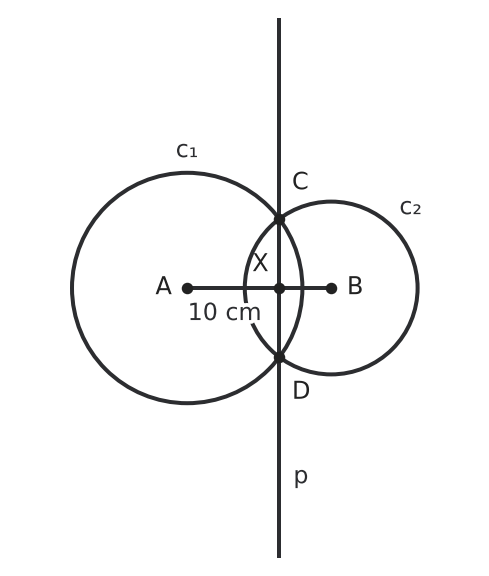
Figure for problem 542349

Hints

- Use the equal radii from each center to compare distances to \(C\) and \(D\). - Introduce one variable for the two parts of \(\overline{AB}\). - Compare the two right-triangle equations before deciding whether \(X\) is a midpoint.

Solution

1. Since \(AC=AD=8\,\text{cm}\), point \(A\) lies on the perpendicular bisector of \(\overline{CD}\). Since \(BC=BD=6\,\text{cm}\), point \(B\) lies on the same perpendicular bisector. 2. Therefore, line \(AB\) is the perpendicular bisector of \(\overline{CD}\), so \(CD\perp AB\). The perpendicular part of the student’s claim is true. 3. Let \(AX=x\), so \(XB=10-x\). The perpendicular line creates right triangles \(AXC\) and \(BXC\). 4. Thus, \(x^2+CX^2=8^2\) and \((10-x)^2+CX^2=6^2\). 5. Subtracting gives \(x^2-(10-x)^2=28\), so \(20x-100=28\) and \(x=6.4\). 6. Therefore, \(AX=6.4\,\text{cm}\) and \(XB=3.6\,\text{cm}\), so \(X\) is not the midpoint of \(AB\). 7. If the two construction circles had equal radii, both \(C\) and \(D\) would be equidistant from \(A\) and \(B\), making \(CD\) the perpendicular bisector of \(AB\).

Answer

\(CD\perp AB\), but it does not bisect \(AB\). The lengths are \(AX=6.4\,\text{cm}\) and \(XB=3.6\,\text{cm}\). Equal circle radii would make \(CD\) the perpendicular bisector of \(AB\).

54235610
Two lines \(\ell\) and \(m\) intersect at \(O\). A geometry app displays the complete locus of centers of circles tangent to both lines. Describe the locus and explain why its two lines are perpendicular.
Figure for problem 542356

Hints

- Express tangency to each line as a perpendicular-distance condition. - Recall the locus of points equidistant from two intersecting lines. - Compare the halves of two adjacent supplementary angles.

Solution

1. A circle tangent to both \(\ell\) and \(m\) has a center whose perpendicular distances to the two lines are equal. 2. The locus of points equidistant from two intersecting lines consists of the bisectors of the four angles formed by the lines. 3. The app displays one full bisector line through the internal bisectors of a pair of vertical angles and a second full bisector line through the other pair. 4. Every point on either bisector line, except \(O\), can serve as a center; its perpendicular distance to either original line is the circle's positive radius. 5. Adjacent angles formed by \(\ell\) and \(m\) are supplementary. Their half-measures sum to \(90^\circ\), so the two bisector lines are perpendicular.

Answer

The complete locus is the union of the internal and external angle-bisector lines through \(O\), excluding \(O\) for circles with positive radius. The two locus lines are perpendicular because they bisect adjacent supplementary angles.
54237010
In acute triangle \(ABC\), a geometry app creates the three altitudes and labels their intersection \(H\). Points \(E\) and \(F\) are the feet of the altitudes from \(B\) and \(C\), respectively. Prove that \(A\), \(E\), \(H\), and \(F\) lie on one circle, and explain how the app can create that circle.
Figure for problem 542370

Hints

- Use the altitude relationships to identify right angles at \(E\) and \(F\). - Recall the circle determined by a diameter and a right inscribed angle. - The midpoint of \(\overline{AH}\) is the center of the required circle.

Solution

1. Since \(A\), \(E\), and \(C\) are collinear while \(E\) and \(H\) lie on the altitude from \(B\), \(AE\perp EH\). Thus \(\angle AEH=90^\circ\). 2. Since \(A\), \(F\), and \(B\) are collinear while \(F\) and \(H\) lie on the altitude from \(C\), \(AF\perp FH\). Thus \(\angle AFH=90^\circ\). 3. Every point forming a right angle with endpoints \(A\) and \(H\) lies on the circle with diameter \(\overline{AH}\). Therefore, both \(E\) and \(F\) lie on that circle. 4. The app can locate the midpoint of \(\overline{AH}\) and draw the circle centered there through \(A\). It also passes through \(E\), \(H\), and \(F\).

Answer

Angles \(AEH\) and \(AFH\) are right angles, so \(E\) and \(F\) lie on the circle with diameter \(\overline{AH}\). The app creates the circle using the midpoint of \(\overline{AH}\) as its center and half of \(AH\) as its radius.
54237710
Segment \(\overline{AB}\) has length \(12\,\text{cm}\). A geometry app marks all points that satisfy \(PA=PB\) and \(\angle APB=90^\circ\). Identify all such points and find the possible value of \(PA\).
Figure for problem 542377

Hints

- Use one locus for points equidistant from \(A\) and \(B\). - Use a second locus for points that subtend a right angle over \(\overline{AB}\). - The resulting triangle is right and isosceles.

Solution

1. The condition \(PA=PB\) places the point on the perpendicular bisector of \(\overline{AB}\). 2. The condition \(\angle APB=90^\circ\) places the point on the circle with diameter \(\overline{AB}\). 3. The perpendicular bisector intersects that circle at exactly two points, \(P\) and \(Q\). These are the only points satisfying both conditions. 4. In right isosceles triangle \(APB\), let \(PA=PB=x\). Then \(x^2+x^2=12^2\). 5. Thus \(2x^2=144\), so \(x=6\sqrt{2}\,\text{cm}\).

Answer

The two points are the intersections \(P\) and \(Q\) of the perpendicular bisector of \(\overline{AB}\) with the circle having diameter \(\overline{AB}\). For either point, \(PA=6\sqrt{2}\,\text{cm}\).
54240610
Point \(P\) lies outside line \(\ell\). A geometry app chooses a point \(A\) on \(\ell\), locates the midpoint \(M\) of \(\overline{AP}\), and draws the circle centered at \(M\) through \(A\) and \(P\). If the circle is tangent to \(\ell\) at \(A\), the app chooses a different point \(A\). Otherwise, the circle meets \(\ell\) again at \(H\). Prove that \(\overline{PH}\perp\ell\), and explain how this method differs from the usual equal-arc construction.
Figure for problem 542406

Hints

- A non-tangent choice of \(A\) gives a second circle-line intersection. - Identify the diameter and the inscribed angle that subtends it. - Compare the diameter method with the standard equal-arc method.

Solution

1. At most one choice of \(A\) makes the circle tangent to \(\ell\) at \(A\), namely the foot of the perpendicular from \(P\). Choosing a different point guarantees a second intersection \(H\ne A\). 2. Segment \(\overline{AP}\) is a diameter of the circle because \(M\) is its midpoint and the circle passes through \(A\) and \(P\). 3. Point \(H\) lies on the circle, so \(\angle AHP\) intercepts diameter \(\overline{AP}\). 4. An inscribed angle that intercepts a diameter is a right angle, so \(\angle AHP=90^\circ\). 5. Points \(A\) and \(H\) lie on \(\ell\), so \(\overline{PH}\perp\ell\). 6. This method creates the right angle using a circle with diameter \(\overline{AP}\), rather than using two intersecting equal-radius arcs.

Answer

Since \(\overline{AP}\) is a diameter, \(\angle AHP=90^\circ\). Because \(A\) and \(H\) lie on \(\ell\), \(\overline{PH}\perp\ell\). This method uses the diameter-right-angle theorem instead of equal-radius arcs.
54241210
Points \(A\) and \(B\) lie on the same side of line \(\ell\). A geometry app reflects \(B\) across \(\ell\) to \(B'\) by making \(\ell\) the perpendicular bisector of \(\overline{BB'}\), then labels \(P=\ell\cap AB'\). Prove that \(P\) minimizes \(AP+PB\) among all points on \(\ell\).
Figure for problem 542412

Hints

- Replace one leg of the broken path with an equal reflected segment. - After reflection, compare a broken line with a straight segment. - Equality in the triangle inequality identifies the minimizing point.

Solution

1. Reflection preserves distance, so for every point \(X\) on \(\ell\), \(XB=XB'\). 2. Therefore, \(AX+XB=AX+XB'\). 3. By the triangle inequality, \(AX+XB'\ge AB'\), with equality exactly when \(A\), \(X\), and \(B'\) are collinear. 4. The app-created point \(P\) lies on both \(\ell\) and line \(AB'\), so \(AP+PB=AP+PB'=AB'\), the least possible value.

Answer

The reflection gives \(PB=PB'\), so \(AP+PB=AP+PB'=AB'\). For any other point \(X\) on \(\ell\), the triangle inequality gives \(AX+XB=AX+XB'\ge AB'\). Therefore, \(P\) is the minimizing point.
54241910
A circle has center \(O\), and point \(M\ne O\) lies inside the circle. A geometry app creates the unique chord \(\overline{AB}\) whose midpoint is \(M\). Explain the app's method and prove both that it works and that no other chord has midpoint \(M\).
Figure for problem 542419

Hints

- Reverse the theorem about the segment from a circle's center to a chord midpoint. - Determine the direction the chord must have. - Use uniqueness of a perpendicular line for the uniqueness argument.

Solution

1. The app creates line \(m\) through \(M\) perpendicular to \(\overline{OM}\), and labels its circle intersections \(A\) and \(B\). 2. Since \(OM\perp AB\), the perpendicular from the center to chord \(\overline{AB}\) bisects the chord. Thus \(AM=MB\). 3. If another chord had midpoint \(M\), the line from \(O\) to that midpoint would also be perpendicular to the chord. 4. There is only one line through \(M\) perpendicular to \(OM\), so any such chord must lie on \(m\) and must be \(\overline{AB}\).

Answer

The app draws the perpendicular to \(OM\) through \(M\); its intersections with the circle are the chord endpoints. This chord is unique because only one line through \(M\) is perpendicular to \(OM\).
54242610
Segment \(\overline{AC}\) is the diagonal of a square and has length \(10\,\text{cm}\). A geometry app bisects \(\overline{AC}\) at \(M\), draws the line through \(M\) perpendicular to \(AC\), and marks points \(B\) and \(D\) on that line so that \(MB=MD=5\,\text{cm}\). Explain why \(ABCD\) is a square, and find its side length.
Figure for problem 542426

Hints

- Compare the lengths and intersection properties of the two diagonals. - Identify a quadrilateral test that uses congruent, perpendicular diagonals that bisect each other. - Use right triangle \(AMB\) to calculate a side of the square.

Solution

1. Since \(M\) is the midpoint of \(\overline{AC}\), \(AM=CM=5\,\text{cm}\). 2. The app places \(B\) and \(D\) on the perpendicular through \(M\) so that \(BM=DM=5\,\text{cm}\). 3. Therefore, diagonals \(\overline{AC}\) and \(\overline{BD}\) are congruent, bisect each other, and are perpendicular. A quadrilateral whose diagonals have all three properties is a square, so \(ABCD\) is a square. 4. Right triangle \(AMB\) has legs \(5\,\text{cm}\) and \(5\,\text{cm}\). By the Pythagorean Theorem, \(AB=\sqrt{5^2+5^2}=5\sqrt{2}\,\text{cm}\).

Answer

\(ABCD\) is a square because its congruent diagonals bisect each other at right angles. Its side length is \(5\sqrt{2}\,\text{cm}\).
54243910
Parallel lines \(\ell\) and \(m\) are given, along with distinct points \(A\) and \(B\). The perpendicular bisector of \(\overline{AB}\) is not parallel to \(\ell\). Describe how a geometry app can locate the unique point \(P\) that is equidistant from \(A\) and \(B\) and also equidistant from \(\ell\) and \(m\). Justify why the point is unique.
Figure for problem 542439

Hints

- Represent each equidistance condition as a locus. - The locus equidistant from two parallel lines is the parallel line halfway between them. - Use the stated nonparallel condition to justify that the two loci have exactly one intersection.

Solution

1. The app creates the perpendicular bisector \(p\) of \(\overline{AB}\). Every point on \(p\) is equidistant from \(A\) and \(B\). 2. The app creates a common perpendicular to \(\ell\) and \(m\), finds the midpoint of the segment between the two lines, and draws line \(q\) through that midpoint parallel to \(\ell\). 3. Line \(q\) is the locus of points equidistant from the parallel lines \(\ell\) and \(m\). 4. Let \(P=p\cap q\). Then \(P\) satisfies both equidistance conditions. 5. Because \(p\) is not parallel to \(\ell\), it is not parallel to \(q\). Thus \(p\) and \(q\) intersect at exactly one point, so \(P\) is unique.

Answer

The app intersects the perpendicular bisector of \(\overline{AB}\) with the line halfway between \(\ell\) and \(m\). Their unique intersection is the required point \(P\).

All problems may be used, copied and printed free of charge for school and tutoring, including paid tutoring. Commercial adaptations as well as publication or redistribution on the internet are not permitted.