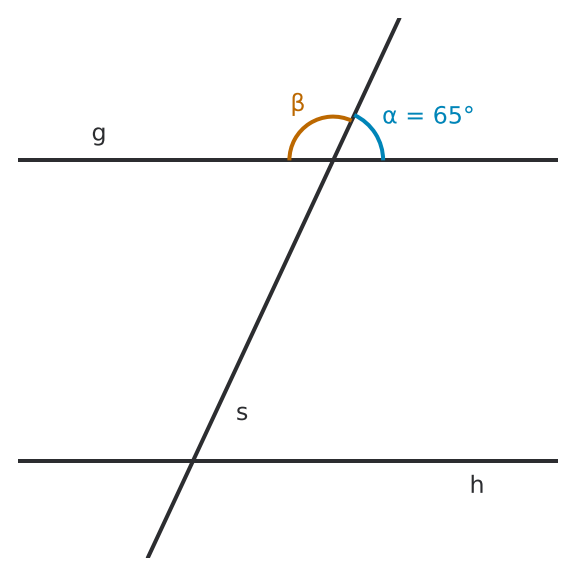
Two parallel lines \(g\) and \(h\) are cut by a transversal \(s\). The diagram marks angle \(\alpha\) and an adjacent angle \(\beta\).
a) Identify three other angles congruent to \(\alpha\), and describe each one's position relative to \(\alpha\).
b) Find \(\beta\), which forms a linear pair with \(\alpha\).
c) Pavel claims, “If the transversal is perpendicular to the parallel lines, all eight angles have the same measure.” Is the claim true? Explain.
Hints
- Recall the angle-pair names used with parallel lines and a transversal.
- What is the sum of a linear pair?
- What happens to a linear pair when one angle is \(90^\circ\)?
Solution
1. Three other \(65^\circ\) angles are the vertical angle to \(\alpha\), the corresponding angle at the other intersection, and the vertical angle to that corresponding angle. The last of these is also alternate to \(\alpha\).
2. Since a linear pair totals \(180^\circ\), \(\beta = 180^\circ - 65^\circ = 115^\circ\).
3. If the transversal is perpendicular to the parallel lines, one angle measures \(90^\circ\). Its linear-pair angle also measures \(180^\circ - 90^\circ = 90^\circ\), and vertical and corresponding angles are congruent. Therefore, all eight angles measure \(90^\circ\), so the claim is true.
Answer
a) The vertical angle to \(\alpha\), its corresponding angle, and the vertical angle to that corresponding angle all measure \(65^\circ\).
b) \(\beta = 115^\circ\)
c) True. All eight angles would measure \(90^\circ\).