Aimathic
Login | English | Deutsch

Free math worksheets

Build your own math worksheets from 30,000+ problems for grades 3 to 12, from fractions to AP Calculus. Every problem comes with step-by-step solutions.

Area of a triangle using sine

Click problems to add them to your worksheet.

53653510
The diagram represents a triangular parcel of land. Find its area and round to the nearest tenth of a square meter.
Figure for problem 536535

Hints

- The diagram shows two sides and their included angle. - Use the sine area formula for a triangle. - The formula works with an obtuse included angle as well as an acute one.

Solution

1. Use the triangle area formula with two sides and their included angle: \(A=\frac{1}{2}bc\sin(\alpha)\). 2. Substitute the diagram values: \(A=\frac{1}{2}\cdot42\cdot58\cdot\sin(125^\circ)\). 3. Therefore, \(A=1218\sin(125^\circ)\approx997.7\,\text{m}^2\).

Answer

\(A\approx997.7\,\text{m}^2\)
53699010
Use the diagram and the sine-area formula \(A=\frac{1}{2}ab\sin C\) to find the area of \(\triangle ABC\). Round to the nearest tenth of a square centimeter.
Figure for problem 536990

Hints

- Identify the two sides that form the marked angle. - Substitute those two side lengths and the included angle into the required formula. - Round only after evaluating the complete sine-area expression.

Solution

1. The two displayed sides adjacent to the included angle have lengths \(8\,\text{cm}\) and \(6\,\text{cm}\), and the included angle is \(37^\circ\). 2. Apply the required formula: \(A=\frac{1}{2}\cdot8\cdot6\cdot\sin(37^\circ)\). 3. Thus, \(A\approx14.4436\,\text{cm}^2\), which rounds to \(14.4\,\text{cm}^2\).

Answer

\(14.4\,\text{cm}^2\)
53653410
Use the diagram. Find the area of parallelogram \(ABCD\). Round to the nearest tenth of a square centimeter.
Figure for problem 536534

Hints

- Read the two adjacent side lengths and the marked interior angle from the diagram. - The sine-area relationship can use either an acute angle or its supplementary obtuse angle. - A parallelogram has twice the area of a triangle with the same two adjacent sides and included angle.

Solution

1. Adjacent angles in a parallelogram are supplementary, so the acute included angle is \(180^\circ-118^\circ=62^\circ\). 2. The height relative to the \(15.0\,\text{cm}\) side is \(9.5\sin(62^\circ)\approx8.388\,\text{cm}\). 3. The area is \(15.0\cdot8.388\ldots\approx125.8\,\text{cm}^2\). 4. Equivalently, \(A=15.0\cdot9.5\sin(118^\circ)\).

Answer

\(A\approx125.8\,\text{cm}^2\)
53654310
Use the diagram to derive a formula for the area of \(\triangle ADB\) in terms of \(a\), \(b\), and \(\alpha\).
Figure for problem 536543

Hints

- Focus on the right triangle formed by the altitude in the diagram. - Express the altitude in terms of \(b\) and \(\alpha\). - Substitute that expression into \(A=\frac{1}{2}(\text{base})(\text{height})\).

Solution

1. Let the shown altitude \(h_a\) from \(D\) meet \(AB\) at \(F\). 2. In right triangle \(AFD\), \(\sin(\alpha)=\frac{h_a}{b}\), so \(h_a=b\sin(\alpha)\). 3. Substitute into the triangle area formula: \(A=\frac{1}{2}ah_a=\frac{1}{2}ab\sin(\alpha)\).

Answer

\(A=\frac{1}{2}ab\sin(\alpha)\)
53654610
A triangular building lot has area \(12{,}000\,\text{ft}^2\). Use the diagram, which is not drawn to scale, to find the unknown side \(a\). Round to the nearest foot.
Figure for problem 536546

Hints

- Read the known side and included angle from the diagram. - Substitute the area and diagram values into the sine area formula. - Isolate \(a\) before rounding.

Solution

1. Use the triangle area formula with two sides and the included angle: \(12{,}000=\frac{1}{2}\cdot a\cdot160\cdot\sin(40^\circ)\). 2. Solve for \(a\): \(a=\frac{24{,}000}{160\sin(40^\circ)}\approx233.36\,\text{ft}\). 3. Rounded to the nearest foot, \(a\approx233\,\text{ft}\).

Answer

\(a\approx233\,\text{ft}\)
53698910
Use the diagram. a) Use the sine area formula to find the area of \(\triangle ABD\). b) Find the area of parallelogram \(ABCD\). Give exact values and decimal approximations to the nearest hundredth.
Figure for problem 536989

Hints

- Read the two sides of \(\triangle ABD\) and their included angle from the diagram. - Use the triangle sine area formula for part a). - A diagonal divides a parallelogram into two congruent triangles.

Solution

1. For part a), use the two shown sides and their included angle: \(A_{\triangle ABD}=\frac{1}{2}\cdot8\cdot5\cdot\sin(45^\circ)=10\sqrt{2}\,\text{cm}^2\approx14.14\,\text{cm}^2\). 2. For part b), diagonal \(BD\) divides the parallelogram into two congruent triangles. Therefore, \(A_{ABCD}=2\cdot10\sqrt{2}=20\sqrt{2}\,\text{cm}^2\approx28.28\,\text{cm}^2\).

Answer

a) \(10\sqrt{2}\,\text{cm}^2\approx14.14\,\text{cm}^2\) b) \(20\sqrt{2}\,\text{cm}^2\approx28.28\,\text{cm}^2\)
55505410
Three triangles are shown. For which panel can the area be found immediately with \(A=\frac{1}{2}ab\sin C\) using only the displayed data? Explain why, and compute that area to the nearest tenth. For the other panels, state what kind of information is missing for an immediate use of the formula.
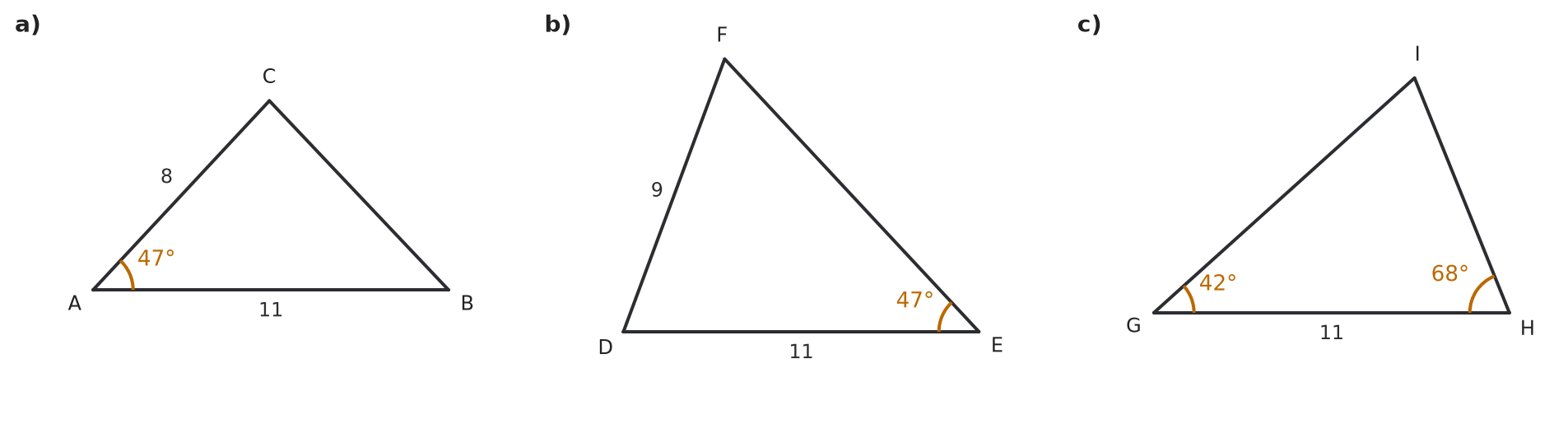
Figure for problem 555054

Hints

- The sine-area formula needs two side lengths and the angle between those two sides. - In each panel, locate the displayed angle and ask whether both sides that form that angle have known lengths. - Only after selecting the applicable panel should you substitute into the formula.

Solution

1. In panel a), the two displayed side lengths, \(8\) and \(11\), meet at the displayed \(47^\circ\) angle. This is exactly the side-angle-side information needed for the sine-area formula. 2. The area is \(\frac{1}{2}\cdot8\cdot11\sin(47^\circ)\approx32.1796\), so the area is about \(32.2\) square units. 3. In panel b), two sides are given, but the displayed \(47^\circ\) angle is not the included angle between them, so the included angle is missing for an immediate use of the formula. 4. In panel c), angles are given with only one side, so a second side forming an included-angle pair is missing.

Answer

Panel a) only. Its area is \(\approx32.2\) square units. Panel b) is missing the included angle between the two given sides, and panel c) is missing a second side needed with an included angle.

51243110
Two triangles each have side lengths \(a = 4\,\text{cm}\) and \(b = 10\,\text{cm}\), and each has area \(10\,\text{cm}^2\). Must the triangles be congruent? Justify your answer.

Hints

- Use the formula for the area of a triangle when two sides and their included angle are known. - What equation does the given area create for \(\sin C\)? - Which two angles between \(0^\circ\) and \(180^\circ\) have the same sine? - Would triangles with different included angles be congruent?

Solution

1. Let \(C\) be the included angle between the sides of lengths \(4\,\text{cm}\) and \(10\,\text{cm}\). 2. Use the area formula \(A = \frac{1}{2}ab\sin C\): \(10 = \frac{1}{2}(4)(10)\sin C\). 3. This gives \(\sin C = \frac{1}{2}\), so the included angle can be \(30^\circ\) or \(150^\circ\). 4. These choices produce triangles with different included angles and therefore different third-side lengths. The triangles do not have to be congruent.

Answer

No. The area condition gives \(\sin C = \frac{1}{2}\), so the included angle can be either \(30^\circ\) or \(150^\circ\). These choices produce noncongruent triangles.
53653610
A triangular glass design has area \(14\,\text{cm}^2\). Use the diagram to find the obtuse included angle \(\gamma\) to the nearest tenth of a degree.
Figure for problem 536536

Hints

- Read the two side lengths adjacent to \(\gamma\) from the diagram. - Solve the sine-area formula for \(\sin(\gamma)\). - Two supplementary angles have the same sine; use the condition that \(\gamma\) is obtuse.

Solution

1. Use \(A=\frac{1}{2}ab\sin(\gamma)\). 2. Substitute the area and the two side lengths from the diagram: \(14=\frac{1}{2}\cdot7.2\cdot5.5\sin(\gamma)=19.8\sin(\gamma)\). 3. Thus, \(\sin(\gamma)=\frac{14}{19.8}\approx0.70707\). 4. The inverse sine gives the acute solution \(45.0^\circ\). The requested angle is obtuse, so \(\gamma=180^\circ-45.0^\circ\approx135.0^\circ\).

Answer

\(\gamma\approx135.0^\circ\)
53654410
The triangle area formula \(A=\frac{1}{2}ab\sin(\gamma)\) also applies when included angle \(\gamma\) is obtuse. Explain why, using \(\sin(180^\circ-\gamma)=\sin(\gamma)\).
Figure for problem 536544

Hints

- Consider the altitude to the extension of the base. - Identify the acute supplementary angle in the exterior right triangle. - Use the given sine relationship to express the altitude.

Solution

1. Let the altitude from \(A\) meet the extension of side \(BC\) at \(F\). 2. In right triangle \(ACF\), the acute angle at \(C\) is \(180^\circ-\gamma\). 3. Thus, \(\sin(180^\circ-\gamma)=\frac{h_a}{b}\). 4. Since \(\sin(180^\circ-\gamma)=\sin(\gamma)\), \(h_a=b\sin(\gamma)\). 5. Substituting into \(A=\frac{1}{2}ah_a\) gives \(A=\frac{1}{2}ab\sin(\gamma)\).

Answer

The exterior right triangle gives \(h_a=b\sin(180^\circ-\gamma)=b\sin(\gamma)\). Therefore, \(A=\frac{1}{2}ah_a=\frac{1}{2}ab\sin(\gamma)\), even when \(\gamma\) is obtuse.

All problems may be used, copied and printed free of charge for school and tutoring, including paid tutoring. Commercial adaptations as well as publication or redistribution on the internet are not permitted.