Aimathic
Login | English | Deutsch

Free math worksheets

Build your own math worksheets from 30,000+ problems for grades 3 to 12, from fractions to AP Calculus. Every problem comes with step-by-step solutions.

Squeeze theorem

Click problems to add them to your worksheet.

54255912
A function \(f\) satisfies \(-x^2\le f(x)\le x^2\) for all \(x\) sufficiently close to \(0\). Use the Squeeze Theorem to find \(\lim_{x\to0}f(x)\).

Hints

- Evaluate the limits of the lower and upper bounds first. - Check whether those two limits agree. - Use the ordering only in a neighborhood of the target input.

Solution

1. As \(x\to0\), both bounding functions satisfy \(-x^2\to0\) and \(x^2\to0\). 2. The function \(f(x)\) remains between these two bounds near \(0\). 3. By the Squeeze Theorem, \(\lim_{x\to0}f(x)=0\).

Answer

\(0\).
54256312
A function \(h\) is defined for \(x\ge0\) and satisfies \(0\le h(x)\le\sqrt{x}\) for \(0<x<1\). Use the Squeeze Theorem to evaluate \(\lim_{x\to0^+}h(x)\).

Hints

- Match the direction of approach to the stated domain. - Find the limits of the lower and upper bounds. - Apply the theorem when those limits agree.

Solution

1. As \(x\to0^+\), the lower bound remains \(0\). 2. The upper bound \(\sqrt{x}\) approaches \(0\). 3. Since \(h(x)\) lies between two functions that both approach \(0\), \(\lim_{x\to0^+}h(x)=0\).

Answer

\(0\).
54256012
For \(x\) near \(1\), a function \(g\) satisfies \(4-2|x-1|\le g(x)\le4+3|x-1|\). Use the Squeeze Theorem to determine \(\lim_{x\to1}g(x)\).

Hints

- Start with the behavior of \(|x-1|\) near the target. - Evaluate each bound independently. - The bounds do not need to be symmetric to squeeze toward the same value.

Solution

1. As \(x\to1\), \(|x-1|\to0\). 2. The lower bound \(4-2|x-1|\) and upper bound \(4+3|x-1|\) both approach \(4\). 3. Therefore the Squeeze Theorem gives \(\lim_{x\to1}g(x)=4\).

Answer

\(4\).
54256112
For all \(x\) sufficiently close to \(2\), a function \(f\) satisfies \(|f(x)-7|\le5(x-2)^2\). Use the Squeeze Theorem to determine \(\lim_{x\to2}f(x)\).

Hints

- Convert the absolute-value inequality into a two-sided bound. - First determine the limit of the deviation from \(7\). - Translate that deviation limit back to the function itself.

Solution

1. The inequality is equivalent to \(-5(x-2)^2\le f(x)-7\le5(x-2)^2\). 2. Both outer expressions approach \(0\) as \(x\to2\). 3. Thus \(f(x)-7\to0\), so \(f(x)\to7\).

Answer

\(7\).
54256212
For every \(x>1\), a function \(g\) satisfies \(|g(x)+3|\le\frac{2}{x}\). Use the Squeeze Theorem to find \(\lim_{x\to\infty}g(x)\).

Hints

- Treat the absolute-value inequality as a bound on the distance from \(-3\). - Examine what happens to the right side as \(x\) grows. - Once the error term is squeezed to zero, recover the function's limit.

Solution

1. Rewrite the bound as \(-\frac{2}{x}\le g(x)+3\le\frac{2}{x}\). 2. Both outer bounds approach \(0\) as \(x\to\infty\). 3. Therefore \(g(x)+3\to0\), which gives \(g(x)\to-3\).

Answer

\(-3\).
54256512
Suppose that for \(x\) near \(1\), \(x^2\le q(x)\le2x+1\). A student says the Squeeze Theorem proves that \(\lim_{x\to1}q(x)=2\), because \(2\) lies between the limiting values of the bounds. Evaluate the student's reasoning.

Hints

- Compute the two bounding limits before looking at possible middle values. - Recall the exact hypothesis required by the Squeeze Theorem. - Being numerically between two different limiting values is not enough.

Solution

1. The lower bound approaches \(1^2=1\). 2. The upper bound approaches \(2\cdot 1+1=3\). 3. The Squeeze Theorem requires the lower and upper bounds to approach the same value. Since they approach \(1\) and \(3\), the theorem does not determine \(\lim_{x\to1}q(x)\).

Answer

The reasoning is invalid. The bounds approach different values, \(1\) and \(3\), so the Squeeze Theorem does not determine the limit of \(q\).
54256612
For all sufficiently large positive \(x\), a function \(g\) satisfies \(x^2-1\le g(x)\le x^2+1\). Use the Squeeze Theorem for infinite limits to describe \(\lim_{x\to\infty}g(x)\).

Hints

- Check the long-run behavior of both bounding functions. - The common behavior can be unbounded rather than a finite number. - Use the ordering only for sufficiently large inputs.

Solution

1. As \(x\to\infty\), both \(x^2-1\) and \(x^2+1\) grow without bound. 2. The function \(g(x)\) remains between these two quantities for all sufficiently large \(x\). 3. Therefore \(g(x)\to+\infty\) as \(x\to\infty\).

Answer

\(g(x)\to+\infty\) as \(x\to\infty\).
54257012
Near \(x=0\), a nonnegative function \(F\) satisfies both \(0\le F(x)\le|x|\) and \(0\le F(x)\le\sqrt{|x|}\). Use the Squeeze Theorem to find \(\lim_{x\to0}F(x)\). Which upper bound is tighter for \(0<|x|<1\)?

Hints

- First check whether each upper bound approaches the same value as the lower bound. - To compare tightness, compare the two positive upper bounds for numbers between \(0\) and \(1\). - A tighter bound is useful but not required if either one already squeezes to the target value.

Solution

1. Both \(|x|\) and \(\sqrt{|x|}\) approach \(0\) as \(x\to0\), so either inequality is enough to squeeze \(F(x)\) to \(0\). 2. For \(0<|x|<1\), \(|x|<\sqrt{|x|}\). 3. Therefore \(|x|\) is the tighter upper bound, and \(\lim_{x\to0}F(x)=0\).

Answer

\(\lim_{x\to0}F(x)=0\). The tighter upper bound near \(0\) is \(|x|\).
54257112
For all sufficiently large positive \(x\), a function \(g\) satisfies \(-\frac{1}{x^2}\le g(x)-5\le\frac{3}{x}\). Use the Squeeze Theorem to find \(\lim_{x\to\infty}g(x)\).

Hints

- Focus first on the quantity \(g(x)-5\). - Evaluate both error bounds at large positive inputs. - Add the center value back after squeezing the error to zero.

Solution

1. As \(x\to\infty\), both \(-\frac{1}{x^2}\) and \(\frac{3}{x}\) approach \(0\). 2. Therefore \(g(x)-5\) is squeezed to \(0\). 3. It follows that \(g(x)\to5\).

Answer

\(5\).
54257312
For every \(x>0\), a function \(H\) satisfies \(\frac{x}{x+1}\le H(x)\le\frac{x+1}{x+2}\). Use the Squeeze Theorem to determine \(\lim_{x\to\infty}H(x)\).

Hints

- Find the end behavior of each rational bound. - Compare the leading terms in numerator and denominator. - Apply the theorem after the two outer limits agree.

Solution

1. Dividing numerator and denominator by \(x\) shows \(\frac{x}{x+1}\to1\). 2. Likewise, \(\frac{x+1}{x+2}\to1\). 3. Since \(H(x)\) stays between two functions approaching \(1\), the Squeeze Theorem gives \(\lim_{x\to\infty}H(x)=1\).

Answer

\(1\).
54257412
A function \(p\) satisfies \(5-|x-2|\le p(x)\le5+|x-2|\) for every \(x\ne2\) sufficiently close to \(2\). In addition, \(p(2)=100\). Use the Squeeze Theorem to find \(\lim_{x\to2}p(x)\), and explain why the value \(p(2)=100\) does not change the conclusion.

Hints

- Evaluate the bounds as \(x\) approaches \(2\). - Keep the function value at exactly \(2\) separate from nearby behavior. - The theorem only needs the ordering in a punctured neighborhood of the target.

Solution

1. As \(x\to2\), both \(5-|x-2|\) and \(5+|x-2|\) approach \(5\). 2. The Squeeze Theorem gives \(\lim_{x\to2}p(x)=5\). 3. The limit depends on values for inputs near \(2\), while the inequality already controls all nearby \(x\ne2\); the single value \(p(2)=100\) is irrelevant to the limit.

Answer

\(\lim_{x\to2}p(x)=5\). The isolated value \(p(2)=100\) does not affect the nearby limiting behavior.
54257512
Near \(x=0\), you already know that \(-2|x|\le F(x)\). Which one of the following upper bounds, if it were also known to hold near \(0\), would be sufficient by the Squeeze Theorem to prove \(\lim_{x\to0}F(x)=0\)? Explain. a) \(F(x)\le|x|\) b) \(F(x)\le1\) c) \(F(x)\le\frac{1}{|x|}\)

Hints

- Start with the limit of the known lower bound. - Test the limiting value of each proposed upper bound. - The Squeeze Theorem needs both outer bounds to approach the same target value.

Solution

1. The known lower bound \(-2|x|\) approaches \(0\) as \(x\to0\). 2. Candidate a) has upper bound \(|x|\to0\), so the lower and upper bounds have the same limit and squeeze \(F(x)\) to \(0\). 3. The upper bounds in b) and c) do not approach \(0\), so those pairs do not satisfy the matching-limit condition.

Answer

a) \(F(x)\le|x|\).
52181112
Let \(f(x)=\frac{5\sin(x)}{x}\), with its maximal real domain. a) State the domain. b) Find all zeros. c) Find \(\lim_{x\to\infty}f(x)\). d) Find a value \(x_0>0\) such that \(|f(x)|<0.01\) for every \(x>x_0\).

Hints

- Exclude inputs that make the denominator zero. - Use the zeros of sine. - Bound the absolute value using \(|\sin(x)|\le1\). - Solve the simpler inequality involving \(\frac{5}{x}\).

Solution

1. The denominator cannot be zero, so the domain is \(\mathbb{R}\setminus\{0\}\). 2. The factor \(\frac{5}{x}\) is never zero. Therefore, zeros occur where \(\sin(x)=0\), at \(x=k\pi\) for \(k\in\mathbb{Z}\setminus\{0\}\). 3. Since \(|\sin(x)|\le1\), \(\left|\frac{5\sin(x)}{x}\right|\le\frac{5}{x}\) for \(x>0\). Because \(\frac{5}{x}\to0\), the squeeze theorem gives \(f(x)\to0\). 4. To guarantee \(|f(x)|<0.01\), it is enough to require \(\frac{5}{x}<0.01\). This gives \(x>500\), so \(x_0=500\) works.

Answer

a) \(\mathbb{R}\setminus\{0\}\) b) \(x=k\pi\), where \(k\in\mathbb{Z}\setminus\{0\}\) c) \(0\) d) \(x_0=500\)
52181212
Let \(g(x)=2+\frac{\cos(x)}{x^2}\), with its maximal real domain. a) State the domain. b) Show that \(g\) has no zeros on \([1, \infty)\). c) Find \(L=\lim_{x\to-\infty}g(x)\). d) Find a positive value \(x_0\) such that \(|g(x)-L|<0.0025\) for every \(x>x_0\).

Hints

- Use \(|\cos(x)|\le1\). - Bound the variable fraction above and below. - Replace the oscillating numerator with its maximum possible absolute value to find a sufficient threshold.

Solution

1. The denominator is zero at \(x=0\), so the domain is \(\mathbb{R}\setminus\{0\}\). 2. For \(x\ge1\), \(\left|\frac{\cos(x)}{x^2}\right|\le\frac{1}{x^2}\le1\). Therefore, \(g(x)\ge2-1=1>0\), so there are no zeros on \([1, \infty)\). 3. Since \(|\cos(x)|\le1\) and \(x^2\to\infty\), the squeeze theorem gives \(\frac{\cos(x)}{x^2}\to0\) as \(x\to-\infty\). Thus, \(L=2\). 4. To guarantee \(|g(x)-2|<0.0025\), it is enough to require \(\frac{1}{x^2}<0.0025\). For positive \(x\), this gives \(x>20\), so \(x_0=20\) works.

Answer

a) \(\mathbb{R}\setminus\{0\}\) b) \(g(x)\ge1>0\) for \(x\ge1\). c) \(L=2\) d) \(x_0=20\)
52190112
Let \(f(x)=(x-2)\sin\left(\frac{1}{x-2}\right)\), with domain \(\mathbb{R}\setminus\{2\}\). Determine whether \(\lim_{x\to2}f(x)\) exists, and find it if it does.

Hints

- Bound the sine factor by its maximum absolute value. - Multiply the bound by \(|x-2|\). - Apply the squeeze theorem.

Solution

1. Since \(\left|\sin\left(\frac{1}{x-2}\right)\right|\le1\), \(|f(x)|\le|x-2|\). 2. Equivalently, \(-|x-2|\le f(x)\le|x-2|\). 3. Both bounding functions approach \(0\) as \(x\to2\). 4. By the squeeze theorem, \(\lim_{x\to2}f(x)=0\).

Answer

The limit exists and equals \(0\).
52190212
Let \(g(x)=\frac{3x+\cos(x^2)}{x}\) for \(x>0\). Determine the behavior of \(g(x)\) as \(x\to\infty\).

Hints

- Split the fraction into two terms. - Use the bounds on cosine. - Apply the squeeze theorem to the oscillating term.

Solution

1. Split the fraction: \(g(x)=3+\frac{\cos(x^2)}{x}\). 2. Since \(-1\le\cos(x^2)\le1\), \(-\frac{1}{x}\le\frac{\cos(x^2)}{x}\le\frac{1}{x}\) for \(x>0\). 3. Both bounds approach \(0\) as \(x\to\infty\), so the squeeze theorem gives \(\frac{\cos(x^2)}{x}\to0\). 4. Therefore, \(g(x)\to3\).

Answer

\(\lim_{x\to\infty}g(x)=3\)
53455112
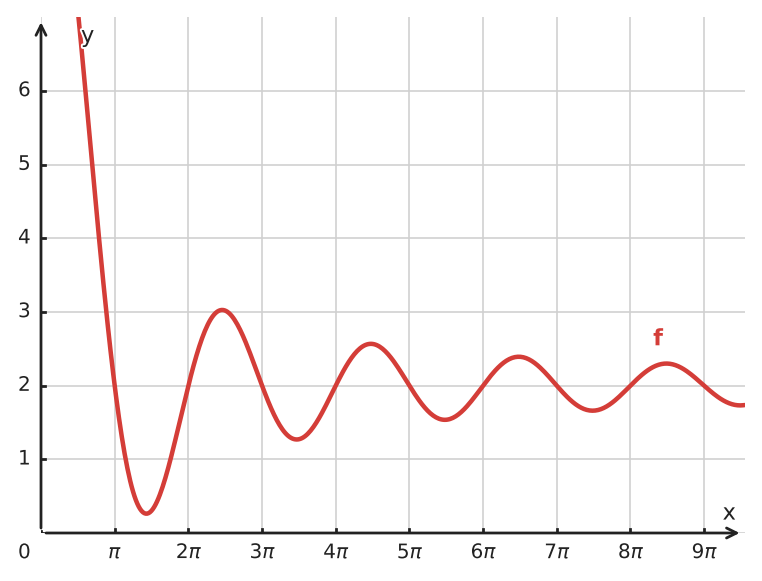
Consider \(f(x)=2+\frac{8\sin(x)}{x}\) for \(x>0\). Analyze the end behavior as \(x\to\infty\) and identify the horizontal asymptote. Support your answer using both the graph and a limit argument based on the range of the sine function.
Figure for problem 534551

Hints

- Use the fact that \(-1\le\sin(x)\le1\). - Create upper and lower bounds for \(\frac{8\sin(x)}{x}\). - Apply the Squeeze Theorem, then add the constant \(2\).

Solution

1. The graph oscillates around \(y=2\), and the size of the oscillations decreases as \(x\) increases. 2. Since \(-1\le\sin(x)\le1\), for \(x>0\) we have \(-\frac{8}{x}\le\frac{8\sin(x)}{x}\le\frac{8}{x}\). 3. Both bounding functions approach \(0\) as \(x\to\infty\). By the Squeeze Theorem, \(\lim_{x\to\infty}\frac{8\sin(x)}{x}=0\). 4. Therefore, \(\lim_{x\to\infty}f(x)=2\), and the horizontal asymptote is \(y=2\).

Answer

\(\lim_{x\to\infty}f(x)=2\), and the horizontal asymptote is \(y=2\).
54256412
Near \(x=1\), a function \(p\) satisfies \(|p(x)|\le3|x-1|^2\). Find a positive radius \(r\) such that every \(x\) with \(0<|x-1|<r\) is guaranteed to satisfy \(|p(x)|<0.03\). Use the bounding inequality rather than a formula for \(p\).

Hints

- Make the known upper bound smaller than the required output tolerance. - Solve the resulting inequality for the distance \(|x-1|\). - Any smaller positive radius would also work.

Solution

1. It is enough to make the upper bound satisfy \(3|x-1|^2<0.03\). 2. Dividing by \(3\) gives \(|x-1|^2<0.01\), so \(|x-1|<0.1\) is sufficient. 3. Therefore \(r=0.1\) guarantees \(|p(x)|<0.03\).

Answer

\(r=0.1\) works.
54256712
Suppose \(\lim_{x\to a}u(x)=0\) and \(|v(x)|\le4\) for all \(x\) sufficiently close to \(a\). Use the Squeeze Theorem to show that \(\lim_{x\to a}u(x)v(x)=0\).

Hints

- Convert the bound on \(v\) into a bound on the absolute value of the product. - Use the factor whose limit is known to be zero as the shrinking envelope. - Turn the absolute-value estimate into a two-sided squeeze.

Solution

1. The bound on \(v\) gives \(|u(x)v(x)|=|u(x)||v(x)|\le4|u(x)|\). 2. Since \(u(x)\to0\), we have \(4|u(x)|\to0\). 3. Thus \(-4|u(x)|\le u(x)v(x)\le4|u(x)|\), and the Squeeze Theorem gives \(u(x)v(x)\to0\).

Answer

\(\lim_{x\to a}u(x)v(x)=0\).
54256812
Near \(x=3\), a function \(f\) satisfies \(|f(x)-2x|\le(x-3)^2\). Use the Squeeze Theorem to determine \(\lim_{x\to3}f(x)\).

Hints

- Convert the error bound around \(2x\) into lower and upper functions. - Evaluate both bounding limits at the target input. - The center of the squeeze can itself vary with \(x\).

Solution

1. The inequality gives \(2x-(x-3)^2\le f(x)\le2x+(x-3)^2\). 2. As \(x\to3\), both bounds approach \(6\). 3. Therefore the Squeeze Theorem gives \(\lim_{x\to3}f(x)=6\).

Answer

\(6\).
54256912
To evaluate \(\lim_{x\to0^-}x\sin\left(\frac{1}{x}\right)\), a student starts with \(-1\le\sin\left(\frac{1}{x}\right)\le1\) and writes \(-x\le x\sin\left(\frac{1}{x}\right)\le x\). Explain the inequality error, write the correct squeeze for \(x<0\), and find the limit.

Hints

- Check the sign of the quantity used to multiply the original inequality. - Reorder the resulting expressions from least to greatest. - Evaluate the two outer limits from the specified one-sided direction.

Solution

1. For \(x<0\), multiplying an inequality by \(x\) reverses both inequality signs. 2. The correct ordering is \(x\le x\sin\left(\frac{1}{x}\right)\le -x\). 3. As \(x\to0^-\), both \(x\) and \(-x\) approach \(0\). The Squeeze Theorem therefore gives the limit \(0\).

Answer

The student failed to reverse the inequality signs when multiplying by negative \(x\). The correct squeeze is \(x\le x\sin\left(\frac{1}{x}\right)\le -x\), so the limit is \(0\).
54266212
For \(0<|x|<\frac{\pi}{2}\), suppose \(\cos x\le\frac{\sin x}{x}\le1\). Use the Squeeze Theorem to establish \(\lim_{x\to0}\frac{\sin x}{x}\). Angles are measured in radians.

Hints

- Identify the lower and upper bounding functions. - Evaluate each bound as \(x\to0\). - Use the common limiting value in the Squeeze Theorem.

Solution

1. The inequality places \(\frac{\sin x}{x}\) between \(\cos x\) and \(1\) for all sufficiently small nonzero \(x\). 2. As \(x\to0\), \(\cos x\to1\). 3. The upper bound is the constant \(1\), whose limit is also \(1\). 4. Because both bounds tend to \(1\), the Squeeze Theorem gives \(\lim_{x\to0}\frac{\sin x}{x}=1\).

Answer

\(\lim_{x\to0}\frac{\sin x}{x}=1\).
54257212
For every positive integer \(n\), a function \(F\) satisfies \(-\frac{1}{n}\le F\left(\frac{1}{n}\right)\le\frac{1}{n}\). A student claims the Squeeze Theorem proves \(\lim_{x\to0}F(x)=0\). Is that conclusion justified? Explain what hypothesis is missing.

Hints

- Check where the stated inequality is guaranteed to hold. - A limit concerns all sufficiently nearby inputs, not only one sequence of inputs. - Consider how the function could behave at nearby points not listed by the condition.

Solution

1. The inequality controls \(F\) only at the discrete inputs \(x=1/n\), not at all inputs sufficiently close to \(0\). 2. The Squeeze Theorem requires a neighborhood-wise inequality around the approach point, apart from the point itself if necessary. 3. For example, a function could satisfy \(F(1/n)=0\) for every \(n\) but equal \(1\) at other nearby inputs, so the given information does not force \(\lim_{x\to0}F(x)=0\).

Answer

No. The bounds hold only on the sequence \(x=1/n\), not throughout a punctured neighborhood of \(0\), so the Squeeze Theorem does not apply to the full limit.

All problems may be used, copied and printed free of charge for school and tutoring, including paid tutoring. Commercial adaptations as well as publication or redistribution on the internet are not permitted.