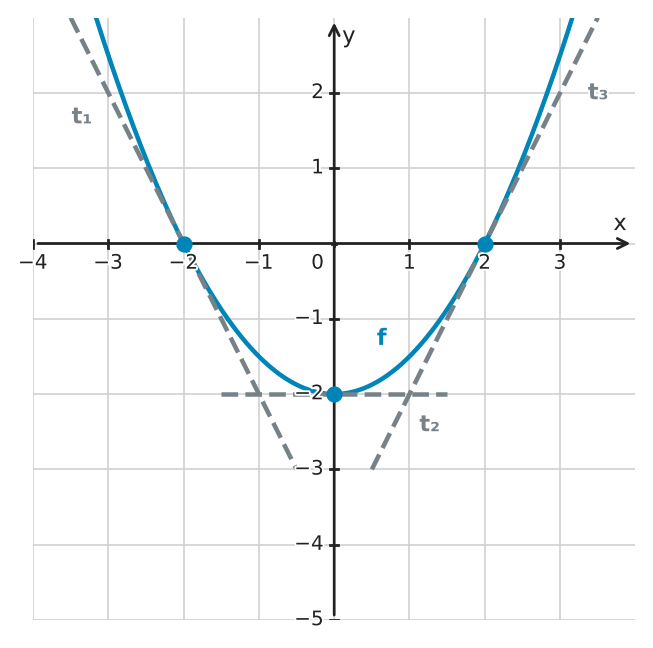
The graph of a quadratic function \(f\) is shown with tangent lines \(t_1\), \(t_2\), and \(t_3\) at \(x_1=-2\), \(x_2=0\), and \(x_3=2\).
a) Read the slopes \(m_1\), \(m_2\), and \(m_3\) from the tangent lines.
b) A point \(Q(x,y)\) on the derivative graph has the tangent slope of \(f\) at \(x\) as its y-coordinate. Give the coordinates of \(Q_1\), \(Q_2\), and \(Q_3\).
c) What type of function do you expect \(f^{\prime}\) to be: constant, linear, quadratic, or another type? Justify your answer.
Hints
- Use rise over run to find each tangent-line slope.
- The y-coordinate on the derivative graph equals the tangent slope at that input.
- Plot the three derivative points mentally and identify their pattern.
- Recall the degree of the derivative of a quadratic polynomial.
Solution
1. At \(x=-2\), tangent line \(t_1\) falls \(2\) units for each unit to the right, so \(m_1=-2\). At \(x=0\), tangent line \(t_2\) is horizontal, so \(m_2=0\). At \(x=2\), tangent line \(t_3\) rises \(2\) units for each unit to the right, so \(m_3=2\).
2. The corresponding derivative points are \(Q_1(-2,-2)\), \(Q_2(0,0)\), and \(Q_3(2,2)\).
3. These three points lie on a line through the origin. Also, the derivative of a quadratic function is linear. Therefore, \(f^{\prime}\) is a linear function.
Answer
a) \(m_1=-2\), \(m_2=0\), and \(m_3=2\)
b) \(Q_1(-2,-2)\), \(Q_2(0,0)\), and \(Q_3(2,2)\)
c) \(f^{\prime}\) is linear.