Aimathic
Login | English | Deutsch

Free math worksheets

Build your own math worksheets from 30,000+ problems for grades 3 to 12, from fractions to AP Calculus. Every problem comes with step-by-step solutions.

Derivatives of sine, cosine, exponential, and logarithmic functions

Click problems to add them to your worksheet.

55178312
Complete both derivative formulas. a) If \(f(x)=\sin x\), then \(f'(x)=\ ?\) b) If \(g(x)=\cos x\), then \(g'(x)=\ ?\)

Hints

- Recall the basic derivative pair for sine and cosine. - Pay attention to which formula carries a negative sign.

Solution

1. The derivative of \(\sin x\) is \(\cos x\). 2. The derivative of \(\cos x\) is \(-\sin x\).

Answer

a) \(f'(x)=\cos x\) b) \(g'(x)=-\sin x\)
55178412
Let \(f(x)=e^x\) and \(g(x)=\ln x\). a) Find \(f'(0)\). b) Find \(g'(1)\).

Hints

- Use the basic derivative formula for the natural exponential function. - Use the basic derivative formula for the natural logarithm on its positive domain. - Evaluate the derivative formulas at the requested inputs.

Solution

1. Since \(f'(x)=e^x\), \(f'(0)=e^0=1\). 2. Since \(g'(x)=\frac{1}{x}\), \(g'(1)=1\).

Answer

a) \(f'(0)=1\) b) \(g'(1)=1\)
52555512
Let \(f(x)=2x^2-4\cos x+\frac{2}{\pi}x\). Find \(f'(x)\), and evaluate \(f'(\pi)\) exactly.

Hints

- Differentiate each term separately. - Recall the derivative of cosine. - Use the exact value of \(\sin\pi\). - Keep the final result exact.

Solution

1. Differentiate each term: \(f'(x)=4x+4\sin x+\frac{2}{\pi}\). 2. Evaluate at \(x=\pi\): \(f'(\pi)=4\pi+4\sin\pi+\frac{2}{\pi}\). Since \(\sin\pi=0\), \(f'(\pi)=4\pi+\frac{2}{\pi}\).

Answer

\(f'(x)=4x+4\sin x+\frac{2}{\pi}\); \(f'(\pi)=4\pi+\frac{2}{\pi}\)
52555612
Let \(f(x)=\frac{1}{2}\sin x-2\cos x+\frac{1}{\pi}x^2\). Find \(f'(x)\), and evaluate \(f'\left(\frac{\pi}{2}\right)\).

Hints

- Differentiate sine and cosine carefully. - Track the sign when differentiating \(-2\cos x\). - Use unit-circle values at \(\frac{\pi}{2}\). - Simplify the polynomial term after substitution.

Solution

1. Differentiate each term: \(f'(x)=\frac{1}{2}\cos x+2\sin x+\frac{2}{\pi}x\). 2. Evaluate at \(x=\frac{\pi}{2}\): \(f'\left(\frac{\pi}{2}\right)=\frac{1}{2}\cos\left(\frac{\pi}{2}\right)+2\sin\left(\frac{\pi}{2}\right)+\frac{2}{\pi}\cdot\frac{\pi}{2}\). Using \(\cos\left(\frac{\pi}{2}\right)=0\) and \(\sin\left(\frac{\pi}{2}\right)=1\), \(f'\left(\frac{\pi}{2}\right)=3\).

Answer

\(f'(x)=\frac{1}{2}\cos x+2\sin x+\frac{2}{\pi}x\); \(f'\left(\frac{\pi}{2}\right)=3\)
52556312
Find the derivative of each function. a) \(f(x)=\frac{3\sin x-\cos x}{4}\) b) \(f(x)=5x^2+3\pi\sin x\) c) \(f(x)=2(x^3-\cos x)\) d) \(f(x)=\sin(\pi)x^2-\cos x\)

Hints

- Differentiate each term separately. - Recall the derivatives of sine and cosine. - Treat numerical expressions such as \(\sin\pi\) as constants. - A constant denominator can be treated as a constant factor.

Solution

1. Apply the sum, difference, and constant multiple rules. 2. For part a, \(f'(x)=\frac{3\cos x+\sin x}{4}\). 3. For part b, \(f'(x)=10x+3\pi\cos x\). 4. For part c, \(f'(x)=2(3x^2+\sin x)=6x^2+2\sin x\). 5. Since \(\sin\pi=0\), part d simplifies to \(f(x)=-\cos x\). Therefore, \(f'(x)=\sin x\).

Answer

a) \(f'(x)=\frac{3\cos x+\sin x}{4}\) b) \(f'(x)=10x+3\pi\cos x\) c) \(f'(x)=6x^2+2\sin x\) d) \(f'(x)=\sin x\)
52556412
Find the derivative of each function. a) \(f(x)=\frac{x^4}{4}-\sqrt{2}\cos x\) b) \(f(x)=3(\sin x-4x)\) c) \(f(x)=\frac{\sin x+12}{3}\) d) \(f(x)=\cos\left(\frac{\pi}{3}\right)x^2+\sin x\)

Hints

- Track the sign when differentiating cosine. - Constant terms disappear under differentiation. - Keep constant factors. - Evaluate \(\cos\left(\frac{\pi}{3}\right)\) before differentiating.

Solution

1. For part a, \(f'(x)=x^3+\sqrt{2}\sin x\). 2. For part b, \(f'(x)=3(\cos x-4)=3\cos x-12\). 3. Rewrite part c as \(\frac{1}{3}\sin x+4\). Then \(f'(x)=\frac{1}{3}\cos x\). 4. Since \(\cos\left(\frac{\pi}{3}\right)=\frac{1}{2}\), part d is \(\frac{1}{2}x^2+\sin x\). Therefore, \(f'(x)=x+\cos x\).

Answer

a) \(f'(x)=x^3+\sqrt{2}\sin x\) b) \(f'(x)=3\cos x-12\) c) \(f'(x)=\frac{1}{3}\cos x\) d) \(f'(x)=x+\cos x\)
52559512
Match each function with its derivative. Functions: \(f(x)=2x^3-\sin x\) \(g(x)=6x^2-\cos x\) \(h(x)=12x+\sin x\) Derivatives: \(A(x)=12x+\sin x\) \(B(x)=12+\cos x\) \(C(x)=6x^2-\cos x\)

Hints

- Differentiate the polynomial and trigonometric terms separately. - Track the signs when differentiating sine and cosine. - Compare each result with the choices. - Each derivative choice is used once.

Solution

1. Differentiate \(f\): \(f'(x)=6x^2-\cos x=C(x)\). 2. Differentiate \(g\): \(g'(x)=12x+\sin x=A(x)\). 3. Differentiate \(h\): \(h'(x)=12+\cos x=B(x)\).

Answer

\(f\to C\), \(g\to A\), \(h\to B\)
52608712
Determine whether each statement about \(f(x)=e^x\) and its transformations is true or false. Briefly justify each answer. a) \(\lim_{x\to-\infty}f(x)=0\). b) The function \(g(x)=e^x+2\) has exactly one real zero. c) The tangent line to the graph of \(f\) at \(x=0\) has slope \(1\). d) The graph of \(f(x)=e^x\) has origin symmetry. e) The graph of \(h(x)=e^{x-2}\) is the graph of \(f\) shifted \(2\) units to the right.

Hints

- Think about the end behavior of the basic exponential graph. - What values can \(e^x\) take? - Recall the derivative of the natural exponential function. - What algebraic condition characterizes origin symmetry? - Compare a horizontal change inside the exponent with a vertical change outside the exponential expression.

Solution

1. As \(x\to-\infty\), \(e^x\to0\), so statement a is true. 2. Since \(e^x>0\) for every real \(x\), \(e^x+2>2\). Therefore, \(g\) has no real zeros, so statement b is false. 3. Because \(f'(x)=e^x\), the slope at \(x=0\) is \(f'(0)=e^0=1\). Statement c is true. 4. Origin symmetry would require \(f(-x)=-f(x)\), but \(e^{-x}\ne-e^x\). Statement d is false. 5. Replacing \(x\) with \(x-2\) shifts the graph \(2\) units right. Statement e is true.

Answer

a) True b) False c) True d) False e) True
52646912
Let \(f(x)=3\sin x+2\). 1. Find the slope of the tangent line at \(x=\frac{\pi}{3}\). 2. Find every input in \([0, 2\pi]\) where the tangent line is parallel to \(y=1.5x-4\).

Hints

- The derivative gives the tangent slope. - Parallel lines have equal slopes. - Set the derivative equal to \(1.5\). - Use the unit circle to solve the cosine equation.

Solution

1. Differentiate: \(f'(x)=3\cos x\). Thus, \(f'\left(\frac{\pi}{3}\right)=3\cdot\frac{1}{2}=1.5\). 2. A parallel tangent must have slope \(1.5\), so \(3\cos x=1.5\). Therefore, \(\cos x=\frac{1}{2}\). In \([0, 2\pi]\), the solutions are \(x=\frac{\pi}{3}\) and \(x=\frac{5\pi}{3}\).

Answer

1. The slope is \(1.5\). 2. \(x=\frac{\pi}{3}\) and \(x=\frac{5\pi}{3}\)
52758712
Let \(f(x)=\ln(x^5e^3)\). a) Find the maximal domain of \(f\). b) Simplify the expression using logarithm properties. c) Find \(f'(x)\).

Hints

- The argument of a logarithm must be positive. - Use the product property of logarithms. - Move an exponent in front of a logarithm. - Recall the derivative of \(\ln x\).

Solution

1. The logarithm requires \(x^5e^3>0\). Since \(e^3>0\), this is equivalent to \(x^5>0\), so \(x>0\). Therefore, \(D_f=(0, \infty)\). 2. Use the product and power properties: \(f(x)=\ln(x^5)+\ln(e^3)=5\ln x+3\). 3. Differentiate: \(f'(x)=\frac{5}{x}\).

Answer

a) \(D_f=(0, \infty)\) b) \(f(x)=5\ln x+3\) c) \(f'(x)=\frac{5}{x}\)
52759712
Let \(f(x)=\ln(5x^4)\). 1. Find the maximal domain of \(f\). 2. Use logarithm properties to rewrite the expression so that the logarithm’s argument contains neither a product nor a power. 3. Use the simplified expression to find \(f'(x)\).

Hints

- Determine when \(5x^4\) is positive. - Split the logarithm of a product into a sum. - Use absolute value when rewriting \(\ln(x^4)\) for a domain containing negative inputs. - Recall the derivative of \(\ln|x|\).

Solution

1. The logarithm requires \(5x^4>0\). Since \(x^4>0\) exactly when \(x\ne0\), \(D_f=\mathbb{R}\setminus\{0\}\). 2. Use the product and power properties, accounting for negative values of \(x\): \(f(x)=\ln5+\ln(x^4)=\ln5+4\ln|x|\). 3. Differentiate on the domain: \(f'(x)=\frac{4}{x}\).

Answer

1. \(D_f=\mathbb{R}\setminus\{0\}\) 2. \(f(x)=\ln5+4\ln|x|\) 3. \(f'(x)=\frac{4}{x}\)
52759812
Let \(g(x)=\ln\left(\frac{\sqrt{x}}{e^2}\right)\). 1. Find the maximal domain of \(g\). 2. Simplify the expression using logarithm properties. 3. Find \(g'(x)\).

Hints

- Combine the square-root and logarithm domain restrictions. - Rewrite the square root as a fractional power. - Use the quotient property of logarithms. - Recall that \(\ln(e^2)=2\).

Solution

1. The square root requires \(x\ge0\), and the logarithm’s argument must be strictly positive. Therefore, \(x>0\), so \(D_g=(0, \infty)\). 2. Use quotient and power properties: \(g(x)=\ln(\sqrt{x})-\ln(e^2)=\frac{1}{2}\ln x-2\). 3. Differentiate: \(g'(x)=\frac{1}{2x}\).

Answer

1. \(D_g=(0, \infty)\) 2. \(g(x)=\frac{1}{2}\ln x-2\) 3. \(g'(x)=\frac{1}{2x}\)
52761912
Let \(f(x)=\ln(x^2e^{3x})\), where \(x>0\). Find the simplest expression for \(f'(x)\).

Hints

- Split the logarithm of a product into a sum. - Simplify \(\ln(e^{3x})\). - Differentiate the logarithmic and linear terms separately.

Solution

1. Use logarithm properties: \(f(x)=\ln(x^2)+\ln(e^{3x})=2\ln x+3x\). 2. Differentiate: \(f'(x)=\frac{2}{x}+3\).

Answer

\(f'(x)=\frac{2}{x}+3\)
52766612
Let \(g(x)=\ln\left(\frac{e^2}{\sqrt[4]{x}}\right)\). 1. Find the maximal domain of \(g\). 2. Simplify using logarithm properties, then find \(g'(x)\).

Hints

- Combine the restrictions from the root, denominator, and logarithm. - Use the quotient property of logarithms. - Rewrite the fourth root as a fractional power. - Recall \(\ln(e^2)=2\).

Solution

1. The fourth root is in the denominator and the logarithm’s input must be positive, so \(x>0\). Thus, \(D_g=(0, \infty)\). 2. Simplify: \(g(x)=\ln(e^2)-\ln(x^{1/4})=2-\frac{1}{4}\ln x\). Differentiate: \(g'(x)=-\frac{1}{4x}\).

Answer

1. \(D_g=(0, \infty)\) 2. \(g'(x)=-\frac{1}{4x}\)
52767712
Let \(f(x)=\ln(x-2)+3\), where \(x>2\). a) Describe how the graph is obtained from the graph of \(y=\ln x\). b) Find an equation of the tangent line at \(x=3\).

Hints

- A change inside the logarithm creates a horizontal shift. - A constant outside creates a vertical shift. - Find both the function value and derivative value at \(x=3\). - Use point-slope form.

Solution

1. Replacing \(x\) by \(x-2\) shifts the logarithm graph \(2\) units to the right. Adding \(3\) shifts it \(3\) units up. 2. At \(x=3\), \(f(3)=\ln1+3=3\). Also, \(f'(x)=\frac{1}{x-2}\), so \(f'(3)=1\). The tangent line is \(y-3=x-3\), which simplifies to \(y=x\).

Answer

a) Shift the graph of \(y=\ln x\) right \(2\) units and up \(3\) units. b) \(y=x\)
52895112
Let \(f(x)=3\sin x-2\cos x\). Find the slope of the graph at \(x=0\) and at \(x=\frac{\pi}{2}\).

Hints

- Differentiate using the sum and constant multiple rules. - Recall the derivatives of sine and cosine. - Use exact unit-circle values at the two inputs. - The derivative value is the graph’s slope.

Solution

1. Differentiate: \(f'(x)=3\cos x+2\sin x\). 2. At \(x=0\), \(f'(0)=3\). 3. At \(x=\frac{\pi}{2}\), \(f'\left(\frac{\pi}{2}\right)=2\).

Answer

At \(x=0\), the slope is \(3\). At \(x=\frac{\pi}{2}\), the slope is \(2\).
52895212
Let \(h(x)=\sin x+\cos x\). At which inputs in \(\left\{0,\frac{\pi}{2},\pi,\frac{3\pi}{2}\right\}\) does the tangent line have slope \(1\)? Verify your answer algebraically.

Hints

- Differentiate first. - Substitute each candidate input into the derivative. - Use exact unit-circle values. - Select the inputs where the derivative equals \(1\).

Solution

1. Differentiate: \(h'(x)=\cos x-\sin x\). 2. Evaluate at the four inputs: \(h'(0)=1\), \(h'\left(\frac{\pi}{2}\right)=-1\), \(h'(\pi)=-1\), and \(h'\left(\frac{3\pi}{2}\right)=1\). Therefore, the tangent slope is \(1\) at \(x=0\) and \(x=\frac{3\pi}{2}\).

Answer

\(x=0\) and \(x=\frac{3\pi}{2}\)
52897612
Find \(f'(x)\) for each function. Pay close attention to signs and constant factors. a) \(f(x)=12\sin x\) b) \(f(x)=-\frac{3}{4}\cos x\)

Hints

- Recall the derivatives of sine and cosine. - A constant factor remains as a multiplier. - In part b, track both negative signs carefully.

Solution

1. For part a, use \(\frac{d}{dx}(\sin x)=\cos x\): \(f'(x)=12\cos x\). 2. For part b, use \(\frac{d}{dx}(\cos x)=-\sin x\): \(f'(x)=-\frac{3}{4}(-\sin x)=\frac{3}{4}\sin x\).

Answer

a) \(f'(x)=12\cos x\) b) \(f'(x)=\frac{3}{4}\sin x\)
53387212
Find the equation of the tangent line to \(f(x)=\sin(x)\) at \(P(0,0)\).
Figure for problem 533872

Hints

- Recall the derivative of the sine function. - Evaluate the derivative at \(x=0\). - A line through the origin has a particularly simple y-intercept.

Solution

1. The point lies on the graph because \(f(0)=\sin(0)=0\). 2. Differentiate: \(f'(x)=\cos(x)\). 3. The tangent slope is \(f'(0)=\cos(0)=1\). 4. A line through the origin with slope \(1\) has equation \(y=x\).

Answer

\(y=x\)
53423112
The functions are \(f(x) = x^2 - 3x\) and \(g(x) = 2\cos(x)\). Two of the four displayed graphs represent \(f'\) and \(g'\). Identify those graphs and justify your choices using features such as slope, symmetry, and intercepts.
Figure for problem 534231

Hints

- First differentiate both functions. - Use the slope and intercepts to identify the linear graph. - Use the value and direction near \(x = 0\) to distinguish \(-2\sin x\) from \(2\sin x\).

Solution

1. Differentiate: \(f'(x) = 2x - 3\) and \(g'(x) = -2\sin(x)\). 2. The graph of \(f'\) is a line with slope \(2\), \(y\)-intercept \(-3\), and \(x\)-intercept \(1.5\). This is graph (1). 3. The graph of \(g'\) is a sine curve with amplitude \(2\), reflected across the \(x\)-axis. It passes through the origin and is negative immediately to the right of the origin. This is graph (2).

Answer

Graph (1) represents \(f'\), and graph (2) represents \(g'\).
53459512
Let \(h(x)=3-e^{x-1}\). Find its exact \(x\)-intercept and a formula for \(h'(x)\).
Figure for problem 534595

Hints

- Set the function equal to zero and isolate the exponential expression. - Apply the natural logarithm. - Differentiate the exponential function using the chain rule.

Solution

1. Set \(h(x)=0\): \(3-e^{x-1}=0\), so \(e^{x-1}=3\). 2. Taking natural logarithms gives \(x-1=\ln(3)\), so the \(x\)-intercept is \((1+\ln(3), 0)\). 3. Differentiate: \(h'(x)=-e^{x-1}\).

Answer

\(x\)-intercept: \((1+\ln(3), 0)\); \(h'(x)=-e^{x-1}\)
52557312
Let \(f(x)=\cos x\). Find all points on the graph where the tangent line is a) parallel to \(y=-\frac{1}{2}x+5\), b) perpendicular to \(y=x\).

Hints

- The derivative gives the tangent slope. - Parallel lines have equal slopes; perpendicular nonvertical lines have slopes whose product is \(-1\). - Use unit-circle values and periodicity. - Substitute each x-coordinate into the original function.

Solution

1. The derivative is \(f'(x)=-\sin x\). 2. In part a, a parallel tangent must have slope \(-\frac{1}{2}\). Thus, \(-\sin x=-\frac{1}{2}\), so \(\sin x=\frac{1}{2}\). The solutions are \(x=\frac{\pi}{6}+2k\pi\) or \(x=\frac{5\pi}{6}+2k\pi\), where \(k\in\mathbb{Z}\). The corresponding y-coordinates are \(\frac{\sqrt{3}}{2}\) and \(-\frac{\sqrt{3}}{2}\). 3. In part b, a line perpendicular to \(y=x\) has slope \(-1\). Thus, \(-\sin x=-1\), so \(\sin x=1\). Therefore, \(x=\frac{\pi}{2}+2k\pi\), and the y-coordinate is \(0\).

Answer

a) \(\left(\frac{\pi}{6}+2k\pi, \frac{\sqrt{3}}{2}\right)\) and \(\left(\frac{5\pi}{6}+2k\pi, -\frac{\sqrt{3}}{2}\right)\), where \(k\in\mathbb{Z}\) b) \(\left(\frac{\pi}{2}+2k\pi, 0\right)\), where \(k\in\mathbb{Z}\)
52557412
The graph of \(g(x)=2\sin x\) has slope \(\sqrt{2}\) at infinitely many points. Find the coordinates of all such points.

Hints

- Differentiate using the constant multiple rule. - Set the derivative equal to the given slope. - Use the unit circle and periodicity to solve the trigonometric equation. - Substitute the inputs into the original function for the y-coordinates.

Solution

1. Differentiate: \(g'(x)=2\cos x\). 2. Set the derivative equal to the required slope: \(2\cos x=\sqrt{2}\), so \(\cos x=\frac{\sqrt{2}}{2}\). Therefore, \(x=\frac{\pi}{4}+2k\pi\) or \(x=-\frac{\pi}{4}+2k\pi\), where \(k\in\mathbb{Z}\). 3. Evaluate \(g\): \(g\left(\frac{\pi}{4}\right)=\sqrt{2}\) and \(g\left(-\frac{\pi}{4}\right)=-\sqrt{2}\).

Answer

\(\left(\frac{\pi}{4}+2k\pi, \sqrt{2}\right)\) and \(\left(-\frac{\pi}{4}+2k\pi, -\sqrt{2}\right)\), where \(k\in\mathbb{Z}\)
52557512
Find the equation of the tangent line to the graph of \(f(x)=\sin x\) at \(P=\left(\frac{2\pi}{3}, \frac{\sqrt{3}}{2}\right)\).

Hints

- The derivative gives the tangent slope. - Use the exact cosine value at \(\frac{2\pi}{3}\). - Write the line in point-slope form. - Keep all angle measures in radians.

Solution

1. Differentiate: \(f'(x)=\cos x\). 2. The tangent slope is \(m=f'\left(\frac{2\pi}{3}\right)=\cos\left(\frac{2\pi}{3}\right)=-\frac{1}{2}\). 3. Use point-slope form: \(y-\frac{\sqrt{3}}{2}=-\frac{1}{2}\left(x-\frac{2\pi}{3}\right)\). Simplifying gives \(y=-\frac{1}{2}x+\frac{\pi}{3}+\frac{\sqrt{3}}{2}\).

Answer

\(y=-\frac{1}{2}x+\frac{\pi}{3}+\frac{\sqrt{3}}{2}\)
52557612
Let \(g(x)=2\cos x\). Find the equation of the tangent line to the graph at \(x_0=\frac{\pi}{6}\).

Hints

- Evaluate the function to find the point of tangency. - Differentiate using the constant multiple rule. - Use the exact sine and cosine values at \(\frac{\pi}{6}\). - Write the tangent line in point-slope form.

Solution

1. Find the point of tangency: \(g\left(\frac{\pi}{6}\right)=2\cos\left(\frac{\pi}{6}\right)=\sqrt{3}\). 2. Differentiate: \(g'(x)=-2\sin x\). The tangent slope is \(g'\left(\frac{\pi}{6}\right)=-2\cdot\frac{1}{2}=-1\). 3. Use point-slope form: \(y-\sqrt{3}=-\left(x-\frac{\pi}{6}\right)\). Therefore, \(y=-x+\frac{\pi}{6}+\sqrt{3}\).

Answer

\(y=-x+\frac{\pi}{6}+\sqrt{3}\)
52560712
Let \(f(x)=\cos x-2\sin x\). Find the equation of the tangent line at \(P=\left(\frac{\pi}{2}, f\left(\frac{\pi}{2}\right)\right)\). Also find the angle of inclination of the tangent line.

Hints

- Evaluate the function and derivative at the given input. - Use point-slope form for the tangent line. - The derivative value is the tangent slope. - Choose the angle of inclination in the interval \([0^\circ, 180^\circ)\).

Solution

1. Evaluate the function: \(f\left(\frac{\pi}{2}\right)=0-2=-2\). Thus, the point is \(\left(\frac{\pi}{2}, -2\right)\). 2. Differentiate: \(f'(x)=-\sin x-2\cos x\). The tangent slope is \(f'\left(\frac{\pi}{2}\right)=-1\). 3. Use point-slope form: \(y+2=-\left(x-\frac{\pi}{2}\right)\). Therefore, \(y=-x+\frac{\pi}{2}-2\). 4. The angle of inclination is measured counterclockwise from the positive x-axis and satisfies \(\tan\alpha=-1\). Thus, \(\alpha=135^\circ\).

Answer

Tangent line: \(y=-x+\frac{\pi}{2}-2\) Angle of inclination: \(135^\circ\)
52560912
Let \(f(x)=2\sin x\) and \(g(x)=2\cos x\). a) Find the intersection point \(S\) of the graphs on \([0, \pi]\). b) Find the angles of inclination \(\alpha\) and \(\beta\) of the tangent lines to the graphs of \(f\) and \(g\), respectively, at \(S\). c) Find the smaller angle \(\gamma\) at which the graphs intersect at \(S\).

Hints

- Set the two function values equal to find the intersection. - Use the derivatives to find the tangent slopes. - Convert each slope to an inclination angle in \([0^\circ, 180^\circ)\). - The smaller intersection angle is the acute difference between the inclination angles.

Solution

1. At an intersection, \(2\sin x=2\cos x\). On \([0, \pi]\), this gives \(x=\frac{\pi}{4}\). The y-coordinate is \(2\sin\left(\frac{\pi}{4}\right)=\sqrt{2}\). Thus, \(S=\left(\frac{\pi}{4}, \sqrt{2}\right)\). 2. The derivatives are \(f'(x)=2\cos x\) and \(g'(x)=-2\sin x\). At \(S\), the slopes are \(m_f=\sqrt{2}\) and \(m_g=-\sqrt{2}\). Therefore, \(\alpha=\arctan(\sqrt{2})\approx 54.74^\circ\) and \(\beta=180^\circ-54.74^\circ\approx 125.26^\circ\). 3. The smaller intersection angle is \(\gamma=\beta-\alpha\approx 70.53^\circ\). Equivalently, \(\tan\gamma=\left|\frac{m_f-m_g}{1+m_fm_g}\right|=2\sqrt{2}\).

Answer

a) \(S=\left(\frac{\pi}{4}, \sqrt{2}\right)\) b) \(\alpha\approx 54.74^\circ\); \(\beta\approx 125.26^\circ\) c) \(\gamma\approx 70.53^\circ\)
52561512
Let \(f(x)=\sin x+\cos x\). Find the equation of the tangent line at \(x_0=\frac{\pi}{2}\). Also find its angle of inclination.

Hints

- Evaluate the function and derivative at the given input. - Use point-slope form. - Relate the derivative value to the tangent slope. - Give the inclination angle in \([0^\circ, 180^\circ)\).

Solution

1. The point of tangency is \(\left(\frac{\pi}{2}, 1\right)\). 2. Differentiate: \(f'(x)=\cos x-\sin x\). The slope at \(x=\frac{\pi}{2}\) is \(-1\). 3. Use point-slope form: \(y-1=-\left(x-\frac{\pi}{2}\right)\). Therefore, \(y=-x+\frac{\pi}{2}+1\). 4. Since the slope is \(-1\), the angle of inclination is \(135^\circ\).

Answer

Tangent line: \(y=-x+\frac{\pi}{2}+1\) Angle of inclination: \(135^\circ\)
52561612
Let \(g(x)=2\cos x+1\). Find the equation of the tangent line at \(P=\left(\frac{2\pi}{3}, g\left(\frac{2\pi}{3}\right)\right)\). Then find its angle of inclination.

Hints

- Evaluate the function to find the point. - Differentiate cosine and keep the constant factor. - Use point-slope form for the tangent line. - A slope of \(-\sqrt{3}\) has an inclination angle in the second quadrant.

Solution

1. Evaluate the function: \(g\left(\frac{2\pi}{3}\right)=2\cdot\left(-\frac{1}{2}\right)+1=0\). Thus, the point is \(\left(\frac{2\pi}{3}, 0\right)\). 2. Differentiate: \(g'(x)=-2\sin x\). The tangent slope is \(g'\left(\frac{2\pi}{3}\right)=-\sqrt{3}\). 3. Use point-slope form: \(y=-\sqrt{3}\left(x-\frac{2\pi}{3}\right)\). Therefore, \(y=-\sqrt{3}x+\frac{2\pi\sqrt{3}}{3}\). 4. The standard angle of inclination in \([0^\circ, 180^\circ)\) is \(120^\circ\).

Answer

Tangent line: \(y=-\sqrt{3}x+\frac{2\pi\sqrt{3}}{3}\) Angle of inclination: \(120^\circ\)
52562712
Let \(f(x)=2\cos x+x\). Find equations for the tangent line and the normal line to the graph at \(P=(\pi, f(\pi))\).

Hints

- Evaluate the function at the given input. - Use the derivative to find the tangent slope. - The normal slope is the negative reciprocal of the tangent slope. - Write both lines in point-slope form.

Solution

1. Find the point: \(f(\pi)=2\cos\pi+\pi=\pi-2\). Thus, \(P=(\pi, \pi-2)\). 2. Differentiate: \(f'(x)=-2\sin x+1\). The tangent slope is \(f'(\pi)=1\). Therefore, the tangent line is \(y-(\pi-2)=x-\pi\), or \(y=x-2\). 3. The normal slope is \(-1\). Thus, \(y-(\pi-2)=-(x-\pi)\), or \(y=-x+2\pi-2\).

Answer

Tangent line: \(y=x-2\) Normal line: \(y=-x+2\pi-2\)
52562812
Let \(f(x)=\sin x-\cos x\). Find equations for the tangent line and the normal line to the graph at \(P=\left(\frac{\pi}{2}, f\left(\frac{\pi}{2}\right)\right)\).

Hints

- Evaluate the function to locate the point. - Differentiate sine and cosine carefully. - Use the derivative value as the tangent slope. - Use the negative reciprocal for the normal slope.

Solution

1. Evaluate the function: \(f\left(\frac{\pi}{2}\right)=1\). Thus, the point is \(\left(\frac{\pi}{2}, 1\right)\). 2. Differentiate: \(f'(x)=\cos x+\sin x\). The tangent slope is \(f'\left(\frac{\pi}{2}\right)=1\). Therefore, the tangent line is \(y-1=x-\frac{\pi}{2}\), or \(y=x-\frac{\pi}{2}+1\). 3. The normal slope is \(-1\). Thus, \(y-1=-\left(x-\frac{\pi}{2}\right)\), or \(y=-x+\frac{\pi}{2}+1\).

Answer

Tangent line: \(y=x-\frac{\pi}{2}+1\) Normal line: \(y=-x+\frac{\pi}{2}+1\)
52603512
Let \(f(x)=e^x\). a) Find an equation of the tangent line to the graph of \(f\) at \(x=0\). b) Show that the tangent line to the graph of \(f\) at \(x=1\) passes through the origin. c) Use the derivative function \(f'\) to explain what makes the base \(e\) different from other exponential bases, such as \(2\).

Hints

- What is the point-slope formula for a tangent line at \(x=x_0\)? - What form does an equation of a line through the origin have? - Recall the derivative rule for \(a^x\). - Compare the slope of \(e^x\) at each point with the function value there.

Solution

1. Since \(f(0)=e^0=1\) and \(f'(x)=e^x\), the slope at \(x=0\) is \(f'(0)=1\). Using point-slope form, \(y-1=1(x-0)\), so the tangent line is \(y=x+1\). 2. At \(x=1\), \(f(1)=e\) and \(f'(1)=e\). The tangent line is \(y-e=e(x-1)\), which simplifies to \(y=ex\). Because this line contains \((0, 0)\), it passes through the origin. 3. For \(f(x)=e^x\), the derivative is the function itself: \(f'(x)=e^x=f(x)\). For a different base, \(a^x\), the derivative is \(\ln(a)a^x\). Only when \(a=e\) is the factor \(\ln(a)\) equal to \(1\).

Answer

a) \(y=x+1\) b) The tangent line is \(y=ex\), so it passes through \((0, 0)\). c) The base \(e\) is the unique positive base for which the derivative of \(e^x\) equals \(e^x\) itself.
52603612
For an exponential function \(h_a(x)=a^x\), the instantaneous rate of change at \(x=0\) depends on the base \(a\). a) Approximate the slopes of \(h_2(x)=2^x\) and \(h_3(x)=3^x\) at \(x=0\) by evaluating the difference quotient \(\frac{a^h-1}{h}\) with \(h=0.0001\). b) The number \(e\approx2.71828\) is the base for which this slope is exactly \(1\). Explain why this property makes it easier to differentiate a function such as \(f(x)=e^{2x+5}\).

Hints

- Substitute each value of \(a\) and the given value of \(h\) carefully into the difference quotient. - Compare both approximate slopes with \(1\). - Recall the derivative rule for \(a^x\) and consider what happens when \(\ln(a)=1\). - Which differentiation rule applies to \(e^{2x+5}\)?

Solution

1. For \(a=2\), \(\frac{2^{0.0001}-1}{0.0001}\approx0.6932\). 2. For \(a=3\), \(\frac{3^{0.0001}-1}{0.0001}\approx1.0987\). 3. In general, \(\frac{d}{dx}a^x=\ln(a)a^x\). Because \(\ln(e)=1\), differentiating an exponential with base \(e\) does not introduce an additional base-dependent factor. Applying the chain rule gives \(f'(x)=2e^{2x+5}\).

Answer

a) For base \(2\), the slope is approximately \(0.6932\). For base \(3\), the slope is approximately \(1.0987\). b) Since \(\frac{d}{dx}e^x=e^x\), only the derivative of the exponent contributes an additional factor. Thus, \(f'(x)=2e^{2x+5}\).
52606412
Consider \(f(x)=e^x\) and \(g(x)=e^{-x}\). Determine whether each statement about their graphs is true or false. Briefly justify each answer. 1. The graphs of \(f\) and \(g\) intersect at \((0, 1)\). 2. The graph of \(g\) is the reflection of the graph of \(f\) across the x-axis. 3. There is an x-value at which the two graphs have the same slope. 4. The function \(h(x)=f(x)g(x)\) is a horizontal line. 5. As \(x\to\infty\), both graphs approach the x-axis.

Hints

- Substitute a convenient x-value to check the proposed intersection. - What graph transformation is represented by replacing \(x\) with \(-x\)? - Compare the signs of the derivatives of the two functions. - Use exponent rules to simplify the product of the function expressions. - Distinguish between behavior as \(x\to\infty\) and as \(x\to-\infty\).

Solution

1. Since \(f(0)=e^0=1\) and \(g(0)=e^{-0}=1\), both graphs contain \((0, 1)\). Statement 1 is true. 2. Because \(g(x)=f(-x)\), the graph of \(g\) is the reflection of the graph of \(f\) across the y-axis, not the x-axis. Statement 2 is false. 3. The derivatives are \(f'(x)=e^x>0\) and \(g'(x)=-e^{-x}<0\) for every real \(x\). Their slopes can never be equal. Statement 3 is false. 4. Using exponent rules, \(h(x)=e^xe^{-x}=e^0=1\). The graph of \(h(x)=1\) is horizontal. Statement 4 is true. 5. As \(x\to\infty\), \(e^x\to\infty\), while \(e^{-x}\to0\). Only the graph of \(g\) approaches the x-axis. Statement 5 is false.

Answer

1. True 2. False 3. False 4. True 5. False
52608012
Let \(f(x)=10e^x+x^2\). Find the equation of the tangent line to the graph of \(f\) at \((-1, f(-1))\). Give the coefficients exactly. Then find the tangent line’s angle of inclination to the nearest tenth of a degree.

Hints

- Find both \(f(-1)\) and \(f'(-1)\). - Use point-slope form for the tangent line. - Keep \(e\) symbolic in the exact equation. - Use the inverse tangent of the slope to find the angle.

Solution

1. Find the point of tangency: \(f(-1)=10e^{-1}+1=\frac{10}{e}+1\). 2. Differentiate: \(f'(x)=10e^x+2x\). The slope at \(x=-1\) is \(m=f'(-1)=\frac{10}{e}-2\). 3. Use point-slope form: \(y-\left(\frac{10}{e}+1\right)=\left(\frac{10}{e}-2\right)(x+1)\). Simplifying gives \(y=\left(\frac{10}{e}-2\right)x+\frac{20}{e}-1\). 4. The angle of inclination satisfies \(\tan\theta=m\). Therefore, \(\theta=\arctan\left(\frac{10}{e}-2\right)\approx 59.2^\circ\).

Answer

Tangent line: \(y=\left(\frac{10}{e}-2\right)x+\frac{20}{e}-1\) Angle of inclination: \(\theta\approx 59.2^\circ\)
52608812
Determine whether each statement about \(f(x)=e^x\), \(q(x)=\ln x\), and simple transformations is true or false. Briefly justify each answer. a) If \(g(x)=3e^x\), then \(g'(x)=3e^x\). b) The graph of \(h(x)=e^x-1\) passes through the origin. c) Because \(f'(x)=e^x\) is positive for every real \(x\), \(f\) is strictly increasing. d) For \(x>0\), the derivative of \(q(x)=\ln x\) is \(q'(x)=\ln x\). e) The range of \(k(x)=e^x-5\) is \(\{y\in\mathbb{R}\mid y>-5\}\).

Hints

- Use the basic derivative formulas for \(e^x\) and \(\ln x\). - Check a claimed intercept by substitution. - Connect a positive first derivative with increasing behavior. - Treat a vertical translation as a change in output values, not in derivative structure.

Solution

1. The constant-multiple rule gives \(g'(x)=3e^x\), so statement a is true. 2. Since \(h(0)=e^0-1=0\), the graph contains \((0,0)\). Statement b is true. 3. Since \(f'(x)=e^x>0\) for every real \(x\), \(f\) is strictly increasing. Statement c is true. 4. For \(x>0\), \(q'(x)=\frac{1}{x}\), not \(\ln x\). Statement d is false. 5. The range of \(e^x\) is \((0,\infty)\). Shifting down \(5\) units gives \((-5,\infty)\). Statement e is true.

Answer

a) True b) True c) True d) False e) True
52611712
Consider the family of functions \(f_k(x)=ke^x-x\), where \(k\in\mathbb{R}\setminus\{0\}\). a) Find \(f_k'(x)\). b) The tangent line at \(x=0\) passes through \((2, 5)\). Find \(k\).

Hints

- Use the point-slope form of a tangent line. - Find both the function value and derivative value at \(x=0\). - A point on the tangent line must satisfy its equation. - Express the tangent slope and y-intercept in terms of \(k\).

Solution

1. Differentiate: \(f_k'(x)=ke^x-1\). 2. At \(x=0\), \(f_k(0)=k\) and \(f_k'(0)=k-1\). 3. The tangent line is \(y=(k-1)x+k\). 4. Substitute \((2, 5)\): \(5=2(k-1)+k\). 5. Solve \(5=3k-2\) to obtain \(k=\frac{7}{3}\).

Answer

a) \(f_k'(x)=ke^x-1\) b) \(k=\frac{7}{3}\)
52613112
Consider the family of functions \(f_k(x)=ke^{2x}-4\), where \(k\in\mathbb{R}\setminus\{0\}\). a) Show that \(f_k''(0)=4k\). b) Find all values of \(k\) for which the tangent line at \((0,f_k(0))\) has negative slope and crosses the x-axis at an x-coordinate less than \(-1\).

Hints

- Use the chain rule for an exponential function with \(2x\) in the exponent. - Write the tangent equation at \(x=0\). - Negative slope gives a sign condition on \(k\). - Reverse an inequality when multiplying by a negative quantity. - Set the tangent equation equal to \(0\) to find its x-intercept.

Solution

1. Differentiate twice: \(f_k'(x)=2ke^{2x}\) and \(f_k''(x)=4ke^{2x}\). Therefore, \(f_k''(0)=4k\). 2. At \(x=0\), the point is \((0, k-4)\) and the slope is \(2k\). The tangent line is \(y=2kx+k-4\). 3. Negative slope requires \(k<0\). 4. The x-intercept is \(x=\frac{4-k}{2k}\). Require \(\frac{4-k}{2k}<-1\). 5. Because \(2k<0\), multiplying reverses the inequality: \(4-k>-2k\), so \(k>-4\). 6. Combining the conditions gives \(-4<k<0\).

Answer

a) \(f_k''(0)=4k\) b) \(-4<k<0\)
52643312
The graph of an exponential function \(f(x)=ba^x\) passes through \(P(1, 45)\) and \(Q(2, 135)\). a) Decide whether \(f\) represents exponential growth or exponential decay. Justify your answer using the coordinates. b) Find the growth factor \(a\) and the initial value \(b\). c) Rewrite the function in the form \(f(x)=be^{kx}\). Then find \(f'(x)\) and the slope of the graph at \(x=0\).

Hints

- Compare the outputs as the x-values increase. - For consecutive x-values, how is the ratio of the outputs related to the base? - Substitute one point after finding \(a\) to determine \(b\). - Use \(a=e^{\ln(a)}\) to rewrite the function. - Apply the chain rule to differentiate \(e^{kx}\).

Solution

1. The function value increases from \(45\) at \(x=1\) to \(135\) at \(x=2\), so the function represents exponential growth. 2. Increasing \(x\) by \(1\) multiplies the output by \(a\). Therefore, \(a=\frac{135}{45}=3\). 3. Substitute \((1, 45)\): \(45=b\cdot3\), so \(b=15\). Thus, \(f(x)=15\cdot3^x\). 4. Since \(3=e^{\ln(3)}\), \(f(x)=15e^{x\ln(3)}\). 5. Differentiate: \(f'(x)=15\ln(3)e^{x\ln(3)}\). Therefore, \(f'(0)=15\ln(3)\approx16.48\).

Answer

a) Exponential growth, because \(135>45\). b) \(a=3\) and \(b=15\) c) \(f(x)=15e^{x\ln(3)}\); \(f'(x)=15\ln(3)e^{x\ln(3)}\); \(f'(0)=15\ln(3)\approx16.48\)
52645412
Consider the family of functions \(f_k(x)=\sin(kx)\), where \(k>0\). Use the derivative to determine how the maximum slope changes when \(k\) is doubled. Justify your conclusion.

Hints

- The first derivative gives the slope. - What is the maximum value of the cosine function? - Express the maximum slope as a function of \(k\).

Solution

1. Apply the chain rule: \(f_k'(x)=k\cos(kx)\). 2. Since the maximum value of cosine is \(1\), the maximum value of the derivative is \(k\). Therefore, the maximum slope is \(k\). 3. Replacing \(k\) by \(2k\) changes the maximum slope from \(k\) to \(2k\). 4. Thus, doubling \(k\) doubles the maximum slope.

Answer

The maximum slope is \(k\). When \(k\) is doubled, the maximum slope doubles to \(2k\).
52657512
Let \(f(x)=e^x\) and \(g(x)=2-e^{-x}\). a) Find the intersection point of the graphs of \(f\) and \(g\). b) Show that the graphs have the same slope at their intersection. Explain what this means geometrically, and determine whether the graphs cross there. c) Determine whether there are any other values of \(x\) where the tangent lines to the two graphs at the same x-value are parallel.

Hints

- Set the two function values equal to find their intersection. - A substitution involving \(e^x\) can turn the intersection equation into a quadratic equation. - Compare both the function values and derivative values at the intersection. - Parallel lines have equal slopes.

Solution

1. Set the functions equal: \(e^x=2-e^{-x}\). Multiplying by \(e^x\) gives \(e^{2x}-2e^x+1=0\). Let \(u=e^x\). Then \((u-1)^2=0\), so \(u=1\), \(x=0\), and the intersection point is \(S(0, 1)\). 2. Differentiate: \(f'(x)=e^x\) and \(g'(x)=e^{-x}\). Thus \(f'(0)=g'(0)=1\), so the graphs share the tangent line \(y=x+1\) at \(S\). 3. To compare the graphs, \(f(x)-g(x)=e^x+e^{-x}-2\geq0\), with equality only at \(x=0\). Therefore, the graph of \(f\) stays above the graph of \(g\), and the graphs touch without crossing at \(S\). 4. At the same x-value, parallel tangent lines require \(f'(x)=g'(x)\). Solving \(e^x=e^{-x}\) gives \(e^{2x}=1\), so \(x=0\) is the only solution.

Answer

a) \(S(0, 1)\) b) \(f'(0)=g'(0)=1\). The graphs share the tangent line \(y=x+1\), and \(f(x)\geq g(x)\) with equality only at \(x=0\), so they do not cross. c) No. At the same x-value, the tangent lines are parallel only when \(x=0\).
52759912
Let \(f(x)=\ln x\), where \(x>0\). a) Find an equation of the tangent line to the graph of \(f\) at \(x_0=e^2\). b) A tangent line to the graph passes through the origin. Find the point of tangency and the tangent-line equation. c) Another tangent touches the graph at \(x_1=\sqrt{e}\). Find the x-intercept of this tangent line.

Hints

- Write the tangent line at a general input \(u\). - A line through the origin has y-intercept \(0\). - The tangent slope is the derivative value at the point of tangency. - Use logarithm properties for powers of \(e\).

Solution

1. Differentiate: \(f'(x)=\frac{1}{x}\). 2. At \(x_0=e^2\), \(f(e^2)=2\) and \(f'(e^2)=\frac{1}{e^2}\). Therefore, \(y=\frac{1}{e^2}(x-e^2)+2=\frac{x}{e^2}+1\). 3. The tangent line at a general input \(u>0\) is \(y=\frac{1}{u}(x-u)+\ln u=\frac{x}{u}+\ln u-1\). For this line to pass through the origin, \(\ln u-1=0\), so \(u=e\). The point of tangency is \((e, 1)\), and the tangent line is \(y=\frac{x}{e}\). 4. At \(x_1=\sqrt{e}\), the tangent line is \(y=\frac{x}{\sqrt{e}}-\frac{1}{2}\). Setting \(y=0\) gives the x-intercept \(x=\frac{\sqrt{e}}{2}\).

Answer

a) \(y=\frac{x}{e^2}+1\) b) Point of tangency: \((e, 1)\); tangent line: \(y=\frac{x}{e}\) c) x-intercept: \(x=\frac{\sqrt{e}}{2}\)
52760012
Let \(f(x)=\ln x\). a) Find the tangent line to the graph of \(f\) that is parallel to \(y=x\). b) A tangent line to the graph passes through \(A(0, -2)\). Find its equation. c) Show that the tangent line at \(x=u\) intersects the y-axis at \((0, \ln u-1)\). Then find \(u\) when this y-intercept is \(3\).

Hints

- Parallel lines have equal slopes. - Write the tangent line at a general input \(u\). - A point on the y-axis determines the tangent’s y-intercept. - Set \(x=0\) in the general tangent equation.

Solution

1. A line parallel to \(y=x\) has slope \(1\). Since \(f'(x)=\frac{1}{x}\), solve \(\frac{1}{x}=1\), giving \(x=1\). Since \(f(1)=0\), the tangent line is \(y=x-1\). 2. The tangent line at a general input \(u>0\) is \(y=\frac{x}{u}+\ln u-1\). Passing through \((0, -2)\) requires \(\ln u-1=-2\), so \(u=e^{-1}\). The slope is \(1/u=e\), giving \(y=ex-2\). 3. From the general tangent equation, setting \(x=0\) gives \(y=\ln u-1\), so the y-intercept is \((0, \ln u-1)\). For an intercept of \(3\), \(\ln u-1=3\), so \(u=e^4\).

Answer

a) \(y=x-1\) b) \(y=ex-2\) c) The y-intercept is \((0, \ln u-1)\), and \(u=e^4\) when the intercept is \(3\).
52760912
Let \(f(x)=3x+2\ln(x)\) for \(x>0\), and let \(G_f\) be its graph. a) Find the point on \(G_f\) where the slope is \(5\). b) Determine whether there is a point on \(G_f\) where the slope is \(2\). Justify your answer. c) Find the equation of the tangent line to \(G_f\) that passes through the origin.

Hints

- The derivative gives the slope of the graph. - Check any solution against the function's domain. - Write the tangent line at a general x-value \(u\), then use the fact that it passes through the origin. - Recall that \(\ln(x)\) is defined only for positive \(x\).

Solution

1. Differentiate: \(f'(x)=3+\frac{2}{x}\). 2. For slope \(5\), solve \(3+\frac{2}{x}=5\). This gives \(x=1\), and \(f(1)=3+2\ln(1)=3\). The point is \(P(1, 3)\). 3. For slope \(2\), solve \(3+\frac{2}{x}=2\), which gives \(x=-2\). This value is outside the domain \(x>0\), so no such point exists. 4. Let the tangent point have x-coordinate \(u>0\). The tangent line is \(y=f'(u)(x-u)+f(u)\). Because it passes through \((0, 0)\), \(0=\left(3+\frac{2}{u}\right)(-u)+3u+2\ln(u)\). 5. Simplifying gives \(-2+2\ln(u)=0\), so \(\ln(u)=1\) and \(u=e\). 6. The slope is \(f'(e)=3+\frac{2}{e}\). Since the line passes through the origin, its equation is \(y=\left(3+\frac{2}{e}\right)x\).

Answer

a) \(P(1, 3)\) b) No. Solving for slope \(2\) gives \(x=-2\), which is outside the domain. c) \(y=\left(3+\frac{2}{e}\right)x\)
52761112
For \(k>0\), let \(f_k(x)=\frac{1}{k}e^x\). Show that for every \(k\), exactly one tangent line to the graph of \(f_k\) passes through \(P(k, 0)\). Find the equation of this tangent line in terms of \(k\).

Hints

- Write the tangent line at a general x-value \(x_0\). - Substitute the coordinates of \(P\) into that line. - Factor the resulting equation. - Explain why the exponential factor cannot be zero.

Solution

1. Differentiate: \(f_k'(x)=\frac{1}{k}e^x\). 2. The tangent line at \(x=x_0\) is \(y=f_k'(x_0)(x-x_0)+f_k(x_0)\). 3. Requiring the line to pass through \(P(k, 0)\) gives \(0=\frac{1}{k}e^{x_0}(k-x_0)+\frac{1}{k}e^{x_0}\). 4. Factor: \(0=\frac{1}{k}e^{x_0}(k-x_0+1)\). Since \(k>0\) and \(e^{x_0}>0\), the nonzero factor can be divided out. Therefore, \(x_0=k+1\). This solution is unique because the remaining equation is linear. 5. Substitute \(x_0=k+1\): \(y=\frac{e^{k+1}}{k}(x-k-1)+\frac{e^{k+1}}{k}=\frac{e^{k+1}}{k}(x-k)\).

Answer

The point of tangency occurs at \(x_0=k+1\), and the tangent line is \(y=\frac{e^{k+1}}{k}(x-k)\).
52762412
Let \(f(x)=\ln\left(\frac{x+2}{x^2}\right)\). Find the maximal domain of \(f\) and find \(f'(x)\).

Hints

- Determine when the fraction inside the logarithm is positive. - Remember that \(x=0\) is excluded. - Use the quotient property of logarithms. - Rewrite \(\ln(x^2)\) as \(2\ln|x|\).

Solution

1. The logarithm’s argument must be positive. Since \(x^2>0\) for \(x\ne0\), the numerator must satisfy \(x+2>0\). Therefore, \(D_f=(-2, 0)\cup(0, \infty)\). 2. Rewrite using logarithm properties: \(f(x)=\ln(x+2)-2\ln|x|\). 3. Differentiate: \(f'(x)=\frac{1}{x+2}-\frac{2}{x}\). Combining the fractions gives \(f'(x)=-\frac{x+4}{x(x+2)}\).

Answer

\(D_f=(-2, 0)\cup(0, \infty)\) \(f'(x)=-\frac{x+4}{x(x+2)}\)
52763612
Let \(f(x)=a\ln(x)\), where \(x>0\) and \(a>0\). 1. Find \(a\) so that the slope of the graph at \(x=2\) is \(1.5\). 2. For \(a=3\), find the absolute change in the function value when the input is increased by \(20\%\). 3. Prove that when the input \(x\) increases by a fixed percentage \(p\), the function value always increases by the same absolute amount. Express that amount in terms of \(a\) and \(p\).

Hints

- Recall the derivative of \(\ln(x)\). - Express a percent increase as a multiplication factor. - Expand \(\ln(kx)\) using the product property. - Check whether the original input cancels from the difference.

Solution

1. The derivative is \(f'(x)=\frac{a}{x}\). The condition \(f'(2)=1.5\) gives \(\frac{a}{2}=1.5\), so \(a=3\). 2. A \(20\%\) increase changes \(x\) to \(1.2x\). Thus, \(f(1.2x)-f(x)=3\ln(1.2x)-3\ln(x)=3\ln(1.2)\approx0.547\). 3. A \(p\%\) increase changes \(x\) to \(x\left(1+\frac{p}{100}\right)\). The change is \(a\ln\!\left(x\left(1+\frac{p}{100}\right)\right)-a\ln(x)=a\ln\!\left(1+\frac{p}{100}\right)\), which is independent of \(x\).

Answer

1. \(a=3\) 2. \(3\ln(1.2)\approx0.547\) 3. \(a\ln\!\left(1+\frac{p}{100}\right)\)
52767812
Let \(g(x)=1-2\ln x\), where \(x>0\). a) Describe the transformations that produce the graph of \(g\) from the graph of \(y=\ln x\). b) Find the coordinates of the point on the graph where the tangent line is parallel to \(y=-x+4\).

Hints

- Read the effects of the factor and constant from the formula. - Parallel lines have equal slopes. - Set the derivative equal to the target slope. - Substitute the resulting input into the original function.

Solution

1. Multiply the y-values of \(\ln x\) by \(2\), reflect the graph across the x-axis, and then shift it up \(1\) unit. 2. The given line has slope \(-1\). Differentiate: \(g'(x)=-\frac{2}{x}\). Set the derivative equal to \(-1\): \(-\frac{2}{x}=-1\), so \(x=2\). The corresponding y-value is \(g(2)=1-2\ln2\).

Answer

a) Vertically stretch by a factor of \(2\), reflect across the x-axis, and shift up \(1\) unit. b) \((2, 1-2\ln2)\)
52790512
Consider \(f(x)=e^x\) and \(g(x)=e^{-x}\), both with domain \(\mathbb{R}\). Determine whether each statement is true or false. Justify each answer. (1) The graph of \(g\) is the reflection of the graph of \(f\) across the y-axis. (2) The derivative function \(f'\) is identical to \(f\), and \(g'(x)=-g(x)\). (3) There is exactly one x-value at which the two functions have the same value. (4) The function \(s(x)=f(x)-g(x)\) has a horizontal tangent at \(x=0\). (5) For every real \(x\), \(f(x)g(x)=1\).

Hints

- Replacing \(x\) by \(-x\) reflects a graph across the y-axis. - Apply the chain rule carefully to \(e^{-x}\). - Set the two exponential expressions equal for the intersection claim. - A horizontal tangent requires the derivative of the relevant function to be zero.

Solution

1. Since \(g(x)=f(-x)\), the graph of \(g\) is the reflection of the graph of \(f\) across the y-axis. Statement (1) is true. 2. The derivatives are \(f'(x)=e^x=f(x)\) and, by the chain rule, \(g'(x)=-e^{-x}=-g(x)\). Statement (2) is true. 3. Solving \(e^x=e^{-x}\) gives \(e^{2x}=1\), so \(x=0\). Statement (3) is true. 4. Since \(s'(x)=e^x+e^{-x}>0\) for every real \(x\), in particular \(s'(0)\ne0\). Statement (4) is false. 5. \(f(x)g(x)=e^xe^{-x}=1\). Statement (5) is true.

Answer

(1) True (2) True (3) True (4) False (5) True
52790612
Let \(h(x)=2-e^{0.5x}\), with domain \(\mathbb{R}\). Determine whether each statement is true or false. Briefly justify each answer. (1) The function \(h\) is strictly decreasing over its entire domain. (2) The graph of \(h\) has the horizontal asymptote \(y=0\). (3) The slope of the graph at \(x=0\) is \(-0.5\). (4) The graph crosses the x-axis at \(x=\ln(4)\). (5) The range of the derivative \(h'\) is \((-\infty,0)\).

Hints

- Use the chain rule to obtain the derivative and study its sign. - Check the relevant end behavior for the asymptote claim. - For the zero, isolate the exponential expression before using logarithms. - Determine which values the positive exponential factor can take before describing the derivative's range.

Solution

1. By the chain rule, \(h'(x)=-0.5e^{0.5x}<0\) for every real \(x\), so statement (1) is true. 2. As \(x\to-\infty\), \(e^{0.5x}\to0\), so \(h(x)\to2\). The horizontal asymptote is \(y=2\), so statement (2) is false. 3. \(h'(0)=-0.5e^0=-0.5\), so statement (3) is true. 4. Solving \(2-e^{0.5x}=0\) gives \(e^{0.5x}=2\), so \(x=2\ln2=\ln4\). Statement (4) is true. 5. Since \(e^{0.5x}\) takes every positive value, \(-0.5e^{0.5x}\) takes every negative value and never equals \(0\). Statement (5) is true.

Answer

(1) True (2) False (3) True (4) True (5) True
52895812
Let \(g(x)=4\cos x\). Which real numbers cannot occur as tangent slopes to the graph? State your answer using inequalities.

Hints

- Find the derivative. - Use the range of sine. - Account for the constant factor and negative sign. - Report the values outside the derivative’s range.

Solution

1. Differentiate: \(g'(x)=-4\sin x\). 2. Since \(-1\le\sin x\le 1\), the derivative satisfies \(-4\le g'(x)\le 4\). Therefore, tangent slopes outside this interval cannot occur.

Answer

The impossible slopes are \(m<-4\) or \(m>4\).
52988312
For \(x>0\) and \(k\in\mathbb{R}\), let \(f_k(x)=k\ln(x)-x+1\). 1. Show that \(P=(1, 0)\) lies on every graph in the family. 2. Find the slope of the tangent line at \(P\) in terms of \(k\). 3. Show that \(P\) is the only point shared by two graphs \(f_{k_1}\) and \(f_{k_2}\) when \(k_1\neq k_2\).

Hints

- Substitute \(x=1\). - Differentiate with respect to \(x\). - Set two family members equal and cancel their common terms. - Solve the remaining logarithmic equation.

Solution

1. \(f_k(1)=k\ln(1)-1+1=0\), so every graph passes through \((1, 0)\). 2. The derivative is \(f_k'(x)=\frac{k}{x}-1\). Thus, the slope at \(x=1\) is \(f_k'(1)=k-1\). 3. If two graphs intersect, then \(k_1\ln(x)-x+1=k_2\ln(x)-x+1\). Hence, \((k_1-k_2)\ln(x)=0\). Since \(k_1\neq k_2\), \(\ln(x)=0\), so \(x=1\). The corresponding output is \(0\), so the only shared point is \((1, 0)\).

Answer

1. \(f_k(1)=0\) 2. \(k-1\) 3. The only shared point is \((1, 0)\).
52994712
Let \(f(x)=\log_3x\), where \(x>0\). Find an equation of the tangent line to the graph at \(x_0=3\).

Hints

- Recall the derivative of \(\log_bx\). - Find the function value and derivative value at \(x=3\). - Use point-slope form. - Convert between base-3 and natural logarithms if needed.

Solution

1. The point on the graph is \(f(3)=\log_33=1\). 2. Differentiate: \(f'(x)=\frac{1}{x\ln3}\). Thus, the slope at \(x=3\) is \(f'(3)=\frac{1}{3\ln3}\). 3. Use point-slope form: \(y-1=\frac{1}{3\ln3}(x-3)\). Therefore, \(y=\frac{x}{3\ln3}+1-\frac{1}{\ln3}\).

Answer

\(y=\frac{x}{3\ln3}+1-\frac{1}{\ln3}\)
52994812
Let \(h(x)=\log_bx\), where \(b>0\) and \(b\ne1\). For what value of \(b\) does the graph have slope \(0.5\) at \(x=2\)?

Hints

- Recall the derivative of \(\log_bx\). - Substitute the given input and slope. - Solve the resulting equation for \(\ln b\). - Exponentiate to solve for \(b\).

Solution

1. Differentiate: \(h'(x)=\frac{1}{x\ln b}\). 2. Use the given slope: \(\frac{1}{2\ln b}=0.5=\frac{1}{2}\). Therefore, \(\ln b=1\), so \(b=e\).

Answer

\(b=e\)
52997412
Consider the family \(f_a(x)=a\ln x-x\), where \(x>0\) and \(a>0\). a) Find the local maximum in terms of \(a\). b) Show that all local maxima lie on the graph \(y=x\ln x-x\). c) Find the point common to all graphs in the family.

Hints

- Set the first derivative equal to zero. - Use the sign of the second derivative to classify the critical point. - Replace the parameter with the maximum x-coordinate. - A common point must have a function value independent of \(a\).

Solution

1. Differentiate: \(f_a'(x)=\frac{a}{x}-1\). The critical-point equation gives \(x=a\). Since \(f_a''(x)=-\frac{a}{x^2}<0\), this point is a local maximum. 2. Its y-coordinate is \(a\ln a-a\), so the local maximum is \((a, a\ln a-a)\). Replacing \(a\) with the maximum x-coordinate gives the locus \(y=x\ln x-x\), where \(x>0\). 3. A common point must make the coefficient of \(a\) equal to zero. Thus \(\ln x=0\), so \(x=1\). Then \(f_a(1)=-1\), giving the common point \((1,-1)\).

Answer

a) \((a, a\ln a-a)\) b) \(y=x\ln x-x\) for \(x>0\) c) \((1,-1)\)
53000812
Find a quadratic polynomial \(p\) whose graph is tangent to \(f(x)=\ln(x+1)\) at the origin and passes through \(A(2, 4)\).

Hints

- Tangent graphs have the same function value and derivative at the point of tangency. - Start with the general form of a quadratic polynomial. - Use the point \(A\) to determine the remaining coefficient. - Check that the leading coefficient is nonzero.

Solution

1. Write \(p(x)=ax^2+bx+c\). 2. Since the graphs are tangent at the origin, they have the same value and slope there. Because \(f(0)=0\), \(p(0)=0\), so \(c=0\). 3. Since \(f'(x)=\frac{1}{x+1}\), \(f'(0)=1\). Also, \(p'(x)=2ax+b\), so \(p'(0)=b=1\). 4. Thus \(p(x)=ax^2+x\). Using \(p(2)=4\), \(4a+2=4\), so \(a=\frac{1}{2}\). 5. Therefore, \(p(x)=\frac{1}{2}x^2+x\).

Answer

\(p(x)=\frac{1}{2}x^2+x\)
53001812
Consider the family \(g_a(x)=x-ae^{2x}\), where \(a>0\). a) Determine the existence and location of any local extrema. b) Show that all local maxima lie on the line \(y=x-\frac{1}{2}\). c) Explain why the graphs have no inflection points.

Hints

- Use the chain rule when differentiating \(e^{2x}\). - Solve the exponential equation by taking a logarithm. - Use the critical-point equation to simplify the y-coordinate. - An inflection point requires a change in concavity.

Solution

1. Differentiate: \(g_a'(x)=1-2ae^{2x}\) and \(g_a''(x)=-4ae^{2x}\). 2. The critical-point equation gives \(e^{2x}=\frac{1}{2a}\), so \(x=-\frac{1}{2}\ln(2a)\). Since \(g_a''(x)<0\) for all \(x\), this is the unique local maximum. 3. At the maximum, \(ae^{2x}=\frac{1}{2}\). Therefore, \(y=x-\frac{1}{2}\), so every maximum lies on \(y=x-\frac{1}{2}\). 4. Because \(g_a''(x)=-4ae^{2x}<0\) for every \(x\), the concavity never changes. Thus there are no inflection points.

Answer

a) \(\left(-\frac{1}{2}\ln(2a), -\frac{1}{2}\ln(2a)-\frac{1}{2}\right)\) b) \(y=x-\frac{1}{2}\) c) The second derivative is always negative, so the graphs have no inflection points.
53002012
Consider the family \(g_k(x)=ke^x-x\), where \(k>0\). a) Explain why each function has exactly one local minimum. b) Show that all local minima lie on the line \(y=1-x\).

Hints

- Set the first derivative equal to zero. - Use the one-to-one property of the exponential function. - Use the sign of the second derivative. - Replace \(\ln k\) using the minimum x-coordinate.

Solution

1. Differentiate: \(g_k'(x)=ke^x-1\). The critical-point equation gives \(e^x=\frac{1}{k}\), so \(x=-\ln k\). Because the exponential function is one-to-one, this is the only critical point. 2. Since \(g_k''(x)=ke^x>0\) for all \(x\), the critical point is a local minimum. 3. Its y-coordinate is \(g_k(-\ln k)=ke^{-\ln k}+\ln k=1+\ln k\). Since \(x=-\ln k\), this becomes \(y=1-x\).

Answer

a) The unique local minimum is \((-\ln k, 1+\ln k)\). b) \(y=1-x\)
53002712
In a physics experiment, the voltage across a charging capacitor is modeled by \(U(t)=15(1-e^{-0.4t})\), where \(U(t)\) is measured in volts and \(t\) is the time in seconds after charging begins. a) Describe the transformations that produce the graph of \(U\) from the graph of \(g(t)=e^{-0.4t}\). b) Find the horizontal asymptote of the graph of \(U\) as \(t\to\infty\). Explain its physical meaning. c) Find \(U'(t)\) and the instantaneous rate of change of the voltage at \(t=2\,\text{s}\). Interpret the result.

Hints

- Rewrite the function so the coefficient and vertical shift are easy to identify. - What happens to the exponential term as time increases without bound? - Use the chain rule to differentiate the exponential expression. - In a time-dependent process, what does the first derivative represent?

Solution

1. Rewrite the function as \(U(t)=-15e^{-0.4t}+15\). Starting with \(g(t)=e^{-0.4t}\), reflect the graph across the \(t\)-axis, stretch it vertically by a factor of \(15\), and shift it up \(15\) units. 2. Since \(e^{-0.4t}\to 0\) as \(t\to\infty\), \(U(t)\to 15\). The horizontal asymptote is \(U=15\). It represents the limiting voltage of the capacitor. 3. Differentiate using the chain rule: \(U'(t)=15\left(0.4e^{-0.4t}\right)=6e^{-0.4t}\). 4. At \(t=2\), \(U'(2)=6e^{-0.8}\approx 2.70\,\text{V/s}\). At that instant, the voltage is increasing at about \(2.70\) volts per second.

Answer

a) Reflect across the \(t\)-axis, stretch vertically by a factor of \(15\), and shift up \(15\) units. b) The horizontal asymptote is \(U=15\). The capacitor voltage approaches \(15\,\text{V}\). c) \(U'(t)=6e^{-0.4t}\), and \(U'(2)\approx 2.70\,\text{V/s}\).
53002812
The spread of an announcement through a company with \(800\) employees is modeled by \(N(t)=800(1-0.85^t)\). Here, \(t\) is the number of hours since the announcement was first shared, and \(N(t)\) is the number of employees who know it. a) Describe the transformations that produce the graph of \(N\) from the graph of \(h(t)=0.85^t\). b) What value does \(N(t)\) approach as \(t\to\infty\)? Interpret the result. c) Find \(N'(t)\) and the initial rate at which the announcement spreads at \(t=0\).

Hints

- Rewrite the function to make the transformations visible. - Consider what repeated multiplication by \(0.85\) does as \(t\) increases. - Use the derivative rule for an exponential function with base \(a\). - What does a rate at \(t=0\) describe about the start of the process?

Solution

1. Rewrite the function as \(N(t)=-800(0.85^t)+800\). Starting with \(h(t)=0.85^t\), reflect the graph across the \(t\)-axis, stretch it vertically by a factor of \(800\), and shift it up \(800\) units. 2. Since \(0<0.85<1\), \(0.85^t\to 0\) as \(t\to\infty\). Therefore, \(N(t)\to 800\), meaning the model predicts that eventually all \(800\) employees will know the announcement. 3. Using \(\frac{d}{dt}(a^t)=a^t\ln(a)\), \(N'(t)=-800\ln(0.85)(0.85^t)\). 4. At \(t=0\), \(N'(0)=-800\ln(0.85)\approx 130.02\). Initially, the announcement is spreading at about \(130\) employees per hour.

Answer

a) Reflect across the \(t\)-axis, stretch vertically by a factor of \(800\), and shift up \(800\) units. b) \(N(t)\to 800\). The model predicts that the announcement eventually reaches the entire company. c) \(N'(t)=-800\ln(0.85)(0.85^t)\), and \(N'(0)\approx 130.02\) employees per hour.
53007812
Consider the family \(f_t(x)=\frac{t}{2}x^2-\ln x\), where \(x>0\) and \(t>0\). a) Find the local minimum in terms of \(t\). b) Find the equation of the locus containing all local minima.

Hints

- Use the derivative of \(\ln x\). - Apply the second derivative test. - Solve the minimum x-coordinate for \(t\). - Use logarithm properties to simplify the locus equation.

Solution

1. Differentiate: \(f_t'(x)=tx-\frac{1}{x}\). The critical-point equation gives \(tx^2=1\), so \(x=\frac{1}{\sqrt{t}}\). 2. Since \(f_t''(x)=t+\frac{1}{x^2}>0\), the critical point is a local minimum. 3. Its y-coordinate is \(\frac{1}{2}-\ln\left(t^{-1/2}\right)=\frac{1}{2}+\frac{1}{2}\ln t\). Thus the local minimum is \(\left(\frac{1}{\sqrt{t}}, \frac{1}{2}+\frac{1}{2}\ln t\right)\). 4. At the minimum, \(t=\frac{1}{x^2}\). Therefore, \(y=\frac{1}{2}+\frac{1}{2}\ln\left(\frac{1}{x^2}\right)=\frac{1}{2}-\ln x\), with \(x>0\).

Answer

a) \(\left(\frac{1}{\sqrt{t}}, \frac{1}{2}+\frac{1}{2}\ln t\right)\) b) \(y=\frac{1}{2}-\ln x\) for \(x>0\)
53025712
Consider the family \(f_a(x)=a\ln x-\frac{1}{2}x^2\), where \(x>0\) and \(a>0\). a) Describe the end behavior as \(x\to0^+\) and as \(x\to\infty\). b) Find the local maximum in terms of \(a\). c) Find the equation of the locus containing all local maxima.

Hints

- Compare logarithmic growth with quadratic growth. - Use the derivative of \(\ln x\) and the domain restriction. - Apply the second derivative test. - Replace \(a\) using the maximum x-coordinate.

Solution

1. As \(x\to0^+\), \(\ln x\to-\infty\) while \(-\frac{1}{2}x^2\to0\), so \(f_a(x)\to-\infty\). As \(x\to\infty\), the negative quadratic term dominates the logarithmic term, so \(f_a(x)\to-\infty\). 2. Differentiate: \(f_a'(x)=\frac{a}{x}-x\). The critical-point equation gives \(x^2=a\), so \(x=\sqrt{a}\). 3. Since \(f_a''(x)=-\frac{a}{x^2}-1<0\), this point is a local maximum. Its y-coordinate is \(\frac{a}{2}\ln a-\frac{a}{2}\), giving the local maximum \(\left(\sqrt{a}, \frac{a}{2}(\ln a-1)\right)\). 4. At the maximum, \(a=x^2\). Therefore, \(y=\frac{x^2}{2}(\ln(x^2)-1)=x^2\ln x-\frac{1}{2}x^2\), with \(x>0\).

Answer

a) \(\lim_{x\to0^+}f_a(x)=-\infty\) and \(\lim_{x\to\infty}f_a(x)=-\infty\) b) \(\left(\sqrt{a}, \frac{a}{2}(\ln a-1)\right)\) c) \(y=x^2\ln x-\frac{1}{2}x^2\) for \(x>0\)
53026612
For \(k>0\), let \(h_k(x)=k\cos(x)\) on \(\left[-\frac{\pi}{2}, \frac{\pi}{2}\right]\). 1. State the range of \(h_k\). 2. Find the tangent line \(t_k\) to the graph at \(x_0=\frac{\pi}{4}\). 3. The tangent line and the coordinate axes enclose a triangle in the first quadrant. Find its area in terms of \(k\). 4. Find \(k\) if the area is \(10\) square units.

Hints

- Determine the values of cosine on the stated interval. - Use point-slope form for the tangent line. - Find both axis intercepts of the tangent line. - Use the area formula for a right triangle.

Solution

1. On the given interval, \(0\leq\cos(x)\leq1\). Since \(k>0\), the range is \([0, k]\). 2. Since \(h_k\left(\frac{\pi}{4}\right)=\frac{k\sqrt{2}}{2}\) and \(h_k'(x)=-k\sin(x)\), the tangent slope is \(-\frac{k\sqrt{2}}{2}\). Thus \(t_k: y=-\frac{k\sqrt{2}}{2}\left(x-\frac{\pi}{4}\right)+\frac{k\sqrt{2}}{2}\). 3. The y-intercept is \(\frac{k\sqrt{2}}{2}\left(1+\frac{\pi}{4}\right)\), and the x-intercept is \(1+\frac{\pi}{4}\). Therefore, \(A(k)=\frac{1}{2}\left(1+\frac{\pi}{4}\right)\frac{k\sqrt{2}}{2}\left(1+\frac{\pi}{4}\right)=\frac{k\sqrt{2}}{4}\left(1+\frac{\pi}{4}\right)^2\). 4. Set \(A(k)=10\): \(\frac{k\sqrt{2}}{4}\left(1+\frac{\pi}{4}\right)^2=10\). Solving gives \(k=\frac{20\sqrt{2}}{\left(1+\frac{\pi}{4}\right)^2}\approx8.87\).

Answer

1. \([0, k]\) 2. \(t_k: y=-\frac{k\sqrt{2}}{2}x+\frac{k\sqrt{2}}{2}\left(1+\frac{\pi}{4}\right)\) 3. \(A(k)=\frac{k\sqrt{2}}{4}\left(1+\frac{\pi}{4}\right)^2\) 4. \(k=\frac{20\sqrt{2}}{\left(1+\frac{\pi}{4}\right)^2}\approx8.87\)
53260512
Let \(f(x)=\cos x\). The graph of \(f\) and the graph of its derivative \(f'\) are shown on \([-2\pi, 2\pi]\). One curve is solid and the other is dashed. a) Determine which curve represents \(f\) and which represents \(f'\). Justify your answer using function values and slope behavior at a convenient input such as \(x=0\) or \(x=\pi\). b) The derivative can be written as \(f'(x)=\cos(x+c)\). Find the smallest positive value of \(c\), and describe the horizontal shift that transforms the graph of \(f\) into the graph of \(f'\).
Figure for problem 532605

Hints

- Compare the graph values at \(x=0\). - Match the sign of the derivative with where cosine is increasing or decreasing. - Recall how \(g(x)=f(x+c)\) shifts a graph. - Use a phase-shift identity relating sine and cosine.

Solution

1. Since \(f(0)=\cos(0)=1\), the solid curve, which passes through \((0, 1)\), represents \(f\). At \(x=0\), the cosine graph has a local maximum, so its derivative is \(0\). The dashed curve passes through \((0, 0)\) and is negative on \((0, \pi)\), matching the decreasing behavior of cosine. Therefore, the dashed curve represents \(f'(x)=-\sin x\). 2. Use the identity \(\cos\left(x+\frac{\pi}{2}\right)=-\sin x\). Thus, the smallest positive value is \(c=\frac{\pi}{2}\). Replacing \(x\) by \(x+\frac{\pi}{2}\) shifts the cosine graph \(\frac{\pi}{2}\) units to the left.

Answer

a) The solid curve represents \(f(x)=\cos x\), and the dashed curve represents \(f'(x)=-\sin x\). b) \(c=\frac{\pi}{2}\). Shift the graph of \(f\) left by \(\frac{\pi}{2}\).
53260712
The graph shows \(f(x)=0.5x+\cos x\), \(g(x)=\cos x\), and \(h(x)=0.5x\) on \([-2, 8]\). a) Explain how the graph of \(f\) is obtained by adding the y-values of \(g\) and \(h\). Illustrate your explanation at \(x=0\). b) Find an equation of the tangent line to \(f\) at \(x_0=\pi\). c) Find all inputs in \([0, 2\pi]\) where the graph of \(f\) has a horizontal tangent.
Figure for problem 532607

Hints

- Compare the three formulas term by term. - A tangent line requires both \(f(x_0)\) and \(f'(x_0)\). - Differentiate sine and cosine carefully. - A horizontal tangent has slope \(0\).

Solution

1. For every \(x\), \(f(x)=g(x)+h(x)\). Thus, the y-coordinate on the graph of \(f\) is the sum of the corresponding y-coordinates on the graphs of \(g\) and \(h\). At \(x=0\), \(f(0)=g(0)+h(0)=1+0=1\). 2. Differentiate: \(f'(x)=0.5-\sin x\). At \(x=\pi\), \(f'(\pi)=0.5\) and \(f(\pi)=\frac{\pi}{2}-1\). Therefore, \(t(x)=0.5(x-\pi)+\frac{\pi}{2}-1=0.5x-1\). 3. Horizontal tangents satisfy \(0.5-\sin x=0\), so \(\sin x=\frac{1}{2}\). On \([0, 2\pi]\), the solutions are \(x=\frac{\pi}{6}\) and \(x=\frac{5\pi}{6}\).

Answer

a) Add corresponding y-values: \(f(x)=g(x)+h(x)\). At \(x=0\), \(f(0)=1+0=1\). b) \(t(x)=0.5x-1\) c) \(x=\frac{\pi}{6}\) and \(x=\frac{5\pi}{6}\)
53261612
Let \(f(x)=\ln(x)\) for \(x>0\). At an arbitrary point \(P(a, f(a))\), where \(a>0\), a tangent line \(t\) is drawn to the graph. The tangent line crosses the y-axis at \(S(0, y_S)\). The figure shows an example with \(a=2\). a) Find the equation of \(t\) in terms of \(a\). b) Find the coordinates of \(S\) in terms of \(a\). c) Show that the vertical distance between the y-coordinate of \(P\) and the y-coordinate of \(S\) is constant, independent of \(a\). State the distance.
Figure for problem 532616

Hints

- Use point-slope form for a tangent line at \(x=a\). - Recall the derivative of the natural logarithm. - A y-intercept occurs where \(x=0\). - Subtract the two y-coordinates and simplify. - A result with no \(a\) is constant for all allowed values of \(a\).

Solution

1. Differentiate: \(f'(x)=\frac{1}{x}\), so the tangent slope at \(x=a\) is \(\frac{1}{a}\). 2. Use point-slope form: \(y-\ln(a)=\frac{1}{a}(x-a)\). Therefore, \(t: y=\frac{1}{a}x-1+\ln(a)\). 3. Set \(x=0\) to find the y-intercept: \(y_S=\ln(a)-1\). Thus \(S=(0, \ln(a)-1)\). 4. The y-coordinate of \(P\) is \(\ln(a)\). The vertical distance is \(\ln(a)-(\ln(a)-1)=1\), which is independent of \(a\).

Answer

a) \(t: y=\frac{1}{a}x-1+\ln(a)\) b) \(S=(0, \ln(a)-1)\) c) The constant vertical distance is \(1\).
53263312
Let \(f(x)=ae^{bx}+c\). The graph of \(f\) and its horizontal asymptote are shown. a) Use the graph to explain why \(c=4\) and \(a=-2\). b) Find \(b\). c) Show that the slopes at the zero and the y-intercept satisfy \(f'(1)=2f'(0)\).
Figure for problem 532633

Hints

- Use the horizontal asymptote to identify \(c\). - Use the y-intercept to find \(a\). - Substitute the graph's zero to find \(b\). - Differentiate using the chain rule and evaluate at \(0\) and \(1\).

Solution

1. The graph approaches the horizontal asymptote \(y=4\) as \(x\to-\infty\), so \(c=4\). The y-intercept is \((0, 2)\), so \(a+4=2\) and \(a=-2\). 2. The graph has a zero at \(x=1\). Thus, \(-2e^b+4=0\), so \(e^b=2\) and \(b=\ln2\). 3. Therefore, \(f(x)=-2e^{(\ln2)x}+4\), and \(f'(x)=-2\ln2\,e^{(\ln2)x}\). Hence, \(f'(0)=-2\ln2\) and \(f'(1)=-4\ln2=2f'(0)\).

Answer

a) \(c=4\), \(a=-2\) b) \(b=\ln2\) c) \(f'(0)=-2\ln2\) and \(f'(1)=-4\ln2=2f'(0)\)
53421612
The graph shows \(f(x)=\sin(x)\) on \([0,2\pi]\). Determine the slopes at \(x=0\), \(x=\frac{\pi}{2}\), \(x=\pi\), \(x=\frac{3\pi}{2}\), and \(x=2\pi\). Then describe the graph of \(f^{\prime}\) and identify the familiar function it represents.
Figure for problem 534216

Hints

- Identify where the sine curve has horizontal tangents. - Estimate whether the curve is increasing or decreasing most steeply at the remaining points. - Plot the slope values and connect them with a smooth periodic curve.

Solution

1. The slopes are \(f^{\prime}(0)=1\), \(f^{\prime}\left(\frac{\pi}{2}\right)=0\), \(f^{\prime}(\pi)=-1\), \(f^{\prime}\left(\frac{3\pi}{2}\right)=0\), and \(f^{\prime}(2\pi)=1\). 2. The corresponding derivative points are \((0, 1)\), \(\left(\frac{\pi}{2}, 0\right)\), \((\pi, -1)\), \(\left(\frac{3\pi}{2}, 0\right)\), and \((2\pi, 1)\). These points and the smooth periodic behavior produce the cosine graph. 3. Therefore, \(f^{\prime}(x)=\cos(x)\).

Answer

\(f^{\prime}(0)=1\), \(f^{\prime}\left(\frac{\pi}{2}\right)=0\), \(f^{\prime}(\pi)=-1\), \(f^{\prime}\left(\frac{3\pi}{2}\right)=0\), \(f^{\prime}(2\pi)=1\); the derivative is \(\cos(x)\).
53436912
Consider the family \(g_a(x)=e^x-ax\), where \(a>0\). Each graph has exactly one local minimum. a) Find the local minimum in terms of \(a\). b) Find the equation of the locus containing all local minima.

Hints

- Set the first derivative equal to zero. - Use the natural logarithm to solve for \(x\). - Apply the second derivative test. - Replace \(a\) using the minimum x-coordinate.

Solution

1. Differentiate: \(g_a'(x)=e^x-a\). The critical-point equation gives \(e^x=a\), so \(x=\ln a\). 2. Since \(g_a''(x)=e^x>0\), this point is a local minimum. 3. Its y-coordinate is \(g_a(\ln a)=a-a\ln a\). Thus the local minimum is \((\ln a, a-a\ln a)\). 4. At the minimum, \(a=e^x\). Substitution gives \(y=e^x-e^x x=e^x(1-x)\).

Answer

a) \((\ln a, a-a\ln a)\) b) \(y=e^x(1-x)\)
53442912
The graph shows \(f(x)=x+1.5\sin x\), \(g(x)=x\), and \(h(x)=1.5\sin x\). a) Explain the shape of the graph of \(f\) using the graphs of \(g\) and \(h\). b) Use the graph to estimate, and then calculate, all inputs in \([0, 2\pi]\) where the tangent to the graph of \(f\) is parallel to the line \(g\). c) Explain without further differentiation why \(f(x)\) cannot be negative when \(x>0\).
Figure for problem 534429

Hints

- Add the y-values of the two component functions. - Parallel lines have equal slopes. - Look for where the cosine term in the derivative is zero. - Use \(-1\le\sin x\le1\) to bound \(f(x)\).

Solution

1. Since \(f(x)=g(x)+h(x)\), the graph of \(f\) is obtained by adding the y-values of the line \(y=x\) and the sine curve \(y=1.5\sin x\). Thus, it oscillates around the line \(y=x\). 2. The line \(g(x)=x\) has slope \(1\). Differentiate: \(f'(x)=1+1.5\cos x\). Parallel tangents satisfy \(1+1.5\cos x=1\), so \(\cos x=0\). On \([0, 2\pi]\), this occurs at \(x=\frac{\pi}{2}\) and \(x=\frac{3\pi}{2}\). 3. For \(0<x\le\pi\), \(\sin x\ge0\), so \(f(x)>0\). For \(x>\pi\), \(f(x)=x+1.5\sin x\ge x-1.5>\pi-1.5>0\). Therefore, \(f(x)>0\) for all \(x>0\).

Answer

a) The graph of \(f\) is the pointwise sum of the graphs of \(g\) and \(h\), so it oscillates around \(y=x\). b) \(x=\frac{\pi}{2}\) and \(x=\frac{3\pi}{2}\) c) For \(0<x\le\pi\), both terms are nonnegative. For \(x>\pi\), \(f(x)\ge x-1.5>0\).
53443012
The figure shows three graphs labeled A, B, and C for the functions \(f(x)=0.5x-\cos x\), \(g(x)=0.5x\), and \(h(x)=-\cos x\). a) Match each graph label to its function. b) Find the coordinates of all points on the graph of \(f\) in \([0, 2\pi]\) where the slope is \(0.5\). c) Determine whether the graph of \(f\) has horizontal tangents. Give all such inputs if they exist.
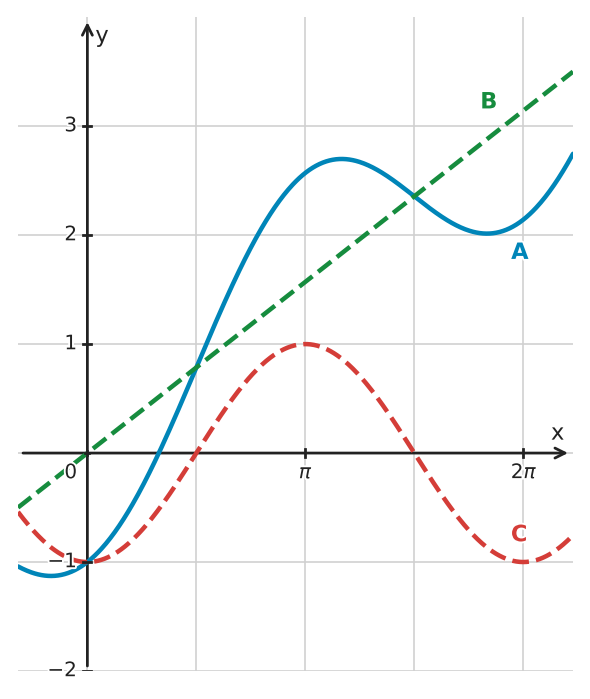
Figure for problem 534430

Hints

- Compare the shapes and formulas of the three functions. - Set the derivative equal to the desired slope in part b. - A horizontal tangent requires the derivative to equal zero. - Use the unit circle to solve the resulting sine equations.

Solution

1. Graph B is the line through the origin, so it represents \(g(x)=0.5x\). Graph C is the reflected cosine curve, so it represents \(h(x)=-\cos x\). Their pointwise sum is Graph A, which represents \(f(x)=0.5x-\cos x\). 2. Differentiate: \(f'(x)=0.5+\sin x\). For slope \(0.5\), solve \(0.5+\sin x=0.5\), so \(\sin x=0\). On \([0, 2\pi]\), the inputs are \(0\), \(\pi\), and \(2\pi\). The corresponding points are \((0, -1)\), \(\left(\pi, \frac{\pi}{2}+1\right)\), and \((2\pi, \pi-1)\). 3. Horizontal tangents satisfy \(0.5+\sin x=0\), so \(\sin x=-\frac{1}{2}\). Therefore, \(x=\frac{7\pi}{6}+2\pi n\) or \(x=\frac{11\pi}{6}+2\pi n\), where \(n\in\mathbb{Z}\).

Answer

a) A: \(f\); B: \(g\); C: \(h\) b) \((0, -1)\), \(\left(\pi, \frac{\pi}{2}+1\right)\), and \((2\pi, \pi-1)\) c) \(x=\frac{7\pi}{6}+2\pi n\) or \(x=\frac{11\pi}{6}+2\pi n\), where \(n\in\mathbb{Z}\)

53446512
Let \(f(x)=\ln(x)\) for \(x>0\). At \(P(a, f(a))\), a tangent line \(t\) is drawn to the graph. a) Show that the tangent always intersects the y-axis at \(S(0, \ln(a)-1)\). b) Compare \(f(a)\) with the y-coordinate of \(S\). What fixed vertical distance separates the two values? c) The graph shows the tangent for one value of \(a\). Determine \(a\) from the tangent’s intercepts.
Figure for problem 534465

Hints

- Differentiate the natural logarithm. - Substitute \(x=0\) into the general tangent equation. - Subtract the y-coordinate of \(S\) from \(f(a)\). - Use the displayed intercepts to find the tangent slope, then set it equal to \(f^{\prime}(a)\).

Solution

1. Since \(f^{\prime}(x)=\frac{1}{x}\), the tangent at \(x=a\) has equation \(y-\ln(a)=\frac{1}{a}(x-a)\). 2. Simplifying gives \(y=\frac{1}{a}x-1+\ln(a)\). At \(x=0\), \(y=\ln(a)-1\), so the y-intercept is \(S(0, \ln(a)-1)\). 3. The vertical difference is \(f(a)-y_S=\ln(a)-(\ln(a)-1)=1\). 4. In the displayed example, the tangent passes through \((0, -1)\) and \((1, 0)\), so its slope is \(1\). Because the tangent slope is \(\frac{1}{a}\), \(\frac{1}{a}=1\), and therefore \(a=1\).

Answer

a) The tangent is \(y=\frac{1}{a}x-1+\ln(a)\), so its y-intercept is \(S(0, \ln(a)-1)\). b) The vertical distance is always \(1\) unit. c) \(a=1\)
53446612
Consider the family of functions \(f_c(x)=\ln(x)+c\), where \(x>0\) and \(c\in\mathbb{R}\). The figure shows graphs p and q. a) Find \(c\) for each graph. b) Determine how the zero changes as \(c\) increases. c) Find \(f_c'(x)\) and explain why all graphs have the same slope at \(x=2\).
Figure for problem 534466

Hints

- Evaluate the graphs at \(x=1\). - Solve the zero equation for \(x\). - The derivative of an added constant is zero.

Solution

1. Since \(\ln(1)=0\), \(f_c(1)=c\). Graph p has value \(2\) at \(x=1\), so \(c=2\). Graph q has value \(-1\) at \(x=1\), so \(c=-1\). 2. A zero satisfies \(\ln(x)+c=0\), so \(x=e^{-c}\). As \(c\) increases, \(-c\) decreases, so the zero moves left toward the y-axis. 3. The derivative is \(f_c'(x)=\frac{1}{x}\), which does not depend on \(c\). Therefore, every graph has slope \(f_c'(2)=\frac{1}{2}\) at \(x=2\).

Answer

a) p: \(c=2\); q: \(c=-1\) b) The zero is \(x=e^{-c}\) and moves left as \(c\) increases. c) \(f_c'(x)=\frac{1}{x}\), so the common slope at \(x=2\) is \(\frac{1}{2}\).
53446712
Consider the family of functions \(g_k(x)=ke^{-x}\), where \(k>0\). The figure shows graphs p and q. a) Find \(k\) for each graph. b) Describe the transformation that occurs when \(k\) is doubled. c) Show that the tangent line at \(x=0\) always crosses the x-axis at \(x=1\), regardless of \(k\).
Figure for problem 534467

Hints

- Evaluate the function at \(x=0\). - A change in an outside multiplier produces a vertical scaling. - Use the point and slope at \(x=0\) to write the tangent line.

Solution

1. Since \(g_k(0)=k\), the y-intercepts give p: \(k=2\) and q: \(k=4\). 2. Doubling \(k\) doubles every function value, which is a vertical stretch by a factor of \(2\). 3. The derivative is \(g_k'(x)=-ke^{-x}\). At \(x=0\), the point is \((0, k)\) and the slope is \(-k\). 4. The tangent line is \(y=-kx+k\). Setting \(y=0\) gives \(x=1\), independent of \(k\).

Answer

a) p: \(k=2\); q: \(k=4\) b) Vertical stretch by a factor of \(2\) c) The tangent is \(y=-kx+k\), with x-intercept \(1\).
53450212
Let \(f(x)=ae^{bx}+c\). The graph of \(f\) and its horizontal asymptote as \(x\to-\infty\) are shown. a) Use the asymptote and y-intercept to find \(c\) and \(a\). b) The graph passes through \(P(2, 3-2e)\). Find the exact value of \(b\). c) Find the equation of the tangent line to the graph at the y-intercept.
Figure for problem 534502

Hints

- The horizontal asymptote identifies the vertical shift. - Use the y-intercept to find \(a\). - Substitute the given point and compare exponents. - Differentiate to find the tangent slope.

Solution

1. The horizontal asymptote is \(y=3\), so \(c=3\). The y-intercept is \((0, 1)\), so \(a+3=1\) and \(a=-2\). 2. Substitute \(P(2, 3-2e)\) into \(f(x)=-2e^{bx}+3\): \(3-2e=-2e^{2b}+3\). Thus, \(e=e^{2b}\), so \(b=\frac{1}{2}\). 3. The function is \(f(x)=-2e^{x/2}+3\), so \(f'(x)=-e^{x/2}\). At \(x=0\), the slope is \(-1\), and the point is \((0, 1)\). Therefore, the tangent line is \(y=-x+1\).

Answer

a) \(c=3\), \(a=-2\) b) \(b=\frac{1}{2}\) c) \(y=-x+1\)
52516612
The standard normal density is \(\phi(x)=\frac{1}{\sqrt{2\pi}}e^{-x^2/2}\). Its graph has inflection points at \(x=-1\) and \(x=1\). a) Find the equations of the tangent lines at these inflection points. b) The tangent lines and the \(x\)-axis form a triangle. Find its area.

Hints

- Use point-slope form for each tangent line. - Use symmetry about the \(y\)-axis. - Find the triangle area from its base and height. - The \(x\)-intercepts of the tangent lines determine the base.

Solution

1. Let \(c=\phi(1)=\phi(-1)=\frac{1}{\sqrt{2\pi e}}\). Since \(\phi'(x)=-x\phi(x)\), the slopes at \(-1\) and \(1\) are \(c\) and \(-c\), respectively. 2. a) At \((-1, c)\), the tangent line is \(y-c=c(x+1)\), so \(y=c(x+2)\). At \((1, c)\), the tangent line is \(y-c=-c(x-1)\), so \(y=-c(x-2)\). 3. b) The lines meet the \(x\)-axis at \((-2, 0)\) and \((2, 0)\), so the base has length \(4\). The tangent lines intersect at \((0, 2c)\), so the height is \(2c\). Therefore, \(A=\frac12\cdot4\cdot2c=4c=\frac{4}{\sqrt{2\pi e}}\approx0.968\).

Answer

a) \(y=\frac{1}{\sqrt{2\pi e}}(x+2)\) and \(y=-\frac{1}{\sqrt{2\pi e}}(x-2)\) b) \(A=\frac{4}{\sqrt{2\pi e}}\approx0.968\) square units
52561012
Let \(f(x)=\sin x\) and \(g(x)=\cos x\) for \(x\in[0, \pi]\). a) Find the input \(x_P\) at which the tangent lines to the two graphs are parallel. b) Show that the product of the two tangent slopes at a common input \(x\) is \(h(x)=-\frac{1}{2}\sin(2x)\). c) Use part b to explain why there is no input in \([0, \pi]\) at which the two tangent lines are perpendicular. d) Find inputs \(x_1,x_2\in[0, \pi]\) such that the tangent to \(f\) at \(x_1\) is perpendicular to the tangent to \(g\) at \(x_2\).

Hints

- Parallel lines have equal slopes. - Use the double-angle identity for sine. - Perpendicular nonvertical lines have a slope product of \(-1\). - Use the maximum possible values of sine and cosine in part d.

Solution

1. The derivatives are \(f'(x)=\cos x\) and \(g'(x)=-\sin x\). Parallel tangents have equal slopes, so \(\cos x=-\sin x\). On \([0, \pi]\), this gives \(x_P=\frac{3\pi}{4}\). 2. The product of the slopes is \(f'(x)g'(x)=-\sin x\cos x=-\frac{1}{2}\sin(2x)\). 3. Perpendicular nonvertical lines require a slope product of \(-1\). That would require \(-\frac{1}{2}\sin(2x)=-1\), or \(\sin(2x)=2\), which is impossible. Therefore, no common input produces perpendicular tangents. 4. For different inputs, require \(\cos(x_1)[-\sin(x_2)]=-1\), so \(\cos(x_1)\sin(x_2)=1\). On \([0, \pi]\), this occurs when \(x_1=0\) and \(x_2=\frac{\pi}{2}\).

Answer

a) \(x_P=\frac{3\pi}{4}\) b) \(f'(x)g'(x)=-\frac{1}{2}\sin(2x)\) c) No such common input exists. d) \(x_1=0\), \(x_2=\frac{\pi}{2}\)
53392612
Consider \(f(x)=\sin(x)\) and \(g(x)=\cos(x)\) on \([0, \pi]\). The graphs intersect once on this interval. Find the coordinates of the intersection and the acute angle at which the graphs intersect.
Figure for problem 533926

Hints

- Determine where sine and cosine have the same value. - Differentiate both functions to find the tangent slopes at the intersection. - The two slopes have equal magnitudes and opposite signs. - Use the formula for the acute angle between two lines.

Solution

1. Set the functions equal: \(\sin(x)=\cos(x)\). On \([0, \pi]\), this gives \(x=\frac{\pi}{4}\). 2. The y-coordinate is \(\sin\left(\frac{\pi}{4}\right)=\frac{\sqrt{2}}{2}\). Thus, the intersection is \(\left(\frac{\pi}{4}, \frac{\sqrt{2}}{2}\right)\). 3. The derivatives are \(f^{\prime}(x)=\cos(x)\) and \(g^{\prime}(x)=-\sin(x)\). At \(x=\frac{\pi}{4}\), the tangent slopes are \(m_f=\frac{\sqrt{2}}{2}\) and \(m_g=-\frac{\sqrt{2}}{2}\). 4. For the acute angle \(\alpha\) between two lines, \(\tan(\alpha)=\left|\frac{m_f-m_g}{1+m_fm_g}\right|\). Therefore, \(\tan(\alpha)=\frac{\sqrt{2}}{1-\frac{1}{2}}=2\sqrt{2}\). 5. Hence, \(\alpha=\arctan(2\sqrt{2})\approx70.5^\circ\).

Answer

The intersection is \(\left(\frac{\pi}{4}, \frac{\sqrt{2}}{2}\right)\), and the acute intersection angle is approximately \(70.5^\circ\).

All problems may be used, copied and printed free of charge for school and tutoring, including paid tutoring. Commercial adaptations as well as publication or redistribution on the internet are not permitted.