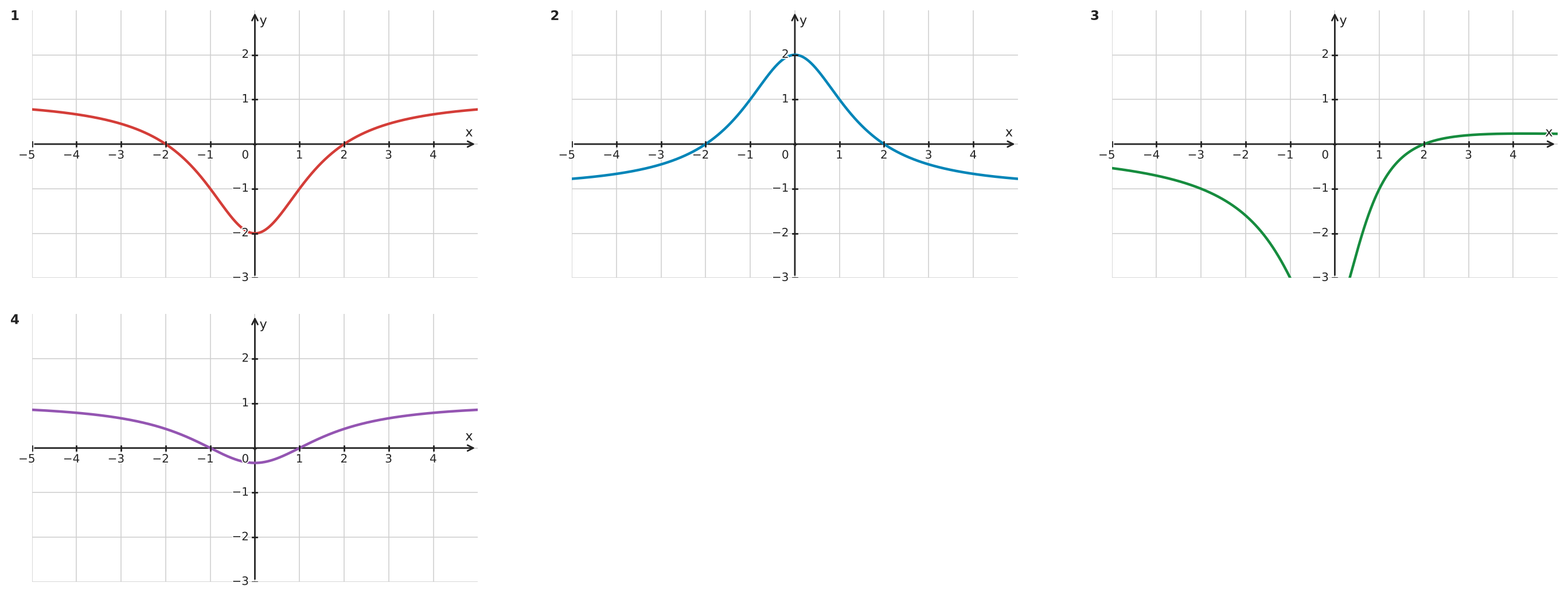
A function \(F\) is an antiderivative of a function \(f\). The four panels show possible graphs of \(F\). You are told that
\(F(0)=-2\), \(F(-2)=F(2)=0\), and \(F(x)\to1\) as \(x\to\pm\infty\).
a) Identify the correct graph of \(F\). Justify your choice using the given values and end behavior.
b) Using the graph you selected, determine where \(f\) is negative, zero, and positive. Justify your answer from where \(F\) is decreasing, has a horizontal tangent, or is increasing.
Hints
- Match all three kinds of information: the y-value at \(0\), the two zeros, and the horizontal end behavior.
- Since \(F\) is an antiderivative of \(f\), the sign of \(f\) is determined by the slope of \(F\).
- Read decreasing, horizontal-tangent, and increasing behavior directly from the chosen graph.
Solution
1. The correct graph must pass through \((0,-2)\), cross the x-axis at \(x=-2\) and \(x=2\), and approach the horizontal level \(y=1\) in both directions. Only Graph 1 has all of these features.
2. Because \(F'=f\), the sign of \(f\) is the sign of the slope of \(F\).
3. Graph 1 is decreasing for \(x<0\), has a horizontal tangent at \(x=0\), and is increasing for \(x>0\).
4. Therefore \(f(x)<0\) for \(x<0\), \(f(0)=0\), and \(f(x)>0\) for \(x>0\).
Answer
a) Graph 1
b) \(f(x)<0\) for \(x<0\), \(f(0)=0\), and \(f(x)>0\) for \(x>0\).