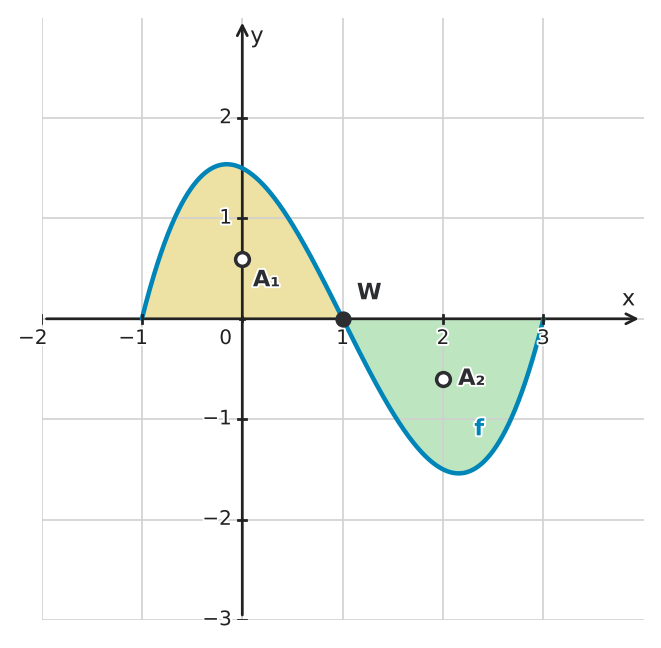
The graph of the cubic function \(f(x)=0.5(x^3-3x^2-x+3)\) encloses two regions, \(A_1\) and \(A_2\), with the x-axis on \([-1,3]\), as shown. The region \(A_1\), above the x-axis, has area exactly \(2\) square units.
a) Use point symmetry about \(W(1,0)\) to find the area of \(A_2\), and state the values of \(\int_{-1}^{1}f(x)\,dx\) and \(\int_{1}^{3}f(x)\,dx\).
b) Evaluate \(\int_{-1}^{3}f(x)\,dx\).
c) Find the total area of \(A_1\) and \(A_2\).
Hints
- Use point symmetry about \(W(1,0)\) to compare the two shaded regions.
- Keep the sign of each definite integral separate from the positive geometric area.
- Use interval additivity over \([-1,3]\).
- Add the magnitudes for total area.
Solution
1. Point symmetry about \(W(1,0)\) maps \(A_1\) on \([-1,1]\) onto the congruent region \(A_2\) on \([1,3]\). Therefore, \(A_2\) also has area \(2\) square units.
2. Since \(A_1\) lies above the x-axis, \(\int_{-1}^{1}f(x)\,dx=2\).
3. Since \(A_2\) lies below the x-axis, \(\int_{1}^{3}f(x)\,dx=-2\).
4. By interval additivity, \(\int_{-1}^{3}f(x)\,dx=2+(-2)=0\).
5. The total geometric area is \(2+2=4\) square units.
Answer
a) The area of \(A_2\) is \(2\) square units; \(\int_{-1}^{1}f(x)\,dx=2\), and \(\int_{1}^{3}f(x)\,dx=-2\).
b) \(\int_{-1}^{3}f(x)\,dx=0\)
c) The total area is \(4\) square units.