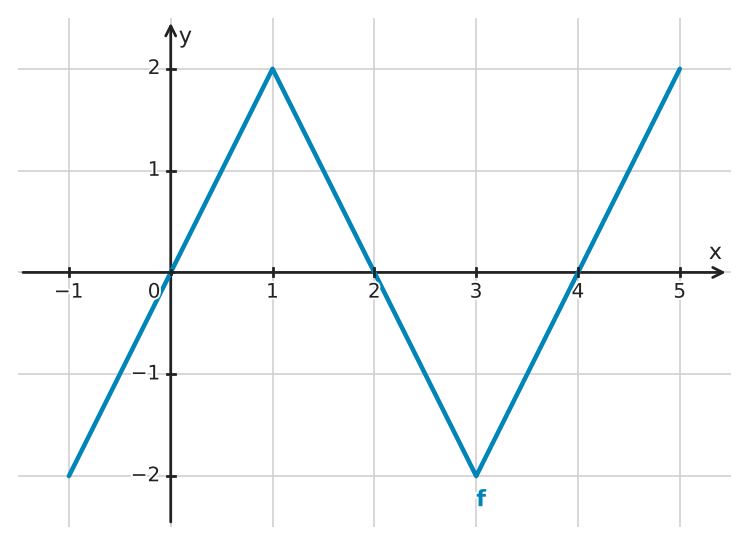
The graph of \(f\) is shown. Define \(I_0(x)=\int_0^x f(t)\,\text{d}t\).
a) Use geometric areas to find \(I_0(2)\) and \(I_0(4)\).
b) Find and classify all local extrema of \(I_0\) on \([0, 5]\), including one-sided endpoint extrema. Give each extremum value and justify your answer.
c) Describe the graph of \(I_0\) qualitatively on \([0, 4]\), including key points, extrema, and concavity.
Hints
- Interpret the integral as signed area.
- Zeros and sign changes of \(f\) determine extrema of \(I_0\).
- Use accumulated triangular areas to find the values at the endpoints and turning points.
- Because \(I_0^{\prime}=f\), increases and decreases in \(f\) determine the concavity of \(I_0\).
Solution
1. a) The triangular area from \(0\) to \(2\) is \(2\), so \(I_0(2)=2\). From \(2\) to \(4\), an equal triangular area lies below the x-axis, so \(I_0(4)=2-2=0\).
2. b) The derivative of \(I_0\) is \(f\). At \(x=2\), \(f\) changes from positive to negative, so \(I_0\) has a local maximum of \(2\). At \(x=4\), \(f\) changes from negative to positive, so \(I_0\) has a local minimum of \(0\).
3. At the left endpoint, \(I_0(0)=0\), and \(I_0\) increases immediately to the right, so \(x=0\) is a one-sided endpoint minimum. At the right endpoint, \(I_0(5)=1\), and \(I_0\) increases as \(x\) approaches \(5\), so \(x=5\) is a one-sided endpoint maximum.
4. c) The graph passes through \((0, 0)\), \((1, 1)\), \((2, 2)\), \((3, 1)\), and \((4, 0)\). It is concave up on \((0, 1)\), concave down on \((1, 3)\), and concave up on \((3, 4)\). It rises to a local maximum at \((2, 2)\) and then falls to a local minimum at \((4, 0)\).
Answer
a) \(I_0(2)=2\) and \(I_0(4)=0\)
b) One-sided endpoint minimum \(I_0(0)=0\); local maximum \(I_0(2)=2\); local minimum \(I_0(4)=0\); one-sided endpoint maximum \(I_0(5)=1\)
c) The graph passes through \((0, 0)\), \((1, 1)\), \((2, 2)\), \((3, 1)\), and \((4, 0)\). It is concave up, then concave down, then concave up on the successive intervals \((0, 1)\), \((1, 3)\), and \((3, 4)\).