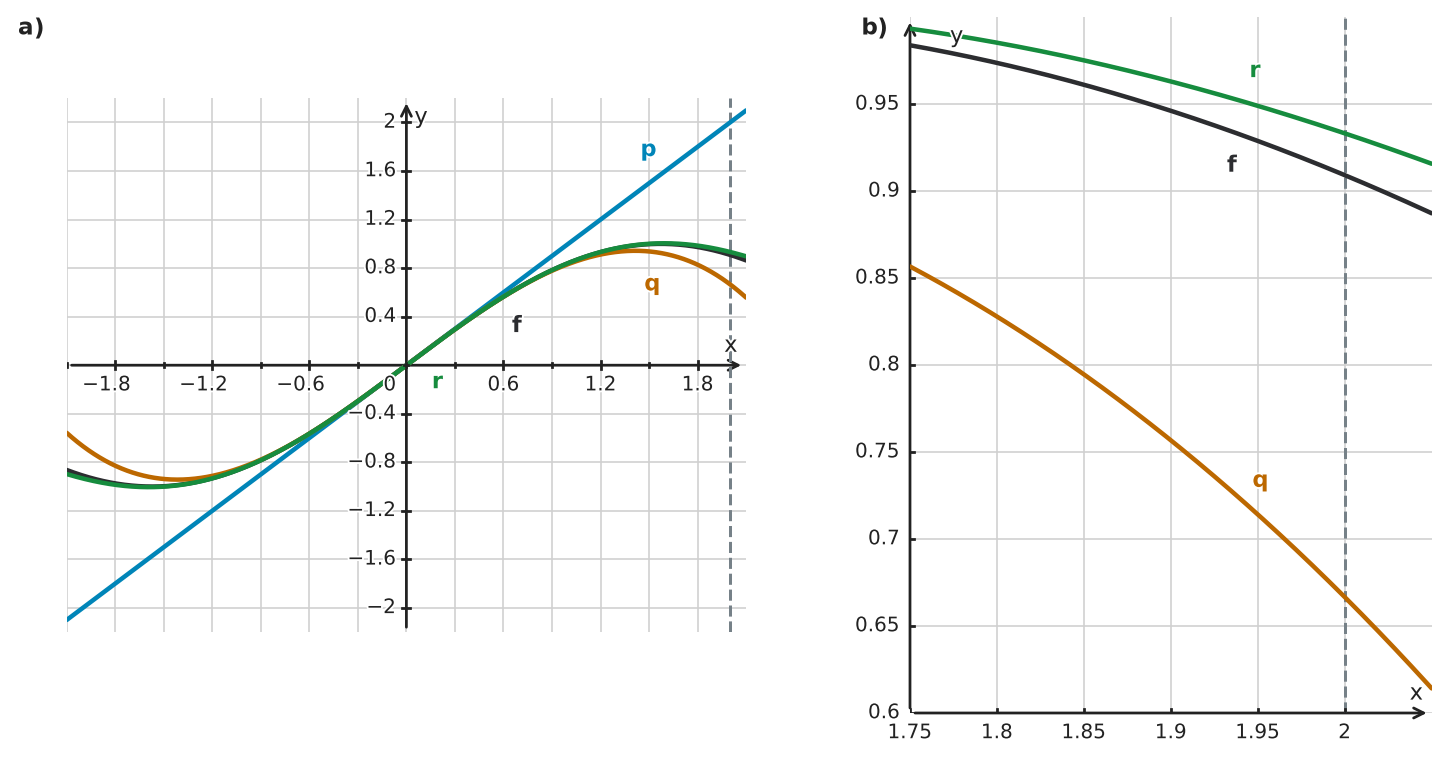
The graph shows \(f(x)=\sin x\) together with its degree-\(1\), degree-\(3\), and degree-\(5\) Maclaurin polynomials, labeled \(p\), \(q\), and \(r\), respectively. Panel b) magnifies the curves near \(x=2\).
a) What value and slope do \(f\), \(p\), \(q\), and \(r\) share at \(x=0\)?
b) Without evaluating the polynomials at \(x=2\), use the graph to rank \(p\), \(q\), and \(r\) from smallest to largest absolute error there. Also state whether each polynomial lies above or below \(f(2)\).
c) Explain, using Taylor-polynomial matching at the center, why the higher-degree polynomials track \(\sin x\) more closely near \(0\).
Hints
- Use what a Maclaurin polynomial matches at the center before reading the comparison away from the center.
- At the marked input, compare vertical separation from \(f\); the magnified panel is intended to distinguish \(q\), \(r\), and \(f\).
- For the explanation, connect polynomial degree with how many derivatives are matched at the center.
Solution
1. Since these are Maclaurin polynomials for \(\sin x\), all four functions have value \(0\) at the center and slope \(1\) there.
2. At \(x=2\), panel a) shows that \(p\) is far above \(f\). Panel b) shows that \(q\) lies below \(f\) while \(r\) lies just above \(f\), and the vertical separation between \(r\) and \(f\) is smaller than the separation between \(q\) and \(f\).
3. Therefore the absolute-error ranking from smallest to largest is \(r\), \(q\), \(p\). At \(x=2\), \(p\) and \(r\) lie above \(f\), while \(q\) lies below \(f\).
4. Increasing the Taylor degree matches more derivatives of \(\sin x\) at \(0\). Consequently, the first possible nonzero local error term occurs at a higher power of \(x\), which is small near the center.
Answer
a) Shared value \(0\) and shared slope \(1\).
b) From smallest to largest absolute error at \(x=2\): \(r\), \(q\), \(p\). The curves \(p\) and \(r\) are above \(f\), and \(q\) is below \(f\).
c) Higher-degree Taylor polynomials match more derivatives of \(\sin x\) at \(0\), pushing the first possible local error to higher degree.