Aimathic
Login | English | Deutsch

Free math worksheets

Build your own math worksheets from 30,000+ problems for grades 3 to 12, from fractions to AP Calculus. Every problem comes with step-by-step solutions.

Definite integral notation

Click problems to add them to your worksheet.

53461812
The graph of a constant function \(f\) is shown. Use the graph to evaluate \(\int_{-2}^{3}f(x)\,\text{d}x\).
Figure for problem 534618

Hints

- Read the constant function value from the graph. - Find the width and height of the rectangle. - Use a negative signed area for a region below the x-axis.

Solution

1. The graph is the horizontal line \(y=-2\), so \(f(x)=-2\). 2. On \([-2, 3]\), the region between the graph and the x-axis is a rectangle below the axis. 3. Its width is \(3-(-2)=5\), and its height is \(2\). 4. Because it lies below the x-axis, its signed contribution is \(-5\cdot 2=-10\).

Answer

\(\int_{-2}^{3}f(x)\,\text{d}x=-10\)
53461912
Use the graph of \(f\) to evaluate \(\int_{-3}^{1}f(x)\,\text{d}x\).
Figure for problem 534619

Hints

- Read the function value from the graph. - Find the width of the integration interval. - Interpret the region as a rectangle.

Solution

1. The graph is the horizontal line \(y=1.5\), so the function is constant and positive. 2. The interval width is \(1-(-3)=4\). 3. The region is a rectangle with width \(4\) and height \(1.5\), so the integral is \(4\cdot 1.5=6\).

Answer

\(\int_{-3}^{1}f(x)\,\text{d}x=6\)
53464312
A shaded region between the displayed graph \(f\) and the x-axis is shown. Write one definite integral, in terms of \(f\), that represents the net signed area of the shaded region. Do not evaluate it.
Figure for problem 534643

Hints

- Read the left and right boundaries of the shaded region from the x-axis. - Keep the displayed curve name \(f\) as the integrand. - Use one definite integral over the entire shaded interval.

Solution

1. The shaded region begins at \(x=0\) and ends at \(x=2\). 2. A definite integral of \(f\) over those bounds represents the net signed area. 3. Therefore the required expression is \(\int_0^2 f(x)\,\text{d}x\).

Answer

\(\int_0^2 f(x)\,\text{d}x\)
53464912
The displayed graph is \(f(x)=\frac{1}{2}x-1\). The orange marks show the interval of the region between the graph and the x-axis. Write the definite integral that represents the net signed area of the marked region.
Figure for problem 534649

Hints

- Read the left and right endpoints of the marked region from the graph. - Net signed area uses the function itself as the integrand. - One definite integral over the whole marked interval combines regions above and below the x-axis automatically.

Solution

1. The graph gives the function \(f(x)=\frac{1}{2}x-1\). 2. The orange marks show that the region extends from \(x=0\) to \(x=4\). 3. Therefore, the net signed area is represented by \(\int_{0}^{4}\left(\frac{1}{2}x-1\right)\,\text{d}x\). The definite integral automatically combines the negative and positive contributions.

Answer

\(\int_{0}^{4}\left(\frac{1}{2}x-1\right)\,\text{d}x\)
54909712
For each expression, state whether it represents a single number or a function of \(x\). a) \(\int_0^3(t^2+1)\,\text{d}t\) b) \(\int_0^x(t^2+1)\,\text{d}t\) c) \(\int_x^{x+2}(t^2+1)\,\text{d}t\)

Hints

- Check whether any limit of integration changes when \(x\) changes. - The dummy variable inside the integral disappears after integration. - Constant bounds produce a fixed value, while variable bounds can produce a varying value.

Solution

1. a) Both bounds are constants, so the expression is a single number. 2. b) The upper bound depends on \(x\), so the value varies with \(x\); it is a function. 3. c) Both bounds depend on \(x\), so the value also varies with \(x\); it is a function.

Answer

a) A single number b) A function of \(x\) c) A function of \(x\)
54909912
The function \(f\) is defined by one formula on \([-2, 1]\) and another on \((1, 5]\). Write \(\int_{-2}^{5}f(x)\,\text{d}x\) as a sum of two definite integrals that respects the change in formula.

Hints

- Locate the point where the defining rule changes. - Use that point as the shared endpoint of two adjacent intervals. - Preserve the original direction from the lower bound to the upper bound.

Solution

1. The formula changes at \(x=1\), so split the interval there. 2. Add the accumulated values over the adjacent intervals. 3. The result is \(\int_{-2}^{1}f(x)\,\text{d}x+\int_{1}^{5}f(x)\,\text{d}x\).

Answer

\(\int_{-2}^{1}f(x)\,\text{d}x+\int_{1}^{5}f(x)\,\text{d}x\)
54910312
A coating machine applies material along a strip. The application density is \(m(x)\) grams per meter at position \(x\), and the coated section runs from \(x=0.1\,\text{m}\) to \(x=0.4\,\text{m}\). a) Write the definite integral representing the total mass of coating applied to this section. b) State the units of the integral.

Hints

- Use position as the variable of integration because the density depends on position. - Match the section's starting and ending positions to the bounds. - Multiply the integrand's unit by the differential's unit. - The result is an accumulated amount, not a density.

Solution

1. a) Accumulate the linear mass density over the coated positions: \(\int_{0.1}^{0.4}m(x)\,\text{d}x\). 2. b) Grams per meter multiplied by meters gives grams.

Answer

a) \(\int_{0.1}^{0.4}m(x)\,\text{d}x\) b) Grams
54910712
A dissolved-oxygen concentration changes at rate \(c'(t)\), measured in milligrams per liter per minute. Interpret the units of \(\int_{10}^{25}c'(t)\,\text{d}t\). A student claims the integral is measured in milligrams. Explain the error.

Hints

- Treat the differential as carrying the unit of the independent variable. - Cancel only the unit that appears in both the rate denominator and the interval measure. - Distinguish concentration from total amount of substance.

Solution

1. The integrand unit is milligrams per liter per minute. 2. Multiplying by the time unit from \(\text{d}t\) cancels minutes. 3. The integral is measured in milligrams per liter and represents a net change in concentration, not a total mass.

Answer

The integral has units of \(\text{mg/L}\). The student incorrectly dropped the “per liter” part of the concentration-rate unit.
54911012
Let \(t\) be hours after \(9{:}00\) a.m., and let \(P(t)\) be a power output in kilowatts. Write the definite integral for the energy produced from \(10{:}30\) a.m. to \(2{:}00\) p.m. State the units.

Hints

- Convert both clock times to elapsed hours from the stated reference time. - Use the earlier elapsed time as the lower limit and the later one as the upper limit. - Combine the power unit with the time unit from the differential.

Solution

1. At \(10{:}30\) a.m., \(t=1.5\). At \(2{:}00\) p.m., \(t=5\). 2. Energy is accumulated power, so the expression is \(\int_{1.5}^{5}P(t)\,\text{d}t\). 3. Kilowatts multiplied by hours give kilowatt-hours.

Answer

\(\int_{1.5}^{5}P(t)\,\text{d}t\), measured in \(\text{kWh}\).
52455712
A shaded trapezoidal region between the displayed line \(f\) and the x-axis is shown. Use the graph to write the definite integral represented by the shaded region and evaluate it using trapezoid geometry, not an antiderivative. Your answer must state the two vertical side lengths and the trapezoid-area calculation.
Figure for problem 524557

Hints

- Read both vertical boundaries of the shaded region from the x-axis. - Read the line's height at each boundary from the grid. - Use the two vertical heights as the parallel sides of a trapezoid.

Solution

1. The graph shows vertical boundaries at \(x=-1\) and \(x=4\), so the integral is \(\int_{-1}^{4}f(x)\,\text{d}x\). 2. The endpoint heights are \(f(-1)=2.5\) and \(f(4)=5\), and the horizontal width is \(5\). 3. The trapezoid area is \(\frac{2.5+5}{2}\cdot5=18.75\). 4. The graph is above the x-axis, so this geometric area equals the definite integral.

Answer

The graph gives side lengths \(2.5\) and \(5\) and width \(5\). Thus \(\int_{-1}^{4}f(x)\,\text{d}x=\frac{2.5+5}{2}\cdot5=18.75\).
52970312
Evaluate each definite integral. Pay attention to the variable of integration; treat every other letter as a constant. a) \(\int_1^3(4x^3y-2y^2)\,\text{d}x\) b) \(\int_1^3(4x^3y-2y^2)\,\text{d}y\) c) \(\int_0^1a^2\,\text{d}x\)

Hints

- The differential identifies the variable of integration. - Treat all other letters as constants. - Use the power rule in the selected variable. - Integrating a constant over an interval multiplies it by the interval length.

Solution

1. For a), integrate with respect to \(x\): \(\int(4x^3y-2y^2)\,\text{d}x=x^4y-2xy^2\). Evaluating from \(1\) to \(3\) gives \(80y-4y^2\). 2. For b), integrate with respect to \(y\): \(\int(4x^3y-2y^2)\,\text{d}y=2x^3y^2-\frac{2}{3}y^3\). Evaluating from \(1\) to \(3\) gives \(16x^3-\frac{52}{3}\). 3. For c), \(a^2\) is constant with respect to \(x\): \(\int_0^1a^2\,\text{d}x=a^2\).

Answer

a) \(80y-4y^2\) b) \(16x^3-\frac{52}{3}\) c) \(a^2\)
52970412
Evaluate each integral in terms of the remaining parameters and variables. a) \(\int_0^k t^3\,\text{d}t\) b) \(\int_0^t k^3\,\text{d}k\) c) \(\int_0^1 e^z w\,\text{d}z\) d) \(\int_0^1 e^z w\,\text{d}w\)

Hints

- The differential identifies the variable of integration. - Treat every other letter as a constant. - After applying the bounds, the result should not contain the variable of integration. - Distinguish \(e^z w\) from \(e^{zw}\).

Solution

1. For a), integrate with respect to \(t\): \(\left[\frac{t^4}{4}\right]_0^k=\frac{k^4}{4}\). 2. For b), integrate with respect to \(k\): \(\left[\frac{k^4}{4}\right]_0^t=\frac{t^4}{4}\). 3. For c), \(w\) is constant with respect to \(z\): \(w[e^z]_0^1=w(e-1)\). 4. For d), \(e^z\) is constant with respect to \(w\): \(e^z\left[\frac{w^2}{2}\right]_0^1=\frac{e^z}{2}\).

Answer

a) \(\frac{k^4}{4}\) b) \(\frac{t^4}{4}\) c) \(w(e-1)\) d) \(\frac{e^z}{2}\)
53268212
The graph shown represents a piecewise linear function \(f\). Evaluate \(\int_{-4}^{4}f(x)\,\text{d}x\) using net signed area.
Figure for problem 532682

Hints

- Interpret the definite integral as net signed area. - Identify which regions lie above and below the x-axis. - Divide the regions into triangles or other simple shapes. - Find the x-intercepts before combining the signed areas.

Solution

1. Split the interval at the zeros \(x=-2\) and \(x=3\). 2. On \([-4, -2]\), the graph forms a triangle below the x-axis with base \(2\) and height \(2\). Its signed contribution is \(-\frac{1}{2}\cdot 2\cdot 2=-2\). 3. On \([-2, 3]\), the graph forms a triangle above the x-axis with base \(5\) and height \(2\). Its contribution is \(\frac{1}{2}\cdot 5\cdot 2=5\). 4. On \([3, 4]\), the graph forms a triangle below the x-axis with base \(1\) and height \(2\). Its signed contribution is \(-\frac{1}{2}\cdot 1\cdot 2=-1\). 5. Therefore, \(\int_{-4}^{4}f(x)\,\text{d}x=-2+5-1=2\).

Answer

\(2\)
53268612
The graph shown represents a piecewise linear function \(f\) on \([-3, 5]\). Evaluate \(\int_{-3}^{5}f(x)\,\text{d}x\) using net signed area.
Figure for problem 532686

Hints

- Interpret the definite integral as net signed area. - Separate regions above and below the x-axis. - Divide the regions into triangles and rectangles. - Combine the areas with the correct signs.

Solution

1. Divide the regions between the graph and the x-axis into triangles and a rectangle. 2. Above the x-axis, the triangle on \([-3, 0]\) has area \(\frac{1}{2}\cdot 3\cdot 2=3\), and the triangle on \([4, 5]\) has area \(\frac{1}{2}\cdot 1\cdot 2=1\). The total positive contribution is \(4\). 3. Below the x-axis, the triangle on \([0, 1]\) has area \(1\), the rectangle on \([1, 3]\) has area \(4\), and the triangle on \([3, 4]\) has area \(1\). The total magnitude of the negative contribution is \(6\). 4. Therefore, \(\int_{-3}^{5}f(x)\,\text{d}x=4-6=-2\).

Answer

\(-2\)
53461612
In figures a)–c), boundary lines mark a region between a graph and the x-axis. Match each figure to the corresponding integral below. Justify each match. 1. \(\int_0^4(0.5x+1)\,\text{d}x\) 2. \(\int_0^2(x-2)^2\,\text{d}x\) 3. \(\int_1^4\frac{4}{x}\,\text{d}x\) 4. \(\int_0^2x^2\,\text{d}x\) 5. \(\int_1^4\frac{1}{x}\,\text{d}x\) 6. \(\int_0^4(0.5x^2+1)\,\text{d}x\)
Figure for problem 534616

Hints

- Compare the horizontal boundaries in each figure with the limits of integration. - Identify whether each graph is linear, quadratic, or reciprocal. - Check key features such as an intercept, a vertex, or points on the graph. - Distinguish a shifted parabola from \(y=x^2\).

Solution

1. Figure a) shows a line with \(y\)-intercept \(1\), slope \(0.5\), and boundaries at \(x=0\) and \(x=4\). It matches integral (1). 2. Figure b) shows an upward-opening parabola with vertex \((2, 0)\), so its equation is \(y=(x-2)^2\). The boundaries are \(x=0\) and \(x=2\), so it matches integral (2). 3. Figure c) shows a reciprocal graph through \((1, 4)\) and \((4, 1)\). For \(y=\frac{k}{x}\), the point \((1, 4)\) gives \(k=4\). The boundaries are \(x=1\) and \(x=4\), so it matches integral (3).

Answer

a) Integral (1) b) Integral (2) c) Integral (3)
53462112
The graph of a linear function \(f\) is shown. Evaluate \(\int_{-2}^{4}f(x)\,\text{d}x\) by interpreting it as net signed area.
Figure for problem 534621

Hints

- Identify the regions above and below the x-axis. - Find the dimensions of the two triangles. - Add their signed areas.

Solution

1. The graph crosses the x-axis at \(x=2\). 2. On \([-2, 2]\), the graph forms a triangle above the axis with base \(4\) and height \(2\). Its contribution is \(\frac{1}{2}\cdot 4\cdot 2=4\). 3. On \([2, 4]\), the graph forms a triangle below the axis with base \(2\) and height \(1\). Its signed contribution is \(-\frac{1}{2}\cdot 2\cdot 1=-1\). 4. The integral is \(4-1=3\).

Answer

\(\int_{-2}^{4}f(x)\,\text{d}x=3\)
53462212
Evaluate \(\int_{-3}^{2}f(x)\,\text{d}x\) for the function shown.
Figure for problem 534622

Hints

- Divide the region into triangles. - Find where the graph changes sign. - Add the signed areas above and below the x-axis.

Solution

1. The graph has zeros at \(x=-3\) and \(x=1\), with a maximum at \((-1, 2)\). 2. On \([-3, 1]\), the graph forms a triangle above the x-axis with base \(4\) and height \(2\). Its area is \(\frac{1}{2}\cdot 4\cdot 2=4\). 3. On \([1, 2]\), the graph forms a triangle below the axis with base \(1\) and height \(1\). Its signed contribution is \(-\frac{1}{2}\cdot 1\cdot 1=-0.5\). 4. Therefore, \(\int_{-3}^{2}f(x)\,\text{d}x=4-0.5=3.5\).

Answer

\(\int_{-3}^{2}f(x)\,\text{d}x=3.5\)
53462312
Use the graph of \(f\) on \([-2, 3]\). a) Evaluate \(\int_{-2}^{3}f(x)\,\text{d}x\). b) Find the total geometric area between the graph and the x-axis on the same interval. c) Explain why the answers to parts a) and b) are different.
Figure for problem 534623

Hints

- Find the x-intercept that separates the positive and negative regions. - Use signs when evaluating the definite integral. - Use positive magnitudes when finding total geometric area. - Compare subtraction with addition of the same two triangular areas.

Solution

1. a) The graph crosses the x-axis at \(x=1\). On \([-2, 1]\), the triangle above the axis has area \(\frac12\cdot3\cdot3=4.5\). On \([1, 3]\), the triangle below the axis has area \(\frac12\cdot2\cdot2=2\), so its signed contribution is \(-2\). Therefore, the integral is \(4.5-2=2.5\). 2. b) Total geometric area counts both regions positively: \(4.5+2=6.5\). 3. c) A definite integral uses signed area, so the region below the x-axis is subtracted. Total geometric area uses the magnitude of every region.

Answer

a) \(2.5\) b) \(6.5\) square units c) The integral subtracts area below the x-axis, while total geometric area counts it positively.
53463312
The graph of a linear function \(f\) is shown. a) Use net signed area to evaluate \(\int_{-1}^{2}f(x)\,\text{d}x\). b) Without recomputing the regions, evaluate \(\int_{2}^{-1}f(x)\,\text{d}x\). Explain the relationship between the two values.
Figure for problem 534633

Hints

- Split the first integral where the graph crosses the x-axis. - Use a negative contribution for the region below the axis. - Recall the property that interchanging the lower and upper limits changes the sign. - The geometric regions do not change when the limits are reversed; only the orientation changes.

Solution

1. a) The graph crosses the x-axis at \(x=1\). The triangle below the axis on \([-1, 1]\) has signed area \(-\frac12\cdot2\cdot2=-2\). The triangle above the axis on \([1, 2]\) has area \(\frac12\cdot1\cdot1=0.5\). Thus, \(\int_{-1}^{2}f(x)\,\text{d}x=-2+0.5=-1.5\). 2. b) Reversing the limits changes the sign of a definite integral. Therefore, \(\int_{2}^{-1}f(x)\,\text{d}x=1.5\).

Answer

a) \(-1.5\) b) \(1.5\); reversing the limits negates the integral.
53463512
Use the graph of \(f\) to evaluate \(\int_{-2}^{2}f(x)\,\text{d}x\).
Figure for problem 534635

Hints

- Use the graph's symmetry to reduce the work. - Identify the positive and negative triangular regions. - Check whether their signed contributions cancel.

Solution

1. The graph is symmetric about the y-axis and crosses the x-axis at \(x=-1\) and \(x=1\). 2. By symmetry, calculate the integral on \([0, 2]\) and double it. 3. On \([0, 1]\), the graph forms a triangle below the axis with base \(1\) and height \(1\), contributing \(-0.5\). 4. On \([1, 2]\), the graph forms a congruent triangle above the axis, contributing \(0.5\). 5. Thus, \(\int_{0}^{2}f(x)\,\text{d}x=-0.5+0.5=0\), and \(\int_{-2}^{2}f(x)\,\text{d}x=2\cdot 0=0\).

Answer

The integral is \(0\).
54909512
Rewrite each item in clear, complete definite-integral notation. a) \(F(x)=\int_0^x (t^2+1)\) b) \(G(x)=\int_1^x g(x)\,\text{d}x\) c) “The signed area under \(h\) from \(x=-2\) to \(x=3\)”

Hints

- Every complete integral needs a differential that matches its integration variable. - Keep the free variable outside the integrand’s dummy role when it also appears as a bound. - Translate the starting and ending x-values directly into lower and upper limits.

Solution

1. a) Include the differential: \(F(x)=\int_0^x(t^2+1)\,\text{d}t\). 2. b) Use a dummy variable distinct from the upper-limit variable: \(G(x)=\int_1^xg(t)\,\text{d}t\). 3. c) The signed area is represented by \(\int_{-2}^{3}h(x)\,\text{d}x\).

Answer

a) \(F(x)=\int_0^x(t^2+1)\,\text{d}t\) b) \(G(x)=\int_1^xg(t)\,\text{d}t\) c) \(\int_{-2}^{3}h(x)\,\text{d}x\)
54909612
Match each context with the appropriate expression. Let \(r(t)\) be a signed rate in gallons per minute, and let \(V_0\) be the volume at \(t=0\). A. \(\int_2^7r(t)\,\text{d}t\) B. \(V_0+\int_0^7r(t)\,\text{d}t\) C. \(\frac{1}{5}\int_2^7r(t)\,\text{d}t\) 1. The volume present at \(t=7\) 2. The net volume change from \(t=2\) to \(t=7\) 3. The average signed rate from \(t=2\) to \(t=7\)

Hints

- Distinguish a net change from a final amount that includes the value at the starting time. - Look for the expression that normalizes by the length of the time interval. - Use the bounds to identify the time span represented.

Solution

1. A accumulates the signed rate over \([2, 7]\), so A matches 2. 2. B adds the accumulated change from \(0\) to \(7\) to the volume at \(t=0\), so B matches 1. 3. C divides the accumulated change by the interval length \(5\), so C matches 3.

Answer

A–2 B–1 C–3
54910012
A continuous function \(f\) satisfies \(f(x)\ge0\) on \([0, 2]\) and \(f(x)\le0\) on \([2, 5]\). a) Write one definite integral for the net signed area from \(x=0\) to \(x=5\). b) Write an expression using definite integrals for the total geometric area between the graph and the x-axis.

Hints

- Decide whether the requested quantity keeps or removes the sign of regions below the x-axis. - Split the interval at the known sign-change point. - Use the sign information to convert the negative signed contribution into positive geometric area.

Solution

1. The net signed area is \(\int_0^5f(x)\,\text{d}x\). 2. The region on \([0, 2]\) contributes positively, while the integral on \([2, 5]\) is nonpositive. 3. The total geometric area is \(\int_0^2f(x)\,\text{d}x-\int_2^5f(x)\,\text{d}x\).

Answer

a) \(\int_0^5f(x)\,\text{d}x\) b) \(\int_0^2f(x)\,\text{d}x-\int_2^5f(x)\,\text{d}x\)
54910112
The net signed accumulation of \(f\) from \(x=3\) to \(x=9\) is \(42\). Write three equivalent definite-integral equations: a) one integral over the full interval, b) a sum of two integrals split at \(x=6\), and c) one integral with the limits reversed.

Hints

- Use the stated starting and ending x-values as the direct bounds. - Split an integral by using the same interior point as the upper bound of one part and the lower bound of the next. - Reversing the order of integration changes the sign. - Check that all three equations describe the same oriented accumulation.

Solution

1. a) The direct equation is \(\int_3^9f(x)\,\text{d}x=42\). 2. b) Additivity over adjacent intervals gives \(\int_3^6f(x)\,\text{d}x+\int_6^9f(x)\,\text{d}x=42\). 3. c) Reversing the limits changes the sign, so \(\int_9^3f(x)\,\text{d}x=-42\).

Answer

a) \(\int_3^9f(x)\,\text{d}x=42\) b) \(\int_3^6f(x)\,\text{d}x+\int_6^9f(x)\,\text{d}x=42\) c) \(\int_9^3f(x)\,\text{d}x=-42\)
54910212
A nonnegative data-transfer rate \(r(t)\), in gigabytes per hour, is defined for \(0\le t\le5\). Write definite-integral notation for the amount of data transferred during each time set. a) Between \(t=1.2\) and \(t=2\) b) After \(t=2\) through the end of the monitoring period c) During the monitoring period but not between \(t=1.2\) and \(t=2\)

Hints

- Use the time interval's endpoints as integration bounds. - Account for the stated monitoring endpoint when interpreting “after.” - A set of two separate time intervals requires two integrals. - Because the rate is nonnegative, each integral represents an amount transferred.

Solution

1. a) The amount transferred between the two times is \(\int_{1.2}^{2}r(t)\,\text{d}t\). 2. b) The monitoring period ends at \(t=5\), so the amount after \(t=2\) is \(\int_2^5r(t)\,\text{d}t\). 3. c) The requested times are \([0, 1.2]\) and \([2, 5]\). Add the two accumulations: \(\int_0^{1.2}r(t)\,\text{d}t+\int_2^5r(t)\,\text{d}t\).

Answer

a) \(\int_{1.2}^{2}r(t)\,\text{d}t\) b) \(\int_2^5r(t)\,\text{d}t\) c) \(\int_0^{1.2}r(t)\,\text{d}t+\int_2^5r(t)\,\text{d}t\)
54910412
The graphs show production rates \(f(x)\) and \(g(x)\), in units per hour, for two machines during the displayed interval. Use the graph to determine which machine has the greater rate, then write one definite integral representing how many more units that machine produces over the interval. Do not evaluate the integral.
Figure for problem 549104

Hints

- Use the graph to identify which rate is higher throughout the displayed interval. - Read the interval endpoints from the horizontal axis. - Accumulating the higher rate minus the lower rate gives the difference in total production.

Solution

1. The graph shows that \(f(x)>g(x)\) throughout the displayed interval, which runs from \(x=0\) to \(x=4\). 2. At time \(x\), the difference in production rates is \(f(x)-g(x)\). 3. Accumulating that rate difference over the displayed interval gives \(\int_0^4[f(x)-g(x)]\,\text{d}x\).

Answer

\(\int_0^4[f(x)-g(x)]\,\text{d}x\)
54910912
The shaded region is shown. Write two equivalent definite-integral expressions for the positive area of the shaded region. Do not evaluate.
Figure for problem 549109

Hints

- Identify the upper and lower boundaries of a vertical slice in the shaded region. - The signed integral of a nonpositive function is not itself a positive area. - Write the area either as top minus bottom or by negating the signed integral.

Solution

1. Since \(f(x)\le0\) on \([1, 4]\), the signed integral \(\int_1^4f(x)\,\text{d}x\) is nonpositive. 2. The positive geometric area is its negative: \(-\int_1^4f(x)\,\text{d}x\). 3. Equivalently, use top minus bottom: \(\int_1^4[0-f(x)]\,\text{d}x\).

Answer

\(-\int_1^4f(x)\,\text{d}x\) and \(\int_1^4[0-f(x)]\,\text{d}x\)
54911112
A function is defined by \(F(s)=\int_s^{2s}p(u)\,\text{d}u\). Write \(F(3)\) and \(F(-1)\) in definite-integral notation with numerical bounds. Do not evaluate.

Hints

- Replace the free variable in every bound before considering their order. - Keep the dummy variable unchanged because its name does not depend on the parameter. - Do not automatically swap numerical bounds when the defining formula produces them in decreasing order.

Solution

1. Substitute \(s=3\) into both bounds: \(F(3)=\int_3^6p(u)\,\text{d}u\). 2. Substitute \(s=-1\): the lower bound is \(-1\) and the upper bound is \(-2\). 3. Thus \(F(-1)=\int_{-1}^{-2}p(u)\,\text{d}u\); the decreasing order is part of the definition and need not be reordered.

Answer

\(F(3)=\int_3^6p(u)\,\text{d}u\) \(F(-1)=\int_{-1}^{-2}p(u)\,\text{d}u\)
54911212
A data center records power use \(P(t)\) in kilowatts, where \(t\) is measured in hours. An analyst wants the total energy used during two separate windows: \(1\le t\le3\) and \(6\le t\le8\). a) Write the correct integral expression. b) Explain why \(\int_1^8P(t)\,\text{d}t\) does not represent the requested total.

Hints

- Treat disconnected time windows as separate intervals. - Add the accumulated quantities from the requested intervals. - Check what extra times would be included by one continuous pair of bounds.

Solution

1. Accumulate power separately over the two requested windows and add: \(\int_1^3P(t)\,\text{d}t+\int_6^8P(t)\,\text{d}t\). 2. The integral from \(1\) to \(8\) also includes energy used during the unrequested gap \([3, 6]\). 3. Therefore, it represents a different time set unless the power in the gap is known to contribute zero.

Answer

a) \(\int_1^3P(t)\,\text{d}t+\int_6^8P(t)\,\text{d}t\) b) \(\int_1^8P(t)\,\text{d}t\) incorrectly includes the interval \([3, 6]\).
52955512
The displayed graph is \(f\). Without finding a formula for \(f\) or evaluating an antiderivative: a) determine the sign of \(\int_0^2 f(x)\,\text{d}x\); b) determine the sign of \(\int_0^4 f(x)\,\text{d}x\), and justify the answer by comparing the visible negative and positive signed-area regions.
Figure for problem 529555

Hints

- Use only whether the graph is above or below the x-axis for part a. - For part b, compare the sizes of the two displayed regions rather than trying to find an antiderivative. - Net signed area subtracts the region below the x-axis from the region above it.

Solution

1. On \([0,2]\), the graph lies below the x-axis except at \(x=2\), so \(\int_0^2 f(x)\,\text{d}x<0\). 2. On \([0,4]\), the negative region is from \(0\) to \(2\) and the positive region is from \(2\) to \(4\). The displayed positive region is larger in area than the negative region, so the net signed area is positive. 3. Therefore \(\int_0^4 f(x)\,\text{d}x>0\).

Answer

a) Negative. b) Positive; the positive signed-area region on \([2,4]\) is larger than the negative signed-area region on \([0,2]\).
52956212
The displayed graph is a piecewise-linear function \(f\). Evaluate \(\int_{-2}^{5}f(x)\,\text{d}x\) using only the areas of the geometric regions shown in the graph. Your answer must list the signed contribution of each region before giving the net value.
Figure for problem 529562

Hints

- Break the displayed region where the graph changes direction or crosses the x-axis. - Identify the rectangle and the two triangles directly from the grid. - Treat the triangle below the x-axis as a negative contribution.

Solution

1. From \(x=-2\) to \(x=1\), the graph forms a rectangle of width \(3\) and height \(2\), contributing \(6\). 2. From \(x=1\) to \(x=3\), the graph forms a triangle above the x-axis with base \(2\) and height \(2\), contributing \(2\). 3. From \(x=3\) to \(x=5\), the graph forms a congruent triangle below the x-axis, contributing \(-2\). 4. The net signed area is \(6+2-2=6\).

Answer

Rectangle: \(6\); triangle above the x-axis: \(2\); triangle below the x-axis: \(-2\). Therefore \(\int_{-2}^{5}f(x)\,\text{d}x=6+2-2=6\).
52979112
The graph of a piecewise-linear function \(f\) is shown on \([0, 7]\). Evaluate \(\int_0^7f(x)\,\text{d}x\) by calculating net signed area between the graph and the x-axis.
Figure for problem 529791

Hints

- Identify the horizontal and slanted line segments in the graph. - Find where the graph crosses the x-axis. - Divide the signed region into rectangles and triangles. - Treat areas below the x-axis as negative contributions.

Solution

1. The segment from \(B(2, 2)\) to \(C(5, -1)\) has slope \(-1\), so its equation is \(y=-x+4\). It crosses the x-axis at \(x=4\). 2. Above the x-axis, the rectangle from \(x=0\) to \(x=2\) contributes \(2\cdot 2=4\), and the triangle from \(x=2\) to \(x=4\) contributes \(\frac{1}{2}\cdot 2\cdot 2=2\). 3. Below the x-axis, the triangle from \(x=4\) to \(x=5\) has area \(\frac{1}{2}\cdot 1\cdot 1=0.5\), and the rectangle from \(x=5\) to \(x=7\) has area \(2\cdot 1=2\). These contribute negatively. 4. The net signed area is \(4+2-0.5-2=3.5\).

Answer

\(\int_{0}^{7}f(x)\,\text{d}x=3.5\)
53268412
The graph of \(f\) is shown. Determine whether each statement is true or false. Justify your conclusions with geometric estimates, such as triangles or grid-square counts. a) \(\int_{-2}^{3}f(x)\,\text{d}x<0\) b) \(\int_{0}^{3}f(x)\,\text{d}x>-5\) c) \(\int_{-2}^{0}f(x)\,\text{d}x>\int_{-2}^{0}1\,\text{d}x\)
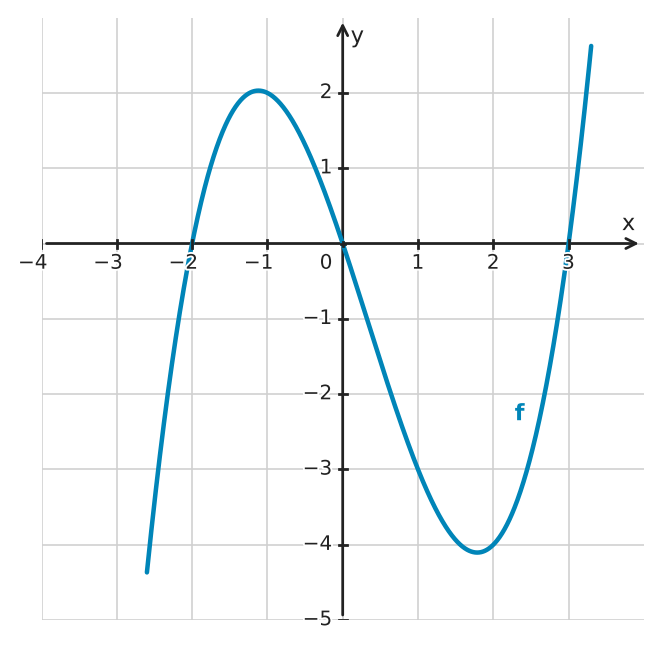
Figure for problem 532684

Hints

- Relate each definite integral to signed area between the graph and the x-axis. - Identify where the graph is above and below the axis. - Bound curved regions with triangles or rectangles. - Interpret the integral of the constant function \(1\) geometrically.

Solution

1. For a), the positive region on \([-2, 0]\) is smaller than the negative region on \([0, 3]\). The net signed area is negative, so the statement is true. Numerically, the integral is about \(-5.21\). 2. For b), the region below the x-axis contains the triangle with vertices \((0, 0)\), \((2, -4)\), and \((3, 0)\), whose area is \(\frac{1}{2}\cdot 3\cdot 4=6\). The curve lies below the two slanted sides of this triangle, so the magnitude of the negative area is greater than \(6\). Thus, \(\int_{0}^{3}f(x)\,\text{d}x<-6\), and the statement is false. 3. For c), \(\int_{-2}^{0}1\,\text{d}x=2\). The region under \(f\) contains the triangle with vertices \((-2, 0)\), \((-1, 2)\), and \((0, 0)\), which has area \(2\). Since the graph lies above the triangle's slanted sides, \(\int_{-2}^{0}f(x)\,\text{d}x>2\). The statement is true.

Answer

a) True. The negative signed area on \([0, 3]\) has greater magnitude than the positive signed area on \([-2, 0]\). b) False. In fact, \(\int_{0}^{3}f(x)\,\text{d}x<-6\). c) True. \(\int_{-2}^{0}f(x)\,\text{d}x>2=\int_{-2}^{0}1\,\text{d}x\).

53274412
The graph of \(f\) and three outlined rectangles are shown. Without finding a formula for \(f\) or evaluating an antiderivative, use the figure to justify that \(\int_{-3}^{3}f(x)\,\text{d}x>6\). Your answer must state the total area of the rectangles and explain why they give a strict lower bound.
Figure for problem 532744

Hints

- Read the rectangle widths and heights from the grid. - Add the three rectangle areas before comparing them with the region under the curve. - A strict inequality requires the graph to be above the rectangle tops on more than isolated points.

Solution

1. The central rectangle has width \(4\) and height \(1.2\), so its area is \(4.8\). 2. Each outer rectangle has width \(1\) and height \(0.6\), so together they contribute \(1.2\). 3. The three rectangles therefore have total area \(6\). 4. Each outlined rectangle lies below the graph on its interval, with the curve strictly above the rectangle top except at isolated points. Therefore the area under the graph is strictly greater than \(6\), so \(\int_{-3}^{3}f(x)\,\text{d}x>6\).

Answer

The rectangles have total area \(4(1.2)+2(1)(0.6)=6\). Because all three rectangles lie below the graph and the curve is strictly above their tops on nonzero-length portions, \(\int_{-3}^{3}f(x)\,\text{d}x>6\).
54909812
Consider \(H(x)=\int_0^x(x+t)\,\text{d}t\). a) Which occurrence of \(x\) is a free variable, and which symbol is the variable of integration? b) Rewrite the expression using \(u\) as the variable of integration without changing its meaning.

Hints

- Use the differential to identify the symbol that is bound by the integral. - A symbol not matched by the differential remains available outside the integration process. - When renaming a dummy variable, change every bound occurrence of that symbol and the differential together.

Solution

1. The symbol \(t\) is the variable of integration. Both occurrences of \(x\) are free: one appears in the upper bound and one acts as a parameter in the integrand. 2. Renaming only the dummy variable gives \(H(x)=\int_0^x(x+u)\,\text{d}u\).

Answer

a) \(t\) is the variable of integration; \(x\) is free in both the bound and the integrand. b) \(H(x)=\int_0^x(x+u)\,\text{d}u\)
54910612
A student wants to represent the accumulation of \((x-k)^2\) as \(x\) runs from \(k\) to \(k+2\), where \(k\) is a fixed parameter. The student writes \(\int_x^{x+2}(x-k)^2\,\text{d}k\). Identify the two notation errors and write the intended definite integral.

Hints

- Decide which symbol should vary during the accumulation and which should stay fixed. - The bounds must be expressions in the fixed parameter, not the dummy variable. - Check that the symbol in the differential matches the symbol that varies inside the integrand.

Solution

1. The draft uses \(k\) as the variable of integration even though \(k\) is intended to remain fixed. 2. The draft also uses the changing symbol \(x\) in the bounds instead of the fixed endpoints determined by \(k\). 3. Use \(x\) as the dummy variable and \(k\) in the bounds: \(\int_k^{k+2}(x-k)^2\,\text{d}x\).

Answer

The differential should be \(\text{d}x\), and the bounds should be \(k\) and \(k+2\). The intended integral is \(\int_k^{k+2}(x-k)^2\,\text{d}x\).
54910812
Which expressions are always equal to \(\int_2^5f(x)\,\text{d}x\)? Select all that apply and justify each choice. A. \(\int_2^5f(t)\,\text{d}t\) B. \(-\int_5^2f(u)\,\text{d}u\) C. \(\int_2^5f(t)\,\text{d}x\) D. \(\int_2^5f(x)\,\text{d}t\)

Hints

- Check that the symbol inside the function matches the differential when it is intended as a dummy variable. - Remember what happens to an integral when its limits are reversed. - Treat unmatched symbols as fixed parameters rather than silently renaming them.

Solution

1. A is equal because the variable of integration is only renamed. 2. B is equal because reversing the limits changes the sign, and the outside negative sign reverses it again. 3. In C, \(t\) is not the variable of integration; \(f(t)\) is constant with respect to \(x\), so it is not generally equal. 4. In D, \(x\) is not bound by \(\text{d}t\), so it is not generally equal.

Answer

A and B only.

All problems may be used, copied and printed free of charge for school and tutoring, including paid tutoring. Commercial adaptations as well as publication or redistribution on the internet are not permitted.