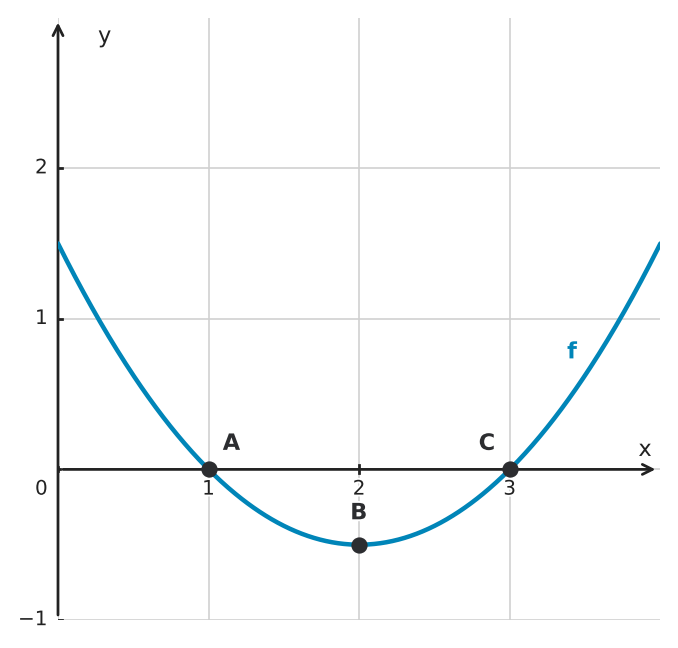
The graph of \(f\) has marked points \(A\), \(B\), and \(C\). For each point, determine whether \(f(x)\), \(f^{\prime}(x)\), and \(f^{\prime\prime}(x)\) are positive, negative, or zero. Complete the table with \(+\), \(-\), or \(0\).
<table> <tr><th>Point</th><th>\(f(x)\)</th><th>\(f^{\prime}(x)\)</th><th>\(f^{\prime\prime}(x)\)</th></tr> <tr><td>\(A\)</td><td>\(\square\)</td><td>\(\square\)</td><td>\(\square\)</td></tr> <tr><td>\(B\)</td><td>\(\square\)</td><td>\(\square\)</td><td>\(\square\)</td></tr> <tr><td>\(C\)</td><td>\(\square\)</td><td>\(\square\)</td><td>\(\square\)</td></tr> </table>
Hints
- Use vertical position to determine the sign of the function value.
- Use increasing, decreasing, or horizontal behavior to determine the sign of the first derivative.
- Use concavity to determine the sign of the second derivative.
- Examine the tangent line at each marked point.
Solution
1. At \(A(1,0)\), the point lies on the x-axis, so \(f(1)=0\). The graph is decreasing, so \(f^{\prime}(1)<0\). The graph is concave up, so \(f^{\prime\prime}(1)>0\).
2. At \(B(2,-0.5)\), the point lies below the x-axis, so \(f(2)<0\). The tangent line is horizontal at the vertex, so \(f^{\prime}(2)=0\). The graph is concave up, so \(f^{\prime\prime}(2)>0\).
3. At \(C(3,0)\), the point lies on the x-axis, so \(f(3)=0\). The graph is increasing, so \(f^{\prime}(3)>0\). The graph is concave up, so \(f^{\prime\prime}(3)>0\).
Answer
The completed table is:
<table> <tr><th>Point</th><th>\(f(x)\)</th><th>\(f^{\prime}(x)\)</th><th>\(f^{\prime\prime}(x)\)</th></tr> <tr><td>\(A\)</td><td>\(0\)</td><td>\(-\)</td><td>\(+\)</td></tr> <tr><td>\(B\)</td><td>\(-\)</td><td>\(0\)</td><td>\(+\)</td></tr> <tr><td>\(C\)</td><td>\(0\)</td><td>\(+\)</td><td>\(+\)</td></tr> </table>