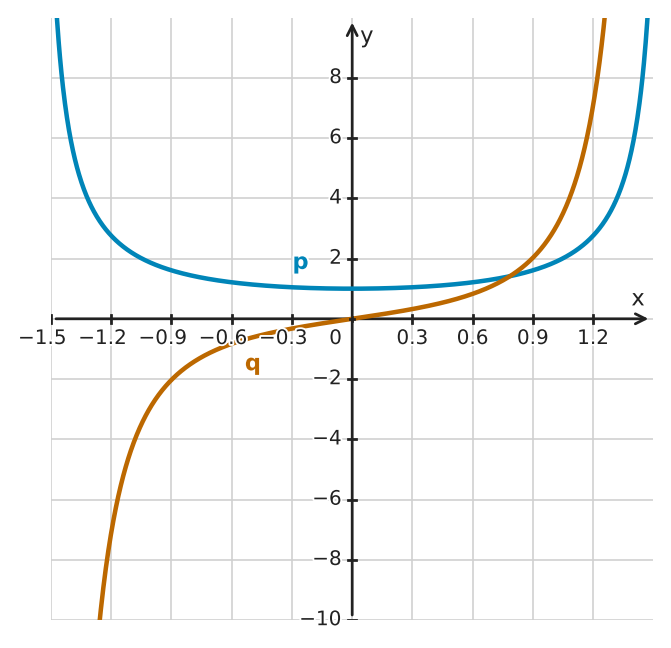
The figure shows portions of two graphs, p and q, for \(-1.5\le x\le1.5\). One graph is \(f(x)=\sec x\), and the other is \(f'(x)\).
a) Identify \(f'\) from the figure.
b) Starting from \(\sec x=\frac{1}{\cos x}\), derive the formula for \(f'(x)\) using the quotient rule.
c) Explain why \(f'\) is an odd function even though \(f\) is even.
d) Find the unique \(x\in\left(-\frac{\pi}{2},\frac{\pi}{2}\right)\) for which \(f'(x)=2\). Give an exact inverse-trigonometric form and a decimal approximation to three decimal places.
Hints
- Use symmetry to distinguish the even secant graph from its derivative graph.
- Derive the secant formula from \(1/\cos x\) rather than quoting it in part b).
- For the parity argument, combine the parity of secant and tangent.
- In part d), a substitution involving \(\tan x\) turns the equation into an algebraic equation in \(\tan^2 x\).
Solution
1. Graph p is positive and even, matching \(\sec x\). Graph q is therefore \(f'\).
2. Write \(f(x)=\frac{1}{\cos x}\). By the quotient rule, \(f'(x)=\frac{0\cdot\cos x-1(-\sin x)}{\cos^2 x}=\frac{\sin x}{\cos^2 x}=\sec x\tan x\).
3. Since \(\sec(-x)=\sec x\) and \(\tan(-x)=-\tan x\), we have \(f'(-x)=\sec(-x)\tan(-x)=-\sec x\tan x=-f'(x)\). Thus \(f'\) is odd.
4. On \(\left(-\frac{\pi}{2},\frac{\pi}{2}\right)\), \(\sec x>0\). Let \(t=\tan x\). Then \(\sec x=\sqrt{1+t^2}\), so \(f'(x)=2\) becomes \(t\sqrt{1+t^2}=2\). Because the right side is positive, \(t>0\).
5. Squaring gives \(t^2(1+t^2)=4\). Let \(u=t^2\). Then \(u^2+u-4=0\), so \(u=\frac{-1+\sqrt{17}}{2}\). Hence \(t=\sqrt{\frac{-1+\sqrt{17}}{2}}\).
6. Therefore, \(x=\arctan\!\left(\sqrt{\frac{-1+\sqrt{17}}{2}}\right)\approx0.896\).
Answer
a) q is \(f'\).
b) \(f'(x)=\sec x\tan x\)
c) \(f'\) is odd because \(\sec x\) is even and \(\tan x\) is odd.
d) \(x=\arctan\!\left(\sqrt{\frac{-1+\sqrt{17}}{2}}\right)\approx0.896\)