Aimathic
Login | English | Deutsch

Free math worksheets

Build your own math worksheets from 30,000+ problems for grades 3 to 12, from fractions to AP Calculus. Every problem comes with step-by-step solutions.

Taylor and Maclaurin series

Click problems to add them to your worksheet.

54887812
The Maclaurin series for \(e^x\) is \( e^x=\sum_{n=0}^{\infty}\frac{x^n}{n!}\). Find the coefficient of \(x^6\).

Hints

- Match the exponent of \(x\) with the index \(n\). - The factorial in the denominator uses the same index.

Solution

1. In the general term \(\frac{x^n}{n!}\), use \(n=6\). 2. The coefficient of \(x^6\) is \(\frac{1}{6!}\).

Answer

\( \frac{1}{6!}\).
55139712
Two power series are written in centered form: A: \(1+2x+3x^2+\cdots\) B: \(1+2(x-2)+3(x-2)^2+\cdots\) State the center of each series. Which one is a Maclaurin series?

Hints

- The expression being raised to powers reveals the center. - “Maclaurin” means Taylor series centered at \(0\).

Solution

1. Series A is written in powers of \(x=x-0\), so its center is \(0\). 2. Series B is written in powers of \(x-2\), so its center is \(2\). 3. A Maclaurin series is a Taylor series centered at \(0\), so Series A is the Maclaurin series.

Answer

Series A is centered at \(0\) and is a Maclaurin series. Series B is centered at \(2\).
54889012
Write the first four nonzero terms of the Maclaurin series for each function. a) \(\sin x\) b) \(\cos x\) c) Explain why one series contains only odd powers and the other contains only even powers.

Hints

- Recall the alternating factorial pattern for the trigonometric series. - Track whether the first exponent is \(0\) or \(1\). - Connect the powers in each series to the symmetry of its function.

Solution

1. The sine series is \( \sin x=x-\frac{x^3}{3!}+\frac{x^5}{5!}-\frac{x^7}{7!}+\cdots\). 2. The cosine series is \( \cos x=1-\frac{x^2}{2!}+\frac{x^4}{4!}-\frac{x^6}{6!}+\cdots\). 3. Sine is an odd function, so its Maclaurin series has only odd powers. Cosine is an even function, so its Maclaurin series has only even powers.

Answer

a) \( x-\frac{x^3}{3!}+\frac{x^5}{5!}-\frac{x^7}{7!}\). b) \( 1-\frac{x^2}{2!}+\frac{x^4}{4!}-\frac{x^6}{6!}\). c) Sine is odd and cosine is even.
54889512
A function is represented by \( f(x)=\sum_{n=0}^{\infty}\frac{(-1)^n4^nx^{2n}}{(2n)!}\). a) Identify the function. b) Write the first four nonzero terms. c) Find the coefficient of \(x^6\).

Hints

- Rewrite \(4^nx^{2n}\) as one even power. - Compare the result with a familiar trigonometric series. - Substitute the index that produces exponent \(6\).

Solution

1. Since \(4^nx^{2n}=(2x)^{2n}\), the series can be written as \( \sum_{n=0}^{\infty}\frac{(-1)^n(2x)^{2n}}{(2n)!}\). 2. This is the Maclaurin series for \(\cos(2x)\), so \(f(x)=\cos(2x)\). 3. The first four nonzero terms are \( 1-2x^2+\frac{2}{3}x^4-\frac{4}{45}x^6\). 4. Therefore, the coefficient of \(x^6\) is \(-\frac{4}{45}\).

Answer

a) \(f(x)=\cos(2x)\). b) \( 1-2x^2+\frac{2}{3}x^4-\frac{4}{45}x^6\). c) \( -\frac{4}{45}\).
54890012
A function has the Maclaurin series \( f(x)=3-2x+4x^3-5x^5+\cdots\). Find \(f(0)\), \(f'(0)\), \(f''(0)\), \(f'''(0)\), and \(f^{(5)}(0)\).

Hints

- Match each exponent with its derivative order. - A missing power has coefficient \(0\). - Multiply a coefficient by the appropriate factorial to recover the derivative.

Solution

1. In a Maclaurin series, the coefficient of \(x^n\) is \(\frac{f^{(n)}(0)}{n!}\). 2. The constant term gives \(f(0)=3\), and the coefficient of \(x\) gives \(f'(0)=-2\). 3. There is no \(x^2\) term, so \(f''(0)=0\). 4. Since \(\frac{f'''(0)}{3!}=4\), \(f'''(0)=24\). 5. Since \(\frac{f^{(5)}(0)}{5!}=-5\), \(f^{(5)}(0)=-600\).

Answer

\(f(0)=3\), \(f'(0)=-2\), \(f''(0)=0\), \(f'''(0)=24\), and \(f^{(5)}(0)=-600\).
54890612
Use the Maclaurin series for \(e^x\) to find the Maclaurin series for \(e^{x^2}\). a) Write the first five nonzero terms. b) Find the coefficient of \(x^8\). c) Find the eighth derivative of \(e^{x^2}\) at \(0\).

Hints

- Replace the input of the exponential series with \(x^2\). - Determine which index produces exponent \(8\). - Convert the coefficient of \(x^8\) into a derivative using \(8!\).

Solution

1. Substitute \(x^2\) for \(x\) in \( e^x=\sum_{n=0}^{\infty}\frac{x^n}{n!}\). 2. This gives \( e^{x^2}=\sum_{n=0}^{\infty}\frac{x^{2n}}{n!}=1+x^2+\frac{x^4}{2!}+\frac{x^6}{3!}+\frac{x^8}{4!}+\cdots\). 3. The coefficient of \(x^8\) is \(\frac{1}{4!}=\frac{1}{24}\). 4. Since the coefficient also equals \(\frac{f^{(8)}(0)}{8!}\), \( f^{(8)}(0)=\frac{8!}{4!}=1680\).

Answer

a) \( 1+x^2+\frac{x^4}{2!}+\frac{x^6}{3!}+\frac{x^8}{4!}\). b) \( \frac{1}{24}\). c) \(1680\).
54891112
Use the Maclaurin series for sine to find the Maclaurin series for \(x\sin x\). a) Write the first four nonzero terms. b) Write the series in sigma notation. c) Find the coefficient of \(x^6\).

Hints

- Multiply every term of the sine series by \(x\). - Track how each exponent changes while the factorial stays tied to the original sine term. - Identify the index that makes \(2n+2=6\).

Solution

1. The sine series is \( \sin x=\sum_{n=0}^{\infty}\frac{(-1)^nx^{2n+1}}{(2n+1)!}\). 2. Multiplying by \(x\) gives \( x\sin x=\sum_{n=0}^{\infty}\frac{(-1)^nx^{2n+2}}{(2n+1)!}\). 3. The first four nonzero terms are \( x^2-\frac{x^4}{3!}+\frac{x^6}{5!}-\frac{x^8}{7!}\). 4. The coefficient of \(x^6\) is \(\frac{1}{5!}=\frac{1}{120}\).

Answer

a) \( x^2-\frac{x^4}{3!}+\frac{x^6}{5!}-\frac{x^8}{7!}\). b) \( x\sin x=\sum_{n=0}^{\infty}\frac{(-1)^nx^{2n+2}}{(2n+1)!}\). c) \( \frac{1}{120}\).
54891612
Find the Maclaurin series for \( f(x)=\sin x-\cos x\). a) Write the first seven nonzero terms in increasing powers of \(x\). b) Find \(f^{(4)}(0)\) from the series.

Hints

- Align the sine and cosine series by powers before subtracting. - Distribute the minus sign to every cosine term. - Read the fourth derivative from the coefficient of \(x^4\).

Solution

1. Use \( \sin x=x-\frac{x^3}{3!}+\frac{x^5}{5!}-\cdots\) and \( \cos x=1-\frac{x^2}{2!}+\frac{x^4}{4!}-\frac{x^6}{6!}+\cdots\). 2. Subtracting gives \( f(x)=-1+x+\frac{x^2}{2!}-\frac{x^3}{3!}-\frac{x^4}{4!}+\frac{x^5}{5!}+\frac{x^6}{6!}+\cdots\). 3. The coefficient of \(x^4\) is \(-\frac{1}{4!}\), so \(f^{(4)}(0)=-1\).

Answer

a) \( -1+x+\frac{x^2}{2!}-\frac{x^3}{3!}-\frac{x^4}{4!}+\frac{x^5}{5!}+\frac{x^6}{6!}\). b) \(f^{(4)}(0)=-1\).
54892712
The hyperbolic cosine is defined by \( \cosh x=\frac{e^x+e^{-x}}{2}\). a) Use the exponential series to derive the Maclaurin series for \(\cosh x\). b) Write the first five nonzero terms. c) Explain why no odd powers appear.

Hints

- Write the two exponential series one above the other by powers of \(x\). - Compare the signs of corresponding odd and even terms. - Apply the factor \(1/2\) after combining the series.

Solution

1. The two exponential series are \( e^x=\sum_{n=0}^{\infty}\frac{x^n}{n!}\) and \( e^{-x}=\sum_{n=0}^{\infty}\frac{(-1)^nx^n}{n!}\). 2. When they are added, every odd-power term cancels and every even-power term doubles. 3. Dividing by \(2\) gives \( \cosh x=\sum_{n=0}^{\infty}\frac{x^{2n}}{(2n)!}\). 4. The first five nonzero terms are \( 1+\frac{x^2}{2!}+\frac{x^4}{4!}+\frac{x^6}{6!}+\frac{x^8}{8!}\).

Answer

a) \( \cosh x=\sum_{n=0}^{\infty}\frac{x^{2n}}{(2n)!}\). b) \( 1+\frac{x^2}{2!}+\frac{x^4}{4!}+\frac{x^6}{6!}+\frac{x^8}{8!}\). c) Odd-power terms cancel between \(e^x\) and \(e^{-x}\).
54893812
Find the Maclaurin series for \( f(x)=\ln(2-x)\). a) Write the series in sigma notation. b) Write the first four nonconstant terms. c) State the interval of convergence.

Hints

- Factor the constant inside the logarithm before expanding. - Match the remaining logarithm to the known series for \(\ln(1-u)\). - Test the two values where \(\left|\frac{x}{2}\right|=1\).

Solution

1. Rewrite the function as \( \ln(2-x)=\ln 2+\ln\left(1-\frac{x}{2}\right)\). 2. Using \( \ln(1-u)=-\sum_{n=1}^{\infty}\frac{u^n}{n}\), \( \ln(2-x)=\ln 2-\sum_{n=1}^{\infty}\frac{x^n}{n2^n}\). 3. The first four nonconstant terms are \( -\frac{x}{2}-\frac{x^2}{8}-\frac{x^3}{24}-\frac{x^4}{64}\). 4. The series requires \(\left|\frac{x}{2}\right|<1\), so its radius is \(2\). At \(x=-2\), the resulting alternating harmonic series converges; at \(x=2\), the harmonic series diverges. Thus the interval is \([-2, 2)\).

Answer

a) \( \ln(2-x)=\ln 2-\sum_{n=1}^{\infty}\frac{x^n}{n2^n}\). b) \( -\frac{x}{2}-\frac{x^2}{8}-\frac{x^3}{24}-\frac{x^4}{64}\). c) \([-2, 2)\).
54894612
For the generalized binomial series \( (1+x)^{\alpha}=\sum_{n=0}^{\infty}c_nx^n\), the coefficients satisfy \( c_0=1,\qquad c_{n+1}=c_n\frac{\alpha-n}{n+1}\). Use \(\alpha=\frac12\) to find \(c_1\), \(c_2\), and \(c_3\), then write the degree-\(3\) Maclaurin polynomial for \(\sqrt{1+x}\).

Hints

- Apply the recurrence one coefficient at a time. - In each step, decrease the numerator factor by \(1\) and increase the denominator index by \(1\).

Solution

1. Starting with \(c_0=1\), \( c_1=c_0\frac{\alpha}{1}=1\cdot\frac12=\frac12\). 2. Next, \( c_2=c_1\frac{\alpha-1}{2}=\frac12\cdot\left(-\frac14\right)=-\frac18\). 3. Then, \( c_3=c_2\frac{\alpha-2}{3}=-\frac18\cdot\left(-\frac12\right)=\frac{1}{16}\). 4. Therefore, \( P_3(x)=1+\frac{x}{2}-\frac{x^2}{8}+\frac{x^3}{16}\).

Answer

\( c_1=\frac12,\quad c_2=-\frac18,\quad c_3=\frac{1}{16}\), and \( P_3(x)=1+\frac{x}{2}-\frac{x^2}{8}+\frac{x^3}{16}\).
54895912
Find the Maclaurin series for \( f(x)=\ln(1+x^2)\). a) Write the series in sigma notation. b) Write the first four nonzero terms. c) State the interval of convergence.

Hints

- Use the logarithm series with a new input equal to \(x^2\). - Every exponent in the result is even. - At either boundary, \(x^2=1\), so the same numerical series appears.

Solution

1. Substitute \(x^2\) for \(u\) in \( \ln(1+u)=\sum_{n=1}^{\infty}\frac{(-1)^{n+1}u^n}{n}\). 2. This gives \( \ln(1+x^2)=\sum_{n=1}^{\infty}\frac{(-1)^{n+1}x^{2n}}{n}\). 3. The first four nonzero terms are \( x^2-\frac{x^4}{2}+\frac{x^6}{3}-\frac{x^8}{4}\). 4. The interior condition is \(|x^2|<1\), or \(|x|<1\). At \(x=1\) and \(x=-1\), the numerical series is the alternating harmonic series, so both endpoints converge.

Answer

a) \( \ln(1+x^2)=\sum_{n=1}^{\infty}\frac{(-1)^{n+1}x^{2n}}{n}\). b) \( x^2-\frac{x^4}{2}+\frac{x^6}{3}-\frac{x^8}{4}\). c) \([-1, 1]\).
54896512
Use the Maclaurin series for \(e^x\) to evaluate \( \lim_{x\to0}\frac{e^x-1-x}{x^2}\) without using l'Hôpital's rule. First write the first three nonzero terms of \(e^x-1-x\).

Hints

- Expand \(e^x\) far enough to see what remains after subtracting \(1+x\). - Factor or divide out the lowest remaining power of \(x\). - After cancellation, identify the constant term of the resulting series.

Solution

1. The Maclaurin series is \( e^x=1+x+\frac{x^2}{2}+\frac{x^3}{6}+\frac{x^4}{24}+\cdots\). 2. Subtracting \(1+x\) gives \( e^x-1-x=\frac{x^2}{2}+\frac{x^3}{6}+\frac{x^4}{24}+\cdots\). 3. For \(x\neq0\), divide by \(x^2\): \( \frac{e^x-1-x}{x^2}=\frac12+\frac{x}{6}+\frac{x^2}{24}+\cdots\). 4. As \(x\to0\), every positive-power term approaches \(0\), so the limit is \(1/2\).

Answer

First three nonzero terms: \( \frac{x^2}{2}+\frac{x^3}{6}+\frac{x^4}{24}\). Limit: \( \frac12\).
54897112
Use the identity \( \sin^2x=\frac{1-\cos(2x)}{2}\) and the Maclaurin series for cosine. a) Find the first four nonzero terms of the Maclaurin series for \(\sin^2x\). b) Find \( \left.\frac{d^6}{dx^6}\sin^2x\right|_{x=0}\).

Hints

- Replace the input of the cosine series by \(2x\) before simplifying coefficients. - Apply the trigonometric identity after the substitution. - Convert the coefficient of \(x^6\) into a derivative value by multiplying by \(6!\).

Solution

1. Substitute \(2x\) into the cosine series: \( \cos(2x)=1-\frac{(2x)^2}{2!}+\frac{(2x)^4}{4!}-\frac{(2x)^6}{6!}+\frac{(2x)^8}{8!}-\cdots\). 2. Subtract from \(1\) and divide by \(2\): \( \sin^2x=x^2-\frac{x^4}{3}+\frac{2x^6}{45}-\frac{x^8}{315}+\cdots\). 3. The coefficient of \(x^6\) is \(\frac{2}{45}\). Since a Maclaurin coefficient equals the corresponding derivative divided by the factorial, \( \left.\frac{d^6}{dx^6}\sin^2x\right|_{x=0}=6!\left(\frac{2}{45}\right)=32\).

Answer

a) \( x^2-\frac{x^4}{3}+\frac{2x^6}{45}-\frac{x^8}{315}\). b) \(32\).
52613912
Euler's number can be represented by the infinite series \(e=\sum_{k=0}^{\infty}\frac{1}{k!}=1+\frac{1}{1!}+\frac{1}{2!}+\frac{1}{3!}+\cdots\). Define the partial sums by \(s_n=\sum_{k=0}^{n}\frac{1}{k!}\). 1. Calculate \(s_5\). Round the result to four decimal places. 2. The error after stopping the series at \(\frac{1}{n!}\) is \(R_n=e-s_n\), and it satisfies \(R_n<\frac{1}{n\cdot n!}\). Use this bound to find the smallest value of \(n\) for which the error is guaranteed to be less than \(10^{-4}\). 3. Compare the efficiency of this series with the sequence \(a_n=\left(1+\frac{1}{n}\right)^n\), which also approaches \(e\). Briefly explain which method is better for obtaining an accurate approximation of \(e\).

Hints

- Recall that \(n!\) is the product of the positive integers from \(1\) through \(n\). - Test consecutive small positive integers in the error bound. - Compare how quickly the denominators or approximation errors change as \(n\) increases.

Solution

1. \(s_5=1+1+\frac{1}{2}+\frac{1}{6}+\frac{1}{24}+\frac{1}{120}=\frac{163}{60}\approx2.7167\). 2. We need \(\frac{1}{n\cdot n!}<10^{-4}\), or equivalently \(n\cdot n!>10{,}000\). For \(n=6\), \(6\cdot6!=4320<10{,}000\). For \(n=7\), \(7\cdot7!=35{,}280>10{,}000\). Therefore, the smallest value is \(n=7\). 3. The factorial in the denominator of the series terms grows very quickly, so the partial sums approach \(e\) rapidly. The sequence \(\left(1+\frac{1}{n}\right)^n\) approaches \(e\) much more slowly. The series is therefore more efficient for high-accuracy approximation.

Answer

1. \(s_5\approx2.7167\) 2. \(n=7\) 3. The series method is more efficient because its error decreases much faster.
52766712
For \(-1<x\leq1\), the natural logarithm has the series representation \(\ln(1+x)=x-\frac{x^2}{2}+\frac{x^3}{3}-\frac{x^4}{4}+\cdots\). 1. Use the first four nonzero terms to approximate \(\ln(1.2)\). Round to four decimal places. 2. Explain why this series cannot be used by direct substitution to calculate \(\ln(4)\).

Hints

- Solve \(1+x=1.2\) before substituting. - Keep track of the alternating signs. - Compare the required value of \(x\) for \(\ln(4)\) with the given interval.

Solution

1. To approximate \(\ln(1.2)\), set \(1+x=1.2\), so \(x=0.2\). 2. The fourth-degree approximation is \(0.2-\frac{0.2^2}{2}+\frac{0.2^3}{3}-\frac{0.2^4}{4}=0.182266\ldots\). 3. Therefore, \(\ln(1.2)\approx0.1823\). 4. For \(\ln(4)\), direct substitution would require \(1+x=4\), or \(x=3\). Since \(3\) is outside the stated interval \((-1,1]\), the series representation does not apply there.

Answer

1. \(\ln(1.2)\approx0.1823\) 2. Direct substitution would require \(x=3\), which is outside \((-1,1]\).
54893312
Find the Taylor series for \(f(x)=xe^x\) centered at \(x=1\). a) Write the first five nonzero terms in powers of \(h=x-1\). b) State the interval of convergence.

Hints

- Replace \(x\) with \(1+h\) before expanding. - Factor out the constant \(e\). - Multiply the two short series and combine equal powers of \(h\).

Solution

1. Write \(x=1+h\). Then \( xe^x=e(1+h)e^h\). 2. Use \( e^h=1+h+\frac{h^2}{2}+\frac{h^3}{6}+\frac{h^4}{24}+\cdots\). 3. Multiplying by \(1+h\) gives \( (1+h)e^h=1+2h+\frac32h^2+\frac23h^3+\frac{5}{24}h^4+\cdots\). 4. Therefore, \( xe^x=e\left[1+2(x-1)+\frac32(x-1)^2+\frac23(x-1)^3+\frac{5}{24}(x-1)^4+\cdots\right]\). 5. The exponential series converges for every real input, so the interval is \((-\infty, \infty)\).

Answer

a) \( e\left[1+2(x-1)+\frac32(x-1)^2+\frac23(x-1)^3+\frac{5}{24}(x-1)^4\right]\). b) \((-\infty, \infty)\).
54894712
Use the generalized binomial series to find the Maclaurin polynomial for \( f(x)=\sqrt{1+x}\) through degree \(3\). Then use it to approximate \(\sqrt{1.1}\).

Hints

- Use exponent \(1/2\) in each generalized binomial coefficient. - Keep the signs from the descending factors in the numerator. - The series input is \(0.1\) because \(1.1=1+0.1\).

Solution

1. For \((1+x)^{1/2}\), the first coefficients are \( 1,\quad \frac12,\quad \frac{(1/2)(-1/2)}{2!}=-\frac18,\quad \frac{(1/2)(-1/2)(-3/2)}{3!}=\frac{1}{16}\). 2. Thus \( P_3(x)=1+\frac{x}{2}-\frac{x^2}{8}+\frac{x^3}{16}\). 3. At \(x=0.1\), \( P_3(0.1)=1+0.05-0.00125+0.0000625=1.0488125\).

Answer

\( P_3(x)=1+\frac{x}{2}-\frac{x^2}{8}+\frac{x^3}{16}\). \(\sqrt{1.1}\approx1.0488125\).
54895312
Define \( f(x)=\frac{1-\cos x}{x^2}\) for \(x\neq0\). a) Use the cosine series to find a power series for \(f\). b) Use the series to define \(f(0)\) continuously. c) Find \(f''(0)\).

Hints

- Expand the numerator before dividing by \(x^2\). - The constant term of the quotient series determines the removable value. - Convert the quadratic coefficient into a second derivative using \(2!\).

Solution

1. Since \( 1-\cos x=\frac{x^2}{2!}-\frac{x^4}{4!}+\frac{x^6}{6!}-\cdots\), division by \(x^2\) gives \( f(x)=\frac{1}{2!}-\frac{x^2}{4!}+\frac{x^4}{6!}-\cdots\). 2. The constant term shows that the continuous extension is \(f(0)=\frac{1}{2}\). 3. The coefficient of \(x^2\) is \(-\frac{1}{4!}=-\frac{1}{24}\). Therefore, \( f''(0)=2!\left(-\frac{1}{24}\right)=-\frac{1}{12}\).

Answer

a) \( f(x)=\frac12-\frac{x^2}{24}+\frac{x^4}{720}-\cdots\). b) \(f(0)=\frac{1}{2}\). c) \( f''(0)=-\frac{1}{12}\).
54897712
Use the generalized binomial series to find the degree-\(3\) Taylor polynomial for \( f(x)=\sqrt{x}\) centered at \(x=4\). Then use the polynomial to approximate \(\sqrt{4.4}\), and state the open interval on which the binomial-series substitution is valid.

Hints

- Factor out the square root of the center value before using the binomial series. - Keep the factor \(\frac{x-4}{4}\) inside every power until the coefficients are simplified. - Translate the condition \(|u|<1\) back into an inequality for \(x\).

Solution

1. Write \( \sqrt{x}=2\sqrt{1+\frac{x-4}{4}}\). 2. Use \( (1+u)^{1/2}=1+\frac{u}{2}-\frac{u^2}{8}+\frac{u^3}{16}+\cdots\). 3. Substituting \(u=\frac{x-4}{4}\) and multiplying by \(2\) gives \( P_3(x)=2+\frac{x-4}{4}-\frac{(x-4)^2}{64}+\frac{(x-4)^3}{512}\). 4. At \(x=4.4\), the displacement is \(0.4\), so \( P_3(4.4)=2+0.1-0.0025+0.000125=2.097625\). 5. The binomial series requires \( \left|\frac{x-4}{4}\right|<1\), which gives the open interval \((0, 8)\).

Answer

\( P_3(x)=2+\frac{x-4}{4}-\frac{(x-4)^2}{64}+\frac{(x-4)^3}{512}\). \( \sqrt{4.4}\approx2.097625\). Open interval: \((0, 8)\).
54898212
Find the Taylor series for \( f(x)=\ln x\) centered at \(x=1\). a) Write the series in sigma notation. b) Write the first four nonzero terms. c) State the interval of convergence and find \(f^{(4)}(1)\) from the series.

Hints

- Express the input as \(1\) plus the displacement from the new center. - Substitute that displacement into the standard series for \(\ln(1+u)\). - Test the two values for which the displacement equals \(-1\) and \(1\).

Solution

1. Write \(x=1+(x-1)\), so \( \ln x=\ln(1+(x-1))\). 2. Using the logarithm series, \( \ln x=\sum_{n=1}^{\infty}(-1)^{n+1}\frac{(x-1)^n}{n}\). 3. The first four nonzero terms are \( (x-1)-\frac{(x-1)^2}{2}+\frac{(x-1)^3}{3}-\frac{(x-1)^4}{4}\). 4. The series converges for \(|x-1|<1\). At \(x=2\), it becomes the alternating harmonic series and converges. At \(x=0\), it becomes the negative harmonic series and diverges. Thus the interval is \((0, 2]\). 5. The coefficient of \((x-1)^4\) is \(-\frac14\), so \( f^{(4)}(1)=4!\left(-\frac14\right)=-6\).

Answer

a) \( \ln x=\sum_{n=1}^{\infty}(-1)^{n+1}\frac{(x-1)^n}{n}\). b) \( (x-1)-\frac{(x-1)^2}{2}+\frac{(x-1)^3}{3}-\frac{(x-1)^4}{4}\). c) Interval \((0, 2]\); \(f^{(4)}(1)=-6\).
54898812
Let \( f(x)=\sin x-x\cos x\). a) Derive a Maclaurin series for \(f\) using only nonzero terms. b) Write the first three nonzero terms. c) Find \(f^{(7)}(0)\).

Hints

- Multiply the cosine series by \(x\) so its powers align with the sine series. - Subtract the two coefficients before simplifying their factorials. - Match the seventh derivative with the coefficient of \(x^7\).

Solution

1. Use \( \sin x=\sum_{n=0}^{\infty}\frac{(-1)^nx^{2n+1}}{(2n+1)!}\) and \( x\cos x=\sum_{n=0}^{\infty}\frac{(-1)^nx^{2n+1}}{(2n)!}\). 2. For \(x^{2n+1}\), the coefficient in the difference is \( (-1)^n\left(\frac{1}{(2n+1)!}-\frac{1}{(2n)!}\right)=\frac{(-1)^{n+1}2n}{(2n+1)!}\). 3. The \(n=0\) term is zero, so \( f(x)=\sum_{n=1}^{\infty}\frac{(-1)^{n+1}2n}{(2n+1)!}x^{2n+1}\). 4. The first three nonzero terms are \( \frac{x^3}{3}-\frac{x^5}{30}+\frac{x^7}{840}\). 5. The coefficient of \(x^7\) is \(\frac{1}{840}\), so \( f^{(7)}(0)=7!\left(\frac{1}{840}\right)=6\).

Answer

a) \( f(x)=\sum_{n=1}^{\infty}\frac{(-1)^{n+1}2n}{(2n+1)!}x^{2n+1}\). b) \( \frac{x^3}{3}-\frac{x^5}{30}+\frac{x^7}{840}\). c) \(f^{(7)}(0)=6\).
54899912
For \(|x-2|<2\), \( \ln x=\ln2+\sum_{n=1}^{\infty}(-1)^{n+1}\frac{(x-2)^n}{n\,2^n}\). At displacement \(1\), let \(E\) be the constant term \(\ln2\) together with all even-power terms, and let \(O\) be the sum of all odd-power terms. a) Verify that \(x=1\) and \(x=3\) are inside the interval of convergence, then write two equations involving \(E\) and \(O\). b) Find \(E\) and \(O\) exactly. c) Explain why the two contributions are equal.

Hints

- Compare each input's distance from the center with the radius \(2\). - Remember that \(E\) includes the constant term. - Even powers keep their signs at opposite displacements, while odd powers change signs.

Solution

1. Both inputs have distance \(1\) from the center, and \(1<2\), so the series represents \(\ln x\) at \(x=1\) and \(x=3\). 2. At \(x=3\), the displacement is \(1\). Every power is positive, so \( E+O=\ln3\). 3. At \(x=1\), the displacement is \(-1\). The constant and even-power terms are unchanged, while the odd-power terms change sign, so \( E-O=\ln1=0\). 4. Adding the equations gives \(2E=\ln3\), and subtracting gives \(2O=\ln3\). Therefore, \( E=O=\frac{\ln3}{2}\). 5. The two contributions are equal because the value at the negative displacement is \(0\), which forces \(E-O=0\).

Answer

a) Since \(|1-2|=|3-2|=1<2\), both substitutions are valid. The equations are \(E+O=\ln3\) and \(E-O=0\). b) \( E=O=\frac{\ln3}{2}\). c) The value \(\ln1=0\) forces the even and odd contributions to be equal.
55139212
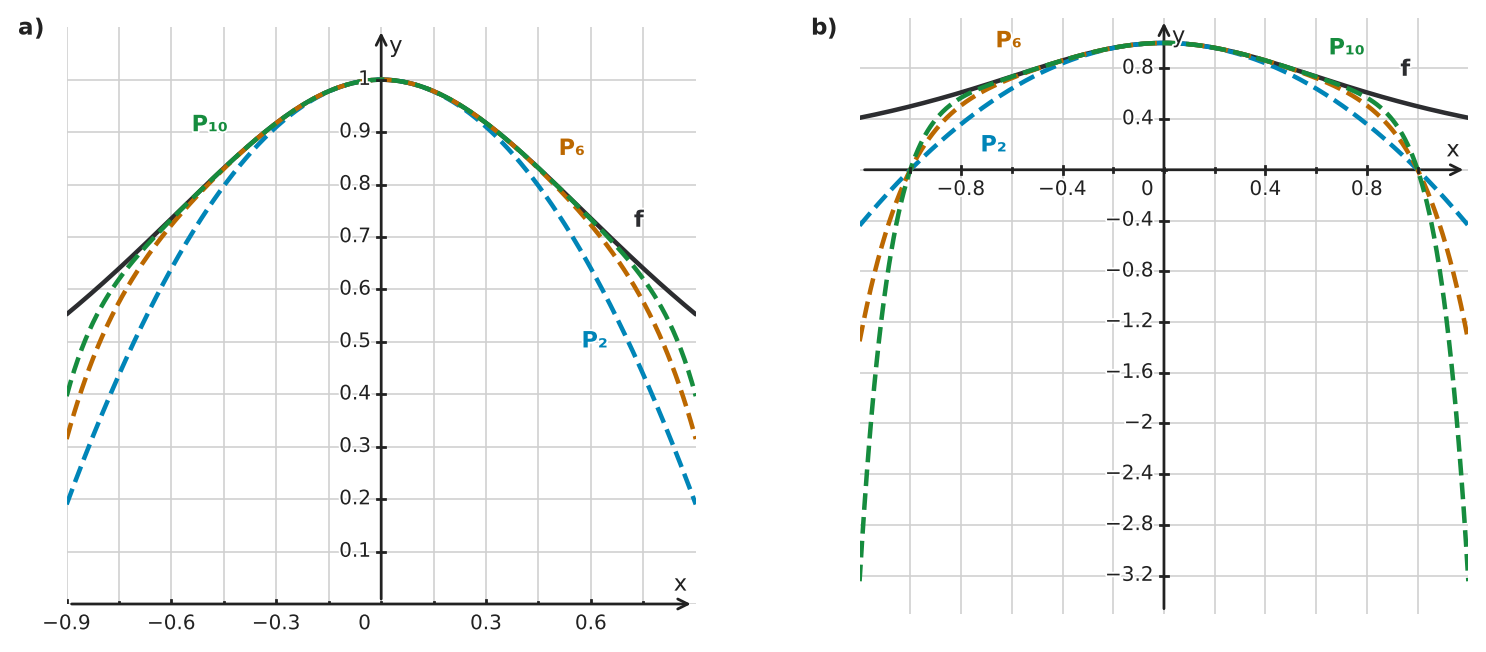
For \(f(x)=\frac{1}{1+x^2}\), consider the Maclaurin partial sums \(P_2(x)=1-x^2\), \(P_6(x)=1-x^2+x^4-x^6\), and \(P_{10}(x)=1-x^2+x^4-x^6+x^8-x^{10}\). The two graph panels compare these partial sums with \(f\) near and beyond \(|x|=1\). a) Use the graph to predict how the approximations change as the degree increases at \(x=0.5\). Verify by evaluating \(f(0.5)\), \(P_2(0.5)\), \(P_6(0.5)\), and \(P_{10}(0.5)\). b) Repeat the comparison at \(x=1.2\). Does increasing the degree improve the approximation there? c) Write \(f\) as a geometric series and use its convergence condition to explain the contrast between parts a) and b).
Figure for problem 551392

Hints

- Compare the vertical separation between each partial-sum curve and \(f\) in the two graph panels before calculating. - Rewrite the denominator so the geometric-series ratio is visible. - The convergence condition belongs to the series representation, not to the domain of the original rational function. - Check whether each test input lies inside or outside the geometric-series condition.

Solution

1. At \(x=0.5\), \(f(0.5)=\frac45=0.8\), \(P_2(0.5)=0.75\), \(P_6(0.5)=0.796875\), and \(P_{10}(0.5)=0.7998046875\). The values move closer to \(0.8\) as the degree increases. 2. At \(x=1.2\), \(f(1.2)=\frac{25}{61}\approx0.409836\), \(P_2(1.2)=-0.44\), \(P_6(1.2)=-1.352384\), and \(P_{10}(1.2)=-3.2443034624\). Here the higher-degree partial sums move farther from \(f(1.2)\), so increasing the degree does not improve the approximation. 3. Since \(\frac{1}{1+x^2}=\frac{1}{1-(-x^2)}\), the geometric-series formula gives \(\frac{1}{1+x^2}=\sum_{n=0}^{\infty}(-1)^n x^{2n}\) when \(|-x^2|<1\), which is equivalent to \(|x|<1\). Thus \(x=0.5\) lies inside the convergence interval, while \(x=1.2\) lies outside it. The function itself still exists at \(1.2\), but this Maclaurin series does not represent it there.

Answer

a) \(0.8,\ 0.75,\ 0.796875,\ 0.7998046875\); the higher-degree partial sums improve the approximation. b) \(f(1.2)\approx0.409836\), while \(P_2(1.2)=-0.44\), \(P_6(1.2)=-1.352384\), and \(P_{10}(1.2)=-3.2443034624\); increasing degree makes the approximation worse there. c) \(\frac{1}{1+x^2}=\sum_{n=0}^{\infty}(-1)^n x^{2n}\) only for \(|x|<1\), explaining the different behavior at \(0.5\) and \(1.2\).
54900012
Let \( P_n(x)=\sum_{k=0}^{n}\frac{x^k}{k!}\). Fix a real number \(x\). a) Use the Lagrange remainder to prove \( |e^x-P_n(x)|\leq e^{|x|}\frac{|x|^{n+1}}{(n+1)!}\). b) Prove that the right-hand side approaches \(0\) as \(n\to\infty\). c) Conclude that the Maclaurin series for \(e^x\) represents \(e^x\) for every real \(x\).

Hints

- Bound the unknown derivative value by using the largest possible exponent between \(0\) and \(x\). - Compare two consecutive values of the remainder bound. - A remainder that tends to \(0\) converts Taylor polynomials into an infinite-series representation.

Solution

1. Taylor's theorem gives \( e^x-P_n(x)=\frac{e^{\xi}x^{n+1}}{(n+1)!}\) for some \(\xi\) between \(0\) and \(x\). Since \(|\xi|\leq|x|\), \(e^{\xi}\leq e^{|x|}\), so \( |e^x-P_n(x)|\leq e^{|x|}\frac{|x|^{n+1}}{(n+1)!}\). 2. Let \( B_n=e^{|x|}\frac{|x|^{n+1}}{(n+1)!}\). Then \( \frac{B_{n+1}}{B_n}=\frac{|x|}{n+2}\to0\). Choose \(N\) so that \(\frac{|x|}{n+2}\leq\frac12\) for every \(n\geq N\). For \(j\geq0\), \( 0\leq B_{N+j}\leq B_N\left(\frac12\right)^j\). The right-hand side approaches \(0\), so \(B_n\to0\). 3. By the squeeze theorem, \(|e^x-P_n(x)|\to0\). Hence, \( e^x=\sum_{k=0}^{\infty}\frac{x^k}{k!}\) for every real \(x\).

Answer

a) \( |e^x-P_n(x)|\leq e^{|x|}\frac{|x|^{n+1}}{(n+1)!}\). b) The bound tends to \(0\) because successive terms have ratio \(|x|/(n+2)\to0\). c) \( e^x=\sum_{k=0}^{\infty}\frac{x^k}{k!}\) for every real \(x\).
54900112
Define \( g(x)=\begin{cases}e^{-\frac{1}{x^2}},&x\neq0,\\0,&x=0.\end{cases}\) You are given that \(g^{(n)}(0)=0\) for every nonnegative integer \(n\). a) Write the Maclaurin series determined by these derivatives. b) State where that series converges and identify its sum. c) Explain why convergence of a Taylor series does not by itself prove that the series represents the original function.

Hints

- Every Taylor coefficient comes directly from a derivative at the center. - Compare the sum of the resulting series with the sign of \(g(x)\) away from \(0\). - Distinguish convergence of a series from equality with the function that supplied its coefficients.

Solution

1. Every Maclaurin coefficient is \( \frac{g^{(n)}(0)}{n!}=0\). Therefore, the Maclaurin series is \( 0+0x+0x^2+\cdots\). 2. The zero series converges for every real \(x\), and its sum is \(0\). 3. For every \(x\neq0\), \(g(x)=e^{-\frac{1}{x^2}}>0\). Thus the convergent Maclaurin series equals \(g\) only at \(x=0\). Convergence of the coefficient series is not enough; one must also prove that the Taylor remainder tends to \(0\).

Answer

a) The Maclaurin series is the zero series. b) It converges for every real \(x\) and sums to \(0\). c) The series does not equal \(g(x)\) for \(x\neq0\), so a separate remainder argument is required to prove representation.

All problems may be used, copied and printed free of charge for school and tutoring, including paid tutoring. Commercial adaptations as well as publication or redistribution on the internet are not permitted.