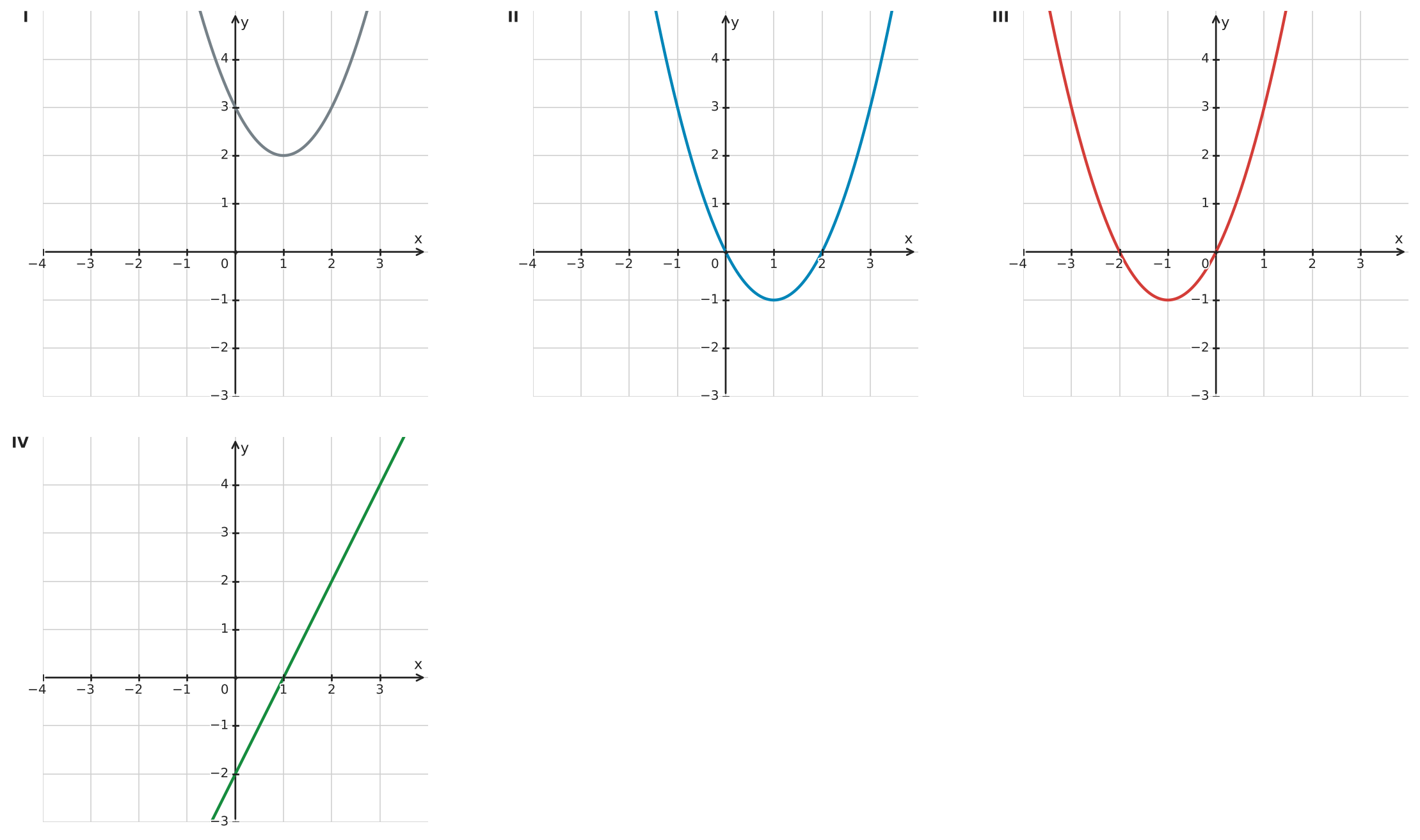
Let \(f(x)=x^2-2x\), \(g(x)=f(x)+3\), and \(h(x)=f(x+2)\). The four figures show \(f\), \(f'\), \(g\), and \(h\) in random order.
a) Compute \(f'(x)\) using the Power Rule together with the constant-multiple and difference rules.
b) Match \(f\), \(f'\), \(g\), and \(h\) with graphs I through IV.
c) Explain one visual feature that confirms your identification of the graph of \(f'\).
Hints
- Differentiate \(f\) before trying to match the panels.
- Use the computed derivative formula to identify the linear panel.
- Then use vertical and horizontal translations to distinguish \(g\) and \(h\).
- Check that a zero of the derivative aligns with a horizontal tangent of \(f\).
Solution
1. Differentiate term by term: \(f'(x)=2x-2\).
2. The graph of \(f\) is an upward-opening parabola with zeros at \(0\) and \(2\) and vertex \((1,-1)\), so it is graph II.
3. The derivative \(f'(x)=2x-2\) is a line with zero at \(x=1\), so it is graph IV. Its zero aligns with the horizontal tangent at the vertex of graph II.
4. The graph of \(g=f+3\) is shifted up \(3\) units and has vertex \((1,2)\), so it is graph I.
5. The graph of \(h(x)=f(x+2)\) is shifted left \(2\) units and has vertex \((-1,-1)\), so it is graph III.
Answer
a) \(f'(x)=2x-2\)
b) Graph I: \(g\); Graph II: \(f\); Graph III: \(h\); Graph IV: \(f'\)
c) Graph IV crosses the x-axis at \(x=1\), the x-coordinate of the horizontal tangent at the vertex of graph II.