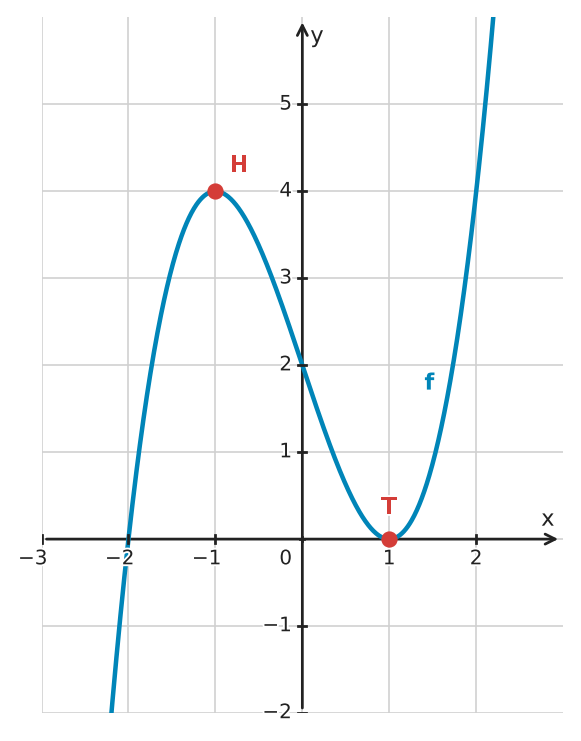
The graph of a cubic polynomial \(f(x)=ax^3+bx^2+cx+d\) is shown, with local maximum \(H\) and local minimum \(T\) labeled.
a) Hana claims that the function can also pass through \(P=(2, 5)\). Use the exact coordinates of \(H\) and \(T\) from the graph to find the function determined by the two extrema and show that the claim is false.
b) Use the graph to find the actual value of \(f(2)\) and the inflection point \(W\). Explain why \(W\) is consistent with the graph's point symmetry.
Hints
- Read the exact coordinates of the labeled extrema from the graph.
- At each extremum, use both the point and zero-slope conditions.
- Substitute \(x=2\) to test Hana's point.
- Find the midpoint of the two extrema.
Solution
1. From the graph, \(H=(-1, 4)\) and \(T=(1, 0)\). The extrema give \(f(-1)=4\), \(f(1)=0\), \(f'(-1)=0\), and \(f'(1)=0\). Solving these four equations gives \(a=1\), \(b=0\), \(c=-3\), and \(d=2\). Thus, \(f(x)=x^3-3x+2\).
2. Evaluating at \(x=2\) gives \(f(2)=8-6+2=4\ne5\), so \(P=(2, 5)\) is not on the graph.
3. The graph shows \(f(2)=4\) and \(W=(0, 2)\). The midpoint of \(H=(-1, 4)\) and \(T=(1, 0)\) is \((0, 2)\), so the extrema are paired by a half-turn about the inflection point.
Answer
a) From \(H=(-1,4)\) and \(T=(1,0)\), the derivative \(f'(x)=3ax^2+2bx+c\) vanishes at both \(x=\pm1\). Subtracting the two conditions yields \(b=0\), and either then gives \(c=-3a\). The point conditions become \(2a+d=4\) and \(-2a+d=0\), so \(a=1\), \(d=2\). Thus \(f(x)=x^3-3x+2\). But \(f(2)=8-6+2=4\neq5\), disproving Hana's claim.
b) \(f(2)=4\) and \(W=(0,2)\). The midpoint of \(H=(-1,4)\) and \(T=(1,0)\) is \(\left(\frac{-1+1}2,\frac{4+0}2\right)=(0,2)=W\), so a half-turn about \(W\) interchanges the extrema, consistent with the graph's point symmetry.