To approximate the reciprocal of a nonzero number \(b\) without using division in the iteration, apply Newton's method to \(f(x) = \frac{1}{x}-b\).
a) Show that the resulting iteration rule is \(x_{n+1} = x_n(2-bx_n)\).
b) For \(b=13\) and \(x_0=0.1\), calculate \(x_1\), \(x_2\), and \(x_3\).
c) For \(b=13\), calculate the first three iterations when \(x_0=0.2\). Explain why this initial value is unsuitable.
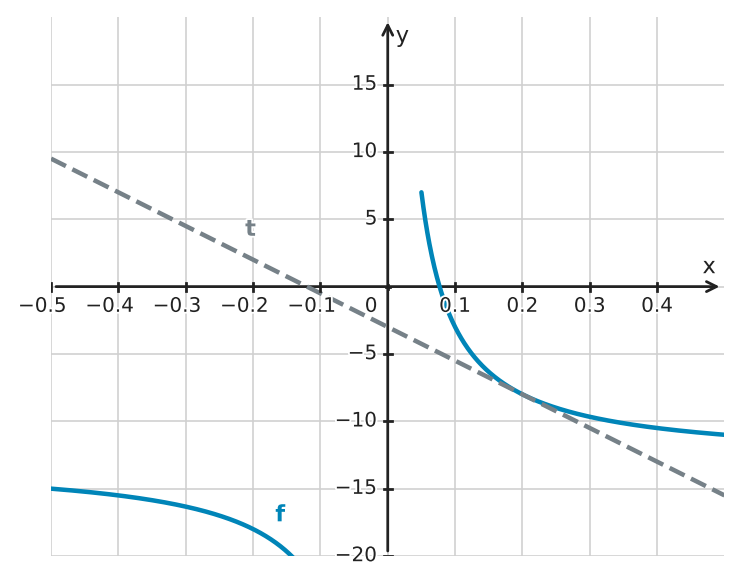
For part c), the graph of \(f(x)=\frac1x-13\) and the tangent at the unsuitable starting value \(x_0=0.2\) are shown.
Hints
- Rewrite \(\frac{1}{x}\) as \(x^{-1}\) before differentiating.
- Simplify the complex fraction by multiplying by the reciprocal of its denominator.
- In part b), evaluate one iteration at a time and track the sign of \(2-bx_n\).
- A sequence that moves farther from the target is diverging.
- In part c), compare the tangent's x-intercept with the starting value to see why the iteration immediately moves away from the positive root.
Solution
1. Differentiate \(f(x)=x^{-1}-b\): \(f'(x)=-x^{-2}=-\frac{1}{x^2}\).
2. Apply Newton's method: \(x_{n+1}=x_n-\frac{\frac{1}{x_n}-b}{-\frac{1}{x_n^2}} = x_n+\left(\frac{1}{x_n}-b\right)x_n^2\).
3. Simplify: \(x_{n+1}=x_n+x_n-bx_n^2=x_n(2-bx_n)\).
4. With \(b=13\) and \(x_0=0.1\), \(x_1=0.1(2-13\cdot0.1)=0.07\), \(x_2=0.07(2-13\cdot0.07)=0.0763\), and \(x_3=0.0763(2-13\cdot0.0763)=0.07691803\).
5. With \(x_0=0.2\), the iterations are \(x_1=-0.12\), \(x_2=-0.4272\), and \(x_3=-3.22689792\). Their magnitudes increase instead of approaching \(\frac{1}{13}\), so the sequence diverges. In fact, a positive initial value must satisfy \(0<x_0<\frac{2}{13}\) for this iteration to converge to \(\frac{1}{13}\).
Answer
a) Newton's formula gives \(x_{n+1}=x_n-\frac{f(x_n)}{f'(x_n)}=x_n-\frac{1/x_n-b}{-1/x_n^2}=x_n+(1/x_n-b)x_n^2=2x_n-bx_n^2=x_n(2-bx_n)\).
b) \(x_1=0.07\); \(x_2=0.0763\); \(x_3=0.07691803\)
c) \(x_1=-0.12\), \(x_2=-0.4272\), and \(x_3\approx-3.2269\). The first step crosses to the negative side, away from the positive target \(\frac1{13}\). For every negative iterate, \(x_{n+1}=x_n(2-13x_n)<0\), with \(|x_{n+1}|=(2+13|x_n|)|x_n|>2|x_n|\). Hence the magnitudes keep growing, so the iteration diverges and \(x_0=0.2\) is unsuitable.